








Contents
- 1 Introduction
- 2 Understanding AI Code Security Scanners
- 3 How Human Experts Detect Code Vulnerabilities
- 4 Comparing Effectiveness: AI Scanners vs. Human Analysis
- 5 The Role of Secure Coding Tools in Enhancing AI Effectiveness
- 6 Recent Developments Driving AI Code Security Innovation
- 7 Challenges and Limitations of AI Code Security Scanners
- 8 Best Practices for Combining AI Scanners with Human Expertise
- 9 External Perspectives on AI in Code Security
- 10 Frequently Asked Questions (FAQ)
- 11 Conclusion
Introduction
In an era where software vulnerabilities can cost companies millions and jeopardize sensitive data, ensuring robust code security has never been more crucial. As cyberattacks grow in sophistication, developers and security teams are turning to advanced tools like AI code security scanners to detect vulnerabilities early in the development cycle. But can these intelligent tools truly outperform skilled human experts when it comes to identifying flaws in software? This article delves into the capabilities of AI-driven code vulnerability scanners, compares their effectiveness with human analysts, and evaluates their role in fostering secure coding practices.
Understanding AI Code Security Scanners
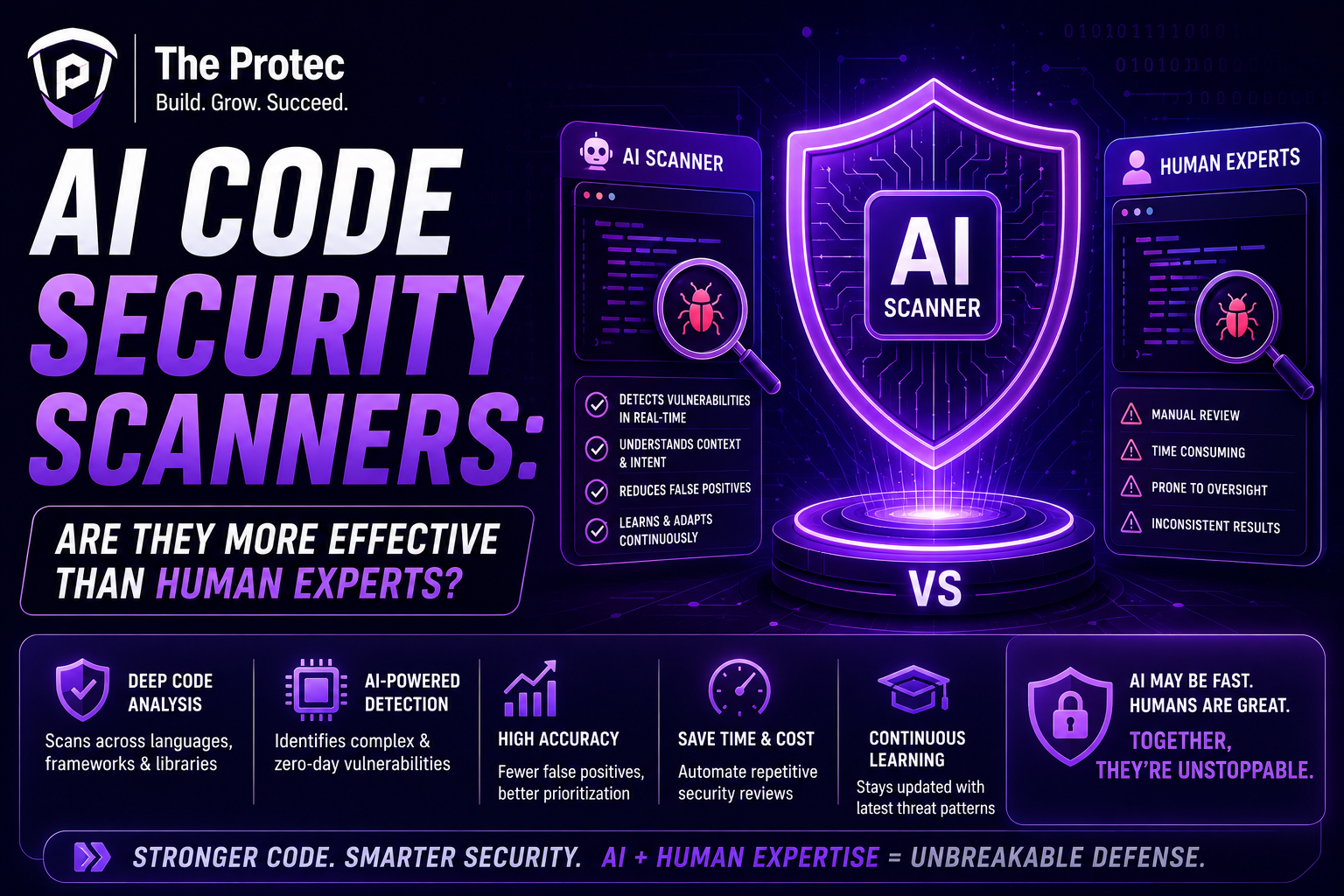
AI code security scanners utilize machine learning, natural language processing, and pattern recognition techniques to analyze source code for security weaknesses. Unlike traditional static application security testing (SAST) tools that rely on rule-based engines, AI scanners continuously learn from vast datasets of code vulnerabilities and adapt to evolving threat landscapes.
Key features of modern AI-powered scanners include:
- Automated vulnerability detection: Rapidly scans codebases to flag potential security issues such as SQL injection, cross-site scripting (XSS), buffer overflows, and insecure APIs.
- Context-aware analysis: Uses AI to understand code semantics, reducing false positives and improving vulnerability prioritization.
- Language and framework support: Supports multiple programming languages and frameworks, making it versatile across diverse development environments.
- Integration with CI/CD pipelines: Seamlessly integrates into automated workflows, allowing continuous security checks during code commits and builds.
How Human Experts Detect Code Vulnerabilities
Human security analysts employ deep expertise, intuition, and contextual understanding to identify vulnerabilities. Their process often involves:
- Manual code reviews: Examining code line-by-line to detect suspicious constructs or logic flaws.
- Threat modeling: Evaluating how an attacker might exploit design or implementation weaknesses.
- Penetration testing: Simulating attacks against running applications to uncover potential breaches.
- Leveraging experience: Applying knowledge of emerging threats and zero-day vulnerabilities that may not yet be in scanners’ databases.
Human analysts excel in assessing complex business logic errors, contextual security implications, and code that deviates from standard patterns.
Comparing Effectiveness: AI Scanners vs. Human Analysis
Speed and Scalability
AI code vulnerability scanners can analyze large codebases in minutes or hours — a task that often takes human teams days or weeks. Their scalability allows continuous scanning of rapidly changing code within agile development cycles, enabling faster vulnerability identification and remediation.
Accuracy and False Positives
Traditional static tools historically suffer from a high rate of false positives, overwhelming developers. AI scanners improve accuracy by applying context-aware algorithms, reducing noise and focusing teams on critical issues. However, despite recent advances, human judgment remains essential for validating complex vulnerabilities and understanding nuances AI may overlook.
Detecting Novel and Complex Vulnerabilities
Humans excel at spotting logic flaws, business-specific design issues, or zero-day exploits that lack historical patterns. AI scanners depend on training data and known vulnerability signatures, so they may miss unprecedented threat vectors. Incorporating human expertise ensures comprehensive coverage across known and emerging risks.
Consistency and Bias
AI scanners provide consistent, repeatable security assessments without fatigue or oversight, qualities that human reviewers cannot always guarantee. However, biases in training data or model design can influence AI outputs. Regular updates and human oversight are critical to mitigating these risks.
The Role of Secure Coding Tools in Enhancing AI Effectiveness
Integrating AI code security scanners with other secure coding tools amplifies their impact. Examples include:
- Automated code formatting and linting: Ensures clean code that reduces the chance of introducing vulnerabilities.
- Dependency analysis tools: Identifies insecure third-party libraries and outdated components.
- Interactive development environment (IDE) plugins: Provide real-time vulnerability alerts as developers write code, enabling immediate fixes.
- Behavioral monitoring solutions: Complements static scans by analyzing runtime behaviors, catching security issues missed in code.
Such ecosystem approaches encourage a shift-left security mindset, where vulnerabilities are caught earlier and with greater precision.
Recent Developments Driving AI Code Security Innovation
Cutting-edge advances contributing to improved AI code vulnerability scanners include:
- Transformer-based models: Leveraging architectures like GPT and BERT to understand code context and semantics better than keyword matching.
- Self-supervised learning: Training on vast unlabeled code repositories, enabling scanners to identify subtle anomalies without explicit vulnerability labels.
- Explainable AI (XAI): Providing transparent reasoning behind flagged vulnerabilities to increase developer trust and reduce remediation time.
- Integration with DevSecOps: Embedding AI scanning into unified platforms for seamless, automated security orchestration.
These developments continue to narrow the gap between AI capabilities and human intuition.
Challenges and Limitations of AI Code Security Scanners
Despite their promise, AI scanners face several hurdles:
- Data quality and representativeness: Models trained on narrow or biased datasets risk missing unique vulnerabilities or generating false alerts.
- Contextual blind spots: Difficulties understanding application-specific logic or nuanced security requirements.
- Adapting to novel programming languages and frameworks: Delays in support can leave gaps in coverage.
- Integration complexity: Organizations may struggle to adopt AI tools effectively within existing workflows.
These issues underscore why AI should complement—not replace—skilled security personnel.
Best Practices for Combining AI Scanners with Human Expertise
To maximize security outcomes, organizations should adopt hybrid approaches:
- Continuous collaboration: Use AI scanners to automate routine detection and free human analysts to focus on complex investigation.
- Feedback loops: Incorporate analyst insights to retrain AI models and improve accuracy over time.
- Contextual validation: Analysts verify AI-flagged issues within business and regulatory contexts.
- Training and awareness: Ensure developers understand AI output limitations and how to interpret results.
- Regular updates: Keep AI scanners current with evolving threat intelligence and coding patterns.
External Perspectives on AI in Code Security
Leading cybersecurity organizations acknowledge AI’s transformative potential. For example, the Open Web Application Security Project (OWASP) highlights AI tools as key drivers in enhancing application resilience, especially when integrated with human review and comprehensive testing strategies.
Similarly, industry reports from firms like Gartner emphasize AI-assisted application security testing as an essential component of modern DevSecOps pipelines, accelerating development without compromising safety.
Frequently Asked Questions (FAQ)
Can AI code security scanners completely replace human security reviewers?
No, while AI scanners significantly enhance detection speed and coverage, human experts remain critical for complex analysis, contextual understanding, and addressing novel or logic-based vulnerabilities that AI may not yet identify.
How do AI scanners reduce false positives compared to traditional tools?
AI scanners use advanced algorithms capable of understanding code context and semantics, which reduces irrelevant alerts. Their learning from real-world code and issues enables prioritizing genuine security risks more effectively than rule-based systems.
What programming languages do AI vulnerability scanners typically support?
Most state-of-the-art AI scanners support popular languages like JavaScript, Python, Java, C#, and Go, along with frameworks commonly used in web, mobile, and enterprise applications. Support continues to grow as scanners adapt to emerging technologies.
Conclusion
AI code security scanners are reshaping how vulnerabilities are detected and managed. Their ability to analyze vast codebases swiftly, learn from diverse data, and integrate seamlessly into development workflows positions them as indispensable tools in the secure coding toolkit. However, they are not infallible and do not yet rival human intuition and contextual judgment in all aspects. The most effective security strategy combines AI scanners’ speed and scalability with human expertise, fostering a proactive and resilient approach to software security. Organizations that embrace this synergy will be better equipped to safeguard their applications against increasingly complex cyber threats.