








Contents
- 1 Introduction
- 2 Understanding AWS S3 and Traditional Cloud Storage
- 3 What Is Decentralized Cloud Storage?
- 4 Comparing Traditional Cloud Storage and Decentralized Solutions
- 5 Recent Developments & Trends in Decentralized Cloud Storage
- 6 Use Cases Where Decentralized Storage Excels
- 7 Challenges and Limitations of Decentralized Cloud Storage
- 8 Is Decentralized Cloud Storage a Real Alternative to AWS S3?
- 9 Frequently Asked Questions (FAQ)
- 9.1 What makes decentralized cloud storage different from traditional cloud storage?
- 9.2 Can decentralized cloud storage guarantee the same reliability as AWS S3?
- 9.3 How cost-effective is decentralized cloud storage compared to AWS S3?
- 9.4 Are decentralized cloud storage solutions secure?
- 9.5 Where can I learn more about decentralized storage platforms?
Introduction
The exponential growth of data generation worldwide demands storage solutions that are not only scalable and cost-effective but also secure and resilient. Amazon Web Services’ Simple Storage Service (AWS S3) has long been the industry standard for cloud storage, powering vast numbers of applications and businesses globally. However, with the rise of blockchain technology and the Web3 movement, decentralized cloud storage solutions have emerged as promising alternatives. They offer a fundamentally different approach that challenges centralized models by distributing data across a network of nodes.
But is decentralized cloud storage truly a viable alternative to AWS S3? This article dives deep into this question by comparing traditional cloud storage with decentralized solutions, highlighting their strengths, weaknesses, and the latest trends shaping the future of data storage.
Understanding AWS S3 and Traditional Cloud Storage
AWS S3, launched by Amazon, is a centralized cloud storage platform designed for scalable object storage with high availability, durability, and security. It allows businesses to store and retrieve any amount of data from anywhere on the web, with extensive features like lifecycle management, encryption, and integration with AWS’s ecosystem.
Key characteristics of AWS S3 and traditional cloud storage include:
- Centralized Infrastructure: Data is stored in Amazon’s data centers under their full control.
- High Availability & Durability: Built on a redundant infrastructure offering 99.999999999% durability and 99.99% availability.
- Cost Models: Pay-as-you-go pricing with varying costs for storage, requests, and data transfer.
- Security: Enterprise-grade encryption, access control, and compliance certifications under Amazon’s management.
- Performance: Optimized for low latency and fast throughput across global edge locations.
While AWS S3 delivers unmatched reliability and a rich feature set, its centralized control carries some concerns about single points of failure, vendor lock-in, and data privacy in certain use cases.
What Is Decentralized Cloud Storage?
Decentralized cloud storage leverages blockchain or other distributed ledger technologies to enable data storage over a peer-to-peer network of nodes that are often geographically spread and independently operated. Instead of trusting a single provider, users benefit from a trustless environment where data integrity and availability are maintained through cryptographic proofs and economic incentives.
Popular decentralized storage platforms include Filecoin, Storj, and Arweave, among others. These projects aim to reshape cloud storage by enhancing autonomy, security, and censorship resistance.
- Data Distribution: Files are split into encrypted pieces and distributed across multiple nodes.
- Redundancy & Integrity: Data replication combined with cryptographic proofs such as Proof-of-Replication ensures data remains intact and available.
- Incentive Mechanisms: Nodes earn tokens or credits for providing storage and bandwidth, fostering a decentralized marketplace.
- Permissionless Access: Many platforms promote open access without dependence on a central authority.
Comparing Traditional Cloud Storage and Decentralized Solutions
1. Control and Trust
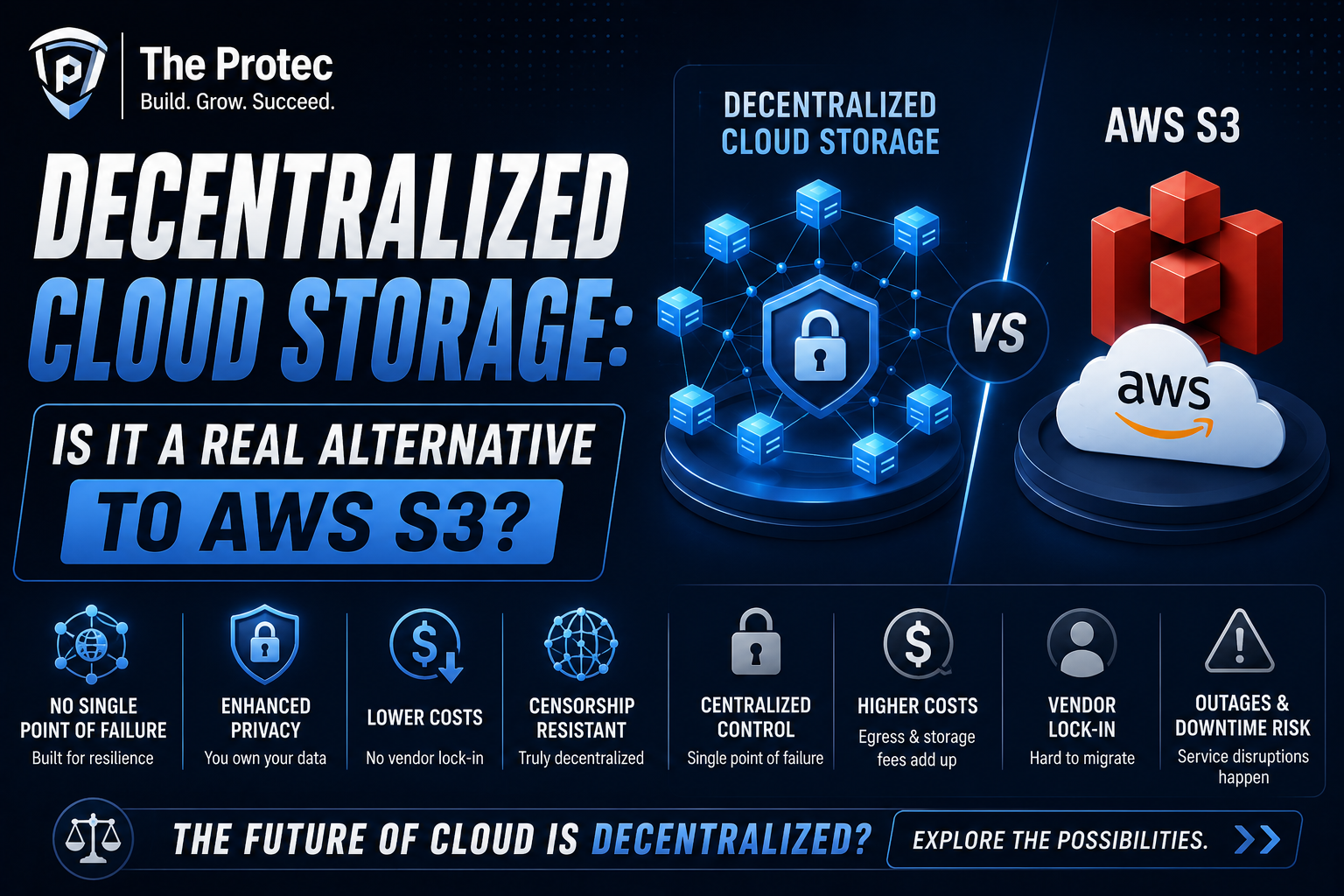
AWS S3: Operates under centralized control, requiring customers to trust Amazon’s management for security, privacy, and uptime.
Decentralized Storage: Eliminates the need for trust in a single entity by distributing control. Immutable cryptographic proofs allow users to verify data integrity independently.
2. Security and Privacy
AWS S3: Offers strong encryption, compliance with international standards, and sophisticated access controls. However, centralized data centers might be prone to targeted attacks or government surveillance.
Decentralized Storage: Uses client-side encryption and data sharding, making it harder for any actor to access full data sets. The distributed architecture offers resilience against censorship and attacks targeting central points.
3. Reliability and Availability
AWS S3: Provides SLA-backed high availability and durability through sophisticated replication and failover strategies.
Decentralized Storage: Uses redundancy across multiple nodes; however, network churn and node reliability can affect availability. Advances in protocol designs and incentive alignment are steadily addressing these challenges.
4. Cost & Pricing Models
AWS S3: Transparent, usage-based pricing model combined with potentially high egress fees, depending on the volume of data transferred out.
Decentralized Storage: Often more cost-efficient by leveraging underutilized storage globally. Costs can be more variable due to token economies and fluctuating network usage but may present savings over traditional providers.
5. Performance and Latency
AWS S3: Optimized for low latency access with a global content delivery network (CDN) infrastructure.
Decentralized Storage: Latency varies depending on node distribution and network conditions. Initiatives are underway to improve performance with edge computing and caching.
6. Ecosystem and Integration
AWS S3: Integrated deeply with AWS’s suite of cloud services, providing extensive APIs, SDKs, and third-party support.
Decentralized Storage: While integration ecosystems are newer, Web3 storage projects are enabling seamless connections with blockchain applications, NFTs, and decentralized apps (dApps), offering unique opportunities for emerging use cases.
Recent Developments & Trends in Decentralized Cloud Storage
Decentralized cloud storage has matured significantly, moving beyond experimental phases into production-ready solutions that attract enterprise attention. Several key trends are driving this evolution:
- Hybrid Architectures: Combining decentralized storage with traditional cloud infrastructures to leverage the strengths of both.
- Interoperability: Protocols increasingly standardize APIs and data formats to integrate with Web2 and Web3 ecosystems seamlessly.
- Data Sovereignty: Empowering users and organizations with full ownership and control over their data, aligned with evolving privacy regulations worldwide.
- Token Incentives & Economics: Refined incentive models reduce volatility and promote long-term storage commitments by providers.
- Scalability Solutions: Protocol upgrades improving speed, throughput, and reliability to rival centralized solutions.
For instance, Filecoin’s recent Network Upgrade aims to improve retrieval speeds and storage verification, enhancing its appeal as a decentralized solution competing with AWS S3 on reliability and performance.
Use Cases Where Decentralized Storage Excels
- Censorship-Resistant Archiving: Ideal for storing content that requires permanence without the risk of takedown.
- NFT and Web3 Applications: Storing metadata and assets for blockchain-based applications where decentralization aligns with underlying principles.
- Privacy-Focused Data Storage: Cases demanding strong guarantees against unauthorized access and third-party control.
- Cost-Sensitive Long-Term Storage: Archival data that benefits from lower costs and strong economic incentives.
Challenges and Limitations of Decentralized Cloud Storage
Despite its promise, decentralized cloud storage still faces obstacles before it can fully replace traditional giants like AWS S3:
- Network Stability: Decentralization means node availability can fluctuate, impacting data access.
- User Experience: Developers and businesses may encounter steeper learning curves and less mature tooling.
- Regulatory Compliance: Ensuring adherence to standards such as GDPR or HIPAA across distributed nodes can be complex.
- Data Retrieval Costs: Token-based payment mechanisms may introduce unpredictability in retrieval pricing.
- Performance Variability: Latency and throughput might not match centralized CDN-backed services in some scenarios.
Is Decentralized Cloud Storage a Real Alternative to AWS S3?
As decentralized cloud storage technology continues to advance, it is increasingly positioning itself as a competitive alternative—particularly for use cases that value trustlessness, privacy, and censorship resistance. For businesses heavily reliant on AWS’s deep ecosystem and SLA-backed guarantees, decentralized options might complement rather than replace existing services.
Nonetheless, for Web3-native applications, privacy-centric organizations, and those seeking to future-proof against centralized failures or vendor lock-in, decentralized cloud storage offers compelling advantages. Hybrid models combining decentralized and centralized storage may become the norm, leveraging the best of both approaches.
Frequently Asked Questions (FAQ)
What makes decentralized cloud storage different from traditional cloud storage?
Decentralized cloud storage distributes data across a peer-to-peer network without a central controlling entity, using cryptographic methods and economic incentives to maintain integrity and availability. Traditional cloud storage is managed and controlled by centralized providers like AWS, relying on proprietary data centers.
Can decentralized cloud storage guarantee the same reliability as AWS S3?
While decentralized storage networks have made significant reliability improvements with redundancy and verification mechanisms, they are still catching up to the enterprise-grade SLAs of AWS S3. However, innovations in protocol design are closing this gap steadily.
How cost-effective is decentralized cloud storage compared to AWS S3?
Decentralized storage can often reduce storage costs by utilizing underused capacity worldwide. However, costs may fluctuate due to token pricing and network demand dynamics. It’s advisable to assess based on specific workload profiles.
Are decentralized cloud storage solutions secure?
Yes, most utilize client-side encryption and data sharding, making data highly secure and private. The distributed nature also makes large-scale attacks more difficult, but users must ensure proper key management.
Where can I learn more about decentralized storage platforms?
Trusted resources include the official documentation of leading projects like Filecoin and Storj, which provide comprehensive technical and user guides.