








Contents
- 1 Introduction
- 2 The Limitations of Traditional Browser Automation Tools
- 3 What Are AI Browser Agents?
- 4 How AI Browser Agents Are Replacing Selenium and Puppeteer
- 5 Real Use Cases Demonstrating AI Browser Agent Superiority
- 6 Key Technologies Powering AI Browser Agents
- 7 Challenges and Considerations with AI Browser Agents
- 8 Future Outlook: The Rise of Autonomous Web Automation
- 9 Frequently Asked Questions (FAQ)
- 10 Conclusion
Introduction
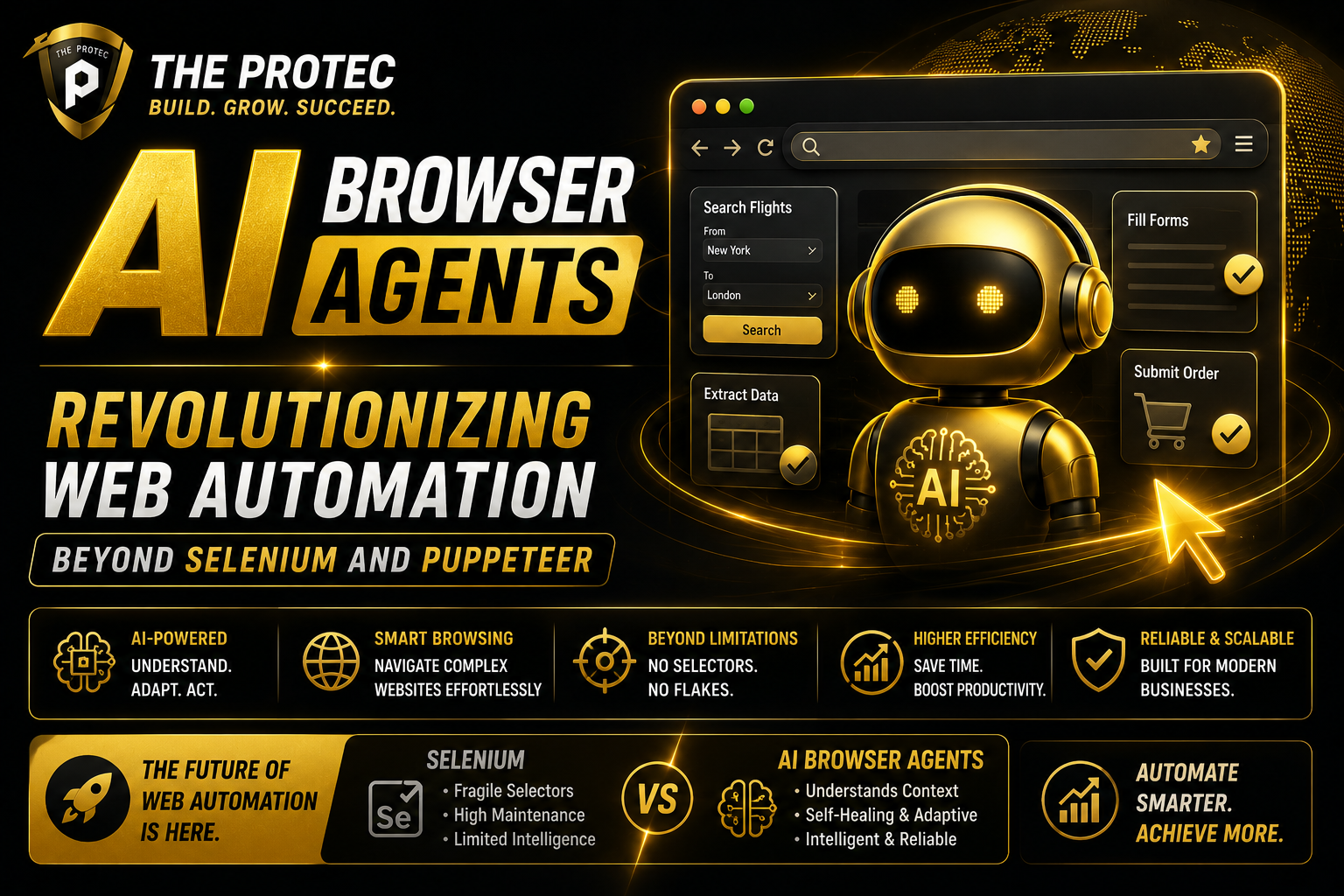
The landscape of web automation has dramatically evolved beyond the well-known frameworks of Selenium and Puppeteer. AI browser agents, leveraging advances in artificial intelligence, are now poised to replace traditional browser automation tools, delivering smarter, more resilient, and context-aware interactions with web applications. This shift not only solves many challenges faced by classical tools but also opens new possibilities for automation across industries.
In this article, we explore why AI browser agents are becoming the new standard in web automation AI, how they achieve what traditional browser automation tools cannot, and present real use cases that illustrate this transformative trend.
The Limitations of Traditional Browser Automation Tools
For years, Selenium and Puppeteer have spearheaded browser automation, providing developers with programmable access to browsers for tasks like testing, scraping, and repetitive interactions. However, these tools come with notable limitations:
- Fragility to UI changes: Both Selenium and Puppeteer operate largely on DOM selectors and scripted instructions, making them vulnerable to UI modifications. When websites change element identifiers or layouts, automation scripts often break and require manual maintenance.
- Rigid scripting: These tools execute pre-defined instructions and cannot adapt dynamically to unexpected content variations or errors without extensive error handling.
- Limited context awareness: Traditional tools do not inherently understand semantic content, user intents, or flows, restricting their ability to automate more complex human-like interactions.
- Scaling challenges: Managing large-scale automation pipelines demands significant engineering overhead to maintain scripts against site changes and diverse environments.
These issues have made maintenance-intensive automation a significant bottleneck for organizations relying on traditional web automation tools.
What Are AI Browser Agents?
AI browser agents are intelligent software entities designed to navigate and interact with web environments using a combination of AI methods, including natural language processing, computer vision, reinforcement learning, and contextual understanding. Unlike scripted tools, AI agents learn and adapt to web pages dynamically, enabling them to handle unpredictable changes and complex tasks.
- Contextual Interaction: AI agents interpret page semantics and user intent, interacting with elements based on meaning rather than brittle identifiers.
- Dynamic Adaptation: They adjust strategies when the UI changes or unexpected conditions arise, reducing script breakage and maintenance.
- Multi-modal Perception: Using computer vision and NLP, AI agents process both visual layouts and textual content for better decision-making.
- Reinforcement Learning: Agents learn from interactions, improving over time by optimizing task completion success.
How AI Browser Agents Are Replacing Selenium and Puppeteer
The growing adoption of AI browser agents is driven by their ability to address the weaknesses of traditional browser automation tools and unlock new capabilities:
1. Reduced Maintenance Through Robustness
Traditional scripts often break due to minor changes in page structure. In contrast, AI agents rely on semantic understanding and visual context, enabling them to identify elements based on their function or appearance rather than static IDs or classes.
For example, instead of relying on a CSS selector like #login-button, an AI agent might recognize a button labeled “Log In” visually and click it, regardless of underlying code changes.
2. Handling Complex, Multi-step Flows
AI browser agents excel in managing workflows that need conditional logic or dynamic decision-making, such as guided form completions, multi-factor authentication, or error recovery without explicit programming by humans.
Where Selenium/Puppeteer require manually scripted fallbacks, AI agents autonomously adapt, navigating pop-ups, captchas, or unexpected errors by exploring alternatives.
3. Faster Development Cycles
Developers using AI browser agents can define high-level goals or intents using natural language or simplified APIs instead of writing lengthy, brittle scripts. This accelerates automation rollout and lowers technical barriers.
4. Greater Scalability and Integration
Because AI agents self-adapt, organizations can scale automation projects across diverse websites and environments without proportionally increasing maintenance staff. They integrate with modern AI-driven analytics and monitoring to optimize performance continuously.
Real Use Cases Demonstrating AI Browser Agent Superiority
Case Study 1: Automated E-Commerce Price Monitoring
A global retailer must monitor competitor pricing across thousands of products daily. Using Selenium, the process required constant script updates due to frequent UI redesigns from competitors’ websites.
After switching to AI browser agents, the retailer’s automation effortlessly tracked price changes by visually identifying price tags and product names, adjusting to page reorganizations without downtime. The AI agents also filtered promotional pricing and detected outliers with natural language understanding, improving accuracy.
Case Study 2: Banking Customer Support Automation
A financial institution deployed AI browser agents to automate web-based customer support tasks, such as account verification and service inquiries. Traditional automation struggled with multi-factor authentication workflows and dynamic forms.
AI agents navigated these complex flows by recognizing form fields contextually, handling two-factor prompts, and adapting to interface updates with minimal human intervention. This resulted in improved response times and reduced operational costs.
Case Study 3: Web Data Extraction for Market Intelligence
Market intelligence firms depend on vast amounts of web data, often accessed through complex web portals with frequent layout changes. Puppeteer scripts would frequently break, incurring delays.
Adopting AI browser agents provided flexible extraction pipelines capable of interpreting content semantically, avoiding abrupt failures. Agents dynamically re-mapped data points using AI-driven pattern recognition, enabling continuous, reliable data harvesting.
Key Technologies Powering AI Browser Agents
AI browser agents draw on several cutting-edge technologies that contrast starkly with traditional automation tools:
- Computer Vision: Enables agents to “see” visual elements, detect buttons, input fields, and manage page layouts.
- Natural Language Processing (NLP): Understanding textual content on pages, user dialogs, and error messages.
- Reinforcement Learning: Learning optimal interaction strategies through trial and error in simulated or real environments.
- Multi-modal AI Models: Combining vision, language, and user interaction signals to make intelligent decisions.
Challenges and Considerations with AI Browser Agents
Despite their advantages, AI browser agents come with considerations that companies should keep in mind:
- Initial Training and Setup: AI agents need substantial initial data and tuning to perform effectively in diverse environments.
- Resource Requirements: Running AI models for real-time web interaction can be resource-intensive compared to lightweight scripted tools.
- Privacy and Compliance: Automated interactions must respect website terms of service and data privacy regulations.
- Debugging Complexity: Diagnosing errors in autonomous AI agents requires new tooling and expertise beyond script debugging.
Future Outlook: The Rise of Autonomous Web Automation
Looking forward, AI browser agents are set to redefine how organizations approach web automation by combining adaptability, intelligence, and ease of deployment. These agents will increasingly become autonomous collaborators capable of handling nuanced workflows and delivering insights from web data with human-level understanding.
As AI techniques continue to improve, expect seamless integration of browser automation AI within broader enterprise AI ecosystems, enabling holistic automation of customer experiences, data operations, and testing.
Frequently Asked Questions (FAQ)
1. How do AI browser agents differ from Selenium and Puppeteer?
While Selenium and Puppeteer use scripted commands to interact with web elements based on fixed selectors, AI browser agents leverage AI techniques like computer vision and NLP to interpret and interact with web pages more flexibly, adapting to changes and handling complex workflows with minimal manual intervention.
2. Can AI browser agents fully replace traditional automation tools?
In many scenarios, yes. AI browser agents effectively reduce maintenance efforts and increase robustness. However, in highly controlled testing environments or simple automation tasks, traditional tools may still be suitable due to their simplicity and lower overhead.
3. What industries benefit most from AI browser agents?
Industries with frequent web interactions, such as e-commerce, finance, travel, and market intelligence, gain significant advantages. AI agents excel where automation must handle frequent UI changes, complex interactions, or high data volumes.
Conclusion
The advent of AI browser agents marks a pivotal shift in web automation, moving beyond the scripted rigidity of Selenium and Puppeteer. By imbuing automation with intelligence, adaptability, and contextual understanding, AI browser agents empower organizations to build more resilient, scalable, and sophisticated automation workflows. Embracing this new paradigm is essential for businesses seeking to maintain competitive edges amid rapidly evolving digital experiences.
For a deeper dive into modern automation frameworks and emerging technologies, resources like Selenium and Puppeteer documentation offer valuable context about their foundational capabilities contrasted with AI-driven approaches.