








Contents
- 1 Introduction
- 2 Understanding the Traditional Backbone: REST APIs
- 3 The Rise of Backend Development Trends
- 4 What Are AI Agents in Backend Development?
- 5 How AI Agents Are Transforming Backend Architecture
- 6 The Future of APIs in an AI-Driven Backend World
- 7 Practical Use Cases Highlighting the Shift
- 8 Challenges to Consider
- 9 Conclusion
- 10 Frequently Asked Questions (FAQ)
- 10.1 What are the main differences between REST APIs and AI agents in backend development?
- 10.2 How do AI agents improve backend security?
- 10.3 Will AI agents replace developers in backend development?
- 10.4 Are there any recommended tools or frameworks for integrating AI agents in backend systems?
- 10.5 How can businesses prepare for this transition in backend architecture?
Introduction
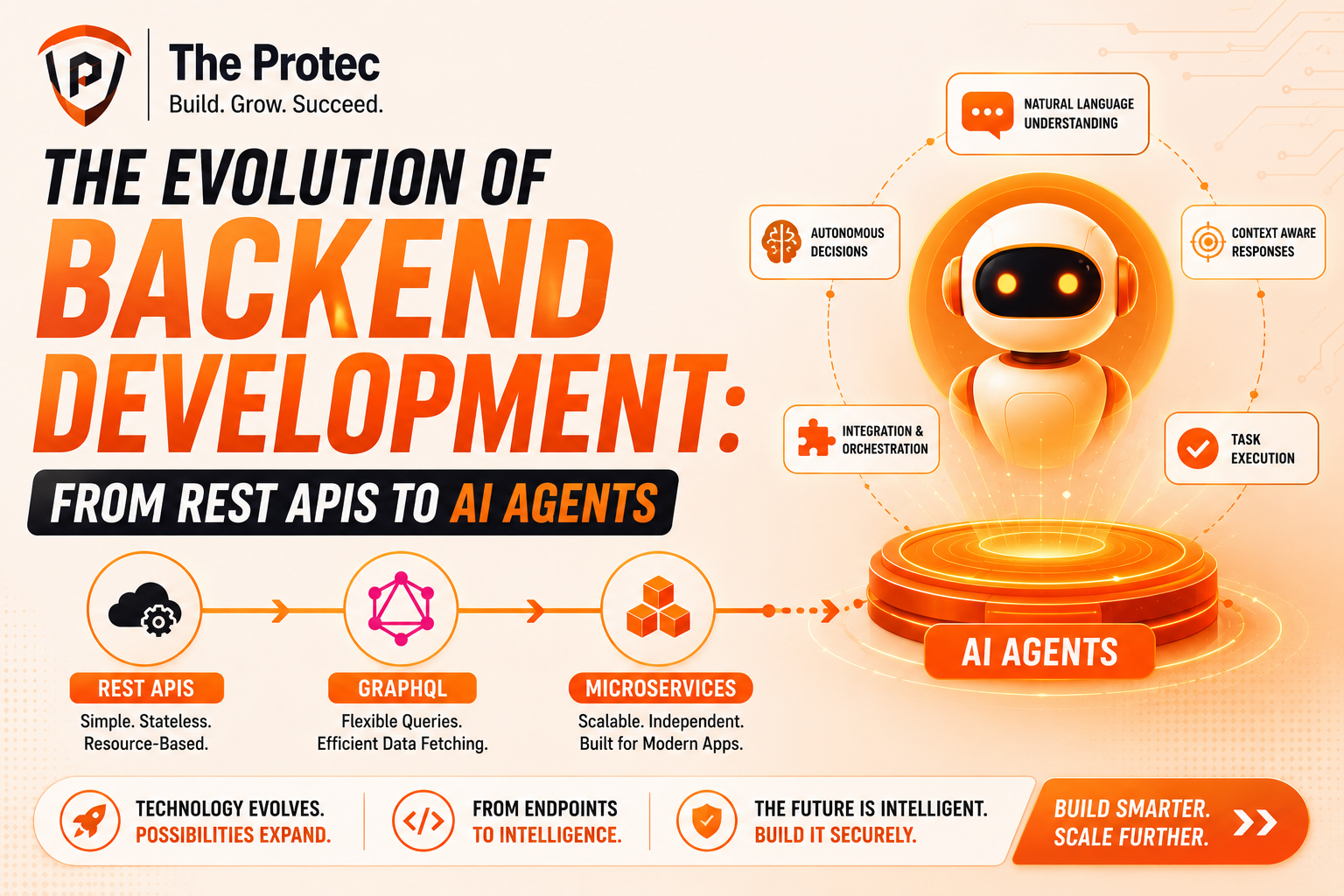
Backend development has always been the silent powerhouse behind modern applications, powering everything from simple websites to complex enterprise systems. Traditionally, REST APIs have been the backbone of backend communication, enabling scalable and standardized interactions between clients and servers. However, as technology progresses rapidly, the backend landscape is undergoing a profound transformation. The rise of artificial intelligence (AI) and machine learning (ML) is reshaping backend architectures, moving beyond static RESTful patterns toward dynamic, intelligent AI agents. This evolution promises to revamp how data is processed, decisions are made, and applications respond in real time.
In this article, we’ll delve into the shifting paradigms within backend development, examining the transition from REST APIs to AI-driven backend systems. We’ll explore the core backend development trends, highlight the role of AI agents in backend operations, and discuss what the future of APIs holds in this new era.
Understanding the Traditional Backbone: REST APIs
REST (Representational State Transfer) APIs have been the gold standard in backend development for over a decade. Their simplicity, scalability, and statelessness made them ideal for web services, mobile apps, and cloud architectures.
Key Characteristics of REST APIs
- Stateless Communication: Each request contains all the information needed to process it, allowing for scalability.
- Resource-Oriented: APIs focus on resources represented by URLs, manipulated through standard HTTP methods (GET, POST, PUT, DELETE).
- Standardized: Leveraging HTTP protocols meant easy adoption and broad interoperability.
This architecture proved effective for many years, but as application complexity grew, so did the limitations of RESTful designs. Complex business logic, extensive data relationships, and dynamic behaviors began to strain the rigid stateless paradigm.
The Rise of Backend Development Trends
Backend development trends reflect shifts toward increased flexibility, scalability, and intelligence. With cloud computing, microservices, and containerization, backend systems have become more distributed and modular. Yet, the most groundbreaking shift involves the integration of AI into backend environments.
Microservices and Beyond
While REST APIs pair well with microservices, each microservice may require tailored logic and dynamic response mechanisms that traditional API calls might struggle to manage efficiently. This is where backend development starts to lean on intelligent systems capable of adapting their behaviors without extensive human intervention.
Event-Driven and Real-Time Architectures
Modern applications demand real-time responsiveness and event-driven workflows that REST’s request-response model can’t fully support. Technologies like WebSockets and server-sent events complement REST but still often require sophisticated backend processing for meaningful results.
What Are AI Agents in Backend Development?
AI agents refer to autonomous software entities capable of perceiving their environment, making decisions, and performing actions toward designated goals. In backend development, AI agents act as intelligent intermediaries or processors that dynamically handle requests, optimize operations, and learn from interactions.
Core Attributes of AI Agents
- Autonomy: Operate without continuous human oversight.
- Learning Capability: Adapt based on previous data and interactions.
- Goal-Oriented Behavior: Take context-aware actions to meet predefined objectives.
- Interactivity: Communicate with APIs, databases, and other services dynamically.
Integrating AI agents in backends enables systems that do not merely respond to predefined requests but actively interpret, optimize, and innovate backend workflows in real time.
How AI Agents Are Transforming Backend Architecture
The conventional backend workflow relies heavily on fixed endpoint responses and manual scaling or logic updates. AI agents introduce several transformational capabilities.
Dynamic API Management
AI agents monitor API usage patterns and can adjust API endpoints dynamically, optimizing routing, throttling, and load balancing. This capability reduces latency and improves resource utilization without requiring manual reconfiguration.
Intelligent Data Processing
Beyond simple data retrieval and storage, AI agents apply natural language processing, anomaly detection, and predictive analytics directly within the backend, tailoring data outputs to specific client contexts.
Autonomous Decision Making
AI agents embedded within backend services can make decisions such as fraud detection, risk assessment, or content personalization on the fly. This shifts backend systems from reactive responders to proactive participants in application workflows.
Enhanced Security
By continuously learning from access patterns and suspicious activities, AI agents bolster security layers, providing adaptive threat detection and automated incident responses.
The Future of APIs in an AI-Driven Backend World
The evolution from static REST APIs to AI-enabled backend agents suggests the emergence of the next generation of APIs ones that are context-aware, self-optimizing, and seamlessly integrated with intelligent logic. Here’s what we can expect:
From REST to Contextual, Conversational APIs
APIs will become more conversational, interpreting natural language requests and adapting responses based on user intent and context rather than strict parameter input. This will blur lines between backend logic and AI-driven interaction layers.
Self-Configuring and Adaptive API Endpoints
Future APIs will leverage AI agents that can reconfigure their own endpoints, load thresholds, and data schemas dynamically to meet evolving client demands.
Integration with Autonomous AI Services
Backend systems will integrate multiple AI agents working collaboratively, forming intelligent API ecosystems capable of orchestrating complex workflows without human administration.
Practical Use Cases Highlighting the Shift
- Financial Institutions: AI agents detect fraudulent transactions autonomously while adapting risk assessment models through continuous learning.
- Healthcare Systems: Intelligent backends analyze medical data, support diagnostic decisions, and personalize patient care dynamically.
- E-commerce Platforms: AI-driven backends personalize recommendations and optimize supply chain logistics through predictive analytics.
Challenges to Consider
Despite its potential, the shift to AI agents in backend development presents challenges:
- Complexity: Designing, training, and maintaining AI systems is significantly more complex than traditional backend logic.
- Data Privacy: Handling sensitive data securely when AI agents require large volumes of data for training.
- Latency and Resource Consumption: AI computations may introduce latency or require more backend resources.
- Reliability and Explainability: Ensuring AI agent decisions are reliable and explainable to stakeholders.
Addressing these will require multidisciplinary teams combining backend expertise with AI specialization.
Conclusion
The evolution of backend development from REST APIs to AI agents marks a pivotal shift toward intelligent, adaptive backend architectures. These AI-driven systems promise to revolutionize how data is managed, how services respond, and ultimately how users experience applications. As backend developers embrace AI agents, the future APIs will transcend static requests and morph into autonomous, context-aware entities shaping the next generation of interconnected software ecosystems.
For developers and businesses alike, staying informed about these backend development trends is crucial. Adopting AI agents within backend infrastructure offers a competitive edge through enhanced automation, security, and user-centric intelligence.
Frequently Asked Questions (FAQ)
What are the main differences between REST APIs and AI agents in backend development?
REST APIs operate on fixed request-response protocols that serve predefined resources, while AI agents use autonomous, learning-driven models to handle data dynamically, make decisions, and optimize backend processes without explicit instructions for every scenario.
How do AI agents improve backend security?
AI agents analyze patterns in user behavior and network activity continuously, enabling real-time threat detection and automated responses to suspicious events, thus enhancing traditional security measures with adaptive intelligence.
Will AI agents replace developers in backend development?
AI agents augment backend workflows rather than replace developers. They automate routine tasks and decision-making processes, allowing developers to focus on design, innovation, and oversight of intelligent systems.
Are there any recommended tools or frameworks for integrating AI agents in backend systems?
Popular frameworks such as TensorFlow Extended (TFX) for ML pipelines, OpenAI APIs for natural language understanding, and custom microservice orchestration platforms help integrate AI agents effectively. Combining these with existing backend technologies like Docker and Kubernetes enables scalable deployment.
How can businesses prepare for this transition in backend architecture?
Businesses should invest in upskilling their teams on AI and ML concepts, experiment with pilot projects involving AI-driven APIs, and adopt modular architectures that allow gradual integration of AI agents to evolve backend infrastructure safely.
For further insights on AI integration in backend systems, consider exploring Google AI Blog and O’Reilly’s AI & ML Backend Trends.