







Website and app optimization has always depended on one simple idea: test what works, measure the results, and keep improving. But as digital experiences grow more complex, traditional experimentation methods often struggle to keep up. Traffic is fragmented across devices, user journeys are nonlinear, and customer expectations shift quickly. That is where AI-driven A/B testing is reshaping the process.
Instead of relying only on manual test design and static analysis, AI A/B testing uses machine learning to identify patterns, predict outcomes, and accelerate decision-making. For product teams, marketers, and growth specialists, this means faster learning and more reliable conversion optimization AI across websites and apps. The result is not just more experiments, but smarter experiments that help teams understand what truly drives engagement, sign-ups, purchases, and retention.
As optimization tools continue to evolve, the best website testing tools now combine experimentation with predictive analytics, personalization, and automation. This shift is especially important for businesses that need to move quickly without sacrificing statistical rigor. In this article, we will explore how AI improves A/B testing, where it delivers the most value, the latest trends shaping experimentation, and how teams can use it to create better digital experiences.
What Is AI-Driven A/B Testing?
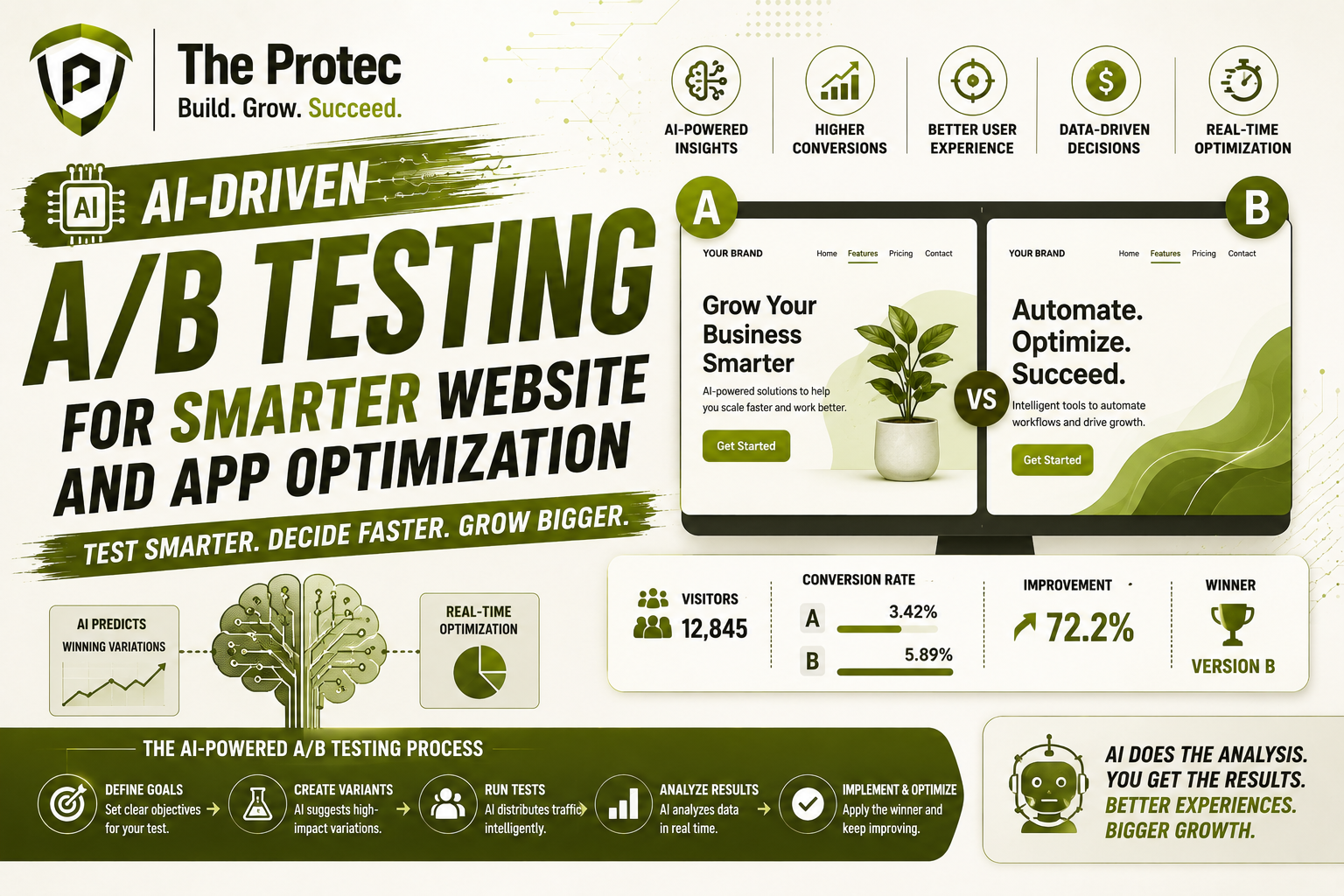
Traditional A/B testing compares one version of a page, feature, or message against another to determine which performs better. The process is powerful, but it can be slow. Teams must choose a hypothesis, split traffic, wait for enough data, and then manually interpret the outcome. AI-driven A/B testing adds intelligence to each stage of that workflow.
With AI, experimentation platforms can analyze large volumes of behavioral data, detect subtle patterns, and suggest which variations are likely to perform best. Some systems automatically allocate more traffic to winning variants, while others use predictive modeling to estimate results before a test reaches statistical significance. This reduces wasted traffic and helps teams prioritize high-impact ideas.
AI A/B testing does not replace experimentation discipline. Instead, it improves the quality and speed of decision-making. The strongest programs still begin with a clear hypothesis and a measurable goal, but AI helps teams refine their test plans, target the right users, and learn faster from every interaction.
Why AI Is Changing Conversion Optimization
Conversion optimization AI matters because digital growth is no longer limited by finding one “best” page design. Today’s users interact with brands across landing pages, mobile apps, onboarding flows, checkout steps, recommendation engines, and support experiences. Each touchpoint creates more variables, more data, and more opportunities to optimize.
AI improves conversion optimization in several important ways:
- It finds patterns humans may miss. Machine learning can identify behavioral signals that correlate with conversion, such as scroll depth, hesitation time, or device-specific actions.
- It reduces analysis bottlenecks. Teams do not need to manually inspect every segment or variation when AI can surface meaningful differences faster.
- It adapts to complexity. AI can handle multivariate environments, multiple traffic sources, and overlapping audience segments more effectively than simple testing workflows.
- It supports faster iteration. Instead of waiting weeks for a conclusion, teams can use adaptive methods to learn continuously.
In practice, this means more than incremental gains. When experimentation is faster and more precise, teams can improve entire conversion funnels, not just isolated page elements. That is why AI is becoming central to modern website testing tools and product experimentation stacks.
How AI A/B Testing Works Behind the Scenes
Most AI A/B testing platforms use a combination of machine learning, statistical modeling, and automation. While the exact implementation varies, the core workflow often looks like this:
1. Data collection and behavioral signals
The system gathers data from user sessions, clicks, form interactions, session depth, purchase behavior, device type, referrer source, location, and other contextual signals. In many cases, the platform also ingests historical performance data from previous tests.
2. Hypothesis scoring and prioritization
AI can rank experiment ideas based on predicted impact, traffic availability, and confidence in the expected result. This helps teams focus on tests with the highest potential return instead of guessing which ideas are worth running.
3. Adaptive traffic allocation
Some systems use bandit algorithms or similar methods to shift traffic toward better-performing variants during the test. This can reduce opportunity cost by showing more users the most effective version sooner.
4. Segment-level insight
AI can reveal that a variation performs well overall, but especially well for certain segments, such as new visitors, mobile users, or traffic from paid search. This is valuable because not every audience responds the same way.
5. Predictive and automated recommendations
Advanced tools can recommend follow-up experiments, suggest personalization opportunities, and identify when a result is likely to be statistically meaningful. This turns experimentation into a continuous optimization system rather than a one-off task.
Key Benefits of AI-Driven A/B Testing
Businesses adopt AI A/B testing because it solves several practical problems that traditional experimentation often cannot address efficiently.
Faster learning cycles
AI can shorten the time between idea and insight. By automating traffic allocation, surfacing patterns quickly, and prioritizing likely winners, teams can move from testing to implementation sooner.
Better use of traffic
Every test consumes visitor attention and opportunity. AI helps reduce the number of low-value experiments that waste traffic, and it can minimize exposure to underperforming variants by adjusting allocations dynamically.
Deeper personalization opportunities
Not all visitors should see the same experience. AI can identify which combinations of content, layout, offer, or messaging work best for specific segments. This is especially useful for e-commerce, SaaS onboarding, and mobile app engagement.
More confident decision-making
Instead of relying only on broad averages, AI provides richer context around what is happening and why. That gives product managers and marketers more confidence when launching winning changes.
Scalable experimentation
As experimentation programs mature, the number of ideas can outpace the team’s ability to evaluate them manually. AI helps scale testing without proportionally increasing analyst workload.
Where AI Excels in Website Testing Tools
Not every use case needs AI, but there are clear areas where modern website testing tools gain an edge from intelligent automation.
Landing pages and acquisition funnels
AI can optimize headlines, hero sections, calls to action, trust signals, pricing presentations, and form layouts based on audience behavior and acquisition channel. For paid traffic, this is especially useful because even small conversion improvements can significantly impact return on ad spend.
E-commerce product and checkout flows
AI can analyze which product page layouts increase add-to-cart rates, which upsell modules improve average order value, and which checkout changes reduce abandonment. Because shopping behavior varies by device and intent, adaptive testing adds real value here.
Mobile app onboarding
Apps often lose users during first-time setup. AI A/B testing can identify which onboarding steps reduce friction, which messaging increases account completion, and which prompts improve activation. This is especially useful when testing multiple steps in a short user journey.
Retention and engagement features
AI can help test notification timing, in-app prompts, content recommendations, loyalty offers, and feature nudges. These experiments are essential for improving repeat usage and long-term customer value.
Latest Trends Shaping AI A/B Testing
The experimentation landscape has shifted quickly as AI has become more capable and accessible. The latest trends reflect a move away from isolated tests and toward integrated optimization systems.
Generative AI for experiment ideation
Teams are increasingly using generative AI to brainstorm test ideas, rewrite headlines, propose variants, and summarize past findings. This does not replace strategic thinking, but it can accelerate the ideation process and help teams explore more possibilities.
Predictive experimentation
Some platforms now estimate likely outcomes before a test reaches completion. Predictive models can help teams decide whether a test is worth continuing, which segments deserve more attention, and whether a variation is likely to produce meaningful uplift.
Multi-armed bandit methods
Rather than splitting traffic evenly between versions for the full test duration, bandit-based systems can shift traffic toward better performers as data comes in. This is useful when businesses want to improve performance during the experiment rather than only after it ends.
Experimentation plus personalization
Modern optimization stacks increasingly blend A/B testing with personalization. The goal is not just to find a universal winner, but to deliver the right experience to the right audience at the right time.
Server-side and app-native testing
As teams test more complex features, server-side experimentation and native mobile app testing have become more important. These approaches support deeper product changes, better performance, and more reliable measurement across environments.
Privacy-aware optimization
With stronger privacy expectations and evolving browser constraints, teams need experimentation methods that are durable and compliant. AI can help by working with first-party data, contextual signals, and privacy-conscious measurement frameworks.
Best Practices for Using AI in A/B Testing
AI makes experimentation more powerful, but only if it is used well. Strong testing programs still depend on clear strategy, clean data, and disciplined execution.
- Start with a clear objective. Define whether you are improving sign-ups, revenue, retention, engagement, or another metric.
- Keep hypotheses specific. AI can help generate ideas, but the test should still answer a focused business question.
- Use enough data quality. Poor tracking, inconsistent events, or missing attribution can distort results no matter how advanced the model is.
- Watch for false confidence. AI predictions are useful, but they should not replace sound statistical judgment.
- Test meaningful changes. Small cosmetic tweaks may be easy to run, but bigger wins often come from changes in messaging, flow, and friction reduction.
- Segment results carefully. A variation may win overall while losing for a valuable audience segment. Look beyond averages.
- Document learnings. Each test should feed future hypotheses, not exist as a standalone event.
Common Mistakes to Avoid
Even with AI, experimentation can fail if teams rush the process or misread the output. A few common mistakes stand out.
Over-automating decisions: AI can recommend actions, but it should not eliminate human review. Product context, brand priorities, and customer experience still matter.
Testing too many variables at once: If the setup is too broad, it becomes hard to know what actually caused the lift. AI can manage complexity, but clarity still matters.
Ignoring sample quality: If traffic is unbalanced, event tracking is flawed, or segments are too small, results may be misleading.
Chasing short-term wins only: Some test winners improve clickthrough rates but hurt downstream quality. The best programs optimize for long-term value, not just immediate spikes.
How to Choose the Right AI Website Testing Tools
Choosing the right platform depends on your testing maturity, traffic volume, and optimization goals. Strong website testing tools typically offer a mix of experimentation, analytics, and AI assistance.
When evaluating platforms, look for:
- Flexible A/B and multivariate testing capabilities
- Server-side and client-side support
- Reliable event tracking and integrations
- Predictive analytics or adaptive traffic allocation
- Audience segmentation and personalization features
- Clear reporting with actionable insights
- Privacy-conscious measurement and governance controls
If you want a broader perspective on experimentation methods and measurement discipline, the Optimizely A/B testing guide is a useful reference. For a deeper look at machine learning concepts that power adaptive systems, Google’s machine learning resources are also helpful.
The Future of AI-Driven Experimentation
The next phase of experimentation will be less about running isolated tests and more about creating continuous optimization loops. AI will increasingly help teams decide what to test, who to test it on, when to adjust traffic, and how to interpret outcomes across channels.
We are also likely to see tighter integration between experimentation platforms, product analytics, customer data platforms, and personalization engines. That will allow organizations to move from reactive testing to proactive optimization. In other words, instead of asking, “What version won?” teams will ask, “What experience should each user see next?”
This is a major shift for digital teams. AI A/B testing is not just a faster version of old experimentation. It is a more intelligent approach to learning, one that can connect user behavior, business goals, and product decisions in real time.
FAQ
What is AI-driven A/B testing?
AI-driven A/B testing uses machine learning and automation to improve how experiments are designed, analyzed, and optimized. It helps teams identify winning variants faster and with more context than traditional testing alone.
How does conversion optimization AI improve results?
Conversion optimization AI improves results by finding behavioral patterns, segmenting audiences more effectively, automating traffic allocation, and generating recommendations based on predictive models. This often leads to faster learning and better conversion outcomes.
Are AI A/B testing tools better than traditional website testing tools?
They are not always better in every situation, but they are often more efficient for complex environments with lots of traffic, segments, or variables. Traditional methods still matter, especially when you need strict control and simple comparisons.
Can AI replace human experimentation teams?
No. AI can accelerate analysis and improve decision-making, but human teams still define strategy, validate insights, and ensure that tests align with business goals and customer experience.
What should companies test first with AI?
Start with high-impact areas such as landing pages, onboarding flows, checkout steps, pricing pages, or app activation screens. These areas usually offer the clearest connection between test results and business outcomes.
Conclusion
AI-driven A/B testing is changing the way websites and apps are optimized. By combining experimentation with machine learning, teams can learn faster, personalize more effectively, and make better decisions with less manual effort. The strongest programs still rely on solid hypotheses and clean measurement, but AI adds the speed and intelligence needed to keep up with modern user behavior.
For businesses serious about growth, the message is clear: the future of optimization is not just testing more. It is testing smarter. With the right strategy and the right website testing tools, AI A/B testing can become a powerful engine for higher conversions, better experiences, and more confident product decisions.