








Wi-Fi 8 Explained: What the Next Generation of Wireless Internet Will Change
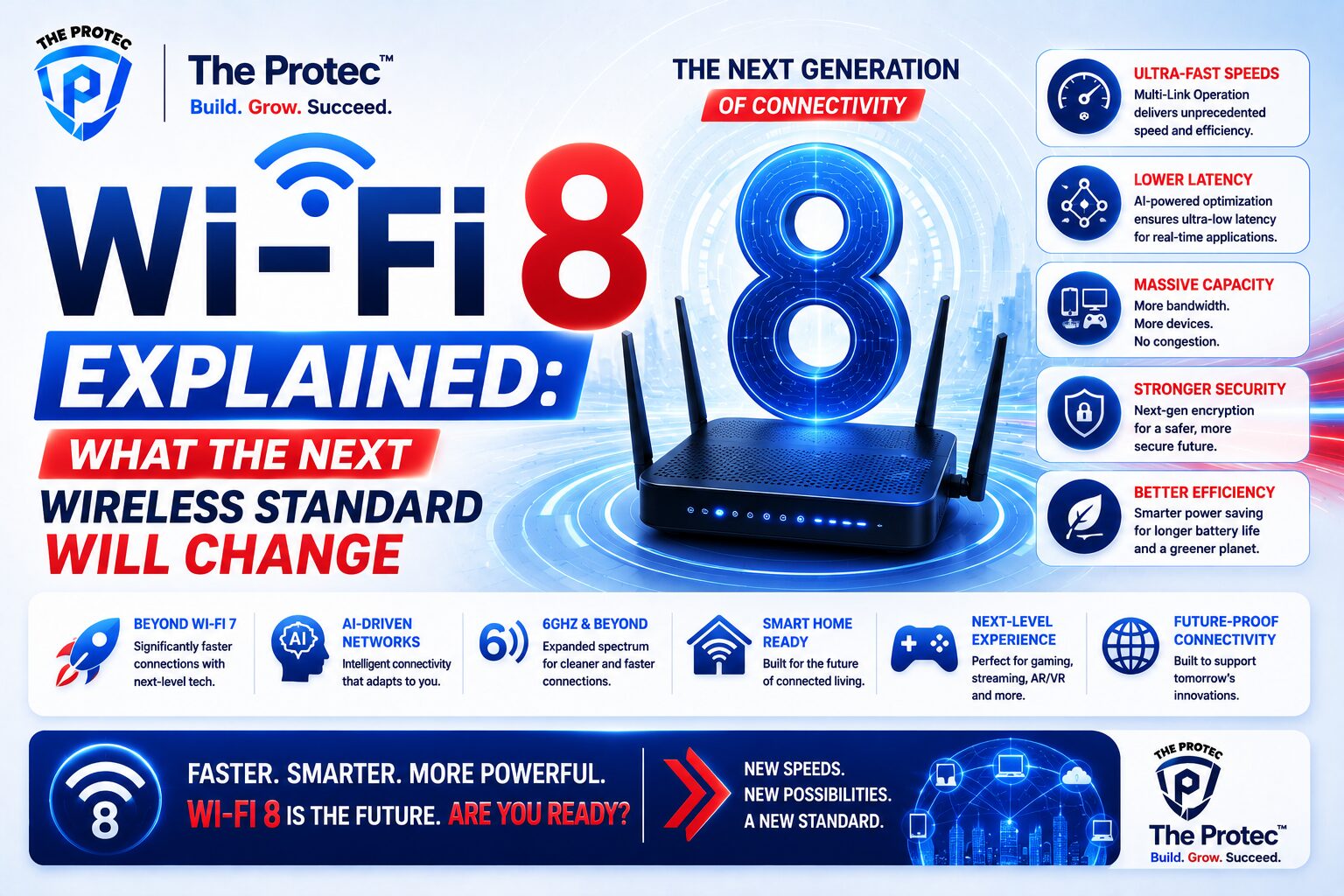
Wi-Fi 8 is already becoming one of the most discussed topics in future WiFi technology, even though it has not reached the consumer market yet. That is a strong signal that the next leap in wireless networking will be judged differently from the last few generations. For years, the conversation around Wi-Fi focused mainly on one thing: speed. But as homes, offices, factories, schools, and public spaces become more crowded with connected devices, raw throughput is only part of the story. Reliability, latency, device coordination, and consistency now matter just as much.
The next generation of wireless internet is expected to respond to those demands. Wi-Fi 8 is widely viewed as a standard built not only to be faster, but to be smarter about how it uses spectrum, serves many users at once, and keeps connections stable in difficult environments. If Wi-Fi 6 and Wi-Fi 7 were about modernizing the network, Wi-Fi 8 appears to be about making wireless feel more predictable, especially when many devices are competing for attention.
For homeowners, that could mean smoother video calls, steadier smart home performance, and fewer drops when everyone is online at once. For businesses, it could mean better support for dense offices, hybrid workspaces, automation, and real-time applications. In other words, Wi-Fi 8 may change how people think about wireless networking altogether.
What Wi-Fi 8 Is Trying to Solve
Every Wi-Fi generation is shaped by the problems that users actually experience. Wi-Fi 8 is expected to focus on the issues that remain even after faster routers and wider channels became common. Those issues include congestion, interference, roaming delays, uneven performance across rooms, and unstable connections in environments full of devices.
In practical terms, this means the next standard is likely to prioritize the quality of the connection rather than just peak speed. That shift matters because most people do not notice theoretical maximum throughput in daily use. They notice whether a meeting freezes, a game lags, a video buffers, or a point-of-sale terminal disconnects. Wi-Fi 8 is being positioned as a response to those real-world pain points.
Consistency: Better performance across the entire home or building.
Low latency: Faster response times for gaming, collaboration, and automation.
Higher reliability: Fewer disconnects and less interference in crowded spaces.
Better multi-device handling: More efficient service for many active devices at once.
How Wi-Fi 8 Fits Into the Future of Wireless Networking
To understand Wi-Fi 8, it helps to look at the direction wireless networking has been taking. The industry has steadily moved from optimizing raw bandwidth to improving coordination. Wi-Fi 6 introduced major efficiency gains in dense environments. Wi-Fi 7 pushed much further with wider channels, lower latency, and stronger support for demanding applications. Wi-Fi 8 is expected to continue that evolution by improving how wireless networks behave under pressure.
That pressure is increasing everywhere. Homes now have dozens of connected devices, from TVs and laptops to cameras, thermostats, appliances, and wearables. Businesses face even more complexity, with cloud services, collaboration tools, security systems, voice devices, industrial sensors, and guest traffic all competing on the same network. Future WiFi technology has to handle that environment gracefully.
One of the most important shifts may be the focus on real-world performance gains. Rather than simply increasing headline speed, Wi-Fi 8 is expected to improve how networks distribute resources, manage interference, and maintain service quality across a wide range of conditions. That makes it particularly relevant for people who have already upgraded hardware but still experience frustrating wireless issues.
Expected Improvements in Wi-Fi 8
Although the final consumer experience will depend on the ratified standard and hardware implementations, the direction of Wi-Fi 8 is becoming clearer. Early discussion points suggest a standard designed to support more reliable wireless networking in dense and demanding environments.
1. Better performance in crowded spaces
Apartment buildings, offices, schools, retail centers, and event venues often suffer from overlapping signals and competing traffic. Wi-Fi 8 is expected to improve how networks deal with these crowded conditions by making spectrum use more efficient and reducing the performance penalties caused by congestion.
2. Lower and more stable latency
Low latency matters for cloud gaming, video conferencing, industrial control, remote desktops, and real-time collaboration. Wi-Fi 8 is likely to refine scheduling and coordination so devices receive data more quickly and more consistently. The result could be fewer spikes and a smoother experience in latency-sensitive applications.
3. Improved roaming and handoff behavior
In larger homes and commercial environments, users often move between access points. A modern wireless standard has to support seamless transitions without interruptions. Wi-Fi 8 may improve roaming behavior so devices switch more intelligently between access points and remain connected while moving.
4. More efficient multi-device management
As connected ecosystems expand, the challenge is no longer simply how much data a network can carry. It is how well it can serve many devices with different needs at the same time. Future WiFi technology like Wi-Fi 8 is expected to be better at balancing high-demand tasks with background traffic, improving the experience for everyone on the network.
5. Stronger support for mixed-use environments
Modern networks often support a mix of devices with very different requirements. A smart camera, a laptop on a video call, and a sensor sending small bursts of data do not need the same treatment. Wi-Fi 8 may help networks classify and prioritize this traffic more effectively, which is especially valuable in business settings.
What Wi-Fi 8 Could Mean for Homes
For homeowners, Wi-Fi 8 is likely to be most noticeable in everyday reliability. Many households already have enough internet speed from their service provider. The problem is that Wi-Fi itself can become the bottleneck. One person is on a work call, another is streaming 4K video, a gaming console is updating, and smart devices are always connected in the background. That is where future wireless networking improvements could make a real difference.
Wi-Fi 8 may help reduce the common frustrations that come from shared household networks. Connections may stay steadier across larger homes, mesh systems may perform more smoothly, and busy evenings may feel less chaotic. This is especially important as more households adopt smart home devices, connected security systems, and remote work setups.
More stable video calls: Fewer interruptions during work or school from home.
Smoother streaming: Less buffering when multiple people are online.
Better smart home reliability: More consistent connectivity for cameras, speakers, and automation.
Improved whole-home coverage: Better performance in larger or multi-floor homes.
For families, the biggest advantage may be that Wi-Fi feels less fragile. Instead of troubleshooting connection issues each time the network is busy, users may experience a more resilient system that handles daily demand with less intervention.
What Wi-Fi 8 Could Mean for Businesses
Businesses stand to benefit even more from the next generation of wireless internet. As organizations rely on cloud applications, collaboration tools, mobile devices, and wireless endpoints, the network becomes a core part of productivity. Even small improvements in reliability can have a measurable effect on operations.
Wi-Fi 8 is likely to be especially valuable in environments where many users share the same infrastructure. That includes offices, warehouses, healthcare settings, schools, hospitality venues, and retail locations. These spaces need wireless networking that remains stable during peak demand and adapts to changing usage patterns.
For IT teams, future WiFi technology could reduce the number of complaints tied to weak coverage, dead zones, and inconsistent roaming. It may also make it easier to support new use cases such as digital signage, location services, smart building systems, and wireless IoT deployments. In highly dynamic environments, that added consistency could be as important as higher speed.
Better support for hybrid work: Reliable conferencing and collaboration tools.
Improved density handling: More stable service in offices and public areas.
Stronger operational continuity: Fewer disruptions for POS, scanners, and wireless terminals.
Scalable infrastructure: Networks that can grow with connected devices and services.
Why Wi-Fi 8 Is About More Than Faster Internet
One of the biggest misconceptions about the next generation of wireless internet is that it will simply make downloads faster. In reality, the biggest gains may come from how Wi-Fi 8 handles stress. Speed matters, but a network that is slightly slower and much more stable can be far more useful than one that is fast only under ideal conditions.
This is where the concept of quality of experience becomes important. Users care whether their applications work smoothly, whether their devices stay connected, and whether the network remains dependable throughout the day. Wi-Fi 8 appears to be moving the industry toward that mindset, with a stronger focus on quality, consistency, and responsiveness.
That shift also reflects how much wireless networking has changed. A generation ago, Wi-Fi was mostly about connecting a few laptops and phones. Today it supports video, gaming, automation, cloud platforms, security systems, and business-critical workflows. A modern standard has to do much more than maximize speed on paper.
How Wi-Fi 8 May Support Emerging Technologies
Future WiFi technology is not evolving in isolation. Wi-Fi 8 is expected to support broader technology trends that depend on dependable, low-latency wireless access. That includes augmented reality, extended reality, cloud gaming, edge computing, automation, and AI-driven devices that constantly exchange data.
As more applications move closer to real time, the network has to become more responsive. A smart device that reacts instantly, a headset that streams without lag, or a business application that syncs continuously all depend on a wireless layer that can handle fluctuating demand. Wi-Fi 8 could become a foundational part of that ecosystem.
It may also play a role in environments where automation and sensing are growing quickly. Factories, warehouses, and smart buildings increasingly rely on wireless systems for monitoring and control. In those settings, consistent latency and dependable roaming may matter more than peak speed. That is exactly the kind of problem Wi-Fi 8 seems designed to address.
What to Expect From Adoption and Upgrades
As with every Wi-Fi generation, the rollout will likely be gradual. New standards take time to move from specification to silicon, then into routers, access points, laptops, phones, and enterprise infrastructure. Early adopters are usually businesses, power users, and organizations that need to plan ahead. Consumer adoption follows later as device ecosystems expand.
That means most households and small businesses will not need to rush. However, understanding Wi-Fi 8 now can help people make smarter upgrade decisions later. If your current network already struggles with congestion, coverage, or latency, the next generation may be worth watching closely. In many cases, the biggest improvements will come when both the router and the client devices support the new standard.
It is also worth noting that upgrading to a future wireless standard is only part of the equation. Placement, backhaul quality, interference management, and internet service all still matter. Wi-Fi 8 may improve the wireless layer, but a well-designed network will still depend on thoughtful deployment.
How Businesses and Homeowners Should Prepare
Even before Wi-Fi 8 arrives in mainstream products, there are practical steps that can make the transition easier. The goal is not to wait for the next standard to solve every issue. It is to build networks that can benefit from it when it becomes available.
Audit current wireless performance to identify dead zones, latency issues, and congestion points.
Use network equipment that supports modern management features and strong firmware updates.
Plan for growth in connected devices rather than just current usage.
Separate critical traffic from guest and low-priority traffic where possible.
Review access point placement, cabling, and backhaul quality for larger environments.
For businesses, proactive planning may be especially important. Wireless networking is increasingly tied to productivity, customer experience, and operations. As future WiFi technology matures, organizations that have already modernized their infrastructure will be better positioned to take advantage of Wi-Fi 8 improvements.
FAQ About Wi-Fi 8
What is Wi-Fi 8?
Wi-Fi 8 is the next major generation of wireless networking expected to follow Wi-Fi 7. It is being designed to improve real-world wireless performance, especially reliability, latency, and efficiency in crowded environments.
Will Wi-Fi 8 only be about faster speeds?
No. While speed will still matter, the bigger emphasis appears to be on stability, lower latency, better congestion handling, and smoother performance across many connected devices.
Is Wi-Fi 8 useful for homes as well as businesses?
Yes. Homes may benefit from fewer drops, better coverage, and more stable performance during heavy use. Businesses may see even greater gains in dense environments with many devices and critical applications.
When will Wi-Fi 8 devices become available?
Device availability will depend on final standardization and manufacturer rollout. As with previous generations, enterprise products and early adopter gear will likely arrive before broad consumer adoption.
The Bottom Line on Wi-Fi 8
Wi-Fi 8 is emerging as a major step forward in wireless networking, but its real promise is not just speed. It represents a shift toward a more resilient, responsive, and intelligently managed wireless experience. That makes it one of the most important developments in future WiFi technology for both homes and businesses.
For everyday users, the most meaningful change may be that Wi-Fi starts to feel less unpredictable. For organizations, the benefits could include better support for dense environments, more dependable collaboration, and improved performance for critical wireless systems. As connected devices continue to multiply, that kind of progress matters more than ever.
To keep up with how wireless standards are evolving, organizations can also follow updates from the Wi-Fi Alliance and technical overviews from industry leaders such as Cisco. The next generation of wireless internet is coming into focus, and Wi-Fi 8 is likely to redefine what people expect from a modern network.