





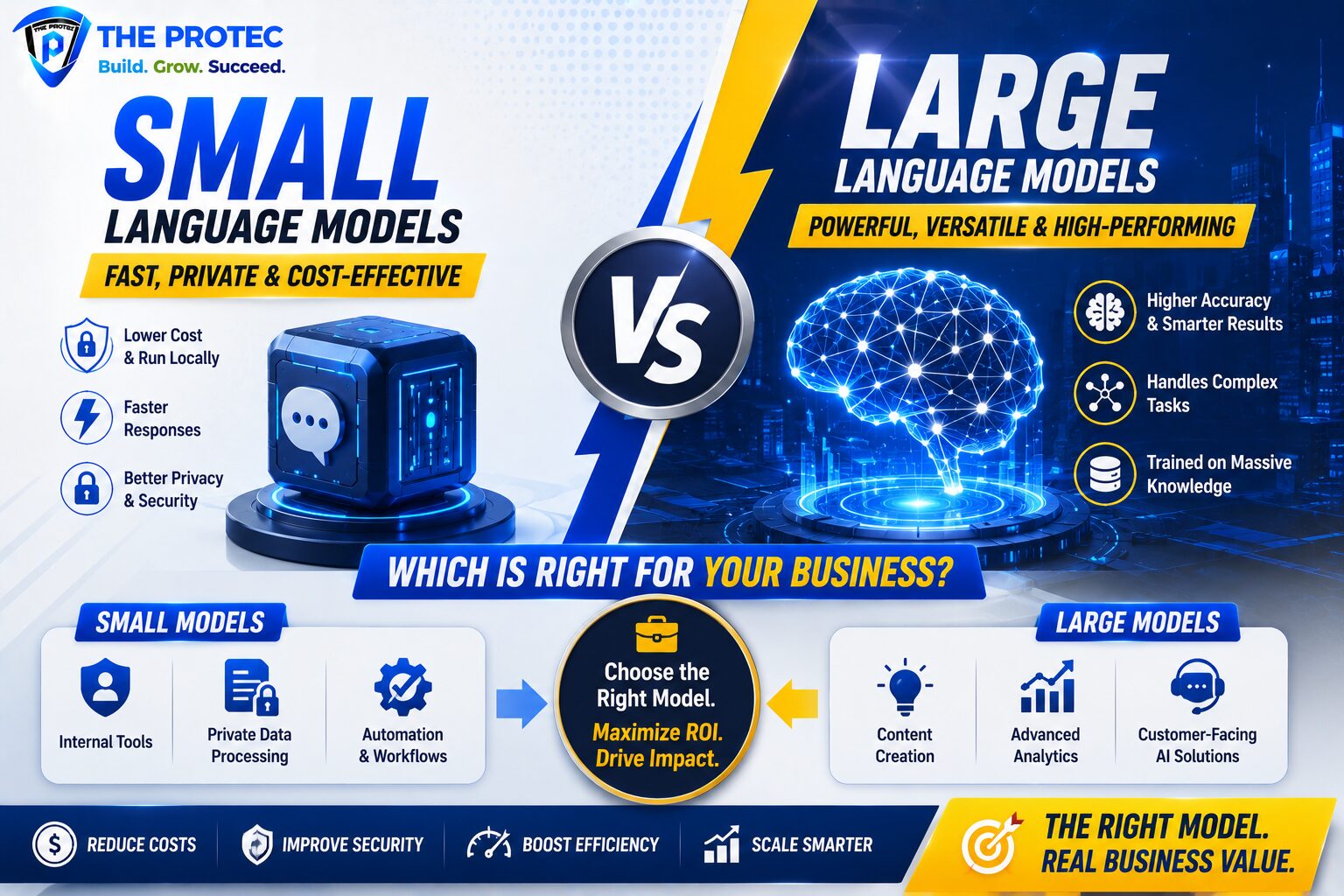
Small Language Models vs Large Language Models: Which AI Is Better for Business?
Businesses have moved past the question of whether to use AI and are now asking a more practical one: which model should power the workflow? That question matters because not every use case needs a giant cloud-based system with billions of parameters. In many cases, small language models can deliver faster responses, lower operating costs, stronger privacy, and easier deployment with less complexity. At the same time, large language models still lead in broad reasoning, flexible generation, and general-purpose knowledge.
This is why the SLM vs LLM debate has become a central issue in enterprise AI models. The market has matured quickly. Smaller models are now far more capable than they were even a short time ago, while large models continue to improve through better tool use, longer context windows, and more efficient inference. Businesses are also under more pressure to control AI spend, keep sensitive data local, and deploy AI directly inside products, workflows, and regulated environments. The result is a shift from “Which model is smartest?” to “Which model is right for the job?”
In this article, we’ll compare small language models and large language models across the factors that matter most to business: cost, speed, privacy, deployment, and accuracy. The goal is not to crown a universal winner. It is to help you choose the right model class for your specific business case.
What Are Small Language Models and Large Language Models?
Small language models, often called SLMs, are AI models with a relatively compact parameter count and lower compute requirements. They are designed to do specific tasks efficiently, such as classification, summarization, extraction, routing, customer support, or domain-specific generation. Because they are smaller, they can be faster and cheaper to run, and they can often be deployed on-premises, on private cloud infrastructure, or even at the edge.
Large language models, or LLMs, are general-purpose models trained on broad and diverse data at massive scale. They are typically stronger at open-ended reasoning, content generation, multi-step problem solving, and handling ambiguous prompts. LLMs often power the most visible AI assistants and are usually accessed through cloud APIs or managed platforms, though some enterprises now deploy self-hosted versions as well.
The difference is not just size. It is also architecture, training strategy, inference cost, and how each model is used in production. Modern enterprise AI models increasingly combine both: an SLM for routine tasks and an LLM for complex requests.
Why the SLM vs LLM Debate Matters for Business
For businesses, AI is no longer a research experiment. It is part of customer service, operations, sales enablement, product experiences, internal knowledge systems, and developer productivity. Each of these use cases comes with different requirements. A support chatbot might need speed and predictable outputs. A legal review assistant may need strong privacy controls. A marketing team may want high-quality generation. A data extraction pipeline may care more about throughput than creativity.
That is why the best model is usually not the largest one. In fact, many companies are discovering that smaller models are enough for a large portion of their workflows. The latest wave of enterprise AI models has shown that domain-tuned SLMs can outperform much larger general models on narrow tasks, especially when the input/output format is well-defined and the business problem is specific.
At the same time, LLMs remain valuable for tasks that require breadth, flexibility, and nuanced reasoning. The key is to match the model to the job instead of using a one-size-fits-all approach.
Cost Comparison: Where Small Language Models Win
Cost is one of the clearest differences between small language models and large language models. LLMs often carry higher inference costs because they require more memory, more compute, and more bandwidth. If your business sends thousands or millions of requests per month, those costs can add up quickly.
SLMs usually require less GPU capacity, lower memory footprints, and less energy per request. That makes them attractive for high-volume applications such as ticket triage, FAQ automation, lead routing, and document processing. They can also reduce dependence on expensive hosted APIs. For companies building AI features into products, an SLM can dramatically improve unit economics.
Cost is not just about model usage fees. It also includes engineering time, observability, governance, security review, and infrastructure. Smaller models are often easier to test, optimize, and maintain. In many enterprise environments, that simplicity translates into lower total cost of ownership.
That said, an LLM may still be the better investment when a single model can replace multiple manual workflows or when quality and flexibility significantly improve conversion, retention, or speed to resolution. The cost question should always be tied to business value, not model size alone.
Speed and Latency: Why Smaller Models Feel Faster
Speed matters whenever AI sits inside a user experience. Slow responses can frustrate customers, interrupt employees, and reduce adoption. Small language models generally have a clear advantage here. Because they are lighter, they can generate answers with less latency and higher throughput, especially under load.
This matters in real business systems. A contact center agent assist tool needs near-instant suggestions. A fraud triage pipeline needs rapid classification. A factory edge device may need on-device inference with minimal delay. In these cases, the speed difference between an SLM and an LLM can be the difference between practical deployment and an abandoned project.
Large language models can also be optimized, but they still tend to be slower than smaller models, especially when prompts are long or when multiple tool calls are involved. If your use case requires high concurrency, predictable response times, or offline operation, SLMs are often the better operational choice.
For broader context on latency and model serving tradeoffs, see the Google Cloud MLOps guidance and the NIST AI Risk Management Framework, both of which help frame deployment decisions in enterprise settings.
Privacy and Data Control: A Major Advantage for Small Language Models
Privacy has become a serious business issue, especially for companies in healthcare, finance, legal services, government, manufacturing, and B2B SaaS. When sensitive data is involved, sending prompts to a third-party cloud model may create compliance, retention, or sovereignty concerns.
Small language models are often easier to run privately. They can be deployed on-premises, within a private VPC, or on edge devices where data never leaves the organization’s controlled environment. This is one reason SLMs are increasingly popular in enterprise AI models built for regulated industries.
Privacy is not only about regulation. It is also about competitive advantage. Many businesses do not want proprietary documents, customer records, product roadmaps, or source code flowing through external systems unless absolutely necessary. Smaller models can reduce exposure and make it easier to implement data minimization policies.
Large language models can still be used securely with the right architecture, but privacy usually becomes more complex. Teams need to think carefully about prompt logging, vendor agreements, data retention, region placement, and access controls. If those concerns are central to your business, SLMs often make governance simpler.
Deployment: Flexible, Local, and Edge-Friendly Options
Deployment is another area where small language models excel. Because they need less memory and compute, they are easier to deploy across a wider range of environments. That includes private servers, laptops, mobile devices, industrial hardware, and edge appliances. This flexibility opens up use cases that are difficult or impossible with larger models.
For example, a retail chain may want AI assistance running locally at each store. A logistics provider may need document understanding in a warehouse with limited connectivity. A hardware company may embed AI directly into a product. In these scenarios, SLMs are often the only practical choice.
LLMs usually require more robust infrastructure, better network reliability, and tighter cost controls. Cloud deployment is convenient, but it can create vendor dependence and introduce latency. Some companies choose self-hosted LLMs, but that still requires substantial infrastructure expertise and ongoing optimization.
Deployment strategy should match the operating environment. If your business needs fast rollout, local control, or offline capability, small language models offer a strong advantage.
Accuracy: When Bigger Models Still Have the Edge
Accuracy is the hardest factor to evaluate because it depends on the task. Large language models often perform better on open-ended prompts, complex reasoning, and tasks requiring broad world knowledge. They are usually more forgiving when instructions are vague or incomplete. That makes them valuable for brainstorming, drafting, summarization across many topics, and multi-step workflows.
Small language models can be highly accurate too, especially when the task is narrow and the model has been fine-tuned or aligned with business-specific examples. In structured workflows, an SLM can outperform a larger model simply because it is better trained for the exact task and less likely to wander off course.
The tradeoff is important. LLMs may give stronger general answers, but they can also be more expensive and more variable. SLMs may be more limited, but they can be more reliable in constrained environments. If your application needs consistent classification, extraction, or routing, smaller models are often enough. If it needs nuanced synthesis across many documents or requires complex reasoning, an LLM may be the safer choice.
The best enterprise AI models usually pair the strengths of both: use an SLM for fast, routine decisions and escalate to an LLM only when needed.
When Small Language Models Are the Better Choice
Small language models are usually the better choice when the business problem is focused, cost-sensitive, or privacy-sensitive. They are especially effective when the output format is known and the model can be trained, tuned, or constrained to stay within a clear task boundary.
- Customer support triage: classify tickets, detect intent, and route requests quickly.
- Information extraction: pull fields from invoices, contracts, forms, or emails.
- Internal search assistants: answer within a bounded knowledge base.
- On-device or edge AI: run locally where latency or connectivity is limited.
- Regulated workloads: keep sensitive data inside private infrastructure.
- High-volume automation: reduce per-request costs at scale.
Businesses often underestimate how much value can come from a smaller model that is consistently right, fast, and cheap. In many cases, that is more valuable than a model that is theoretically more powerful but operationally expensive.
When Large Language Models Are the Better Choice
Large language models are the better choice when the task is broad, ambiguous, or creative. They are especially useful when users ask open-ended questions, when context changes frequently, or when a workflow requires reasoning across multiple sources.
- Complex decision support: synthesize large amounts of information into recommendations.
- Content generation: draft long-form copy, proposals, and strategic summaries.
- Multi-step reasoning: plan, compare, and analyze across changing inputs.
- General-purpose assistants: support many departments and many types of questions.
- Rapid prototyping: test new product ideas before narrowing scope.
LLMs are also useful as a fallback layer. In a hybrid system, they can handle edge cases after an SLM has filtered, classified, or retrieved the right context. This reduces unnecessary LLM usage while preserving quality where it matters.
Hybrid Enterprise AI Models: The Most Practical Strategy
For many businesses, the smartest answer is not SLM or LLM alone. It is both. Hybrid enterprise AI models are becoming the dominant architecture because they balance cost, speed, privacy, and accuracy better than any single-model approach.
A common pattern is to use an SLM as the first line of processing. It handles intent detection, document routing, extraction, summarization, or confidence scoring. If the request is simple, the SLM returns the answer immediately. If the request is complex, sensitive, or low-confidence, the system escalates to an LLM. This approach improves efficiency while keeping the best model reserved for the hardest tasks.
Hybrid systems can also reduce latency by avoiding unnecessary calls to larger models. They can improve governance by keeping most traffic local. And they can lower cost by making LLM usage selective instead of default. For businesses scaling AI responsibly, this layered approach is often the best long-term strategy.
How to Choose the Right Model for Your Business
Choosing between small language models and large language models starts with a clear use-case analysis. Ask the following questions before committing to a model class:
- Is the task narrow and repetitive, or broad and open-ended?
- Does the workflow involve sensitive or regulated data?
- How important are latency and throughput?
- What is the acceptable cost per request or per user?
- Can the task be standardized with prompts, fine-tuning, or rules?
- Do we need local deployment, offline access, or edge inference?
If most answers point toward control, speed, and efficiency, an SLM is likely the better fit. If the use case requires flexibility, deep context handling, and broad reasoning, an LLM may be worth the added cost. If your organization has multiple AI needs, a multi-model architecture is often the most resilient option.
FAQ: Small Language Models vs Large Language Models
Are small language models good enough for business use?
Yes. For many business workflows, small language models are more than sufficient. They work especially well for structured tasks like classification, extraction, routing, summarization, and domain-specific assistance.
Do large language models always produce better answers?
Not always. LLMs are stronger for open-ended and complex tasks, but they are not automatically better for every business case. In narrow workflows, an SLM can be more accurate, faster, and cheaper.
Which is better for privacy: SLMs or LLMs?
SLMs are usually better for privacy because they are easier to deploy locally or in private infrastructure. That reduces data exposure and simplifies compliance for sensitive workloads.
What is the biggest business advantage of using SLMs?
The biggest advantage is efficiency. Small language models can reduce cost, improve latency, and make deployment easier without sacrificing performance on well-defined tasks.
Should businesses replace LLMs with SLMs?
No. The best approach is usually to use both. Replace LLMs where smaller models can do the job well, and keep LLMs for tasks that need broader reasoning or more creative generation.
Final Verdict: Which AI Is Better for Business?
There is no universal winner in the SLM vs LLM debate. Large language models are better when you need broad knowledge, flexible reasoning, and open-ended generation. Small language models are better when you need speed, lower cost, privacy, and easier deployment. In many businesses, the strongest AI strategy is not choosing one over the other, but using each where it fits best.
As enterprise AI models continue to evolve, smaller models are becoming a serious competitive option rather than a compromise. For businesses focused on scale, governance, and operational efficiency, small language models are often the smarter default. For teams building premium AI experiences or tackling complex knowledge work, LLMs still have an important role.
The winning strategy is to evaluate your use case honestly, measure performance against business outcomes, and design a model stack that balances capability with control. That is how AI becomes a durable business asset instead of an expensive experiment.