







Samsung Galaxy Z Fold 8: The Biggest Upgrades and Should You Upgrade?
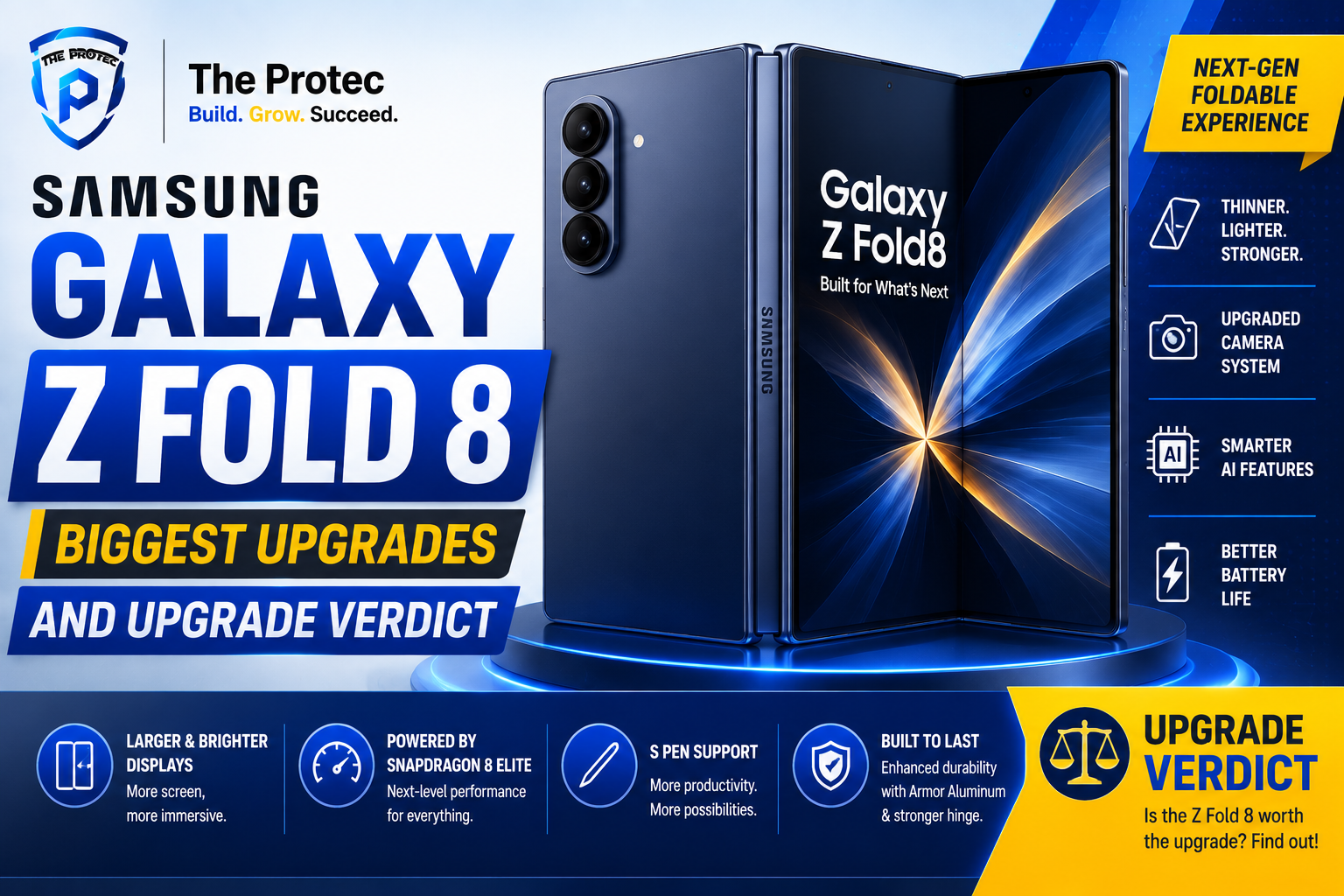
The Samsung Galaxy Z Fold 8 arrives at a pivotal moment for foldables. After years of refining the hinge, slimming the chassis, and pushing multitasking software forward, Samsung’s newest flagship foldable phone is no longer just about novelty. The Galaxy Z Fold 8 is built to feel more complete, more durable, and more intelligent than previous generations, with a sharper focus on everyday usability rather than just benchmark wins.
For many buyers, the question is no longer whether foldables are cool. It is whether the Samsung Fold 8 finally justifies the premium price over both its predecessors and excellent slab-style flagships. This matters even more in a market where AI features, camera performance, battery efficiency, and true productivity features are shaping what people expect from a premium phone. In this article, we break down the biggest Galaxy Z Fold 8 upgrades, how it compares with earlier models, and whether you should upgrade now or wait.
What Makes the Galaxy Z Fold 8 Stand Out
The Galaxy Z Fold 8 is not a radical reinvention. Instead, it is a highly targeted refinement of Samsung’s foldable formula. That is a good thing. The most valuable upgrades in a Samsung foldable phone are often the ones you feel every day: a lighter body, a more usable cover screen, improved battery life, better cameras, and software that genuinely takes advantage of the folding display.
Compared with older Fold devices, the Fold 8 appears to be the most polished version yet. Samsung has continued to reduce thickness, improve hinge engineering, enhance water and dust resistance, and tune the display experience so it feels less fragile and more practical. These changes may not sound dramatic on paper, but they add up to a device that is easier to carry, easier to use one-handed, and more comfortable to live with.
Design and Build: Thinner, More Comfortable, More Premium
One of the biggest talking points around the Galaxy Z Fold 8 is its design refinement. Foldables have long been criticized for being bulky, heavy, and awkward when closed. The Samsung Fold 8 addresses that complaint with a slimmer profile and a more balanced in-hand feel. Samsung’s design language now leans toward a phone that feels closer to an ultra-premium slab device when folded, while still opening into a tablet-sized workspace.
That matters because the biggest barrier to foldable adoption has never been the concept. It has been daily convenience. A foldable that is too thick becomes a pocket burden. A foldable that is too narrow on the cover display can feel cramped for typing and quick tasks. The Galaxy Z Fold 8 improves this balance by making the outer screen more practical and the entire chassis more refined.
The hinge also plays a major role. Samsung has consistently improved the folding mechanism, and the Fold 8 benefits from a smoother action, tighter tolerance, and a reduced visible crease. While the crease is not eliminated entirely, it is less distracting in real-world use, especially when watching videos, reading, or using split-screen apps.
Display Upgrades: Better Cover Screen, Better Main Screen
The display is still the heart of any Galaxy Z Fold device, and the Fold 8 continues that tradition with upgrades focused on usability and brightness. The outer display feels more natural for everyday tasks such as messaging, checking email, scrolling social feeds, and using navigation apps. Samsung’s challenge has always been to make the cover screen useful enough that users do not need to unfold the phone constantly, and the Galaxy Z Fold 8 moves closer to that goal.
The main folding display is expected to deliver improved brightness, better outdoor visibility, and stronger color consistency across viewing angles. Those improvements matter because foldables are often used in more varied orientations than standard phones. Whether you are editing documents, reviewing photos, or splitting the display between a video call and notes, the Fold 8’s large screen becomes a genuine productivity advantage.
For media users, the larger display also remains one of the best reasons to buy a Samsung foldable phone. Streaming content, gaming, and reading long-form articles all feel more immersive on the Fold 8 than on a conventional smartphone. Samsung’s software continues to optimize app scaling and task switching so that the foldable format feels intentional rather than improvised.
Galaxy Z Fold 8 AI Features: Smarter Than Before
AI is one of the most important reasons the Galaxy Z Fold 8 matters. Samsung has leaned heavily into on-device and cloud-assisted AI tools across its flagship lineup, and the Fold 8 takes that experience further by combining AI with the unique folding form factor. This is where the device starts to feel less like a spec sheet exercise and more like a genuinely intelligent productivity machine.
Expect the Samsung Fold 8 to emphasize AI features such as:
- Smarter writing assistance for emails, notes, and messages
- Real-time translation and transcription tools
- Advanced photo editing with generative cleanup and object adjustment
- Search and summarization tools that reduce app switching
- Context-aware multitasking suggestions based on usage patterns
What makes these AI capabilities important on a foldable is the bigger screen. AI tools often become more useful when you can view a prompt, result, and source material side by side. On the Galaxy Z Fold 8, that workflow is easier. You can draft a message on one side of the screen, reference an email thread on the other, and use AI to rewrite or summarize without constantly jumping between apps.
Samsung’s broader Galaxy AI ecosystem has also become more mature, and that matters for long-term value. Buyers are not just investing in hardware anymore. They are investing in a software experience that can evolve through updates, making the Fold 8 feel more future-ready than older models that launched before the current wave of AI integration.
Camera Improvements: A More Serious Foldable Camera System
Camera performance has always been one of the most debated aspects of the Samsung Galaxy Z Fold series. Foldables traditionally compromised on camera hardware compared with Samsung’s top slab phones, leaving some buyers hesitant to pay flagship pricing. The Galaxy Z Fold 8 addresses that criticism with a stronger camera package designed to feel more competitive in everyday photography.
Rather than treating the camera as an afterthought, Samsung has focused on sensor quality, image processing, and AI-enhanced capture. The result is a foldable phone that is far better suited to travel, portrait shots, low-light moments, and quick content creation. This is especially important for creators, professionals, and social media users who want one device that can do almost everything.
Key camera advantages expected on the Fold 8 include:
- Improved main sensor detail and dynamic range
- Better low-light performance with reduced noise
- Stronger portrait separation and skin tone accuracy
- Enhanced zoom processing and stabilization
- AI photo cleanup and scene optimization
The folding form factor also creates unique camera use cases. You can use the device as its own tripod for hands-free shots, preview selfies on the cover screen, or shoot videos with the main camera while monitoring framing on the inner display. These are the kinds of practical advantages that make a Samsung foldable phone more than just another premium handset.
For readers who want to compare Samsung’s broader camera strategy with its other devices, Samsung’s official product pages and camera feature breakdowns are a useful starting point: Samsung.
Performance and Battery Life: Built for Heavy Use
Performance on the Galaxy Z Fold 8 should be strong enough to handle demanding workflows, gaming, and AI features without hesitation. Foldables need more than raw speed. They require sustained performance under multitasking loads, especially when users run multiple apps, drag and drop content, or keep background processes active while the display is unfolded.
The Samsung Fold 8 is expected to benefit from a flagship-class processor, faster memory, and better thermal tuning. Those improvements help keep the device responsive during long sessions, which is especially valuable for professionals who use the phone as a mini workstation. If you regularly edit documents, manage calendars, join video calls, and browse while splitting the screen, the Fold 8 should feel notably more efficient than older generations.
Battery life remains a critical area for foldables. A larger inner display naturally consumes more power, but Samsung has continued to improve efficiency through both hardware and software. The Galaxy Z Fold 8 should offer more reliable all-day use for mixed workloads, though heavy camera use, constant 5G, and extended multitasking will still drain faster than a standard smartphone.
For power users, the real benefit is not just battery size. It is smarter power management that allows the device to stretch further during workdays, travel, and entertainment-heavy sessions.
Multitasking and Productivity: Still the Best Reason to Buy a Fold
If you are asking what the Galaxy Z Fold 8 does better than most phones, the answer is productivity. Samsung has spent years tuning its multitasking environment, and the Fold 8 builds on that foundation with faster app switching, better window management, and more intuitive drag-and-drop behavior. It is one of the few devices that can realistically replace a small tablet for many users.
The larger inner display lets you run three apps at once, keep a floating window on top, and move content between apps with minimal friction. That makes the Fold 8 ideal for:
- Work email and document editing
- Split-screen research and note-taking
- Video calls while referencing files
- Travel planning with maps, booking apps, and messaging
- Content review for creators and social teams
This is also where the Galaxy Z Fold 8’s AI tools become especially effective. A larger screen makes it easier to combine AI summarization, writing help, and translation with real work. Instead of feeling like novelty features, they become practical shortcuts.
If you have never owned a foldable phone, the productivity jump can be surprisingly meaningful. The device changes how you interact with information. Instead of toggling endlessly, you can keep more context visible at once.
Galaxy Z Fold 8 vs Previous Generations
To understand whether the Galaxy Z Fold 8 is worth it, you need to look at how it stacks up against earlier models. Samsung’s earlier Fold devices established the concept, but each generation had trade-offs. Some were too thick, some had underwhelming cover screens, and some still felt like first-generation experiments in disguise.
Compared with older generations, the Fold 8 offers meaningful progress in several areas:
- Versus early Fold models: much better durability, usability, and refinement
- Versus mid-generation models: better hinge design, lighter construction, and improved display comfort
- Versus the last generation: stronger AI integration, more polished multitasking, and a more complete camera system
If you already own a recent Fold, the jump may feel incremental rather than revolutionary. But if you are using an older device, the difference should be obvious almost immediately. The Fold 8 is the kind of phone that makes previous models feel dated in day-to-day handling, not because they stopped working, but because Samsung has removed so many small annoyances.
For prospective buyers, this is the most important takeaway: the Galaxy Z Fold 8 is less about one headline feature and more about a series of meaningful improvements that make the foldable experience more mature.
Should You Upgrade to the Samsung Fold 8?
The upgrade decision depends on what you own now and what you expect from a premium phone. The Galaxy Z Fold 8 is easiest to recommend for users coming from an older Fold model, especially if you value multitasking, AI tools, and better camera performance. In that case, the upgrade is likely to feel substantial enough to justify the move.
You should strongly consider upgrading if:
- You use your phone for work, content creation, or heavy multitasking
- You want better AI features without sacrificing screen size
- You have an older foldable and want a more refined design
- Camera quality matters, but you still want the flexibility of a foldable
You may want to wait if:
- You already own the previous generation and are satisfied with it
- You mainly use your phone for basic tasks and media consumption
- You are not interested in foldable-specific productivity benefits
- Price is your primary concern and you can live without the newest AI tools
For many buyers, the Samsung Galaxy Z Fold 8 is less a necessary upgrade and more a premium lifestyle and productivity choice. It is not the cheapest or simplest phone to own, but it may be one of the most versatile.
Who the Galaxy Z Fold 8 Is Best For
The Galaxy Z Fold 8 is best suited for people who want more than a regular smartphone can offer. It is ideal for executives, entrepreneurs, mobile professionals, creators, power users, and anyone who likes carrying a device that can shift from phone to tablet in seconds.
It is also a strong fit for users who have been waiting for foldables to become more practical. If your biggest hesitation has been the bulk, battery concerns, or camera compromises of earlier Samsung foldable phones, the Fold 8 is the clearest sign yet that the category is maturing.
That said, not everyone needs a foldable. If you prioritize compactness, lower cost, or the best possible camera hardware in Samsung’s lineup, a traditional flagship may still make more sense. The Fold 8 is excellent, but it remains a specialized premium device.
Final Verdict
The Samsung Galaxy Z Fold 8 represents the most convincing version of Samsung’s foldable vision so far. It improves the basics that matter most: a more refined design, better displays, stronger AI features, improved camera performance, and smarter multitasking. Instead of chasing gimmicks, Samsung has focused on making the Samsung Fold 8 feel genuinely useful every day.
If you want the most advanced Samsung foldable phone available, the Galaxy Z Fold 8 is a compelling option. If you are upgrading from an older Fold, the leap should feel worthwhile. If you already have a recent model, the decision is more nuanced, and it comes down to how much you value incremental improvements in AI, cameras, and portability.
For a closer look at Samsung’s latest ecosystem and foldable direction, you can also review the company’s newsroom and device pages: Samsung Newsroom.
FAQ: Galaxy Z Fold 8
Is the Galaxy Z Fold 8 worth upgrading to?
Yes, if you are coming from an older foldable or you want stronger AI features, better cameras, and a more refined design. If you already own a recent Fold, the upgrade is more optional than essential.
What is the biggest upgrade in the Samsung Fold 8?
The biggest upgrades are the overall polish of the design, improved multitasking, and more advanced AI capabilities. The camera system also feels more competitive than on earlier Fold models.
How does the Galaxy Z Fold 8 compare with previous generations?
Compared with earlier models, it should feel thinner, more practical, and more capable in everyday use. Samsung has improved the areas that matter most to long-term owners: comfort, software, and productivity.
Is the Galaxy Z Fold 8 good for photography?
Yes, it is significantly better positioned for mobile photography than older foldables, thanks to stronger image processing, AI-assisted editing, and a more capable overall camera setup.
Who should buy a Samsung foldable phone like the Fold 8?
It is best for users who want productivity, multitasking, media consumption, and a premium experience that goes beyond a standard smartphone.