








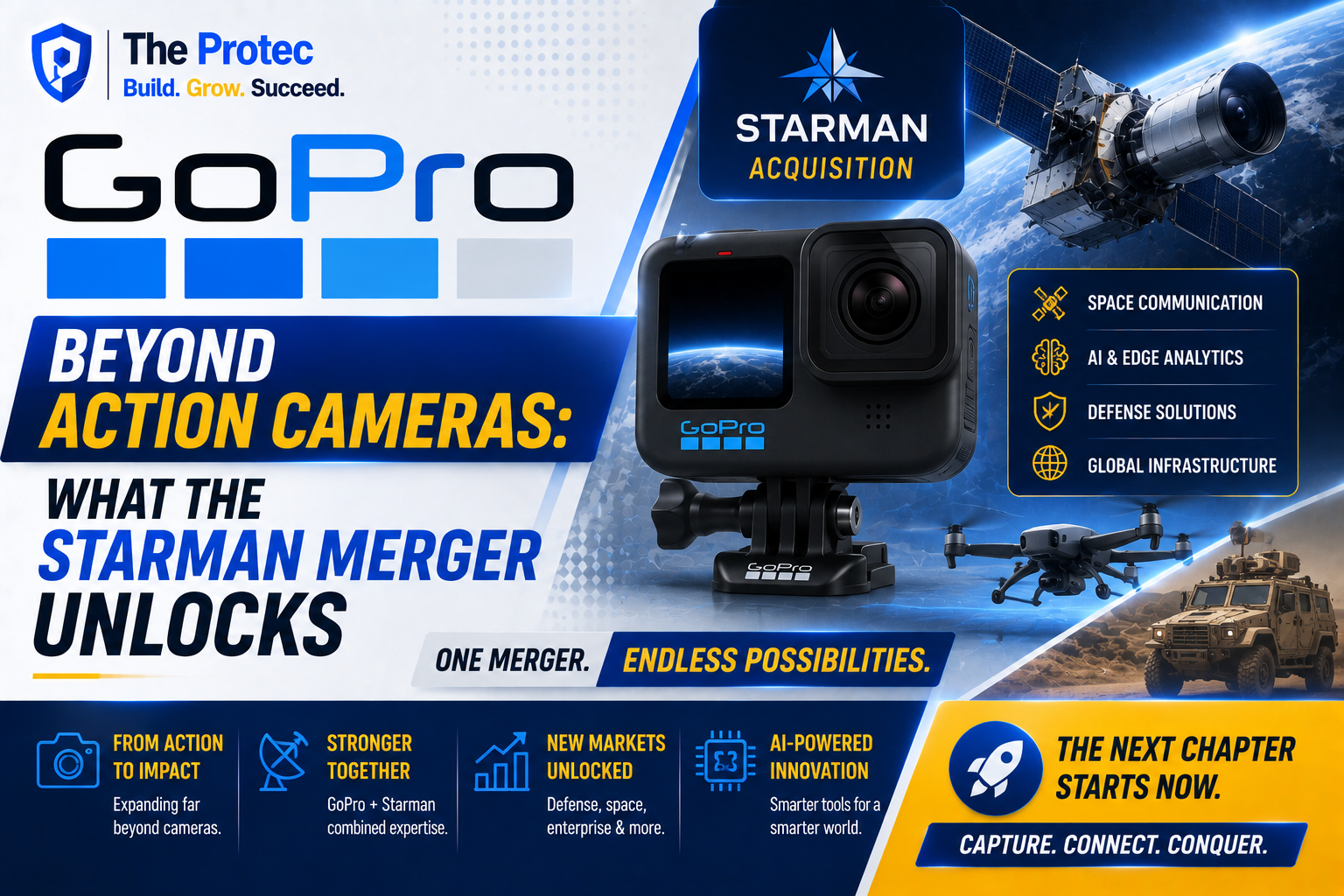
For most consumers, GoPro is inseparable from compact cameras mounted on helmets, surfboards and drones. That identity remains valuable, but it no longer captures the full ambition behind the company. GoPro’s planned combination with Starman Optical points toward a much broader future—one built around imaging intellectual property, high-speed optical connectivity, domestic manufacturing and technology for demanding commercial and government markets.
The proposed GoPro Starman Optical combination is not simply an attempt to sell more cameras. It is a bid to unite two complementary technology portfolios. GoPro brings a recognized brand, a large patent library, advanced imaging expertise and a global creator ecosystem. Starman Optical contributes optical-transceiver technology and U.S.-based manufacturing capabilities relevant to artificial intelligence infrastructure, defense systems, robotics and aerospace.
As of September 2026, the transaction should still be evaluated as a planned combination rather than proof of a completed transformation. Even so, it creates a new strategic narrative for GoPro stock—and a potentially different way to value GPRO over the long term.
GoPro Merger Explained: The Strategy Behind the Combination
The simplest GoPro merger explained is that each business supplies something the other lacks. GoPro has spent years developing hardware, software and intellectual property for capturing, processing and transmitting visual information in difficult environments. Starman operates deeper in the communications stack, where optical transceivers convert electrical data into light and back again so information can move rapidly through networks.
Those capabilities intersect in increasingly important ways. AI servers need enormous amounts of optical connectivity. Autonomous machines require cameras and low-latency communications. Defense and aerospace systems depend on reliable sensing, data movement and hardware that can function under physical stress. Government customers are also placing more emphasis on trusted domestic production and resilient supply chains.
The planned combination therefore offers a path from a consumer-focused camera business to a diversified technology platform. That does not mean GoPro is abandoning the action-camera market. Instead, the consumer business could become one part of a larger organization serving multiple industries.
GoPro’s Imaging and Optics Patents Are a Strategic Asset
GoPro’s most visible products are cameras, but much of their value comes from less visible engineering. The company has built intellectual property around digital imaging, image stabilization, ruggedized camera design, lens systems, mounting, spherical capture, image processing and software-assisted content creation.
This knowledge is useful beyond recording mountain biking or travel videos. A camera that must deliver stable footage while moving through rain, vibration, heat and impact presents many of the same engineering challenges found in industrial robots, unmanned systems and aircraft. Computational imaging can also improve machine perception by correcting distortion, stabilizing inputs and extracting usable information from difficult scenes.
GoPro’s patent portfolio does not automatically translate into defense or robotics revenue. Products must still meet application-specific performance, security and procurement requirements. However, the portfolio gives a combined company a meaningful base from which to design specialized imaging systems, license technology or develop components with industry partners.
Investors assessing the intellectual-property angle should review the company’s disclosures through GoPro’s SEC filings, where transaction risks, patents and business dependencies are described more precisely than in market speculation.
What Starman Optical Adds to GoPro
Starman Optical’s core appeal lies in optical-transceiver technology and manufacturing. Optical transceivers are essential links in modern data networks. They enable switches, servers and other computing systems to exchange data through fiber-optic connections, offering the bandwidth and efficiency required by large computing environments.
That capability is particularly relevant as AI clusters grow. Training and operating advanced models require thousands of accelerators to work together, which creates a networking problem as much as a computing problem. Faster chips provide limited benefit if data cannot move efficiently among them. Optical links are consequently becoming a critical layer of AI infrastructure.
Starman’s U.S. manufacturing capability may be just as strategically important as its optical designs. Domestic production can support supply-chain visibility, faster iteration and eligibility for customers that prioritize trusted sourcing. It may also reduce exposure to geopolitical disruptions affecting overseas component production. U.S. manufacturing alone does not guarantee government contracts or competitive economics, but it creates opportunities that a consumer-camera company would struggle to pursue independently.
GoPro AI Infrastructure Could Become the Biggest New Market
The phrase GoPro AI infrastructure may initially sound unusual. GoPro is known for capturing video, not connecting data centers. Starman Optical changes that equation by giving the combined organization exposure to the physical networks behind artificial intelligence.
AI data centers are moving toward faster optical connections as model sizes, inference demand and cluster density increase. This creates demand for transceivers that can deliver higher bandwidth without excessive power consumption, heat or cost. The opportunity extends beyond selling a single module: customers increasingly need reliable supply, rapid product development, testing and manufacturing at scale.
GoPro could contribute capital-market visibility, product-development experience, procurement relationships and operational infrastructure. Starman contributes a more direct path into photonics and high-performance networking. If the combined company wins meaningful customers, optical communications could eventually reduce GoPro’s dependence on seasonal consumer-electronics sales.
The risks are substantial. Optical networking is competitive, technically demanding and exposed to rapid product cycles. Major customers can also have considerable pricing power. Investors should look for verified design wins, repeat orders, manufacturing yields and customer diversification rather than relying only on the size of the AI market.
GoPro Defense Technology, Robotics and Aerospace Ambitions
Defense, robotics and aerospace share a need for reliable sensing and communications in environments where ordinary electronics may fail. Combining GoPro’s imaging expertise with Starman’s optical technology could support several categories of future products.
- Defense and government: Rugged cameras, optical links and machine-vision components could be used in training systems, situational-awareness platforms, unmanned vehicles or secure infrastructure. Government procurement would require testing, compliance and long sales cycles.
- GoPro robotics: Mobile robots need compact imaging, stabilization and fast data transfer to perceive surroundings and respond safely. GoPro’s camera engineering may be adaptable to inspection, warehouse, field and public-safety robots.
- GoPro aerospace: Aircraft, drones, satellites and launch systems place strict limits on size, weight, power use and reliability. Specialized optical and imaging components could address those constraints if they satisfy demanding qualification standards.
These markets should be viewed as ambitions, not guaranteed revenue streams. GoPro defense technology will require more than repackaging an action camera, while GoPro aerospace products must withstand certification and mission-assurance processes. The strongest long-term opportunity may come from purpose-built components that use GoPro intellectual property without carrying the shape or feature set of a consumer camera.
Why the Markiplier GoPro Connection Still Matters
Moving into infrastructure does not make GoPro’s creator ecosystem irrelevant. Consumer cameras remain a source of brand recognition, field data, product feedback and recurring engagement. Creators routinely push cameras into conditions that reveal weaknesses in stabilization, batteries, audio, thermal management and software workflows.
The Markiplier GoPro connection is especially useful as a symbol of that ecosystem. Mark Fischbach, better known as Markiplier, represents a generation of creators who operate across video production, entertainment, entrepreneurship and direct audience relationships. His association with GoPro reinforces the idea that the company’s products are not merely pieces of hardware; they are tools within a broader creative workflow.
That creator perspective can inform professional technology. Faster editing, automated scene selection, intelligent tracking and cloud-based media management all rely on AI. Features developed for creators can improve GoPro’s software capabilities, while advances from industrial imaging may eventually reach consumer products. The relationship between the two sides can be reciprocal rather than a choice between cameras and enterprise technology.
What the Combination Could Mean for GoPro Stock and GPRO
GoPro stock has historically been evaluated as a consumer-hardware investment. Under that framework, analysts focus on camera shipments, average selling prices, retail inventory, holiday demand, subscription performance and competition from smartphones or other camera brands.
The planned combination asks the market to consider a different framework. If optical networking, defense, government, robotics or aerospace becomes material, GPRO could gain exposure to markets with different growth rates and purchasing cycles. Successful diversification might also reduce dependence on the launch schedule of GoPro cameras.
That possibility helps explain renewed searches for gopro stock, go pro stock and gpro stock following merger developments. However, a broader story does not automatically justify a higher valuation. The market will need evidence that the company can convert technology into durable revenue and acceptable margins.
Key risks include transaction completion, integration costs, dilution, additional capital needs, manufacturing execution and customer concentration. AI infrastructure can be cyclical, while defense and government programs may take years to generate meaningful sales. Combining two companies also introduces cultural and operational challenges.
For GPRO investors, the most useful questions are practical:
- Has the transaction met its closing conditions and received required approvals?
- Are optical products producing commercial orders rather than only development activity?
- Can U.S. manufacturing scale while maintaining quality and competitive costs?
- Does the combined business have enough liquidity to fund product development?
- Are new markets improving revenue quality, margins and customer diversity?
- Is the core Go Pro camera business stable enough to support the transition?
The company’s official investor-relations site remains the best source for announcements, financial reports and updates to transaction timing. Investors should distinguish company disclosures from social-media interpretations of the GoPro merger.
What Comes Next for the Combined Technology Strategy
The next phase will be defined by execution. Closing the transaction is only the first milestone. GoPro and Starman must then establish a coherent product roadmap, retain technical talent and determine where their combined assets create a real competitive advantage.
Near-term progress may appear through optical-transceiver orders, manufacturing partnerships, patent licensing or specialized imaging programs. Longer-term success would involve products that integrate sensing, processing and optical communication rather than treating the businesses as unrelated divisions.
Management must also preserve the consumer franchise. Action cameras generate recognition and provide a direct relationship with millions of users. Weakening that foundation before new businesses mature would increase financial risk. The better strategy is to use the existing brand and engineering base as a launchpad while allowing enterprise and government products to develop their own identities.
If that balance works, GoPro may no longer be valued solely as the company that popularized the action camera. It could become a broader supplier of technologies that help machines see, process information and communicate—from creator cameras to AI data centers and autonomous platforms.
Frequently Asked Questions
Is GoPro merging with Starman Optical?
GoPro has outlined a planned combination with Starman Optical. Until all required conditions are satisfied and the transaction closes, it should be treated as a proposed combination. Investors should consult current regulatory filings for definitive terms and status updates.
Why does Starman Optical matter to GoPro?
Starman adds optical-transceiver expertise and U.S. manufacturing capabilities. Those assets could give GoPro entry points into AI networking, trusted government supply chains, defense systems, robotics and aerospace applications.
Will GoPro stop making action cameras?
There is no strategic reason to assume GoPro must abandon cameras. Its consumer business provides revenue, brand equity, imaging expertise and creator relationships. The merger thesis is based on expanding beyond action cameras, not necessarily replacing them.
Is the GoPro merger good for GPRO stock?
The combination could expand GoPro’s addressable markets and reduce reliance on consumer-camera cycles, but it also introduces integration, financing and execution risks. Its effect on GPRO stock will depend on transaction terms, commercial orders, margins, cash requirements and the stability of the existing camera business.