







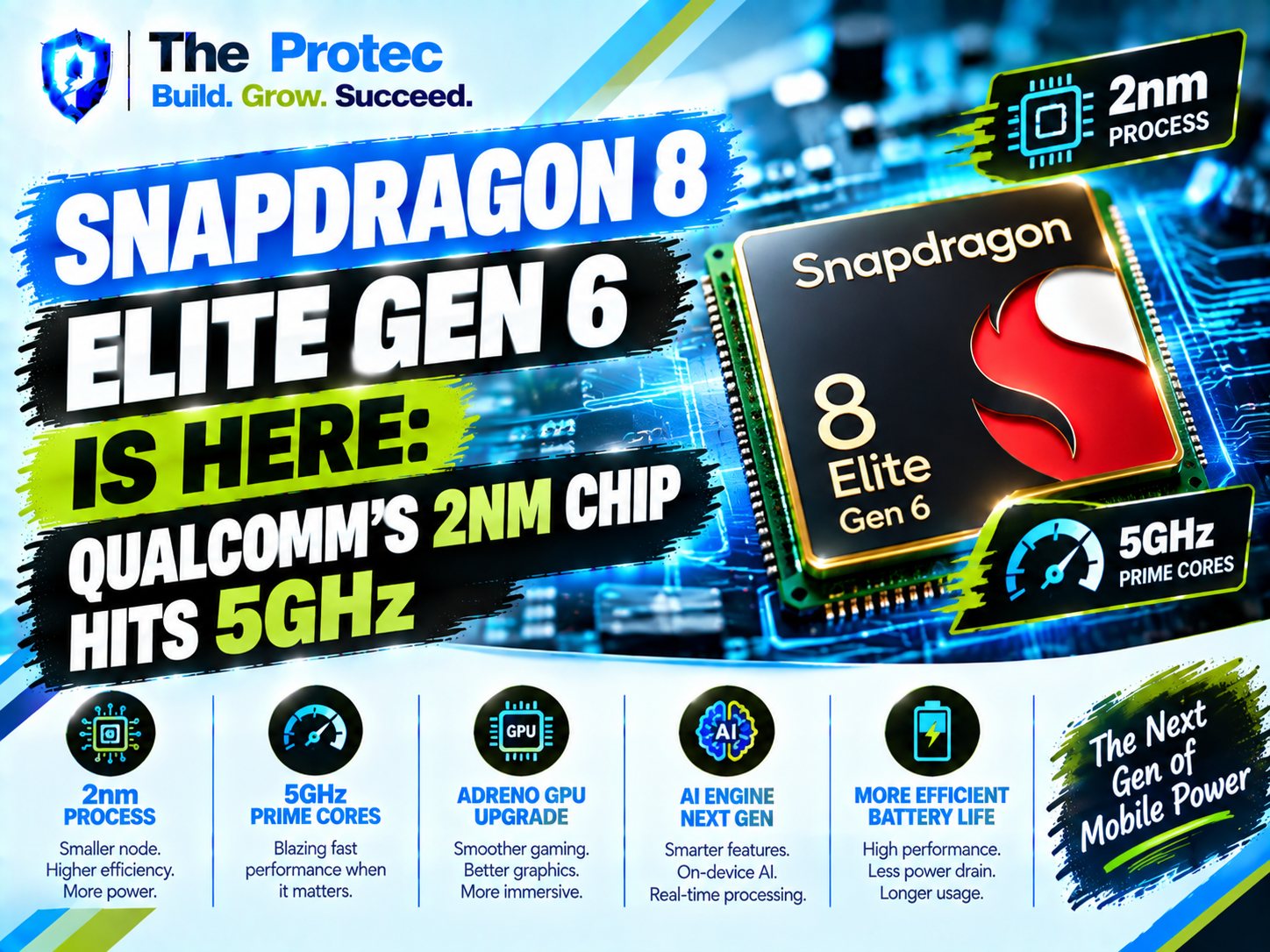
Qualcomm has opened the next chapter of flagship Android hardware. Introduced at Snapdragon Summit 2026, the Snapdragon 8 Elite Gen 6 and Snapdragon 8 Elite Extreme Gen 6 combine a cutting-edge 2nm process with new Qualcomm Oryon CPU cores, redesigned Adreno graphics and a substantially more capable Hexagon NPU. The headline number is impossible to miss: the Extreme platform pushes peak CPU frequency to the 5GHz threshold, an unprecedented target for a mainstream smartphone processor.
Frequency alone does not define the Snapdragon 8 Elite Gen 6 performance story, however. Qualcomm is positioning this generation around sustained speed, power efficiency and agentic AI that can operate across apps using information stored on the device. Gaming, computational photography, wireless connectivity and AI-assisted productivity are all central to the pitch.
The arrival of two Elite chips is equally important. Instead of forcing every premium Android manufacturer into one configuration, Qualcomm now has a top-tier Extreme option and a broader Elite platform. That strategy could create more differentiation among flagship phones—but it may also make device-level testing more important than ever.
Snapdragon 8 Elite Gen 6 specs at a glance
The Snapdragon 8 Elite Gen 6 family represents Qualcomm’s first flagship move to a TSMC 2nm smartphone chip process. Both platforms integrate the major components expected from a modern system-on-chip: an Oryon CPU, Adreno GPU, Hexagon NPU, image signal processor, security hardware and a flagship 5G modem-RF system.
Qualcomm’s announcement emphasizes the following platform-level upgrades:
- Second-generation 2nm manufacturing designed to improve performance per watt and transistor density.
- Next-generation Qualcomm Oryon CPU cores, with the Extreme edition reaching a peak 5GHz-class clock.
- A redesigned Snapdragon 8 Elite Gen 6 GPU with architectural changes for gaming, ray tracing and advanced graphics effects.
- An upgraded Hexagon NPU for multimodal generative AI and persistent on-device agents.
- Expanded camera intelligence for real-time scene analysis, video processing and AI-assisted editing.
- Faster cellular, Wi-Fi and device-to-device connectivity with improved power management.
Qualcomm has not presented the two chips as completely unrelated designs. They belong to the same family and share a common foundation. The Snapdragon 8 Elite Extreme Gen 6 is the maximum-performance implementation, while the standard model gives manufacturers more flexibility around thermals, battery capacity, pricing and industrial design.
Why Qualcomm’s 2nm chip matters
The move from the 3nm-class Snapdragon 8 Elite Gen 5 to Qualcomm Snapdragon 2nm manufacturing is more than a routine process update. Smaller transistors can increase density while reducing the energy required for specific workloads. In practical terms, manufacturers can use those gains to pursue higher performance, better battery life or a balance of both.
That balance is crucial because smartphones operate within tight thermal limits. A processor may record an excellent short benchmark run and still lose speed during a long gaming session, 4K video capture or sustained AI task. The real advantage of the Snapdragon 8 Elite Gen 6 2nm process should therefore be measured through sustained performance per watt—not simply its highest clock speed.
TSMC describes its advanced process roadmap as targeting gains in power, performance and density. Readers can review the foundry’s official 2nm technology overview for broader manufacturing context. Final results will still depend on Qualcomm’s architecture and each phone maker’s cooling, memory, software and battery tuning.
Qualcomm Oryon reaches the 5GHz milestone
The Snapdragon 8 Elite Extreme Gen 6 5GHz peak is the announcement’s showpiece. Crossing that threshold demonstrates how aggressively Qualcomm is scaling its custom Oryon architecture, which replaced off-the-shelf CPU designs in the company’s highest-end mobile platforms.
A 5GHz smartphone processor does not run every core at that speed continuously. Peak frequency normally applies to selected performance cores under favorable power and temperature conditions. Everyday responsiveness also depends on instructions per clock, cache design, memory latency, scheduler behavior and how quickly the processor completes work before returning to a low-power state.
The standard Snapdragon 8 Elite Gen 6 is tuned below the Extreme edition’s ceiling, but it retains the same architectural direction. It could consequently deliver most of the user experience with lower heat or reduced power consumption. Thin foldables and camera-focused flagships may favor that balance, while gaming phones with large vapor chambers are natural candidates for the Extreme chip.
Redesigned Adreno GPU targets sustained gaming
Qualcomm’s Adreno architecture has long been one of Snapdragon’s strongest assets. The redesigned Snapdragon 8 Elite Gen 6 GPU focuses on higher throughput, improved efficiency and more sophisticated rendering rather than treating peak frame rate as the only goal.
Modern mobile games increasingly combine high-resolution assets, complex lighting, ray-traced effects and upscaling. Those workloads require coordination among the GPU, CPU, memory subsystem and AI engine. Qualcomm says the new design improves that cooperation, allowing developers to use AI-assisted rendering and frame-generation techniques without placing the entire burden on conventional graphics hardware.
For players, sustained frame rate will matter more than a brief peak. Device cooling, display resolution and game-specific optimization can create large differences between phones using the same Android flagship processor. Independent tests should examine one-percent-low frame rates, surface temperature, power draw and performance after 20 or 30 minutes—not just a single benchmark score.
Hexagon NPU brings agentic AI closer to reality
The upgraded Hexagon NPU is central to the Snapdragon 8 Elite Gen 6 AI strategy. Qualcomm is moving beyond isolated features such as text generation or image removal and toward an agentic AI smartphone model. In that model, an assistant can understand context, plan several steps and coordinate actions across supported services.
Potential uses include summarizing messages before a meeting, finding a relevant document, preparing a reply and suggesting a departure time based on live conditions. Multimodal models can also combine text, voice, images and camera input, allowing a device to understand what the user is seeing as well as what they are saying.
Local processing is important for latency, privacy and offline availability. The Hexagon NPU can handle suitable workloads on the phone while cloud services tackle larger tasks when permission and connectivity allow. Qualcomm’s broader Snapdragon platform information explains how its CPU, GPU, NPU and sensing components operate as a heterogeneous computing system.
Hardware capability does not automatically guarantee a useful agent. Android APIs, app permissions, model efficiency and manufacturer support will determine what ships. Buyers should distinguish demonstrations from features available on retail devices—and check whether advertised AI tools run locally or require a subscription and cloud connection.
Camera and connectivity upgrades
Photography benefits from the platform’s combined image processor and AI resources. Qualcomm says the new pipeline can apply semantic segmentation to more parts of a scene, identifying subjects, faces, skies, clothing and background elements in real time. That enables selective exposure, color, focus and noise-reduction adjustments before an image is saved.
Video is an even harder workload because processing must occur continuously. Greater efficiency should help phones sustain advanced stabilization, low-light enhancement, HDR processing and high-resolution capture without excessive heat. The final output will still vary because lenses, sensors and each manufacturer’s imaging models are just as important as the chip.
Connectivity improvements span 5G, Wi-Fi, Bluetooth and positioning. Qualcomm is emphasizing AI-assisted optimization that can anticipate signal conditions and choose more efficient network behavior. Faster peak speeds attract attention, but reduced modem power, stronger reception at the edge of coverage and reliable low-latency connections may have a greater everyday impact.
Snapdragon 8 Elite Gen 6 vs Snapdragon 8 Elite Gen 5
The Snapdragon 8 Elite Gen 6 vs Snapdragon 8 Elite Gen 5 comparison centers on four changes: the 2nm node, a faster Oryon CPU, redesigned Adreno graphics and a more capable Hexagon NPU. Gen 5 established Qualcomm’s custom-CPU direction; Gen 6 attempts to scale it without allowing heat and battery consumption to rise at the same pace.
Owners of a Gen 5 flagship should not expect every ordinary app to feel dramatically different. Both generations are already fast enough for browsing, messaging and media. The larger separation should appear in sustained gaming, local generative AI, complex camera processing and professional workloads. Battery behavior may become the most meaningful upgrade if commercial phones convert the 2nm efficiency gains into longer real-world endurance.
Snapdragon 8 Elite Gen 6 vs Apple A20 Pro
A Snapdragon 8 Elite Gen 6 vs A20 Pro comparison will be inevitable, but frequency numbers cannot settle it. Apple’s A20 Pro operates within a tightly controlled combination of custom silicon, iOS, memory and first-party software. Qualcomm supplies a platform used across devices with different cooling systems and software policies.
The Snapdragon 8 Elite Gen 6 vs Apple A20 Pro contest should be judged across single-core responsiveness, multicore throughput, sustained GPU performance, NPU capability, camera workloads and energy efficiency. Qualcomm’s 5GHz milestone is notable, but architecture and power consumption determine how much useful work that frequency produces.
At launch, statements about leadership remain vendor claims. Comparable retail phones, updated applications and independent laboratory testing are required before declaring a winner.
How it compares with MediaTek Dimensity 9600 Pro
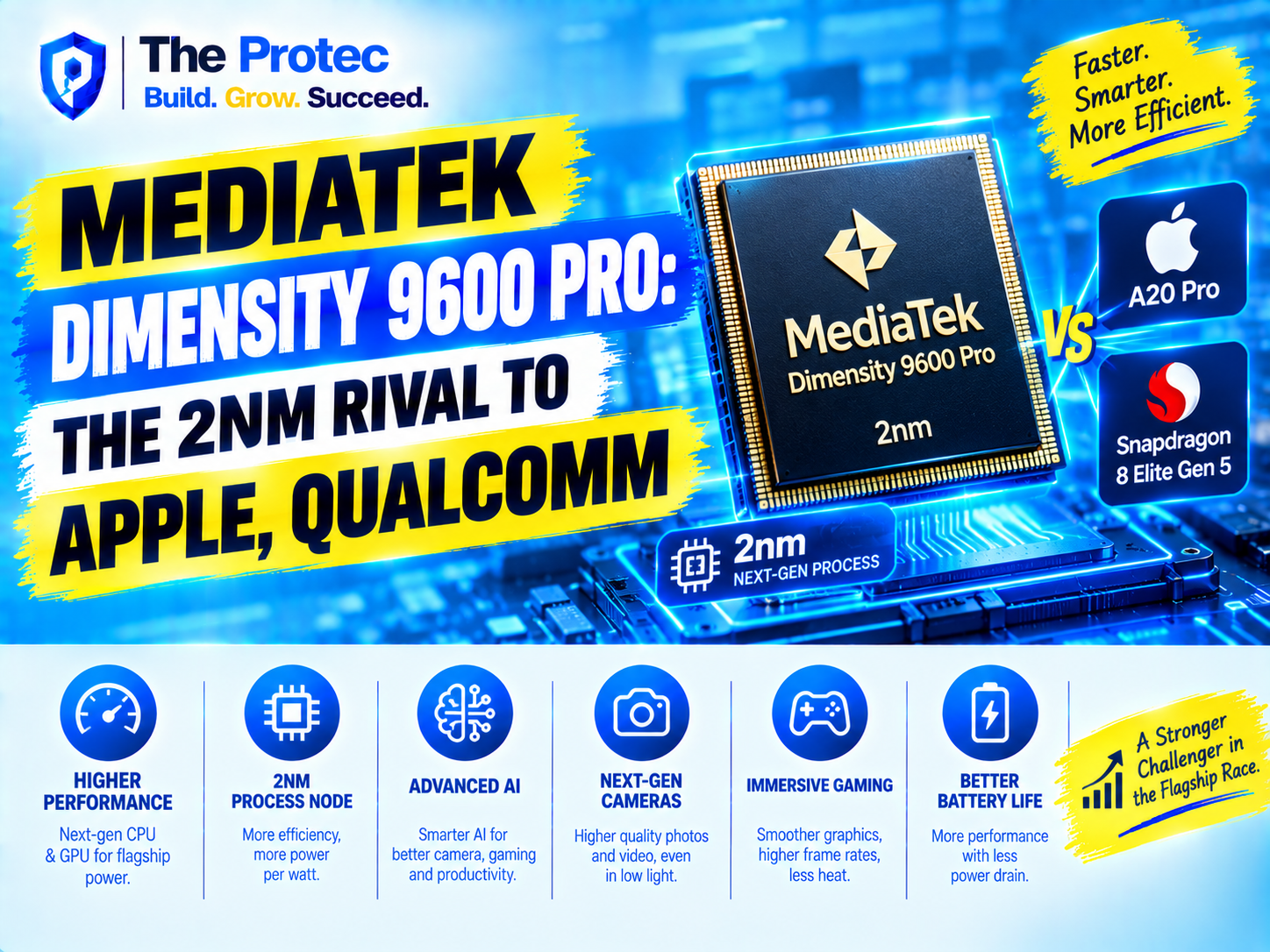
The Snapdragon 8 Elite Gen 6 vs MediaTek Dimensity 9600 Pro rivalry may be even more relevant to Android buyers. MediaTek’s flagship strategy also combines an advanced process, high-performance CPU design, powerful graphics and an AI-focused NPU. Competition between the platforms should give manufacturers more leverage and encourage faster innovation.
Qualcomm’s advantages include its established Adreno ecosystem, Oryon roadmap, modem expertise and broad premium-device presence. MediaTek can counter through aggressive performance-per-watt targets and competitive device pricing. As with Apple, meaningful conclusions must wait for shipping products tested under the same settings. Official slides from either company are not substitutes for independent benchmarks.
What Qualcomm’s two-chip strategy means for Android phones
The Snapdragon 8 Elite Extreme Gen 6 specs target uncompromised flagships, gaming devices and showcase products capable of cooling the 5GHz Oryon CPU. The regular Gen 6 can serve premium phones that prioritize thin designs, balanced endurance or lower prices.
This segmentation could expand choice, but buyers will need to read specification sheets carefully. Similar product names may hide differences in CPU clocks, GPU limits or sustained power. Phone makers can also tune the same processor differently, so an Extreme badge does not guarantee the fastest device in every test.
Qualcomm’s announcement establishes an ambitious direction: 2nm efficiency, desktop-class clock speeds and AI agents that live on the device. Whether the Snapdragon 8 Elite Gen 6 becomes the new performance standard will depend on retail hardware, software support and transparent independent testing.
Frequently asked questions
Is the Snapdragon 8 Elite Gen 6 a 2nm chip?
Yes. Qualcomm announced the Snapdragon 8 Elite Gen 6 family as a 2nm flagship platform manufactured using TSMC’s advanced process technology. The transition is intended to improve performance, efficiency and transistor density.
Which Snapdragon 8 Elite Gen 6 chip reaches 5GHz?
The Snapdragon 8 Elite Extreme Gen 6 is the top configuration associated with the 5GHz-class peak CPU frequency. The standard Elite Gen 6 uses the same broader platform direction but is tuned for a different balance of speed, heat and power.
Is Snapdragon 8 Elite Gen 6 faster than Apple A20 Pro?
Qualcomm presents Gen 6 as a leading mobile platform, but launch claims do not establish an overall winner. Independent comparisons of retail devices are needed to evaluate CPU speed, GPU performance, AI processing, thermals and battery efficiency.
When will Snapdragon 8 Elite Gen 6 phones arrive?
Qualcomm’s flagship partners are expected to introduce devices following the Snapdragon Summit announcement. Availability will vary by manufacturer and region, with Extreme-equipped models likely concentrated in ultra-premium and gaming categories.