






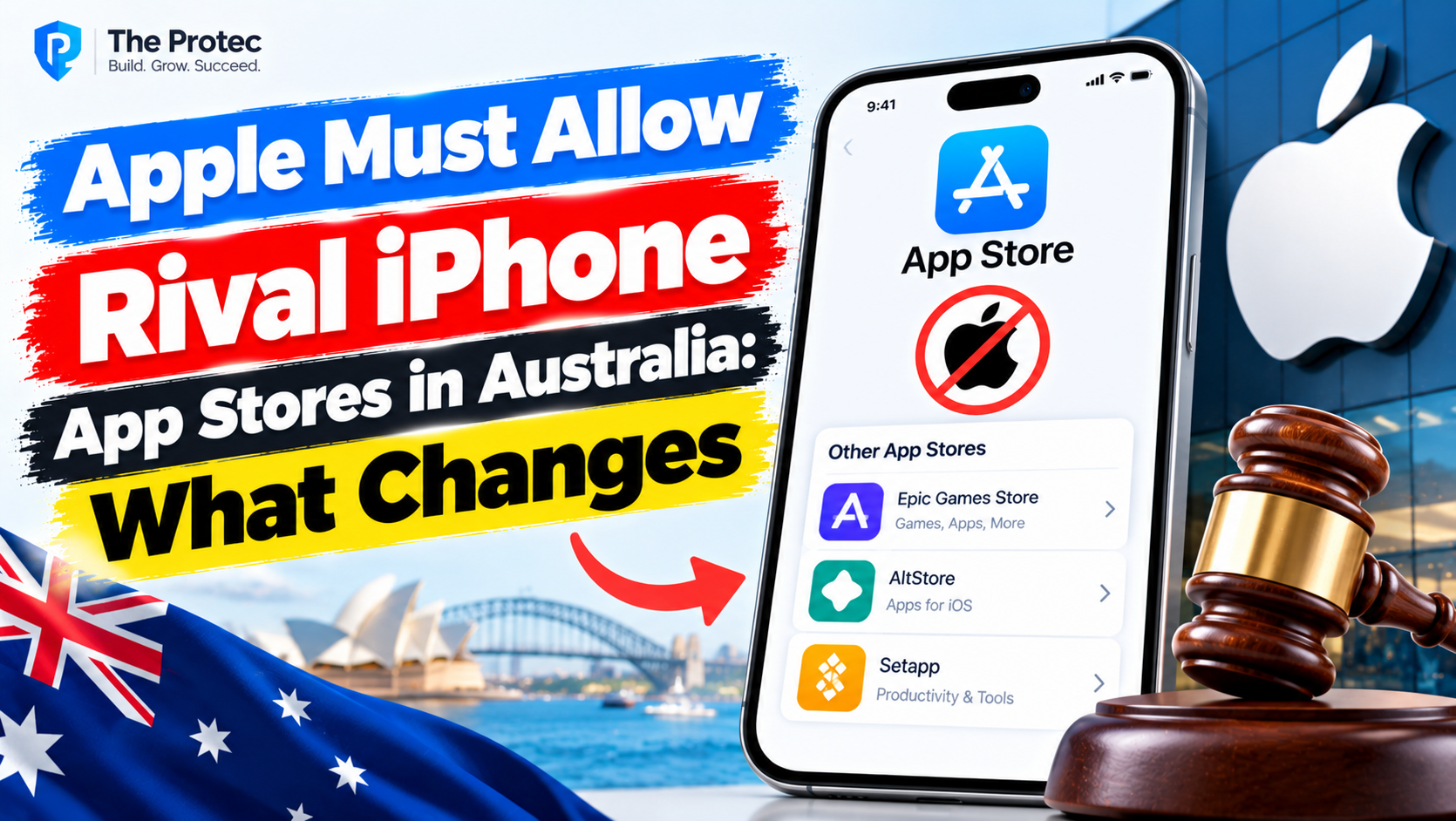
Apple’s tightly controlled iPhone software ecosystem is facing one of its most consequential legal challenges outside Europe. An Australian competition case brought by Epic Games found that important restrictions covering Apple iOS app distribution and in-app payments harmed competition, creating a potential path for rival app stores and alternative payment methods on Australian iPhones.
The headline is significant, but the practical position requires careful explanation. Australian users cannot yet install a competing iPhone marketplace simply because of the ruling. The litigation has involved separate questions of liability, remedies and appeal, while any implementation could include technical safeguards, developer requirements and new fee structures. Reports pointing to 2027 should therefore be treated as an expected or possible implementation window—not a guaranteed launch date—unless confirmed in final, operative court orders.
Here is what the Apple Australia app store ruling could mean for iPhone owners, developers, payment providers and games such as Fortnite.
What did the Australian court actually decide?
The underlying case is Epic Games, Inc v Apple Inc (No 2) [2025] FCA 848, decided by Justice Jonathan Beach of the Federal Court of Australia in August 2025. The extensive judgment examined Apple’s control over iOS app distribution, its requirement that native apps generally come through the App Store and its restrictions on alternative in-app payment systems.
The court found that aspects of Apple’s conduct contravened Australian competition law by substantially lessening competition. The legal analysis focused on the Competition and Consumer Act 2010, including the prohibition against misuse of market power in section 46. Epic did not succeed on every argument, including its unconscionable-conduct claims, and the judgment should not be reduced to a finding that every App Store rule or commission is automatically unlawful.
The authoritative liability judgment can be read through the Federal Court of Australia.
This distinction matters because the liability judgment identified unlawful competitive effects but did not, by itself, switch on third-party app stores on iPhone. Detailed relief must determine what Apple is required to change, when it must comply and whether implementation is paused or altered during an appeal.
Is this an Apple Australia court ruling from 2026?
Searches for “Apple Australia court ruling 2026” often combine the original decision with the later remedies and appeal process. The foundational Federal Court liability judgment was delivered in August 2025. Its consequences continued to develop afterward, which is why newer reports may attach a later date to the dispute.
This was also litigation initiated by Epic Games, not an Australian Competition and Consumer Commission rule that immediately created a new app marketplace regime. The ACCC has separately advocated stronger competition rules for major digital platforms, but those policy initiatives should not be confused with the orders arising from Epic’s case.
Apple responded to the liability decision by welcoming the rejection of some of Epic’s claims, strongly disagreeing with findings about parts of its conduct and stating that it would appeal. That appeal position is crucial: appellate proceedings can uphold, narrow or overturn findings, while a stay can delay enforcement. At the October 2026 cutoff for this explainer, a reported 2027 rollout should not be treated as an unconditional deadline unless it appears in final operative orders that remain effective after any stay or appeal.
Will Apple have to support rival app stores in Australia?
The likely practical objective of the case is to loosen Apple’s exclusive control over native iOS app distribution and payments. Depending on the final remedy, Apple could be required to permit alternative app marketplaces in Australia, allow developers to direct customers to outside payment options, or remove rules that prevent meaningful competition with the App Store.
However, permission for Apple rival app stores in Australia is not necessarily the same as unrestricted sideloading. These terms describe different models:
- Alternative app marketplaces are organized stores operated by companies other than Apple. They may authenticate developers, manage updates and review apps under their own policies.
- Direct distribution allows a developer to offer an app from its own website or another approved channel.
- Unrestricted sideloading generally means installing software packages from almost any source without marketplace supervision or meaningful platform review.
A court can require competitive distribution without forcing Apple to permit every unsigned app or remove all operating-system protections. Final rules could still require marketplace authorization, app notarization, malware scanning, identity checks, warning screens, user consent and mechanisms for revoking malicious software.
What could change for Australian iPhone users?
If third-party app stores on iPhone are ultimately implemented, Australian users may gain more ways to discover, purchase and install software. A game publisher could distribute through its own marketplace, while a specialist store might focus on business tools, independent games or open-source apps. Developers excluded from the App Store for commercial-policy reasons could potentially gain another route to customers, subject to legal and technical requirements.
Competition could also affect pricing. Alternative marketplaces may charge developers less, offer different subscription terms or permit payment processors that compete with Apple’s in-app purchasing system. Developers could pass those savings to customers, although lower prices are not guaranteed.
Users may also assume more responsibility. Apple currently provides one account system for purchases, refunds and subscription management. An app acquired elsewhere might use a different support process, payment provider or refund policy. Family Sharing, purchase history, parental controls and subscription cancellation may not work identically across every marketplace.
Nothing changes immediately on an Australian iPhone merely because the user installs a routine iOS update. Until Apple implements a compliant system under enforceable rules, attempts to install apps outside the Apple App Store may remain blocked except through existing limited channels such as enterprise deployment, testing tools and web apps.
How Apple App Store payment rules and commissions may change
The case reaches beyond where an app is downloaded. Apple App Store payment rules have historically required many digital goods and subscriptions sold within iOS apps to use Apple’s in-app purchase system. Apple then collects a commission, commonly described as up to 30%, with lower rates applying in certain programs, subscription periods and categories.
A meaningful remedy could allow developers to integrate a competing processor or link users to a website for payment. That could create competition over transaction fees, settlement times, fraud tools, customer data and refund handling. It may be particularly important for streaming services, game publishers, news organizations and other businesses selling digital content.
Developers should not assume that every Apple App Store commission will disappear. The court did not declare that Apple can never charge for distribution, intellectual property, developer tools or platform services. Apple could propose revised commissions, marketplace fees, payment-related charges or other developer fees in Australia. Whether those arrangements comply would depend on the final orders and their competitive effect.
Apple’s response in Europe demonstrates one possible model, although it is not an Australian blueprint. Apple’s official explanation of alternative app distribution in the European Union describes authorization, notarization and other controls, alongside different commercial terms. Australia’s courts may accept, reject or modify comparable measures.
Does the ruling mean Fortnite returns to iPhone Australia?
The prospect that Fortnite returns to iPhone Australia is one of the case’s most visible consequences. Epic removed Fortnite from Apple’s App Store dispute after introducing its own payment option, and the game has remained unavailable through the ordinary Australian iOS App Store.
A viable Epic Games Store or direct-distribution route could make an Australian return possible. It is not guaranteed. Epic would still need a legally available distribution channel, compatible technology, developer access and commercial terms it is prepared to accept. Appeals, implementation delays or restrictive marketplace conditions could also affect timing. The Apple Epic Games lawsuit opens a door; it does not provide a confirmed Fortnite release date.
Apple’s security concerns versus the competition argument
Apple argues that centralized App Store review helps protect users against malware, fraud, privacy abuse, objectionable content and intellectual-property infringement. It also says alternative distribution can make it harder to prevent deceptive subscriptions, protect children and remove software that steals data. Those concerns are not hypothetical: mobile marketplaces can be targeted by fake wallets, credential-stealing apps and repackaged software.
Epic and other critics respond that security should not become a blanket justification for excluding competitors. They argue that Apple can preserve technical protections while allowing qualified marketplaces, much as desktop operating systems permit software from multiple sources. Competing stores may also develop strong review systems because users will avoid services they do not trust.
The central policy question is therefore not whether security matters, but which safeguards are necessary and proportionate. Notarization can check software for known malicious behavior without giving Apple exclusive control over an app’s content or business model. Clear warning screens can inform users without making third-party installation unnecessarily difficult. Marketplace accountability rules can address fraud without preserving a single distributor.
What users and developers should expect before implementation
Australian iPhone owners should expect
- Further court orders, appeal developments or implementation guidance before rival stores become usable.
- Apple to retain substantial control over iOS security, device permissions and software integrity.
- Different payment, refund, privacy and customer-support policies across marketplaces.
- A possible 2027 implementation window, but only if confirmed requirements survive the legal process and Apple receives sufficient development time.
Australian iPhone owners should not expect
- Alternative app stores to appear automatically or immediately.
- Unrestricted installation of any downloaded iPhone application file.
- Every app to become cheaper or every previously removed app to return.
- Apple’s review systems, platform rules and fees to disappear entirely.
Developers should prepare for
- New distribution agreements, marketplace eligibility checks and security documentation.
- Choices between Apple’s App Store, a competing marketplace and any permitted direct channel.
- Tax, consumer-law, refund, privacy and payment-security obligations that Apple may no longer handle for them.
- Careful comparison of Apple developer fees in Australia with the full cost of alternative distribution.
Developers should avoid rebuilding their Australian strategy around an assumed January 2027 launch or any other date that is not contained in binding orders. The final iPhone app distribution rules could change through appeal, negotiated implementation or further judicial supervision.
Frequently asked questions
Are Apple alternative app stores available in Australia now?
No. The competition ruling does not itself provide Australian users with an active menu of alternative marketplaces. Apple must first implement any final requirements, and appeals or stays may affect when those requirements become enforceable.
Will iPhone sideloading in Australia be completely unrestricted?
That is unlikely based on comparable platform models. Alternative marketplace distribution can coexist with notarization, developer identification, malware checks and installation warnings. The precise Australian safeguards will depend on the final remedy.
Will developers be allowed to use their own payment systems?
Alternative payment options are a central part of the competition dispute, but the exact permissions, disclosures and fees must be defined by final rules. Apple may retain charges for some platform services even if developers can use another payment processor.
Is Fortnite definitely returning to Australian iPhones?
No. The ruling improves the possibility of a return through an Epic-operated store or another channel, but distribution access, technical requirements, commercial terms and unresolved proceedings still matter.
Is 2027 the confirmed launch date for rival iPhone app stores?
It should be treated as a reported or expected timeline rather than a guaranteed date unless confirmed by binding primary-source orders. An appeal, stay or revised implementation plan could move or change the rollout.
The bottom line
Australia’s Epic decision challenges Apple’s ability to remain the only general distributor of native iPhone apps and the mandatory payment intermediary for many digital purchases. It could eventually bring competing marketplaces, more payment choices and stronger pressure on commissions.
But the legal finding is not the same as a completed rollout. Final remedies, Apple’s appeal, security architecture and commercial terms will determine whether alternative app marketplaces in Australia offer genuine competition. Until those details are settled, users and developers should view 2027 as a possible implementation horizon—not a promise that every store, app or payment option will become available.