







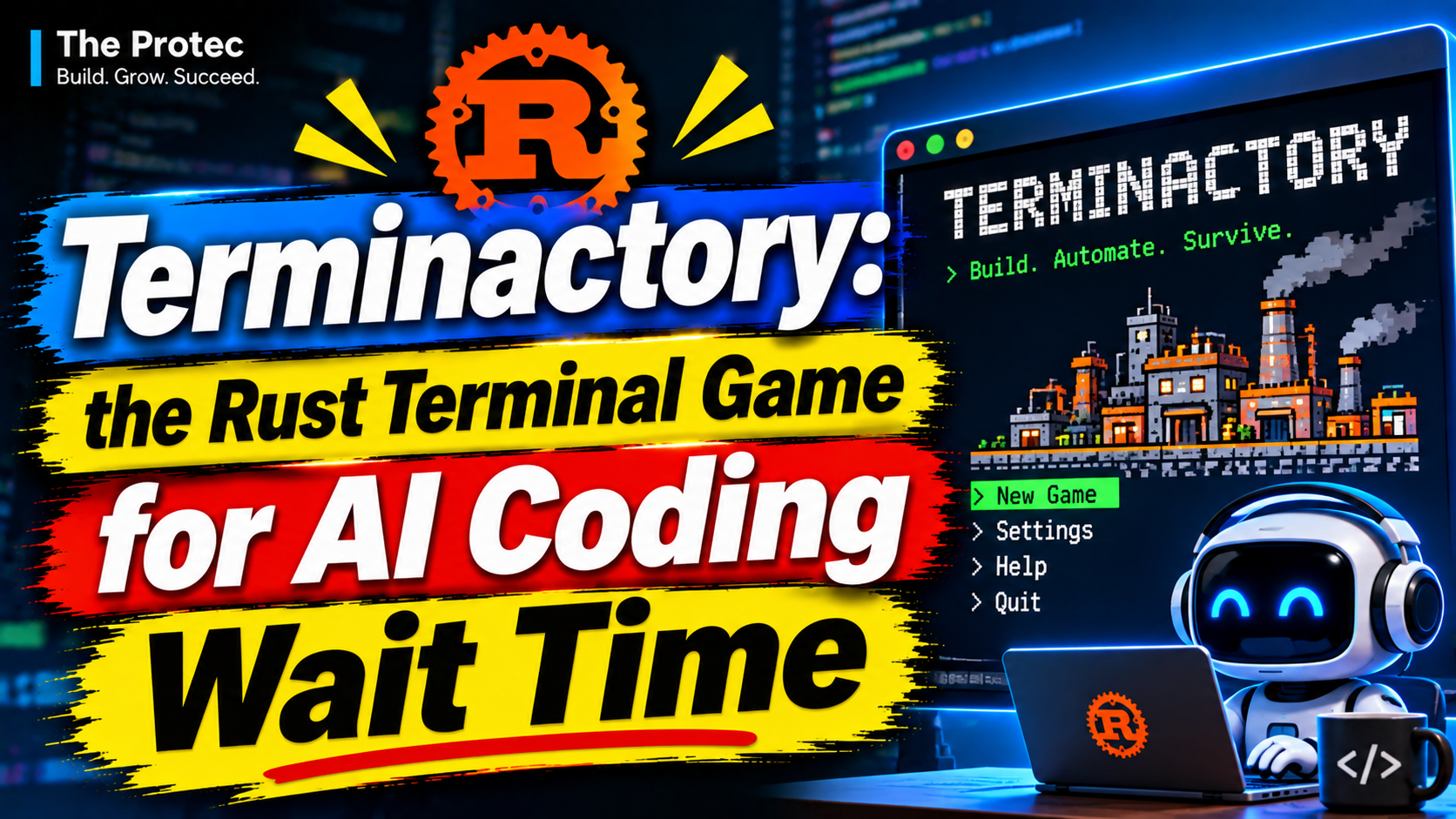
Waiting for an AI coding agent to finish a task creates an oddly specific kind of downtime: long enough to invite distraction, but often too short to justify leaving the terminal. Terminactory turns that pause into play. This small, open-source Rust terminal game fits an idle factory-building loop into a text-based interface, letting players construct production lines, manage resources and pursue research beside an active coding session.
What is Terminactory?
Terminactory is an experimental factory-building game written in the Rust programming language and presented through a terminal user interface, or TUI. Instead of opening a graphical window, the game draws its controls, maps, status panels and notifications inside a terminal. Its interface is built with ratatui, a Rust library for creating interactive, text-based applications.
The concept borrows familiar ideas from factory and automation games, but compresses them into a keyboard-driven environment. According to the project’s official GitLab repository, players can build a factory, move resources through production chains, measure output and unlock research. The project also integrates with Claude Code, giving it a purpose that goes beyond recreating a conventional management game with text characters.
- Genre: Idle factory and production-management game
- Interface: Terminal-based TUI powered by ratatui
- Language: Rust
- Controls: Primarily keyboard-driven
- Distinctive feature: Claude Code hook events can appear as in-game messages
As of November 2026, Terminactory is best understood as a small indie experiment rather than a major commercial release. Its significance comes from the combination of factory mechanics, terminal productivity culture and AI-assisted development—not from an attempt to match the scale of established automation games.
How factory building works in a terminal
Factory games are usually visual and spatial. Players place machines, connect inputs to outputs, find bottlenecks and redesign systems as demand grows. Terminactory preserves that recognizable loop while translating it into compact terminal panels and symbols.
The player must consider what resources are available, what can be produced from them and where production is falling short. Output measurements provide the feedback needed to improve a line. Research adds longer-term goals by unlocking additional possibilities rather than leaving the player with a static set of machines from the beginning.
That makes the interface more than a decorative command-line skin. Factory design depends on readable state: inventory levels, rates, dependencies and machine status all need to be visible without the animated belts and detailed models used by graphical games. Terminactory’s challenge is to communicate those relationships through layout, color, text and keyboard navigation.
Calling it an idle factory game does not mean players should assume every feature associated with mobile idle games, such as unlimited offline progress. Here, “idle” more usefully describes a game that can occupy short intervals and reward incremental management without demanding constant high-speed input.
A game designed for the split-terminal era
Terminactory’s most unusual idea is not its presentation but its intended setting. The developer imagines it running in one terminal pane while an AI coding agent works in another. A programmer can check the factory, adjust production or review research without switching to a separate desktop game and mentally leaving the development environment.
This reflects a new workflow problem. Agentic coding tools may spend meaningful time reading a repository, generating changes, running tests or waiting for commands. Developers still need to supervise the process, so they cannot always begin another deep task. Conventional social media can turn a short pause into a much longer distraction. A contained game in the neighboring pane offers a more deliberate interruption.
That does not automatically make gameplay productive. It remains entertainment. The terminal productivity angle is instead about context: Terminactory stays close to the work session, launches without a graphically intensive environment and is easy to leave when the agent needs attention.
Claude Code hooks become in-game telegrams
Terminactory connects that premise to the game through Claude Code hooks. Hooks allow external actions to run when supported events occur during an agent session. With the project’s integration configured, agent responses can be passed into Terminactory and displayed as in-game notifications or telegram-style messages.
The practical benefit is straightforward. A player does not have to stare continuously at the agent pane to know that a response has arrived. The factory itself can announce the event, making the boundary between waiting and supervision less awkward. The message is part of the game’s presentation, but it still points back to real work that may require review.
This is also a clever example of contextual software integration. Terminactory is not claiming to improve an agent’s code or accelerate inference. It uses event information from the coding tool to make a waiting-time game responsive to the surrounding workflow.
Users should still inspect hook configuration before enabling it. Hooks can execute commands or transfer data between processes, so paths, permissions and message contents deserve the same care as any other development automation. The repository documentation should be treated as the source of truth because setup details can change as the project evolves.
Why Rust and ratatui suit terminal-based games
TUI applications occupy a useful middle ground between traditional command-line programs and full graphical software. They can provide multiple panels, selectable controls, live updates, pop-ups and responsive layouts while retaining the speed and composability associated with a terminal.
Ratatui supplies building blocks for this style of application, including layout management and terminal widgets. A game can redraw changing production values, highlight a selected machine and organize dense information without implementing every low-level terminal operation from scratch. The library does not provide a complete game engine; developers still need to design state, input handling, timing and gameplay rules.
Rust game development is a logical fit for that work. Rust supports native binaries, strong type checking and explicit control over application state. Its ownership model can help prevent broad classes of memory errors, while its ecosystem offers libraries for terminal events, serialization and asynchronous work. Those qualities are valuable for responsive command-line applications that continuously process input and redraw state.
A terminal-native game can also offer practical advantages:
- Fast keyboard navigation without pointer-dependent controls
- Easy placement beside editors, shells and coding agents
- Modest graphical requirements compared with a 3D game
- A visual style shaped by typography, symbols and color
- Potential portability across terminal environments
These are design opportunities, not automatic guarantees. Terminal behavior varies, windows can be resized to awkward dimensions and color support is not identical everywhere. A polished TUI must account for those constraints rather than assuming that text rendering makes interface development simple.
What its AI-assisted development reveals
The developer has been candid that Terminactory was built with heavy AI assistance. That disclosure is particularly relevant because the game is designed to accompany AI coding agents. It is both a product of AI-assisted coding and a response to the waiting patterns those tools create.
The project illustrates how solo development roles are changing. A human can define the premise, choose Rust and ratatui, specify mechanics, evaluate generated code and repeatedly redirect an agent. The AI may produce a substantial amount of implementation, but it does not eliminate the need for product judgment. Someone still decides whether a factory loop is understandable, whether a panel contains too much information and whether generated behavior matches the intended design.
Nor should “AI-assisted” be mistaken for proof of quality or lack of authorship. Generated code can contain duplication, incorrect assumptions and subtle defects. Human direction, testing, review and maintenance remain important, particularly when hooks interact with other tools. The more useful question is not who typed each line, but whether the developer understands, validates and can maintain the resulting system.
Terminactory therefore offers a grounded view of AI-assisted coding: agents can help one person attempt an unusually broad project, while creative direction and technical accountability remain human responsibilities.
The limitations of putting a factory in a TUI
The same constraints that make Terminactory distinctive may also limit its audience. Factory games produce large amounts of information, and a terminal has restricted space. Compact panels can become dense, especially on smaller panes—the exact environment in which the game is meant to run.
Participants in the project’s Hacker News discussion raised questions familiar to many experimental TUI projects: how readable the interface is, whether newcomers can discover the controls and how much long-term depth a terminal factory can provide. These comments are community reactions rather than definitive judgments, but they identify real design pressures.
- Interface density: Rates, inventories, machines and research must compete for limited screen area.
- Accessibility: Heavy use of color, symbols or memorized shortcuts can create barriers without alternatives and clear guidance.
- Discoverability: Keyboard commands need visible prompts so new players are not forced to guess.
- Depth: Text presentation alone cannot replace the progression, logistics and balancing expected from mature factory games.
It would be unfair to expect a small experimental project to compete feature for feature with large graphical titles. Its better test is whether the production loop remains legible and satisfying within its chosen format. Some players will enjoy the concentration and novelty; others will miss visual conveyor systems, large maps and mouse-driven construction.
Why Terminactory is worth watching
Terminactory brings together several emerging ideas without pretending to be a blockbuster: terminal-based games, Rust-powered TUI applications, AI-assisted coding and tools that react to agent workflows. Its factory mechanics give waiting time a structured rhythm, while Claude Code notifications connect that rhythm to the task happening next door.
Its lasting appeal will depend on interface refinement and mechanical depth. Even so, it demonstrates that the terminal can still be a playful application platform—and that modern development tools can inspire new game concepts as well as help implement them.
Frequently asked questions
What is Terminactory?
Terminactory is an open-source, terminal-based idle factory game built with Rust and ratatui. Players develop production systems, manage resources, monitor output and unlock research through a keyboard-driven TUI.
Does Terminactory require Claude Code?
Claude Code integration is a distinctive part of the concept, but it should not be confused with the core factory mechanics. The hook integration can route agent responses into the game as notifications or telegrams. Consult the current repository documentation for exact requirements and configuration.
Why build a factory game in Rust?
Rust is well suited to native terminal applications because it combines performance, strong compile-time checks and a mature command-line ecosystem. With ratatui handling interface primitives, the developer can focus more attention on game state, production rules and input behavior.
Can Terminactory replace a conventional factory game?
Probably not for players seeking expansive maps, rich graphics or deeply developed logistics. Terminactory serves a narrower purpose: brief, keyboard-focused play inside a terminal session. Its value lies in that constraint rather than in matching larger factory games feature by feature.