








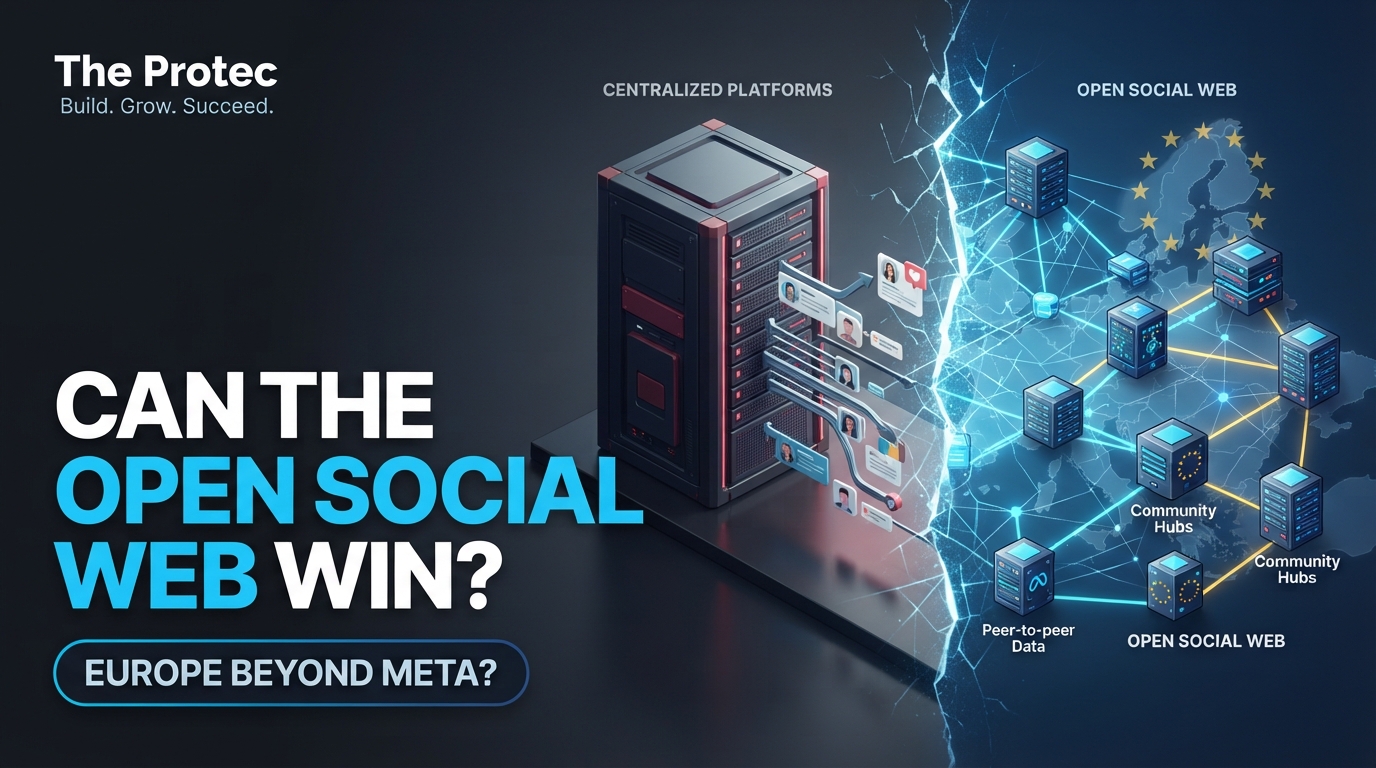
Email users rarely think about which provider their contacts use. A message can travel from one company’s server to another because both sides support common standards. Social media works differently: an account, audience and archive are usually confined to one platform. Europe’s proposed Open Social Web asks whether shared protocols and public-interest infrastructure could replace those isolated networks with services that communicate across organizational boundaries.
The idea is not to create a single European replacement for Facebook, Instagram, TikTok or YouTube. The Open Social Web Alliance instead proposes an ecosystem in which public institutions, media organizations, businesses, researchers and civil society can operate independent services while remaining connected. As of November 2026, this remains a vision, policy program and funding roadmap—not an operational unified network or evidence that Europe has already migrated away from Big Tech.
What the Open Social Web Alliance is proposing
Meta, ByteDance and Alphabet control some of the world’s largest social platforms. Their scale makes it difficult for alternatives to attract users: people stay where their friends, creators and customers already are. This network effect persists even when users dislike a platform’s moderation, advertising model, recommendation system or data practices.
The Open Social Web Alliance argues that interoperability could weaken that dependency. A person might choose an account from a local media organization, public broadcaster, cooperative or commercial provider and still follow people using other compatible services. Providers could compete on trust, features, moderation and price without forcing users to abandon every existing connection.
This model advances European digital sovereignty without requiring one institution to own the whole network. Its central components include open protocols, portable identities, shared technical infrastructure, transparent governance and sustained public investment. The Alliance’s October policy paper outlines a roadmap for coordinating those elements and building participation across sectors.
No single protocol currently handles every form of online social interaction. ActivityPub, AT Protocol and Matrix address overlapping but distinct layers of the problem. Understanding those differences is essential: adopting open standards does not automatically make every application compatible.
| Protocol | Primary purpose | Architecture | Notable strengths | Important limitations |
|---|---|---|---|---|
| ActivityPub | Federated publishing and social networking | Independent servers exchange activities | Mature Fediverse ecosystem; used for posts, follows, replies and video publishing | Implementations and content types can differ; complete account and post migration remains difficult |
| AT Protocol | Portable identity, data repositories and interoperable social applications | Personal data servers, relays and application services | Account portability, domain-based handles and access to network-wide data streams | Operational infrastructure can be demanding; native compatibility with ActivityPub is not automatic |
| Matrix | Decentralized real-time messaging | Homeservers synchronize rooms and events | Federated messaging, persistent rooms and support for end-to-end encryption | Designed primarily for communication rather than public social feeds; large rooms can be costly to synchronize |
ActivityPub and the Fediverse
The W3C’s ActivityPub protocol powers much of the Fediverse, including Mastodon and PeerTube. A Mastodon user on one server can generally follow, mention and reply to a user on another. PeerTube applies federation to video, allowing independent sites to publish and share content without relying on a single YouTube-style host.
ActivityPub distributes responsibility among server operators. Each provider sets policies, maintains infrastructure and decides which other servers to federate with. That flexibility is valuable, but user experiences vary. One application may interpret polls, quote posts, visibility settings or video metadata differently from another. Federation therefore means communication is possible, not that every feature behaves identically everywhere.
AT Protocol and Bluesky interoperability
AT Protocol, the technology underlying Bluesky’s network, separates several functions that conventional platforms bundle together. It uses portable identity mechanisms, signed data repositories, relays that aggregate network events and application services that turn those events into feeds and interfaces.
This design can support competing applications and algorithmic feeds over a shared data layer. Users may be able to change a hosting provider without changing their public identity or rebuilding their social graph, provided migration systems and participating services function as intended. However, Bluesky interoperability should not be confused with universal Fediverse compatibility. ActivityPub and AT Protocol use different data models and distribution systems; bridges can translate some activity, but they introduce technical, moderation and identity complications.
Matrix protocol for decentralized messaging
Matrix focuses on conversations rather than follower-based public feeds. Users join rooms whose events are synchronized among participating homeservers. Organizations can run their own infrastructure while communicating with people elsewhere, making Matrix relevant to the private and group-messaging layer of an open social environment.
An eventual ecosystem could therefore use ActivityPub or AT Protocol for public publishing and Matrix for messaging. That combination would require common identity, consent and safety rules. Simply placing the protocols beside one another would not create a seamless product.
The Alliance’s vision depends on more than protocol adoption. Several user-facing and infrastructural components must operate across independent providers.
- Identity: Domain-linked names could let people establish recognizable identities without receiving a permanent handle from one platform. Reliable verification and recovery would still be needed.
- Account portability: Users should be able to move identity, followers and data when a provider closes or becomes unsuitable. Current systems offer different degrees of portability, and moving complete post histories is not consistently supported.
- Content distribution: Federation servers, relays or other shared services could deliver posts beyond their original host. The architecture would affect cost, resilience and who can observe network activity.
- APIs: Documented, stable interfaces would allow developers to build clients, accessibility tools, moderation systems and analytics without seeking permission from one dominant platform.
- Algorithms: People might select among chronological timelines, community-designed recommenders and commercial discovery services. Algorithmic choice could become a competitive feature rather than a platform mandate.
- Data ownership: Open protocols can make export and migration easier, but they do not by themselves establish legal ownership or privacy. Providers still need clear retention, consent and data-protection practices.
Moderation would also be distributed. A provider could enforce its own rules, block a harmful server or subscribe to shared safety information. Users might add personal filters on top. This creates more choice, but it can also produce inconsistent decisions and disputes over who must respond to abuse crossing several services.
How Mastodon, Bluesky and PeerTube differ
Mastodon resembles a network of independently administered communities. Users choose a server, while ActivityPub connects them to much of the wider Fediverse. Governance and moderation are local, although servers can share block lists or coordinate responses.
Bluesky-related applications use a more modular AT Protocol architecture. Hosting, relaying, application interfaces and custom feeds can be separated, potentially allowing portability without making every participating service maintain a fully federated copy of each interaction.
PeerTube demonstrates how federation can apply to bandwidth-intensive media. Each operator hosts videos and chooses federation relationships, while peer-to-peer delivery can supplement conventional streaming. Other open social platforms specialize in blogging, events, photos or link sharing. The result is not one uniform website but a collection of applications that may exchange selected content.
Infrastructure, governance and public funding
The Alliance’s proposal recognizes that protocols alone cannot compete with platforms backed by global advertising and cloud businesses. An Open Social Web would need dependable hosting, identity services, directories, search and discovery, moderation tools, protocol testing, developer support and accessible consumer applications.
Its policy direction calls for shared governance and public-interest funding rather than leaving essential infrastructure to short-term volunteer labor or one venture-funded company. The ambition is to bring together civil society, research institutions, media, businesses and public bodies. Those participants could fund core components, test deployments, develop standards and establish accountability processes.
The Alliance policy paper should be read as a proposed roadmap. Funding commitments, governance structures, procurement programs and interoperable production services must still be implemented and evaluated. The existence of a coalition or technical standard does not prove that mass adoption will follow.
What could prevent widespread adoption?
The largest obstacle may be convenience. Established networks already offer polished applications, enormous audiences and mature advertising systems. Most people will not switch merely because an alternative has a better architecture.
Technical fragmentation is another risk. Two services can claim support for the same protocol while interpreting optional features differently. Cross-protocol translation is harder still. Conformance testing and carefully defined profiles may be necessary to prevent an open ecosystem from becoming a set of incompatible islands.
Other challenges include:
- Moderation across servers: Harassment, illegal content and coordinated manipulation can spread between jurisdictions and providers with different policies.
- Spam and fraud: Open registration and federation can be exploited unless reputation, rate limits and abuse-reporting systems improve.
- Identity migration: Moving an account safely requires protection against impersonation, broken links and lost history.
- Discovery: Privacy-conscious decentralization can make it harder to find relevant people and content without recreating centralized surveillance.
- Infrastructure costs: Video, search, relays, archives and large Matrix rooms require substantial storage, bandwidth and operational expertise.
- Sustainable funding: Grants can start projects, but long-term maintenance needs durable public budgets, memberships, subscriptions or responsible commercial services.
Interoperability can make social media more email-like by allowing people to choose providers without surrendering communication across the network. But social feeds are more complex than email: they combine public identity, viral distribution, recommendations, moderation, advertising and multimedia hosting.
Europe’s proposal is credible as a direction, not a completed transition. Success would mean users can move, communicate and choose algorithms without one company controlling every layer. If governance, funding and usability match the protocols’ promise, decentralized social networks could become practical infrastructure rather than niche social media alternatives.
Frequently asked questions
What is the Open Social Web?
It is a model for social networking in which independent providers communicate through open protocols. Users could choose among services while retaining access to people and content elsewhere, reducing dependence on a single platform owner.
Not as a single unified platform. As of November 2026, the Alliance presents a policy vision, coalition-building effort and roadmap for infrastructure, governance and funding. Existing networks such as Mastodon, PeerTube and Bluesky illustrate parts of the model but do not constitute one unified Alliance network.
Are ActivityPub and AT Protocol compatible?
They are separate protocols with different architectures. Bridges may translate certain posts and interactions, but direct, complete interoperability is not inherent. Identity, moderation, formatting and feature differences can limit what crosses a bridge.
No. It could distribute moderation and give communities more control, but abuse can cross provider boundaries. Effective systems would require local rules, user controls, trusted reporting channels, shared safety tools and transparent appeals.