








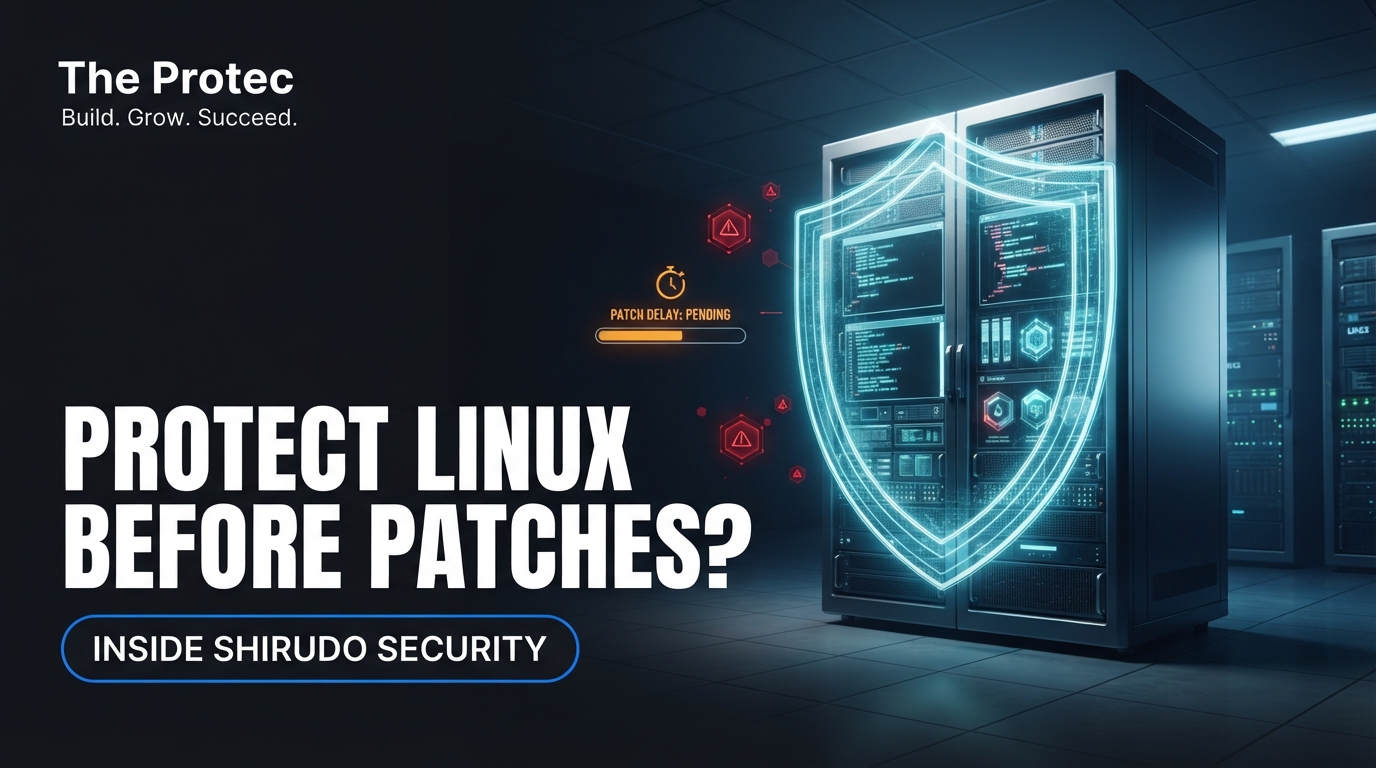
A critical Linux flaw can become public hours or days before administrators have a tested patch ready for production. Shirudo Linux security addresses that dangerous interval with an unusual proposition: let AI agents develop and test a temporary runtime shield that blocks an exploit path while the permanent update is prepared. The OpenAI Cisco Shirudo project could give defenders a faster option, but it is not autonomous patching—and it is not yet a replacement for established vulnerability management.
Shirudo combines AI-assisted policy creation with Linux observability and enforcement technologies, including eBPF and Tetragon. Rather than rewriting vulnerable kernel or application code, a generated policy monitors relevant runtime behavior and intervenes when a process attempts the action associated with an exploit. Because the policy can be loaded into a running system, protection may be applied without rebooting the server.
The short answer to whether AI can protect servers before patches arrive is therefore potentially, under controlled conditions. The longer answer depends on policy quality, kernel compatibility, representative testing, human approval and a reliable rollback process.
What Is the OpenAI Cisco Shirudo Project?
Shirudo has been presented as a project for using AI cybersecurity agents to create temporary Linux runtime protections. An agent receives information about a vulnerability, reasons about the behavior required to exploit it, proposes an enforcement policy and tests that policy in an isolated environment. The intended output is a narrowly scoped shield, not a source-code fix.
This distinction matters. A patch removes or corrects vulnerable code. A runtime shield tries to stop a particular route to that code, deny a dangerous operation or constrain the process that can reach it. If the policy does not cover every viable exploit path, the underlying vulnerability remains reachable through an unmodeled path.
Shirudo should also be understood as an emerging security engineering project rather than a mature, fully autonomous platform. As of November 26, 2026, publicly available project descriptions do not justify treating it as a generally available managed security product with universal Linux support, contractual service levels or a complete compatibility guarantee. Organizations evaluating it should confirm the current repository, test coverage, licensing, release status and supported configurations directly before any production trial.
How eBPF Makes Runtime Protection Possible
Extended Berkeley Packet Filter, or eBPF, allows verified programs to run in the Linux kernel in response to selected events. Depending on the hook and available kernel features, an eBPF-based security tool can observe system calls, process execution, file access, networking activity and other kernel-level behavior.
Before loading an eBPF program, the kernel verifier checks properties intended to prevent unsafe execution, such as invalid memory access. That verification is important, but it does not prove that a security policy is operationally correct. A technically valid program can still block legitimate activity, miss an exploit variation or create excessive overhead.
The Linux kernel BPF documentation explains the underlying subsystem, including program types, maps and verifier behavior. Shirudo operates at a higher level: its AI agents are intended to reason about a disclosed weakness and propose a usable defense using the runtime enforcement tools available on the target.
Why a shield may not require a reboot
Traditional kernel updates often replace files on disk and require a reboot before the new kernel becomes active. An eBPF policy is different. It can be loaded into the running kernel and attached to an existing hook, allowing administrators to introduce or remove an enforcement rule dynamically.
This property is especially valuable for high-availability databases, Kubernetes nodes and infrastructure that cannot be restarted immediately. It does not eliminate maintenance, however. The permanent update may still require a reboot, workload migration or node replacement later.
Tetragon’s Role in Linux Runtime Security
Tetragon is an open-source security observability and runtime enforcement project associated with the Cilium ecosystem. It uses eBPF to observe processes and other kernel events and can apply enforcement through tracing policies. In a Shirudo-style workflow, Tetragon supplies a structured way to express and deploy the runtime behavior that an agent has proposed.
A tracing policy might watch a sensitive system call, limit access to a kernel interface or stop a suspicious process when specific conditions are met. This is generally safer and more manageable than asking an AI model to produce unconstrained kernel code. The framework still requires careful configuration and validation.
The official Tetragon documentation should be the source of truth for current installation requirements, supported hooks and policy semantics. Those details can change independently of Shirudo.
From Vulnerability Report to Temporary Runtime Shield
A defensible Shirudo workflow would separate generation, testing, approval and deployment rather than allowing an agent to push a new rule directly into production.
- Analyze the vulnerability. The agent reviews trusted technical material, affected components, prerequisites and known proof-of-concept behavior.
- Identify an enforceable action. It determines whether exploitation depends on an observable event that eBPF or Tetragon can reliably detect and constrain.
- Generate a narrow policy. The proposed shield should target the exploit behavior while preserving normal application operations.
- Test in isolation. The policy is evaluated against exploit attempts, legitimate workloads, failure cases and performance-sensitive paths.
- Request human approval. A security or platform engineer reviews the assumptions, policy scope, evidence, expiry conditions and rollback plan.
- Deploy gradually. Teams can begin in observation mode or with a small canary group before expanding enforcement.
- Remove the shield after patching. Once the permanent update is installed and validated, the temporary rule should be retired unless it provides separate, documented value.
That final step prevents temporary controls from becoming undocumented permanent dependencies. Every shield should have an owner, review date and clear removal criterion.
Shirudo Versus Traditional Linux Patching
Patching and runtime vulnerability mitigation operate at different layers. A vendor patch changes the affected software so the defect is no longer present. A Shirudo-generated policy changes what the vulnerable software is permitted to do while it runs.
- Speed: A runtime policy may be produced and deployed faster than a thoroughly tested update.
- Persistence: A patch remains part of the updated software; a shield depends on active tooling and policy state.
- Coverage: A correct patch addresses the root defect. A shield covers only the behavior it recognizes.
- Operational impact: A policy may avoid an immediate reboot, but it can introduce false positives or latency.
- Assurance: Vendor patches normally receive component-specific engineering and regression testing. An AI-generated mitigation needs its own local validation.
Live kernel patching provides another comparison. Technologies such as kpatch or Kernel Live Patching can modify kernel code without an immediate reboot, but they still rely on a prepared patch for a supported kernel. Shirudo’s model is behavioral containment: it may be useful before such a code-level fix is available.
Kubernetes Security and Cloud Applications
Kubernetes environments are a natural test case because they contain many similar Linux nodes and already use declarative policy, staged rollouts and automated telemetry. A cloud infrastructure team could test a runtime shield on a disposable node pool, monitor application behavior and then deploy it to a controlled subset of affected nodes.
Potential applications include reducing exposure while a managed cluster update is pending, protecting legacy workloads during migration, or buying time when an emergency reboot would breach an availability objective. Tetragon can also provide evidence about which workloads encounter the monitored behavior, helping teams prioritize remediation.
Cluster-wide deployment magnifies mistakes, however. A policy that blocks a common runtime, storage or networking operation could disrupt many pods simultaneously. Teams should use canaries, workload-specific selectors, policy versioning and automated health checks. Admission controls and infrastructure-as-code reviews can help ensure that the emergency process remains auditable.
Compatibility, Kernels and Hardware Requirements
There is no responsible way to claim that Shirudo supports every eBPF-capable Linux system. Effective compatibility depends on the kernel version and configuration, available attachment points, BTF metadata, Tetragon release, distribution customizations, container environment and the behavior being controlled.
Tetragon commonly targets modern Linux kernels and widely used x86-64 and Arm64 environments, but its current support matrix—not a general statement about eBPF—must govern deployment. Older enterprise kernels may contain backports that complicate simple version checks. Secure Boot policies, restricted cloud kernels and missing kernel features may also affect installation or enforcement.
The protected server generally does not need an AI accelerator merely to enforce an approved Tetragon policy. It does need sufficient CPU and memory for the runtime security agent and its event volume. AI inference may run through a remote service or separate control plane; local model execution would introduce its own GPU, memory and data-governance requirements. Shirudo’s public maturity does not support a universal minimum hardware specification, so teams must benchmark their exact workload.
Validation, Human Approval and Safe Rollback
Human approval is not ceremonial. Reviewers need to understand what the rule blocks, what evidence supports it and what business operations could be affected. They should also verify that vulnerability data supplied to the agent came from trusted sources. A poisoned advisory, malicious proof of concept or misleading issue report could influence the generated policy.
Validation should include a reproducible exploit test where legally and operationally appropriate, negative tests for normal behavior, load tests, long-running workload tests and a fail-safe rollback exercise. Observability must distinguish between a blocked attack and a blocked customer request.
Rollback should be simple, authenticated and tested before deployment. Operators need a path to detach the policy even if the central control plane is unavailable. They should preserve policy versions, agent reasoning artifacts, approval records and deployment logs for incident review.
Operational Risks Linux Administrators Should Consider
- False confidence: Blocking one proof of concept does not demonstrate coverage of every exploit technique.
- False positives: Legitimate processes may perform the same low-level action as malicious code.
- Performance overhead: High-frequency hooks and excessive event export can consume measurable resources.
- Agent error: AI-generated reasoning or policy syntax may be incomplete despite appearing plausible.
- Control-plane exposure: A system authorized to distribute enforcement policies becomes a high-value target.
- Configuration drift: Kernel upgrades or workload changes may invalidate earlier assumptions.
- Privacy and compliance: Vulnerability details, logs or proprietary workload information may leave the environment if sent to an external model.
For practical adoption, Linux server security teams should start with advisory output rather than automatic enforcement. Let the agent propose policies and test cases, but require engineers to reproduce the result. Initial production trials should focus on well-understood vulnerabilities with clear runtime signals and low-risk canary environments.
Why Runtime Protection Complements Patching
The strongest case for Shirudo is reducing the gap between vulnerability disclosure and permanent remediation. Runtime shields can provide breathing room for testing, change approval and orderly maintenance. They may also offer useful telemetry about attempted exploitation.
They cannot repair vulnerable source code, guarantee complete exploit coverage or remove the need for vendor-supported updates. Administrators must continue inventorying affected systems, applying patches, rebooting when required and confirming that the vulnerable version is gone. The shield is a bridge, not the destination.
Frequently Asked Questions
Is Shirudo Linux security ready for production?
It should be treated as experimental unless the project’s current maintainers provide a supported release and compatibility statement for your environment. Organizations can evaluate it in laboratories and controlled canaries, but should not infer production readiness from a demonstration alone.
Can Shirudo protect a server without rebooting it?
Potentially. If the mitigation can be expressed through a supported eBPF or Tetragon policy, it can be attached to a running kernel. The eventual permanent kernel or software update may still require a restart.
Does Shirudo automatically patch Linux vulnerabilities?
No. It aims to create temporary behavioral protections around vulnerable systems. It does not rewrite the affected source code or replace the vendor’s security update.
Does every protected server need a GPU?
No. Enforcing an approved eBPF policy does not inherently require a GPU. Accelerated hardware may be needed only where an organization chooses to run the AI model locally, depending on that model’s size and architecture.
What should administrators verify before a trial?
Confirm the exact kernel and distribution support, Tetragon prerequisites, policy hooks, architecture, resource overhead and rollback procedure. Then test both exploit blocking and normal workloads on infrastructure that accurately represents production.
The Practical Verdict
Shirudo points toward a valuable use of AI cybersecurity agents: shortening the period when defenders know about a flaw but cannot yet apply a permanent fix. Its combination of AI-assisted reasoning, eBPF security and Tetragon-based enforcement could make temporary mitigation faster and more systematic.
The same power demands disciplined controls. Policies need trusted inputs, representative tests, human authorization, gradual rollout and reliable removal. Used that way, Shirudo Linux security could become a useful layer in cloud and server defense. Used as an excuse to delay updates or automate unreviewed kernel enforcement, it could create a new class of operational risk.