








Snapdragon 8 Gen 5 vs Apple A20 Pro: Which Chip Is Really Faster?
The battle for mobile performance has never been tighter. With Qualcomm’s Snapdragon 8 Gen 5 pushing Android flagships toward higher sustained performance and Apple’s A20 Pro continuing its reputation for raw efficiency and single-core dominance, buyers are left with a difficult question: which mobile chip is actually faster in real use?
This mobile processor comparison goes beyond marketing claims and looks at what matters most: benchmark behavior, AI processing, gaming performance, thermal control, and battery efficiency. In the current flagship market, speed is no longer just about a peak score. It is about how long a chip can hold that speed, how well it handles on-device AI workloads, and whether it can do all of that without draining the battery.
For anyone choosing between a Snapdragon-powered Android flagship and an iPhone with Apple silicon, the answer is more nuanced than ever. The Snapdragon 8 Gen 5 is built to close the gap in sustained workloads and graphics-heavy tasks, while the Apple A20 Pro is expected to preserve Apple’s edge in per-core efficiency, media engines, and tightly integrated software optimization. Let’s break down the comparison section by section.
Quick Verdict: It Depends on the Workload
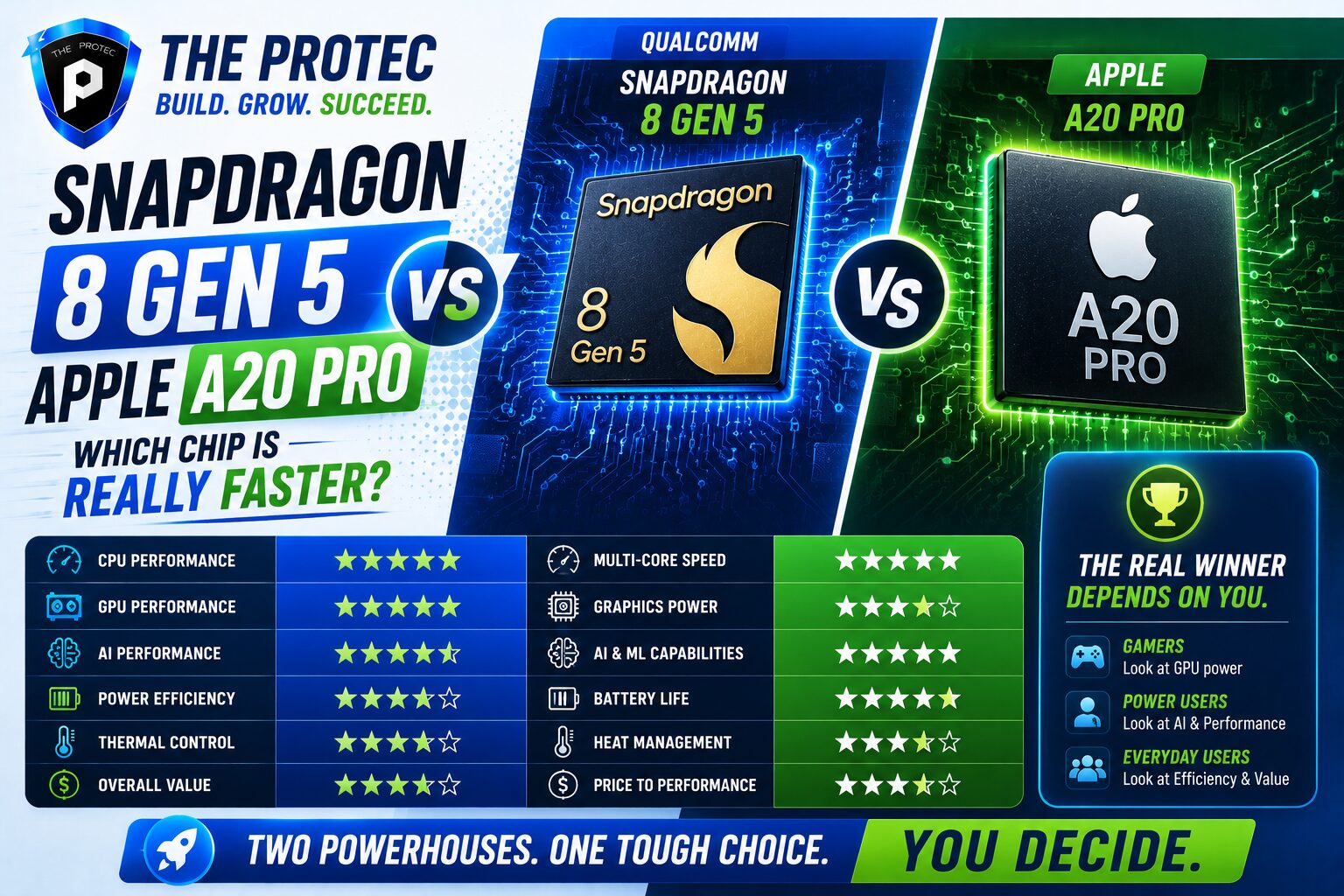
If you want the shortest answer possible, here it is: the Apple A20 Pro is likely to remain ahead in single-core CPU performance and system efficiency, while the Snapdragon 8 Gen 5 may be more competitive in sustained multi-core loads, Android gaming flexibility, and AI feature variety. That means “faster” depends on what you do most.
- CPU burst speed: Apple A20 Pro advantage
- Multi-core sustained performance: Snapdragon 8 Gen 5 competitive or better in some devices
- GPU gaming: Snapdragon 8 Gen 5 can be stronger in Android flagships with larger cooling solutions
- AI processing: Both are highly capable, but Apple’s on-device integration may feel smoother in everyday use
- Battery efficiency: Apple A20 Pro often leads in efficiency per watt, though Snapdragon 8 Gen 5 narrows the gap
Still, benchmarks only tell part of the story. Real-world behavior matters just as much, especially as both chips are being paired with faster LPDDR5X memory, advanced NPU blocks, and more aggressive thermal tuning from phone makers.
Benchmark Expectations and What They Actually Mean
Benchmark numbers are useful, but they can be misleading if read in isolation. A chip that posts a higher short-term score may not feel faster after ten minutes of gaming, camera processing, or AI tasks. That is why it helps to look at the most common benchmark categories separately.
Single-core performance is still the best indicator of app launch speed, browser responsiveness, and many everyday tasks. Apple has built its reputation on this area, and the A20 Pro is expected to continue that trend. Its architecture tends to extract more performance from fewer cycles, which is why iPhones often feel extremely quick even when peak core counts are lower.
Multi-core performance matters when tasks become heavier: exporting video, processing large photo libraries, using generative AI tools, or running demanding background workloads. Here, Snapdragon 8 Gen 5 has a real chance to compete more aggressively, especially in phones that allow it to maintain higher power draw for longer periods.
GPU benchmarks are equally important because mobile gaming, 3D rendering, and UI smoothness are increasingly graphics-dependent. Qualcomm’s recent focus has been on improving sustained graphics output and reducing throttling, while Apple usually relies on highly optimized Metal support and strong frame pacing.
For reference, many device reviews still rely on benchmarking suites such as Geekbench and 3DMark because they provide a useful baseline for comparing architectures across platforms.
CPU Performance: Apple A20 Pro Still Sets the Pace
On the CPU side, the Apple A20 Pro is expected to keep its lead in single-threaded workloads. That matters because a large share of mobile interactions are still bursty rather than sustained. Opening apps, loading web pages, switching between camera modes, and navigating dense interfaces all benefit from a chip that can complete short tasks extremely quickly.
Apple’s chip design philosophy remains focused on high IPC, efficient task scheduling, and deep OS-level integration. iOS and the A-series chip family are built together, which reduces overhead and improves consistency. That is a major reason Apple devices often outperform Android rivals in many real-world responsiveness tests even when the raw core count is lower.
The Snapdragon 8 Gen 5, however, is not standing still. Qualcomm’s newer flagship silicon has increasingly emphasized balanced performance across performance and efficiency cores. In prolonged multi-threaded loads, that can make a tangible difference. If a device manufacturer pairs the chip with strong cooling, the Snapdragon 8 Gen 5 may sustain higher CPU clocks for longer than earlier Android flagships, shrinking the gap in workloads like file compression, multi-tab browsing, and light productivity.
In practical terms, if your definition of “fastest” means instant responsiveness, the A20 Pro is the safer bet. If it means maintaining speed under pressure, the Snapdragon 8 Gen 5 is much more competitive than older Android chips were.
GPU and Gaming: Snapdragon 8 Gen 5 Has the Better Upside
Gaming is where this comparison becomes especially interesting. Apple’s A20 Pro will almost certainly deliver excellent frame pacing, strong optimization in major titles, and efficient rendering through its graphics stack. But the Snapdragon 8 Gen 5 may have the edge in peak gaming flexibility because Android flagships often use larger vapor chambers, more aggressive game modes, and higher power envelopes.
That means two things can be true at once: the A20 Pro may produce smoother, more predictable performance in a broader mix of apps, while the Snapdragon 8 Gen 5 can push harder in long gaming sessions on well-cooled devices. For users who play extended sessions of graphically intensive titles, the Snapdragon platform may feel more configurable and, in some phones, more powerful after sustained load.
Another advantage for Snapdragon is ecosystem flexibility. Android manufacturers frequently tune refresh rates, thermal curves, and GPU drivers for gaming-centric models. This can create a larger performance ceiling than Apple allows in most iPhones, where thermal and battery policies are more conservative.
That said, Apple still holds a major advantage in optimization consistency. Because iOS devices are fewer and more controlled, developers can tailor games and creative apps very efficiently. So while Snapdragon 8 Gen 5 may win some raw gaming tests, the A20 Pro may still feel more polished in supported apps.
AI Processing: On-Device Intelligence Is the New Battleground
AI is no longer a side feature. It is becoming one of the main reasons people upgrade phones. Both Snapdragon 8 Gen 5 and Apple A20 Pro are designed around heavier on-device AI workloads, including photo enhancement, transcription, context-aware assistants, live translation, and generative tools.
Qualcomm’s advantage lies in flexibility. Snapdragon-powered phones often support broader AI feature experimentation from OEMs and app developers. The Snapdragon 8 Gen 5 is expected to pair with a powerful NPU and improved memory bandwidth, which can help it handle multiple AI tasks in parallel. That matters for Android phones that market themselves as AI-first devices.
Apple’s strength is integration. The A20 Pro’s Neural Engine, coupled with iOS and Apple’s app framework, tends to deliver smooth, efficient, and predictable AI experiences without exposing as much complexity to the user. Apple is also usually very good at keeping AI processing local when possible, which can improve responsiveness and privacy.
In benchmark terms, AI performance should be judged by both throughput and efficiency. A chip that can complete an inference task quickly but overheats or drains the battery is less useful in daily life. The Snapdragon 8 Gen 5 may have the broader AI hardware ambition, but the A20 Pro is likely to remain the more efficient and tightly optimized platform for consumer AI workflows.
Battery Efficiency: Apple’s Strength, Qualcomm’s Progress
Battery life is where many users make their final decision, and this is one of the toughest categories to predict from spec sheets alone. Still, the trend is familiar: Apple’s A-series chips usually deliver exceptional performance per watt, while Snapdragon chips have made major progress but often depend more heavily on device-level optimization.
The Apple A20 Pro is expected to benefit from Apple’s continued control over silicon, operating system, and core software services. That vertical integration gives Apple an edge in idle power management, background task scheduling, and display-to-chip coordination. In real use, this often means better standby efficiency and more predictable battery drain across the day.
The Snapdragon 8 Gen 5, on the other hand, can shine when paired with larger batteries and aggressive power management in premium Android phones. Newer flagship Android devices are increasingly using smarter thermal design and adaptive performance tuning to keep efficiency high without sacrificing speed. In some scenarios, that can produce excellent screen-on time, especially if the phone prioritizes battery life over sustained peak output.
The key difference is consistency. Apple tends to deliver a more uniform efficiency profile across devices because the hardware lineup is narrow. Snapdragon-based phones vary more depending on the manufacturer’s cooling system, software tuning, and battery capacity. That makes the A20 Pro the safer winner in battery efficiency overall, even if the Snapdragon 8 Gen 5 can be excellent in the right handset.
Thermals and Sustained Performance Matter More Than Peak Scores
One of the biggest mistakes in mobile processor comparison is overvaluing peak benchmark scores. A chip can win a short benchmark by a few percentage points and still lose in actual usage if it throttles hard after a few minutes.
This is where Snapdragon 8 Gen 5 has an opportunity. Android OEMs have become much better at designing large cooling solutions, especially in gaming phones and premium flagships. If heat is controlled well, the Snapdragon chip can maintain a strong performance curve over time. That is especially important for gaming, video capture, and AI tasks that run continuously.
Apple’s A20 Pro will likely remain highly efficient, but iPhones tend to be more conservative with thermal headroom. That helps preserve battery life and device longevity, though it can limit sustained peak performance under long, heavy loads. In short, Apple often wins the burst test; Qualcomm may win more often in the endurance test.
Real-World Use: Which Chip Feels Faster?
When people ask which chip is “faster,” they often really mean which phone feels quicker in everyday use. On that front, Apple’s A20 Pro likely still has the edge in immediate responsiveness. Apps open quickly, animations feel fluid, and background management remains tightly controlled.
But the Snapdragon 8 Gen 5 is closing the gap in ways that matter. Top-tier Android phones now boot fast, handle multitasking smoothly, and manage demanding AI features better than before. In phones with excellent software tuning, the user experience can feel nearly indistinguishable from Apple in common tasks.
If you are a heavy multitasker, mobile gamer, or someone who wants more flexibility from your device, Snapdragon 8 Gen 5 may offer the better overall package. If you prioritize the smoothest possible responsiveness, long-term efficiency, and a highly polished software-hardware stack, the Apple A20 Pro remains the benchmark to beat.
Who Should Choose Snapdragon 8 Gen 5?
- Users who want the strongest Android flagship performance
- Gamers who value sustained frame rates and larger cooling systems
- People who use AI features across multiple apps and services
- Buyers who prefer customization, flexibility, and broad hardware options
Who Should Choose Apple A20 Pro?
- Users who want the fastest single-core responsiveness
- Buyers who prioritize battery efficiency and standby life
- People who want a tightly optimized, stable software experience
- Creators and professionals who rely on Apple’s integrated ecosystem
Final Verdict: Apple A20 Pro Leads Overall, Snapdragon 8 Gen 5 Wins on Flexibility
So which mobile chip is really faster? If the question is about raw peak responsiveness and efficiency, the Apple A20 Pro still looks like the overall leader. Apple’s silicon strategy continues to pay off in single-core performance, battery management, and smooth real-world behavior.
However, if you care about sustained performance, gaming versatility, and wider AI experimentation, the Snapdragon 8 Gen 5 is the more exciting chip. It may not always beat Apple in headline benchmarks, but it is increasingly capable of matching or exceeding expectations in long-duration workloads and Android-optimized devices.
The truth is that this is no longer a one-sided fight. The gap has narrowed dramatically, and the winner depends on how you use your phone. For pure benchmark bragging rights, Apple still has the edge. For flexible, high-performance Android phones, Snapdragon 8 Gen 5 is closer than ever.
FAQ
Is Snapdragon 8 Gen 5 faster than Apple A20 Pro?
Not across every workload. The Apple A20 Pro is likely faster in single-core tasks and overall efficiency, while Snapdragon 8 Gen 5 may be stronger in sustained multi-core and gaming scenarios depending on the device.
Which chip is better for gaming?
Snapdragon 8 Gen 5 often has the advantage in long gaming sessions because Android phones can use larger cooling systems and more aggressive performance tuning. Apple A20 Pro can still deliver excellent game performance, especially in optimized titles.
Which processor has better battery life?
Apple A20 Pro is generally expected to deliver better efficiency per watt, especially in standby and mixed-use scenarios. Snapdragon 8 Gen 5 can still offer strong battery life, but it depends more on the phone maker’s tuning and battery size.
Which chip is better for AI features?
Both are highly capable. Snapdragon 8 Gen 5 offers strong flexibility for Android AI features, while Apple A20 Pro benefits from deep hardware-software integration that can make AI tools feel faster and more seamless in daily use.
Should I choose a phone based only on the chip?
No. Cooling design, software optimization, display efficiency, battery size, and app support all affect real performance. The chip matters a lot, but the phone around it matters too.
For deeper benchmark methodology and chipset testing standards, you can also review resources from Tom’s Guide and AnandTech.