






AI coding agents have moved beyond suggesting snippets. Modern agents can inspect repositories, edit multiple files, execute tests, install dependencies, open pull requests, operate browsers, and interact with cloud services. That autonomy makes them useful, but it also gives them many of the capabilities associated with a privileged human developer—or an intruder.
An agent does not need malicious intent to cause damage. A misleading instruction in a repository, a compromised package, an unsafe shell command, or an incorrect assumption can lead to deleted files, exposed credentials, unauthorized network activity, or altered production resources. The central security question is therefore not whether an agent is trustworthy. It is how much damage the agent can cause when its reasoning, tools, or inputs fail.
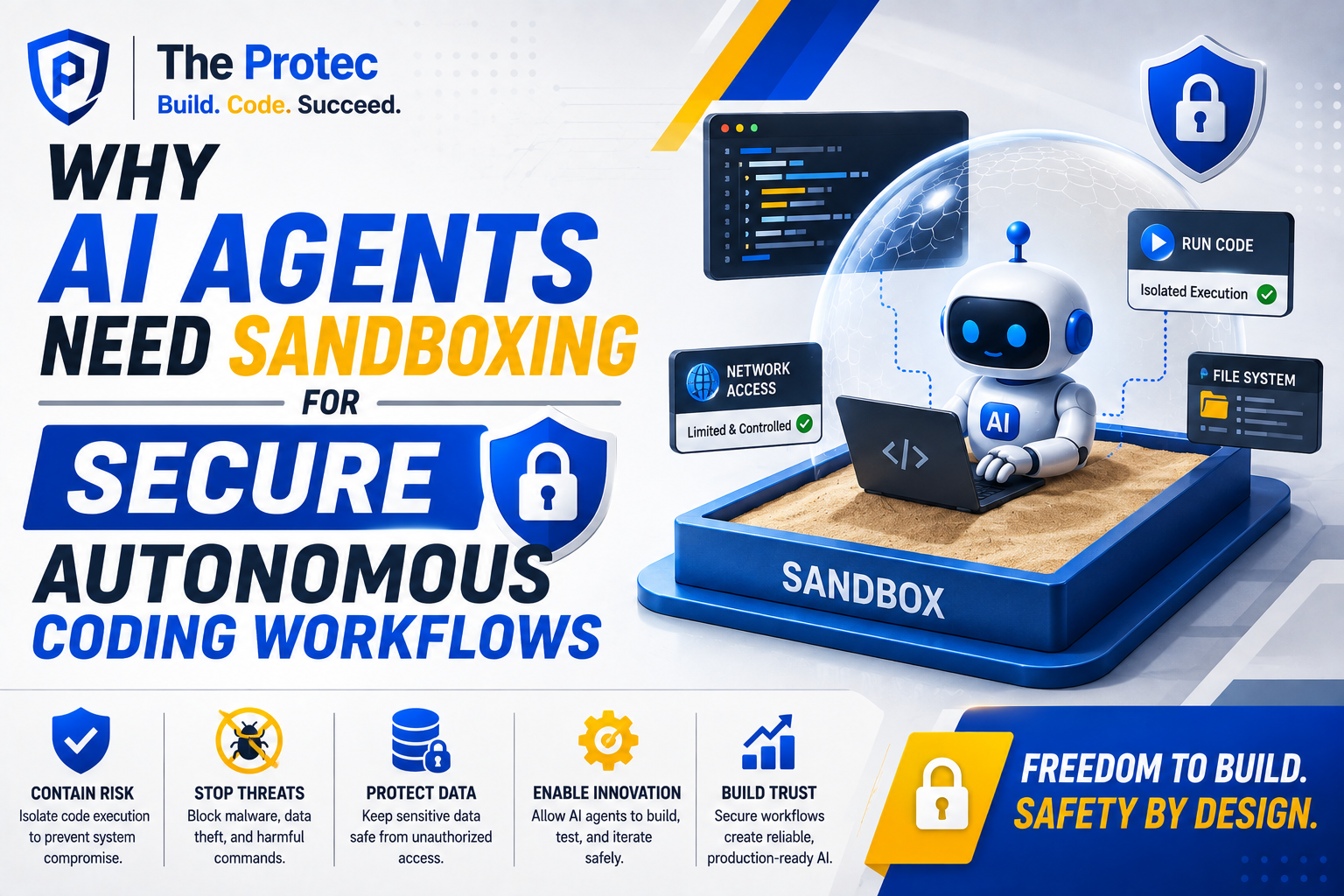
AI agent sandboxing answers that question by placing autonomous activity inside a controlled environment. Combined with least-privilege permissions, filesystem restrictions, network policies, secret isolation, and human approval gates, a sandbox turns unrestricted automation into bounded execution.
What Is AI Agent Sandboxing?
AI agent sandboxing is the practice of running an agent and its tools inside an isolated environment with explicitly limited access to the host system, files, network, credentials, processes, and external services. The sandbox may be implemented with a container, virtual machine, microVM, operating-system isolation mechanism, WebAssembly runtime, remote development environment, or a combination of controls.
The important characteristic is not the technology label. A container running as root with the host filesystem mounted is not a meaningful security boundary. A useful sandbox enforces policy even if the agent generates a dangerous command or a tool invoked by the agent becomes compromised.
Good sandboxes are also disposable. Each task can begin from a known image, receive only the necessary code and credentials, and be destroyed when the task ends. This reduces persistence, limits cross-task contamination, and makes behavior easier to reproduce during an investigation.
Why Autonomous Coding Agents Create a Distinct Risk
Traditional chat assistants return text for a person to review. Autonomous software agents act through tools, often across many steps. They may plan a change, search the web, modify source code, execute a package manager, run a shell, interpret the output, and try again. Small errors can compound throughout that loop.
Agents also process untrusted content. Source files, issue descriptions, documentation, websites, test output, dependency metadata, and tool responses may contain instructions that conflict with the operator’s intent. Prompt injection can exploit this boundary by persuading an agent to reveal information or misuse an available tool. When an agent can execute commands, the difference between manipulated text and a security incident may be a single tool call.
Other risks include hallucinated commands, destructive refactoring, dependency confusion, malicious install scripts, credential discovery, privilege escalation, and resource exhaustion. Long-running and multi-agent workflows add further complexity because permissions and untrusted data can pass between agents. Secure AI agents must therefore be designed on the assumption that model output is untrusted input to an execution system.
Core Controls for AI Coding Agent Security
No single safeguard is sufficient. Effective AI coding agent security uses overlapping controls so that a failure in one layer does not provide unrestricted access.
Isolate Code Execution
Shell commands, compilers, tests, and generated programs should run away from the developer’s workstation and production infrastructure. Ephemeral microVMs provide a strong boundary for higher-risk workloads, while hardened containers or restricted runtimes may suit lower-risk tasks. The choice should reflect the sensitivity of the code and the consequences of escape.
Run workloads as an unprivileged user, remove unnecessary Linux capabilities, apply syscall filtering, prevent access to host sockets, and set limits for CPU, memory, process count, storage, and execution time. Nested container access and mounted Docker sockets are especially dangerous because they can effectively grant control over the host.
Apply Least-Privilege Tool Permissions
An agent should receive only the tools required for its current task. A documentation agent does not need a shell, and a test-fixing agent may not need permission to publish packages or merge code. Tool permissions should distinguish between reading, writing, executing, deploying, and administering rather than treating access as all or nothing.
Capabilities should be short-lived and task-scoped. If an agent needs to create a branch, issue a token that can write only to the intended repository and expires after the session. High-impact actions such as merging, changing access controls, deploying, or deleting cloud resources should require separate authorization.
Restrict Filesystem Access
Filesystem isolation prevents an agent from wandering into home directories, SSH keys, browser profiles, cloud configuration, or unrelated repositories. Mount the target repository into a dedicated workspace and expose other files only when required. Base images and dependency caches can be read-only, while writes are confined to a temporary volume.
Path controls must account for symbolic links, traversal sequences, hard links, archive extraction, and race conditions. A policy that merely checks whether a requested path begins with an approved string is easy to bypass. Changes should also be recorded as a diff so reviewers can see exactly what the agent created, modified, or removed.
Control Network Egress and Ingress
Unrestricted internet access allows a compromised agent to exfiltrate code, download malware, contact command-and-control infrastructure, or interact with unauthorized APIs. Default-deny egress is the safest starting point. Permit only required destinations, protocols, and methods through an authenticated proxy, and log every request.
Package repositories deserve special handling. Use approved registries, internal mirrors, lockfiles, checksum verification, and dependency allowlists where practical. Block access to cloud instance metadata and private network ranges. Most coding sandboxes do not need inbound connectivity at all; when a preview server is necessary, expose it through a temporary authenticated gateway rather than opening the sandbox directly.
Keep Secrets Outside the Agent’s Reach
Do not place broad, long-lived credentials in environment variables or files the agent can inspect. Prefer a broker that issues narrowly scoped, temporary credentials after checking the requested operation. The agent may need permission to call a test API, but it rarely needs to see the underlying master token.
Redact secrets from prompts, command output, logs, and model traces. Canary credentials and automated secret scanning can help detect attempted leakage, but they do not replace isolation. If a credential is visible to the agent, assume it can appear in generated code, tool arguments, or outbound traffic.
Defend Against Software Supply Chain Threats
Installing a dependency executes code in many ecosystems, sometimes through lifecycle scripts. Agent-generated package names may also be incorrect, increasing the chance of typosquatting or dependency confusion. Require lockfiles, pin versions and image digests, scan artifacts, and disable install scripts unless they are necessary.
Build outputs should retain provenance linking them to the source revision, sandbox image, dependency set, and agent session. These practices align with broader guidance from the Open Source Security Foundation and make it harder for an agent session to introduce an unaudited artifact into a release.
Use Approval Gates for Irreversible Actions
Human oversight is most valuable at consequential boundaries, not after every harmless step. Agents can usually search code, edit a temporary branch, and run tests autonomously. Publishing a package, merging protected code, changing infrastructure, sending external messages, or accessing sensitive customer data should trigger approval.
The approval screen must show the exact action, parameters, destination, relevant diff, and requested permission. A vague prompt asking whether to let the agent continue encourages rubber-stamping. Approval should authorize one specific operation, not grant permanent elevated access.
A Secure Architecture for Agentic Development
A practical architecture separates reasoning from execution. The model proposes a structured tool call, while a policy enforcement layer validates the request before sending it to a sandbox. That layer checks the agent’s identity, task, allowed tools, path scope, network destination, risk level, and approval status. The sandbox then executes the operation and returns filtered output.
This design is increasingly important as agents connect to expanding tool ecosystems and standardized context interfaces. Tool descriptions are not security controls; the enforcement point must sit outside the model and remain authoritative even when instructions are manipulated.
Every action should produce an audit event containing the session identifier, tool, arguments, policy decision, result, resource usage, and associated code change. Sensitive fields should be redacted without making the log useless. Security teams can map these controls to governance frameworks such as the NIST AI Risk Management Framework, while retaining controls specific to code execution.
Common Sandboxing Mistakes
Running the agent in a container while mounting the host filesystem, credential directories, or container-management socket.
Allowing unrestricted outbound traffic because network filtering seems inconvenient during dependency installation.
Giving one shared service account to every agent, repository, and task.
Relying on system prompts to prohibit dangerous behavior instead of enforcing restrictions outside the model.
Preserving sandboxes indefinitely, allowing compromised state or secrets to survive between tasks.
Logging prompts and command output without redacting credentials, proprietary code, or personal information.
Sandboxing also does not prove that generated code is correct or secure. Static analysis, tests, dependency scanning, code review, and deployment protections remain necessary. The sandbox limits operational damage during the agent session; it does not validate every artifact the session produces.
Implementation Checklist for Secure AI Agents
Classify agent tasks by risk and define which actions may be autonomous, restricted, or approval-only.
Create minimal, reproducible sandbox images and run each task in a fresh environment.
Use non-root execution, syscall restrictions, resource quotas, and a strong host isolation boundary.
Mount only the required repository paths and keep sensitive host directories inaccessible.
Deny network access by default, then allow specific package registries and APIs through a monitored proxy.
Broker short-lived credentials instead of exposing reusable secrets to the model or workspace.
Require review for merges, releases, deployments, destructive commands, and privilege changes.
Record tool calls, policy decisions, filesystem changes, network activity, and produced artifacts.
Test the controls with prompt injection, malicious repositories, dependency attacks, path traversal, and sandbox escape scenarios.
Where AI Agent Sandboxing Is Heading
Agent security is shifting from simple command confirmation toward policy-driven execution. Ephemeral microVMs, remote sandboxes, capability-based credentials, signed tool definitions, and fine-grained egress brokers are becoming more relevant as agents work longer and use more services. Security testing is also expanding beyond model behavior to include the entire agent harness: tool adapters, context servers, plugins, approval interfaces, and credential brokers.
The durable principle is straightforward: autonomy must not imply ambient authority. Agents can be highly productive while operating inside narrow, observable boundaries. Organizations that build those boundaries early can adopt more capable agents without making every model mistake a host, repository, or cloud compromise.
Frequently Asked Questions
Is a Docker container enough for AI agent sandboxing?
Not automatically. A hardened container can be suitable for some low-risk tasks, but its security depends on configuration. Root execution, excessive capabilities, host mounts, privileged mode, or access to the Docker socket can defeat isolation. Sensitive workloads may require a microVM or full virtual machine as an additional boundary.
Should an AI coding agent have internet access?
Only when the task requires it, and preferably through a default-deny proxy. Allow specific registries, documentation sites, or APIs rather than unrestricted internet access. Block private networks and metadata services, inspect destinations, and log outbound requests to reduce exfiltration and malware risks.
How does sandboxing reduce prompt injection risk?
Sandboxing does not stop an agent from interpreting a malicious instruction, but it limits what the manipulated agent can do. Filesystem boundaries, network rules, tool permissions, and approval gates can prevent it from reading secrets, contacting an attacker, modifying protected resources, or executing high-impact actions.
Can sandboxing replace human code review?
No. AI agent sandboxing protects the execution environment and reduces blast radius. Human review and automated testing are still needed to catch insecure logic, subtle backdoors, licensing concerns, architectural mistakes, and code that passes tests while violating business requirements.