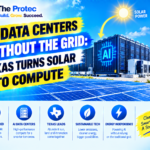




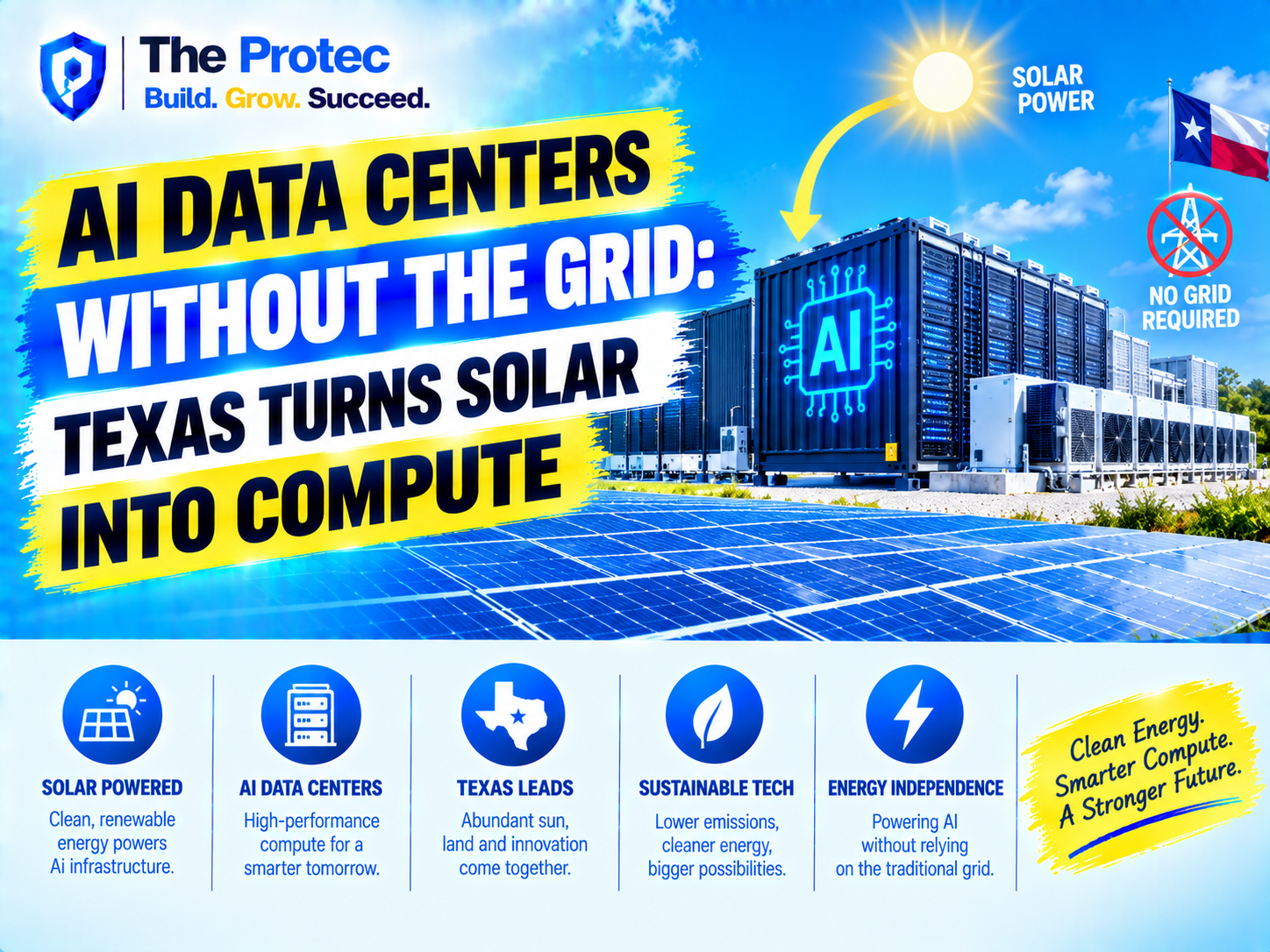
Texas has two fast-growing resources that do not always meet in the right place: abundant solar electricity and seemingly insatiable demand for AI computing power. Utility-scale solar farms can generate more electricity than nearby transmission lines or the regional market can absorb during bright, low-demand hours. At the same time, AI data centers are searching for enormous quantities of power, often in areas where a conventional data center grid connection could take years to secure.
That mismatch is creating an unconventional opportunity. Instead of moving every available megawatt of renewable electricity across a constrained grid, developers could move computing equipment closer to the energy. An off-grid AI data center or behind-the-meter facility located beside a Texas solar project could turn wasted solar power into model inference, data processing, rendering, or other valuable digital work.
The concept is not as simple as placing servers next to photovoltaic panels. Data centers require stable electricity, cooling, network capacity, security, and carefully managed hardware. Yet advances in batteries, modular facilities, power electronics, and workload orchestration are making solar-powered computing increasingly practical. Texas offers a real-world test of whether flexible AI infrastructure can help address both renewable-energy curtailment and soaring AI data center electricity demand.
Why Texas Is a Natural Test Bed for Solar AI Data Centers
Texas has become one of the largest solar markets in the United States, supported by strong sunlight, available land, competitive energy development, and the large wholesale market operated by the Electric Reliability Council of Texas. Solar generation is particularly concentrated in West and South Texas, while major electricity demand centers sit around Dallas-Fort Worth, Houston, Austin, and San Antonio.
This geographic separation matters. Building a solar project can be faster than constructing the high-voltage lines required to deliver all of its output to distant cities. When local generation exceeds demand or transmission capacity, wholesale prices may fall sharply and can even become negative. A renewable plant may then reduce its production because selling another unit of electricity has little or negative value.
Meanwhile, Texas AI data centers are joining semiconductor facilities, industrial plants, cryptocurrency mines, and population growth in pushing regional demand higher. Large computing campuses can require hundreds of megawatts, and their requests are forcing utilities and grid planners to reassess connection studies, generation adequacy, and transmission needs. The ERCOT generation information illustrates the scale and changing composition of the market serving this demand.
A solar AI data center can bridge these trends. By consuming electricity at or near a generation site, it may avoid some transmission bottlenecks, improve the economics of the solar asset, and create computing capacity without relying entirely on a traditional grid connection.
What Wasted and Curtailed Solar Power Actually Mean
Solar panels do not necessarily stop producing because society has enough electricity overall. Their output may be limited because the grid cannot use that electricity at that location and moment. Curtailment occurs when a generator is instructed or economically encouraged to reduce output that it could otherwise produce.
Several conditions can lead to curtailed solar power:
- Transmission lines between renewable-rich areas and load centers are congested.
- Solar output is high during midday while regional electricity demand is comparatively low.
- Other generators must remain online to provide reliability services or meet expected evening demand.
- Local substations and interconnection equipment cannot accommodate additional exports.
- Wholesale prices become too low to justify continued production.
This electricity is not physically stored somewhere and later discarded. It is energy that could have been generated but was not. A co-located computing facility creates a controllable customer for that otherwise uneconomic output. When solar production rises, servers can process more work. When clouds arrive or market prices make grid exports more valuable, the facility can reduce consumption or shift to stored energy.
The broader growth of solar generation documented by the U.S. Energy Information Administration makes this challenge relevant beyond Texas. However, Texas combines renewable scale, constrained transmission corridors, large tracts of developable land, and a business environment already familiar with flexible computing loads.
Off-Grid and Behind-the-Meter Designs
Not every solar powered data center would operate in the same way. The two most important models are fully off-grid facilities and behind-the-meter projects that retain some connection to the electricity system.
Fully off-grid AI data centers
A genuinely off-grid AI data center has no routine utility supply. Solar panels feed the facility through inverters and power-management equipment, while batteries stabilize voltage and provide short-duration backup. Additional firm generation may be included for emergency operations, although using fossil-fuel generators extensively would weaken the renewable-energy case.
This design can avoid a lengthy data center grid connection process, but it cannot promise conventional 24-hour capacity unless the project dramatically overbuilds solar and storage. For that reason, off-grid sites are best suited to interruptible work rather than services that must respond instantly at all times.
Behind-the-meter facilities
A behind-the-meter AI facility connects directly to a solar plant before electricity reaches the wider transmission system. It may still maintain a limited grid connection for backup, power quality, exports, or nighttime operation. This hybrid model offers more reliability while allowing the data center to consume energy that might otherwise be curtailed.
The arrangement also enables economic optimization. Software can compare the value of exporting a megawatt-hour with the value of using it for AI inference. Electricity can flow to whichever option creates more value, subject to interconnection rules and operating agreements.
The Infrastructure Required Near a Solar Farm
Cheap electricity alone does not create a functioning data center. Remote renewable sites often lack the supporting infrastructure found in established technology corridors. A viable solar AI data center needs several integrated systems.
- Modular computing capacity: Prefabricated data halls or containerized systems can be deployed in phases and matched to available generation.
- Power electronics: Inverters, transformers, switchgear, uninterruptible power supplies, and microgrid controls must deliver clean, stable power to sensitive accelerators.
- Battery storage: Batteries smooth second-to-second fluctuations, bridge passing clouds, support safe shutdowns, and extend operation beyond daylight hours.
- Efficient cooling: Texas heat raises cooling demand precisely when solar output is high. Direct-to-chip liquid cooling can reduce fan energy and support dense GPU racks more effectively than conventional air cooling.
- Fiber connectivity: High-capacity, redundant communications links are essential for moving datasets, receiving jobs, and returning results.
- Physical and cyber security: Remote sites require controlled access, surveillance, fire protection, monitoring, and resilient operational technology.
- Workload-control software: The computing scheduler must communicate with weather forecasts, battery controls, electricity prices, and solar production forecasts.
Water availability also deserves attention. Solar-rich locations may be hot and dry, making water-intensive cooling undesirable. Closed-loop liquid systems, dry coolers, and carefully designed heat-rejection equipment can limit consumption, although they may involve higher capital costs or reduced efficiency during extreme heat.
Why AI Inference Fits Variable Solar Power
AI training receives much of the attention because large training runs use thousands of accelerators. But training jobs can be sensitive to interruption. If power disappears unexpectedly, lost progress and idle hardware can become expensive, even when checkpointing is available.
Some AI inference energy demand is more flexible. Batch inference jobs such as document processing, video analysis, recommendation generation, synthetic-data creation, image rendering, and non-urgent model evaluation can be queued and executed when energy is abundant. A distributed platform could send time-sensitive requests to grid-connected regions while directing delay-tolerant jobs to solar-powered capacity.
This flexibility turns AI data center power consumption into a controllable load rather than a fixed obligation. Servers can ramp up around midday, scale down as solar production falls, and prioritize the most profitable jobs based on available electricity and service deadlines.
Not every inference application belongs off-grid. Search, financial transactions, autonomous systems, and interactive assistants often require low latency and continuous availability. The strongest early use cases are workloads with flexible timing, modest latency requirements, and the ability to move between sites. Over time, better workload orchestration could make renewable energy data centers part of a wider computing network rather than isolated facilities.
How Batteries Change the Economics
Battery storage is central to most practical designs, but using batteries to run an entire AI campus through every night would be expensive. The better approach is often to assign batteries several targeted roles.
A relatively short-duration battery can protect servers from rapid solar fluctuations, maintain power while workloads migrate, and prevent abrupt shutdowns. A larger battery can shift some afternoon production into the evening, when electricity prices and computing demand may be higher. It can also reserve enough energy for networking, security, control systems, and orderly server shutdowns.
Battery sizing therefore depends on the operating goal. A facility designed to maximize annual uptime needs more storage and solar capacity than one designed to consume only surplus energy. Developers must compare the value of additional computing hours with battery degradation, replacement costs, and the opportunity to sell stored electricity into the grid.
The result may be a layered system: direct solar for the bulk of AI data center energy, batteries for stability and limited time shifting, and a constrained grid connection for resilience. That structure can deliver meaningful reliability without waiting for the full utility capacity required by a conventional hyperscale campus.
Benefits for the Grid and Renewable Developers
Co-located computing could give solar developers revenue during periods when wholesale electricity has little value. This may improve project financing, reduce exposure to negative prices, and support renewable construction in areas where transmission expansion is lagging.
The grid may benefit when flexible facilities reduce consumption during scarcity and increase it during oversupply. Unlike a traditional data center designed for constant operation, a dispatchable computing campus could respond to market signals within minutes. It could lower demand during a grid emergency, preserve battery capacity for critical periods, or pause non-urgent jobs when local conditions tighten.
These advantages are not automatic. If a behind-the-meter project imports heavily at night or during extreme weather, it can add to peak demand rather than relieve it. Grid planners must evaluate the facility’s maximum import, ramping behavior, backup arrangements, and potential effect on local reliability. Transparent operating rules are essential if flexible AI infrastructure is to receive faster or smaller interconnections.
The Limitations of Turning Sunshine Into Compute
The idea does not eliminate the AI power problem. Solar production is seasonal and weather-dependent, while expensive accelerators generate the strongest financial returns when used frequently. Operating GPUs only during curtailed hours may save electricity costs but leave valuable equipment idle.
Remote sites can also face high fiber-construction costs, equipment maintenance challenges, dust, heat, and limited access to skilled technicians. Building dedicated solar and batteries requires substantial capital even when the underlying sunlight is free. Hardware replacement cycles may be shorter than the lifespan of the energy infrastructure.
There are environmental trade-offs as well. Large projects use land, batteries require minerals, and data centers consume materials and water. Developers should measure avoided curtailment, actual carbon intensity, water consumption, and lifecycle impacts rather than labeling every co-located project sustainable.
Most importantly, surplus solar is not permanently free. As batteries, transmission, hydrogen production, industrial electrification, and other flexible loads expand, they will compete for the same low-cost electricity. A solar AI data center must create enough value per megawatt-hour to win that competition.
Could Texas Solve Two Energy Problems at Once?
Texas will still need transmission expansion, new generation, storage, and stronger efficiency standards. Co-located AI infrastructure is not a substitute for a reliable electric system. It is a complementary strategy that can put constrained energy to work while larger grid projects move forward.
The most credible near-term model is likely a modular, behind-the-meter solar AI data center with batteries, limited grid access, liquid cooling, and software that schedules flexible inference workloads around energy availability. Such a facility can begin at a manageable scale and expand when solar utilization, network performance, and computing revenue justify additional capacity.
If operators can coordinate energy and computing as one system, Texas data center power constraints may become a catalyst for a different kind of infrastructure. Instead of demanding uninterrupted electricity first and choosing workloads second, developers can start with available renewable energy and build computing services that adapt to it. That shift could turn curtailed sunlight from a grid-management problem into a valuable source of AI computing power.
Frequently Asked Questions
Can an AI data center operate entirely on solar power?
Yes, but a fully off-grid facility must adapt its workloads to solar availability or use substantial battery storage and backup generation. Flexible batch inference is a better fit than always-on, latency-sensitive services. Most commercial projects are likely to use a hybrid configuration that combines direct solar, batteries, and limited grid support.
Why not transmit surplus Texas solar electricity to cities?
Transmission remains an important long-term solution, but major power lines are expensive and can take years to permit and construct. Local grid equipment may also be congested before electricity reaches the main transmission network. Co-located computing can consume some surplus generation without requiring every megawatt to travel to a distant load center.
Do batteries make solar AI data centers reliable?
Batteries improve power quality, smooth fluctuations, provide shutdown time, and extend operating hours. However, enough storage for continuous operation through long cloudy periods can be costly. Reliability depends on battery duration, excess solar capacity, workload flexibility, and whether the facility retains a grid connection.
Which AI workloads work best with curtailed solar power?
Delay-tolerant inference, media processing, synthetic-data generation, model evaluation, rendering, and other queue-based jobs are strong candidates. Applications requiring immediate responses or guaranteed continuous service generally need grid-connected capacity or enough backup resources to maintain uptime.
Will solar-powered data centers reduce AI energy consumption?
They do not necessarily reduce the total electricity used by AI. Their primary benefit is changing where and when that electricity is consumed. By matching computing with renewable oversupply, they can reduce curtailment, limit pressure on constrained transmission, and lower the carbon intensity of suitable workloads.