








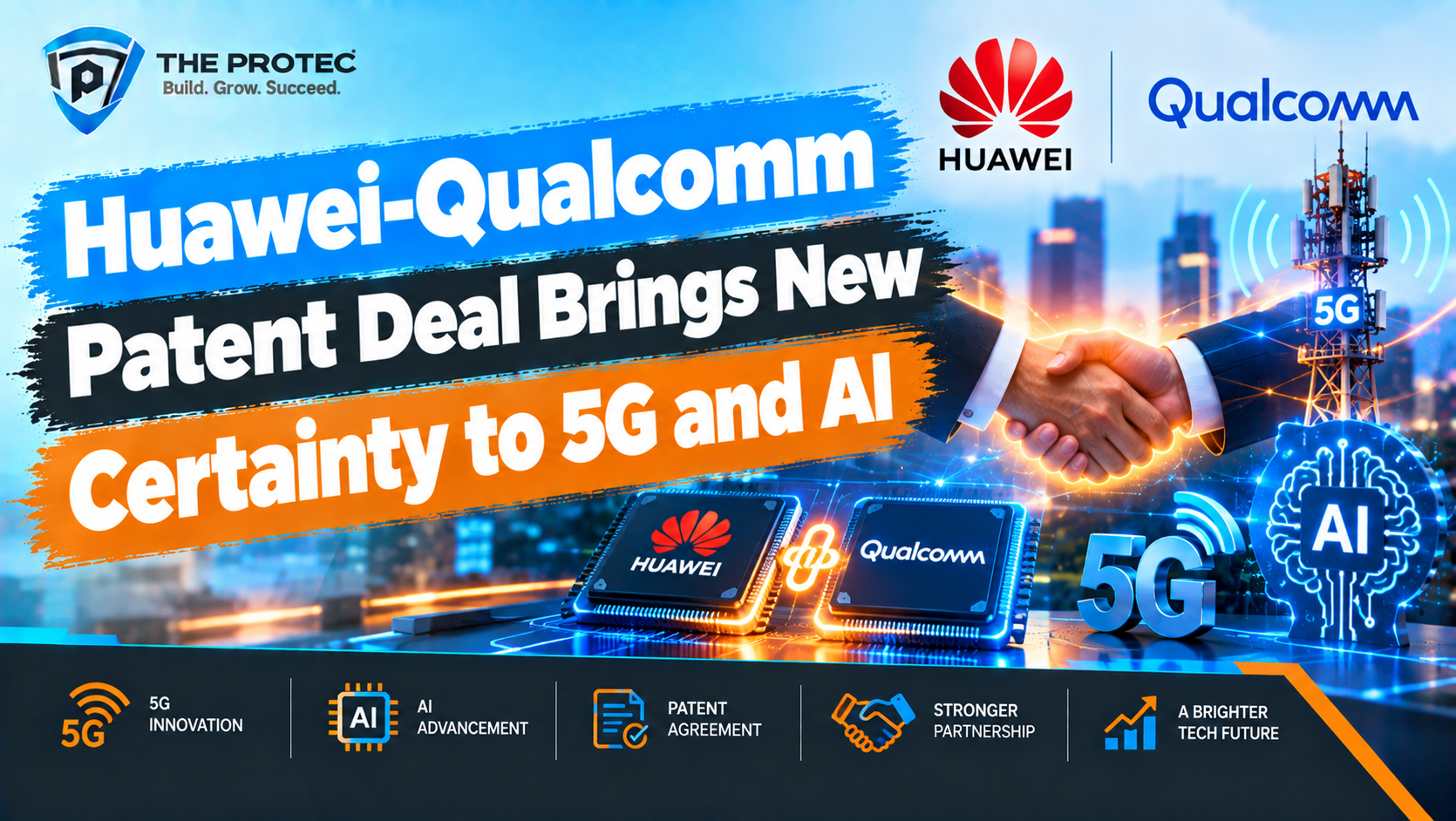
Huawei and Qualcomm have reached a multiyear patent agreement/deal covering technologies central to the connected economy: 5G, artificial intelligence, computing and networking. The arrangement is significant not because it transforms the two companies into conventional business partners, but because it establishes a clearer framework for using protected technology across industries in which their patent portfolios, products and commercial interests frequently intersect.
The Huawei Qualcomm patent deal arrives as smartphones, vehicles, industrial equipment, data centers and edge devices incorporate an expanding mix of wireless and computing capabilities. A single connected product can implement thousands of patented inventions, including technologies required by cellular standards and features developed outside those standards. Predictable licensing is therefore becoming as important to technology deployment as access to chips, software and network equipment.
For Huawei and Qualcomm, the multiyear structure can reduce uncertainty surrounding intellectual-property rights while allowing each company to preserve its independent product, research and licensing strategies. However, the scope of the agreement should not be overstated: patent licensing does not necessarily involve joint product development, chip supply commitments or a broader commercial alliance.
What the Huawei Qualcomm Multiyear Agreement Covers
The confirmed framework is a multiyear patent agreement spanning 5G, AI, computing and networking technologies. Those categories reflect the increasing convergence of wireless communications and general-purpose computing. Modern devices no longer treat connectivity, processing and intelligence as separate functions; they combine them to support capabilities such as on-device AI, cloud services, autonomous systems and real-time industrial applications.
The agreement gives the companies a defined licensing relationship for relevant intellectual property over multiple years. That can be more useful than a short-term arrangement because product development cycles, network investments and standards work often extend across several generations of technology.
Public descriptions of the deal do not establish every commercial detail. Unless disclosed by the companies, it is not appropriate to assume a specific royalty rate, payment amount, geographic allocation, patent-by-patent valuation or effect on quarterly earnings. It is also important not to characterize the arrangement as an unrestricted transfer of technology. A patent license generally grants defined rights under agreed conditions; ownership of the Huawei technology patents and the Qualcomm patent portfolio remains with the respective rights holders.
Why 5G Patent Licensing Is Strategically Important
The 5G portion of the Huawei Qualcomm licensing agreement carries particular weight because both companies have invested heavily in wireless research and contributed technology to global cellular development. Huawei has extensive interests across network infrastructure, devices and communications research, while Qualcomm has built a major wireless chip and patent-licensing business.
Many inventions used in mobile networks are standard-essential patents, or SEPs. A patent is considered essential when implementing a technical standard requires using the patented invention. Companies producing standards-compliant phones, modems, connected vehicles or other wireless products may therefore need licenses from multiple SEP owners.
Organizations such as 3GPP develop the technical specifications underpinning cellular systems, while intellectual-property policies help establish how essential patents are declared and licensed. SEP owners commonly make commitments to offer licenses on fair, reasonable and non-discriminatory terms, generally known as FRAND. The ETSI intellectual-property framework is one prominent part of that standards ecosystem.
For patent holders, 5G patent licensing can generate returns that fund long-term research. For manufacturers, a license provides legal certainty to implement standardized technology. The system must balance those interests: royalty demands that are perceived as excessive can slow adoption, while weak protection can reduce incentives to invest in foundational wireless research.
What the Deal Means for Each Company’s IP Strategy
Huawei gains greater licensing predictability
Huawei operates across devices, telecommunications equipment, cloud computing and enterprise technology. That broad footprint can create exposure to patents owned by other major research companies, including Qualcomm. A multiyear agreement gives Huawei more predictable rights within the covered areas and may reduce the possibility that unresolved licensing questions disrupt long product cycles.
The deal also reinforces Huawei’s role as a major technology intellectual-property owner. Licensing is not only about obtaining permission to use another company’s inventions; it is also a way to establish value for a company’s own research portfolio. As Huawei expands patent monetization and licensing activity, negotiated agreements can support its objective of earning returns from research while demonstrating that it also participates as a licensee where appropriate.
Qualcomm reinforces its licensing model
Qualcomm’s business extends beyond selling Snapdragon processors and modem technology. Its patent portfolio covers foundational wireless inventions as well as developments in AI, computing and connectivity. Licensing that intellectual property has long been an important part of the company’s strategy.
The Qualcomm Huawei technology agreement supports that model by placing relevant rights within a longer-term contractual framework. It also illustrates why the Qualcomm patent portfolio can retain value even where the companies’ hardware businesses face different market conditions. Patent rights and semiconductor sales are related but legally distinct. A licensing agreement can exist without requiring Qualcomm to supply a particular chip or guaranteeing Huawei access to specific components.
How Licensing Supports Global Wireless and Computing Deployment
Telecom patent licensing allows standardized inventions to be used across products made by many companies. That interoperability is essential to global 5G technology: a device produced in one market must communicate with networks and equipment built by different vendors elsewhere.
The same principle is becoming more relevant to AI technology patents, computing technology patents and networking inventions. Connected products increasingly combine cellular modems, neural-processing capabilities, security functions, cloud connectivity and edge computing. Uncertainty over any layer can complicate investment decisions or create the risk of litigation after a product reaches the market.
A broad, multiyear licensing framework can provide several practical benefits:
- Greater visibility for product and network planning across multiple development cycles.
- Lower risk of disputes over covered intellectual property.
- More consistent access to patented technology used in connected devices.
- Stronger incentives for both companies to continue funding advanced research.
- A clearer basis for valuing wireless technology licensing and related patent portfolios.
These benefits do not eliminate every possible intellectual-property disagreement. The companies have large portfolios, and the precise boundaries of any license depend on its contract. Still, a negotiated framework can narrow the areas of uncertainty and create mechanisms for handling licensing issues without immediately turning to litigation.
Competitors, Counterparties and Not Necessarily Partners
Huawei and Qualcomm have a complex relationship because they participate in overlapping parts of the technology market. Qualcomm is a leading supplier of mobile processors and modem platforms. Huawei has designed devices, developed chips through its semiconductor operations and supplied telecommunications infrastructure. Both companies also conduct substantial wireless research and hold patents relevant to cellular standards.
That history makes the Huawei Qualcomm intellectual-property agreement commercially meaningful, but describing it as a full Huawei Qualcomm partnership would be misleading. Companies can compete in chips, devices, networking and infrastructure while simultaneously licensing patents to one another. Such arrangements are common in industries where no single participant owns every invention needed to build a standards-compliant product.
The agreement also should not be interpreted as proof that the companies are jointly designing devices, combining product road maps or coordinating market strategy. Nor does a patent license automatically override trade controls, export restrictions or regulatory requirements that may apply to semiconductor transactions. Intellectual-property permission is only one element of bringing a technology product to market.
Licensing Certainty Can Reduce Disputes and Support Innovation
Patent disputes are costly and can span multiple jurisdictions. They may involve arguments over whether a patent is valid, whether a product infringes it, whether the patent is essential to a standard and whether licensing terms satisfy FRAND obligations. Resolving those questions through negotiated agreements can save time and reduce the risk of injunctions or supply-chain disruption.
The Huawei Qualcomm business deal provides a measure of certainty because it replaces at least part of that potential conflict with agreed licensing terms. A multiyear duration is especially valuable in telecom, where research conducted today may not generate commercial returns until future standards and products are widely deployed.
Licensing revenue can then be reinvested in areas such as advanced radio systems, energy-efficient computing, AI acceleration, network automation and next-generation connected devices. Licensees benefit from the ability to implement proven inventions without having to recreate every foundational technology independently.
What Is Confirmed—and What Remains Unknown
The confirmed elements are the multiyear nature of the arrangement and its coverage of major technology areas including 5G, AI, computing and networking. Those facts support the conclusion that both companies wanted a broader period of licensing stability.
Financial outcomes should be treated more cautiously. Without detailed disclosure, observers cannot reliably calculate net payments, future revenue, royalty offsets or the agreement’s profit impact. It is equally unsafe to infer exclusivity, ownership transfers or joint engineering programs. The sound interpretation is narrower: two major technology companies have established contractual rights for covered patents while remaining independent competitors.
Why the Agreement Matters Beyond Huawei and Qualcomm
The deal reflects a wider shift in the technology industry. Wireless connectivity is spreading into cars, factories, medical equipment, energy systems and intelligent edge devices. At the same time, AI functions are moving from centralized clouds into phones, PCs, vehicles and network infrastructure. This convergence expands the number of companies that may encounter wireless, computing and AI patents.
Well-structured semiconductor patent licensing and networking patent agreements can help manage that complexity. They establish a route for innovators to receive compensation while enabling manufacturers to deploy interoperable technology at scale. The Huawei Qualcomm patent deal is therefore relevant not only to two corporate portfolios, but also to the broader debate over how intellectual property should support competition, standardization and continued research.
Frequently Asked Questions
Does the patent deal mean Huawei and Qualcomm are developing products together?
No joint product-development program is implied by a patent license alone. The agreement concerns rights to covered intellectual property. It does not necessarily include shared engineering, coordinated product launches, semiconductor supply or joint ownership of future inventions.
Why are 5G standard-essential patents so valuable?
SEPs can be required to implement standardized cellular functions. Because compatible devices and networks may need those inventions, the patents can have broad commercial relevance. Their value is balanced by licensing commitments intended to make standardized technology available on FRAND terms.
Does the agreement disclose how much either company will pay?
The existence and technology scope of the multiyear arrangement do not, by themselves, reveal its complete financial structure. Royalty rates, offsets, payment schedules and expected earnings effects should not be assumed unless they are specifically disclosed.
Can a patent license allow restricted chip sales?
Not automatically. Patent rights, product sales and government authorizations are separate matters. A license may address intellectual-property permission, but semiconductor shipments can still be subject to export rules, trade restrictions and other regulatory requirements.
The Bottom Line
The Huawei Qualcomm multiyear agreement gives both companies greater clarity across 5G, AI, computing and networking patents. It strengthens the role of licensing as a bridge between competitors, reduces some intellectual-property uncertainty and supports the wider deployment of connected technologies. Its significance lies in predictable patent access—not in an assumed commercial partnership or undisclosed financial windfall.