








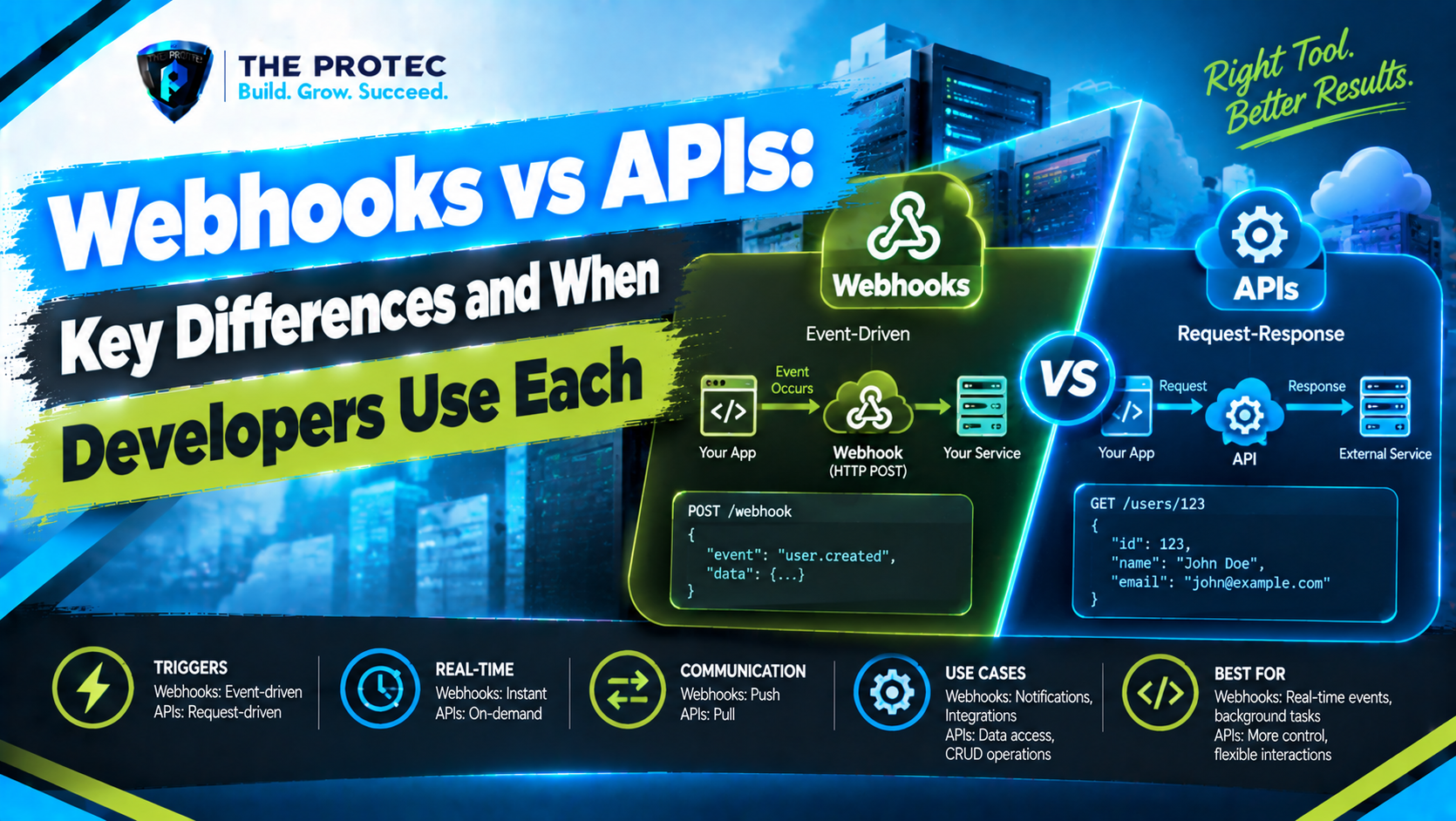
A customer completes a payment, an order ships, or a sales lead changes status. How should another application learn about it? Developers can repeatedly ask for the latest state through APIs, or the system that owns the data can send webhooks when the event occurs.
That distinction drives the webhooks vs APIs discussion, but it does not make the technologies competitors. A REST API integration is usually designed for requesting data or initiating an action. Webhook architecture reverses the direction: the provider initiates an HTTP request to notify a subscriber about an event. Reliable integrations commonly use both.
Understanding when to request state, when to receive API event notifications, and how to recover when either mechanism fails is essential for modern payment, e-commerce, CRM, and SaaS integrations.
Webhooks vs APIs: The Fundamental Difference
How request-response APIs work
An API exposes operations that a client can call when it needs them. The client sends a request, such as GET /orders/123 or POST /customers, and waits for a response. The client controls the timing and usually receives either the requested resource, confirmation of an action, or an error.
Conventional APIs are ideal for interactive and query-driven work: loading an account dashboard, searching a product catalog, creating a subscription, or retrieving an authoritative record. They support immediate feedback and often provide filtering, pagination, validation, and predictable resource models.
Webhooks explained
A webhook is an event notification delivered from one system to another, commonly as an HTTP POST containing JSON. Instead of asking whether an order has shipped, the receiving application supplies an endpoint and waits for an order.shipped event.
The provider controls when delivery begins, while the consumer controls how the event is validated and processed. This is a lightweight form of event-driven architecture. Webhooks are especially useful when changes are unpredictable, timely processing matters, and repeated status checks would create unnecessary traffic.
How API Polling Works—and Where It Falls Short
API polling means calling an endpoint on a schedule to detect changes. A CRM connector might request updated contacts every five minutes using a timestamp cursor. A fulfillment service might check an order endpoint every 30 seconds until the status becomes ready_to_ship.
Polling is straightforward and gives the client control, but its interval creates a trade-off. Short intervals improve freshness while increasing request volume, rate-limit pressure, compute use, and cost. Long intervals save resources but delay updates. Most requests may return no change at all.
Polling still has valid uses. It works when a provider offers no webhooks, when updates are infrequent and delay is acceptable, or when a scheduled reconciliation job must verify that no event was missed. Incremental endpoints, change tokens, ETags, and conditional requests can make API polling more efficient.
Webhook vs REST API at a Glance
- Initiator: An API client initiates a request; a webhook provider initiates an event delivery.
- Timing: APIs run on demand or on a polling schedule; webhooks run when relevant events occur.
- Primary purpose: APIs retrieve state or execute commands. Webhooks announce that something changed.
- Latency: Webhooks can support near-real-time integrations without aggressive polling. API latency depends on when the client makes its next request.
- Availability: An API client can call when ready, but a webhook endpoint must be reachable when deliveries arrive or rely on provider retries.
- Data model: APIs often return complete resources. Webhooks may contain a snapshot, a small event payload, or only a resource identifier.
- Failure handling: API callers can react directly to errors. Webhook consumers must account for retries, duplicate events, delays, and out-of-order delivery.
Practical Webhook and API Integration Scenarios
Payment gateway webhooks
A checkout application uses an API to create a payment intent, but it should not rely solely on the browser redirect to confirm payment. Authentication steps, delayed payment methods, network failures, and disputes can change the payment asynchronously. Payment gateway webhooks notify the server about events such as payment completion, failure, refund, or chargeback.
After receiving the notification, the application can call the payment API to retrieve the current transaction before fulfilling the order. Provider-specific requirements matter; for example, the official Stripe webhook documentation describes signature verification, retries, and event handling for its platform.
E-commerce and fulfillment
An online store can use APIs to create shipments, update inventory, and display order details. Webhooks can announce inventory changes, shipment creation, delivery, or cancellation. This avoids polling thousands of orders while allowing warehouse and customer-notification systems to respond quickly.
A nightly API reconciliation remains valuable. It can compare orders, payments, and shipments to repair discrepancies caused by configuration mistakes, extended downtime, or expired webhook retention windows.
CRM synchronization
A marketing platform may receive webhooks when a contact, company, or opportunity changes. The event triggers targeted synchronization rather than a complete account scan. The consumer can then request the latest CRM record through the API, apply field mappings, and store a synchronization cursor.
This pattern is safer than treating every event payload as a permanent source of truth. A rapid sequence of edits may arrive out of order, while the API exposes the current authoritative state.
SaaS integrations and automation
Collaboration, identity, support, and developer platforms use webhooks for events such as a ticket assignment, repository update, account deactivation, or document approval. APIs perform the follow-up work: adding a comment, provisioning access, updating a workflow, or fetching additional context.
Serverless receivers, durable queues, event catalogs, and AsyncAPI contracts have made this combined approach easier to operate across large SaaS ecosystems. The goal is not simply faster notifications, but observable and recoverable automation.
Combining APIs and Webhooks for Reliable Integrations
A robust design treats the webhook as a trigger and the API as a command or state interface. A typical flow looks like this:
- The application uses an API to create or modify a resource.
- The provider later sends a webhook describing a state transition.
- The receiver verifies the signature and checks the event identifier.
- The event is committed to durable storage or a queue before a success response is returned.
- A worker retrieves authoritative state from the API when necessary.
- The worker applies an idempotent local update and records the result.
- A scheduled API reconciliation detects anything that was missed.
Conceptually, a webhook implementation can follow this pattern:
receive(rawBody, headers):
  verifySignature(rawBody, headers.signature, secret)
  event = parse(rawBody)

  transaction:
    insert event.id with unique constraint
    enqueue event for processing

  return HTTP 202

worker(event):
  resource = api.get(event.resourceId)
  applyUpdateOnce(resource, event.id)
The unique event record makes repeated delivery harmless. The durable queue separates fast acknowledgement from slower business logic. Fetching the resource protects the consumer when the webhook contains limited data or an older state.
Webhook Implementation, Security, and Reliability
Verify signatures before trusting payloads
Webhook security should begin with HTTPS and cryptographic webhook signature verification. Compute or validate the signature against the exact raw request body—not parsed and reserialized JSON—using the provider’s documented algorithm. Compare signatures in constant time, validate a signed timestamp to limit replay attacks, and rotate secrets safely.
Standardized HTTP message signing is also maturing across the ecosystem; RFC 9421 defines HTTP Message Signatures. Regardless of format, never assume a request is legitimate merely because it reached an obscure URL or came from an allowlisted address.
Design for webhook retries
Providers generally retry when an endpoint times out or returns a non-success status, but retry schedules and retention periods differ. Consumers should acknowledge accepted events quickly and move substantial processing to a queue. Providers should use bounded exponential backoff with jitter and expose delivery history or manual redelivery controls.
Return a failure response when an event could not be durably accepted. Returning success before persistence can silently lose data. Conversely, do not make the provider wait for slow API calls, email delivery, or complex workflows.
Use idempotency to handle duplicate webhook events
At-least-once delivery means duplicates are normal, not exceptional. Handling duplicate webhook events usually requires a stable event ID stored under a unique database constraint. Business operations should also be idempotent. For example, recording that order 123 is paid is safer than blindly incrementing its payment count.
Idempotency in webhooks must cover concurrency. Two deliveries can arrive simultaneously, so an in-memory check is insufficient. Use transactional inserts, compare-and-set updates, or an idempotency table shared by all receiver instances.
Expect endpoint outages and unordered events
Webhook endpoints can become unavailable during deployments, DNS failures, scaling events, or regional incidents. Run receivers behind resilient infrastructure, monitor success rates and latency, and retain events long enough for recovery. A dead-letter queue can isolate events that repeatedly fail inside the consumer.
Do not assume event ordering unless the provider guarantees it for a documented scope. Compare resource versions, sequence numbers, or update timestamps where available. When ordering is unclear, retrieve current state through the API and prevent an older event from overwriting newer data.
Log the full delivery lifecycle
Useful logging connects the provider’s event ID, delivery attempt, event type, account, HTTP result, queue message, processing outcome, and correlation ID. Redact secrets and sensitive payload fields. Metrics should reveal verification failures, duplicate rates, queue age, processing latency, retry volume, and permanently failed events.
Schema validation is equally important. Version event contracts, tolerate additive fields, and route unknown event types safely. Alerting should focus on sustained failure patterns rather than every expected retry.
When Should Developers Use Each?
Choose a conventional API when a user or process needs an immediate answer, must search or filter data, wants to create or update a resource, or requires control over request timing. Choose webhooks when another system must react promptly to unpredictable changes and polling would waste requests.
Use API polling when webhook support is unavailable, delayed synchronization is acceptable, or reconciliation is required. For business-critical real-time integrations, combine all three ideas: webhooks for timely triggers, APIs for commands and authoritative reads, and periodic polling for recovery.
Frequently Asked Questions
Are webhooks a type of API?
A webhook is an HTTP-based callback interface, so it can be considered an API pattern. The practical difference is control: a conventional API waits for the consumer to make a request, while a webhook sends an event to a consumer-registered endpoint.
Are webhooks always real time?
No. Webhooks are usually near real time, but queues, provider workloads, retries, and endpoint outages can introduce delays. Systems should monitor event age and avoid assuming instantaneous delivery.
Can webhooks replace API polling completely?
Not always. Polling remains useful for reconciliation, backfills, unsupported event types, and recovery after extended downtime. A hybrid webhook vs API polling strategy is often the most reliable choice.
What HTTP status should a webhook endpoint return?
Return a documented 2xx status after the event has been authenticated and durably accepted. Return an appropriate failure status when validation fails or durable acceptance is impossible. Provider rules vary, so follow the specific delivery contract.