







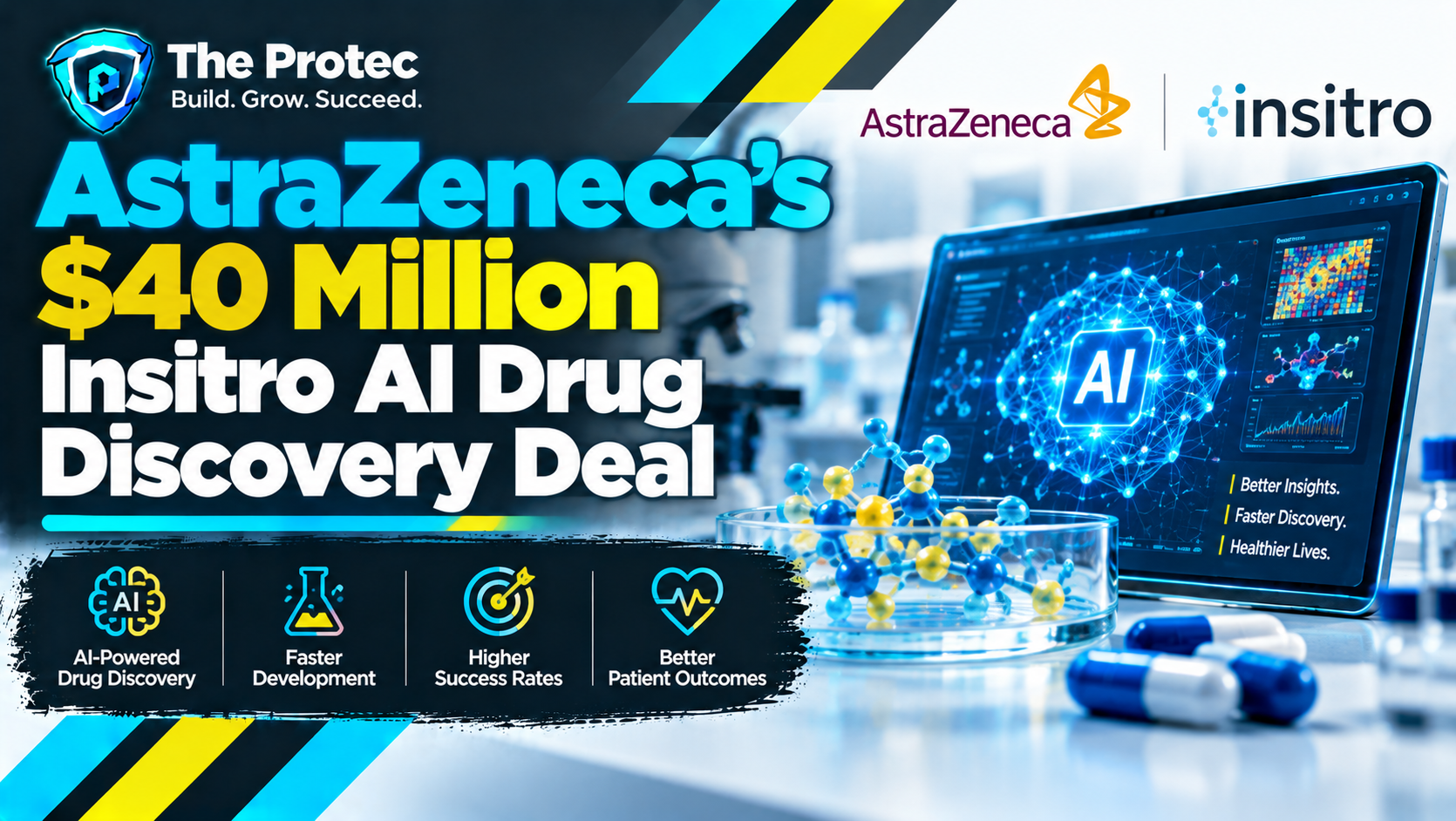
The reported AstraZeneca $40 million deal with Insitro is another clear sign that artificial intelligence is moving deeper into the pharmaceutical research process. Rather than treating AI as a standalone experiment, major drugmakers increasingly are using machine learning, computational biology and large biological datasets to help decide which disease mechanisms deserve further investigation.
The AstraZeneca Insitro deal brings together two different but complementary organizations. AstraZeneca contributes global drug development experience, therapeutic expertise and the infrastructure needed to move promising discoveries toward clinical testing. Insitro, a biotechnology company built around data-driven research, contributes a platform designed to analyze complex human biology, generate experimentally useful hypotheses and identify patterns that conventional methods may miss.
The headline value is important, but it does not mean AI has already produced a successful medicine. The agreement concerns discovery research, where uncertainty remains high. Any targets or therapeutic candidates emerging from the collaboration would still need laboratory validation, preclinical evaluation, human clinical trials and regulatory review. Understanding that distinction is essential when assessing both the deal and the wider promise of AI-powered drug discovery.
What Has Been Reported About the AstraZeneca Insitro AI Deal?
The collaboration has been described as a $40 million AI drug discovery agreement. That figure represents the principal publicly reported financial commitment associated with the partnership. It should not automatically be interpreted as the value of a market-ready drug, a guaranteed return for Insitro or proof that AstraZeneca will advance a candidate into clinical trials.
Public deal announcements often separate economics into several categories, including upfront payments, research funding, option fees, development milestones, regulatory milestones, commercial milestones and royalties. Unless the companies explicitly describe how every dollar is allocated, the reported $40 million figure should not be recast as entirely upfront cash or as the collaboration’s maximum possible lifetime value.
The safest reading is that AstraZeneca has committed meaningful capital to access Insitro’s machine learning and computational discovery capabilities within an agreed research framework. Public disclosures do not necessarily identify every target, biological pathway or candidate under consideration. They also should not be read as confirmation that a specific disease program has reached preclinical or clinical development unless the companies announce that progression separately.
Readers can monitor the companies’ respective corporate updates through the official AstraZeneca media center and Insitro news page. These primary sources are the appropriate reference points for future disclosures about research areas, milestones or candidate advancement.
How Insitro’s Artificial Intelligence Platform Supports Discovery
Insitro’s artificial intelligence strategy is based on combining high-quality biological experiments with machine learning. That combination matters because an algorithm is only as useful as the data, experimental design and scientific questions behind it. A model trained on incomplete or poorly controlled information can produce confident-looking predictions that fail when tested in a laboratory.
The Insitro drug discovery platform is intended to build and analyze large datasets that connect biological features with disease-related outcomes. Those datasets may include genetic information, cellular measurements, imaging data, molecular profiles and results from perturbation experiments in which researchers alter genes or expose cells to compounds. Machine learning can then search for relationships across far more variables than scientists could efficiently evaluate by hand.
This approach can support pharmaceutical research in several ways:
- Characterizing disease biology: Models can help divide a broadly defined disease into biologically distinct subgroups, potentially revealing why patients with the same diagnosis respond differently.
- Identifying potential targets: Genetic and cellular evidence can be combined to find proteins, pathways or mechanisms that appear to influence disease.
- Testing causal hypotheses: Laboratory perturbation data can help researchers distinguish a mechanism that contributes to disease from a feature that is merely correlated with it.
- Prioritizing candidates: Computational models can rank compounds or therapeutic strategies according to predicted activity, selectivity and other desirable characteristics.
- Finding measurable biomarkers: Data-driven analysis can suggest biological signals that may help identify suitable patients or monitor whether a treatment is affecting its intended pathway.
For AstraZeneca AI drug discovery teams, the value is not simply faster data processing. The larger opportunity is to improve decision quality at the beginning of development, before a company invests heavily in manufacturing, toxicology studies and clinical trials.
How the Companies’ Responsibilities May Complement Each Other
In a typical AstraZeneca biotechnology partnership of this kind, the technology company leads platform-based discovery work while the pharmaceutical partner contributes disease expertise and downstream development capabilities. The exact division of work is governed by the collaboration agreement, and not every operational detail is made public.
Insitro’s responsibilities can include creating disease-relevant datasets, applying machine learning models, analyzing genetic or cellular evidence and proposing targets or therapeutic hypotheses. Its scientists may also conduct experimental validation to determine whether a computational finding can be reproduced in biological systems.
AstraZeneca’s research and development organization can evaluate those findings in the context of existing scientific knowledge, portfolio priorities and drug development requirements. The company has capabilities spanning medicinal chemistry, translational science, safety testing, clinical development, regulatory strategy and commercialization. If a discovery program meets agreed criteria, AstraZeneca may be positioned to undertake or lead the resource-intensive stages needed to turn a research hypothesis into an investigational therapy.
This division of responsibilities illustrates why AI healthcare partnerships are expanding. A biotechnology startup may have a specialized platform and a highly focused technical team but lack the infrastructure to conduct multinational clinical trials. A large pharmaceutical company may have that infrastructure but benefit from external innovation, differentiated datasets and new methods of investigating disease.
Why Pharmaceutical Companies Are Investing in AI Discovery
Traditional drug discovery is slow, expensive and marked by high failure rates. Many projects fail because the original target is not sufficiently connected to human disease, the compound has unacceptable safety properties or results from experimental models do not translate into patients. Machine learning drug development cannot remove those risks, but it may help researchers address them earlier.
Better target selection
Selecting the wrong biological target can undermine an entire development program. AI pharmaceutical research can integrate evidence from human genetics, molecular biology and laboratory experiments to rank targets according to the strength and consistency of their disease connection. This does not prove that a target will work, but it can provide a more systematic basis for deciding which hypotheses deserve investment.
More efficient experimentation
Drug discovery requires researchers to choose among enormous numbers of possible experiments and chemical structures. Computational drug discovery can narrow that search space, directing laboratory teams toward experiments with greater expected information value. The benefit may come from avoiding low-priority work rather than instantly discovering a finished medicine.
Detection of overlooked biological patterns
Human biology contains nonlinear relationships and interactions across genes, proteins and cell states. Machine learning may detect patterns that are difficult to identify with traditional statistical analysis. Those patterns can suggest unexpected disease mechanisms, patient subgroups or opportunities to repurpose a therapeutic approach.
Stronger portfolio decisions
Pharmaceutical industry innovation also depends on stopping weak programs before they consume substantial resources. AI-assisted models may help companies compare opportunities, quantify uncertainty and identify missing evidence. A negative recommendation can be valuable if it prevents years of investment in an unsupported hypothesis.
The $40 Million Figure Does Not Eliminate Scientific Risk
The 40 million dollar AI deal demonstrates commitment, but financial investment should not be confused with scientific validation. Discovery partnerships are structured around uncertainty. The companies may investigate several hypotheses before finding one that meets the required standard, and some collaborations end without producing a clinical candidate.
An AI system can generate a plausible target that fails when researchers manipulate it in cells or animals. A molecule can behave well in a computational model but prove difficult to synthesize, insufficiently selective or toxic. Even a candidate that performs well in preclinical studies may fail to demonstrate safety or efficacy in human trials.
Biological data can also contain hidden biases. Patient samples may not represent the full population affected by a disease. Measurements can vary among laboratories, instruments or experimental batches. Models may learn technical artifacts instead of meaningful biology. Researchers therefore need transparent quality controls, independent validation and experiments designed to challenge predictions rather than merely confirm them.
Generative AI in pharmaceuticals introduces additional considerations. Systems can propose novel molecular structures or optimize selected characteristics, but a generated compound is still a hypothesis. Chemists must determine whether it can be made, pharmacologists must study how it behaves in living systems and toxicologists must evaluate possible harm. Regulators ultimately assess evidence generated through established development processes, not the sophistication of the algorithm that proposed the molecule.
How the Partnership Fits AstraZeneca’s Broader Research Strategy
AstraZeneca has increasingly incorporated digital tools, data science and computational methods across research and development. Its interest in Insitro fits a broader strategy of combining internal scientific capabilities with technologies developed by specialist biotechnology companies.
External partnerships give large drugmakers access to new datasets, technical talent and platform approaches without requiring every capability to be built from the ground up. They also allow companies to test emerging technologies against real research questions. For Insitro, working with an established pharmaceutical company can provide funding, development knowledge and a path for promising discoveries to move beyond platform validation.
The biotechnology AI investment trend is therefore not simply a competition to acquire algorithms. High-value partnerships increasingly combine proprietary biological data, experimental systems, machine learning engineering and pharmaceutical development expertise. Algorithms may become widely available, but differentiated data and the ability to validate predictions experimentally remain important competitive advantages.
What the Collaboration Could Reveal About AI-Driven Medicine
The most meaningful measure of the AstraZeneca Insitro deal will be whether the collaboration produces better-supported targets, reproducible biological findings and candidates that advance through defined development gates. Speed matters, but quality-adjusted progress matters more.
If the partnership can identify a therapeutic mechanism that conventional research overlooked, it would strengthen the case for data-first discovery. If it helps AstraZeneca terminate weak hypotheses earlier, that would also represent a practical success, even if it receives less public attention than a clinical candidate. Learning what not to pursue is a central part of efficient research.
The agreement may also show how the relationship between startups and pharmaceutical companies is evolving. Instead of licensing a single laboratory-discovered asset, established companies increasingly are partnering around repeatable discovery engines. This model gives a startup opportunities to apply its platform across multiple questions while giving the pharmaceutical partner access to a continuing source of experimentally testable ideas.
Still, the future of drug development using AI is likely to be hybrid rather than automated. Computational systems can organize evidence, generate predictions and prioritize experiments. Scientists must frame the questions, inspect the data, test the predictions and determine whether the results are clinically meaningful. Human expertise and experimental validation remain indispensable.
Frequently Asked Questions
What is the AstraZeneca Insitro deal worth?
The agreement has been reported at $40 million. That figure should be interpreted according to the companies’ official disclosures and not automatically treated as entirely upfront cash, guaranteed profit or the value of a completed drug. Additional economics, if applicable, may depend on research progress or other contractual conditions.
What does Insitro contribute to the partnership?
Insitro contributes machine learning, computational biology and data-generation capabilities designed to study disease mechanisms, identify potential drug targets and prioritize therapeutic hypotheses. Its approach combines computational analysis with laboratory experimentation rather than relying on software alone.
Has the collaboration already produced an approved medicine?
No approved medicine should be inferred from the announcement of a discovery agreement. Any resulting candidate would need to pass laboratory studies, preclinical testing, phased clinical trials and regulatory review before it could become available to patients.
Can artificial intelligence reduce drug development costs?
AI may improve efficiency by prioritizing stronger targets, narrowing experimental choices and identifying weak programs earlier. However, it does not eliminate the cost of laboratory research, manufacturing, safety assessment or clinical trials. The economic benefit must be demonstrated through better research outcomes over time.
Why is this agreement significant for the pharmaceutical industry?
The deal reflects a broader shift toward partnerships that combine biotechnology platforms with large-scale pharmaceutical development. It also shows that artificial intelligence in healthcare is being evaluated as part of core research strategy, not merely as an administrative or experimental tool.
The Bottom Line
AstraZeneca’s reported $40 million agreement with Insitro is a noteworthy test of how machine learning and computational biology can influence pharmaceutical decision-making. Insitro offers a data-centered discovery platform, while AstraZeneca brings the expertise and infrastructure required to evaluate and potentially develop resulting opportunities.
The partnership’s projected benefits—greater efficiency, stronger target selection and the possibility of uncovering overlooked biology—remain possibilities rather than guaranteed outcomes. Success will depend on data quality, experimental reproducibility and the ability of any discovery to survive the demanding path through preclinical and clinical development. That balance between technological promise and scientific proof is what makes the agreement an important development in the latest pharmaceutical technology news.