







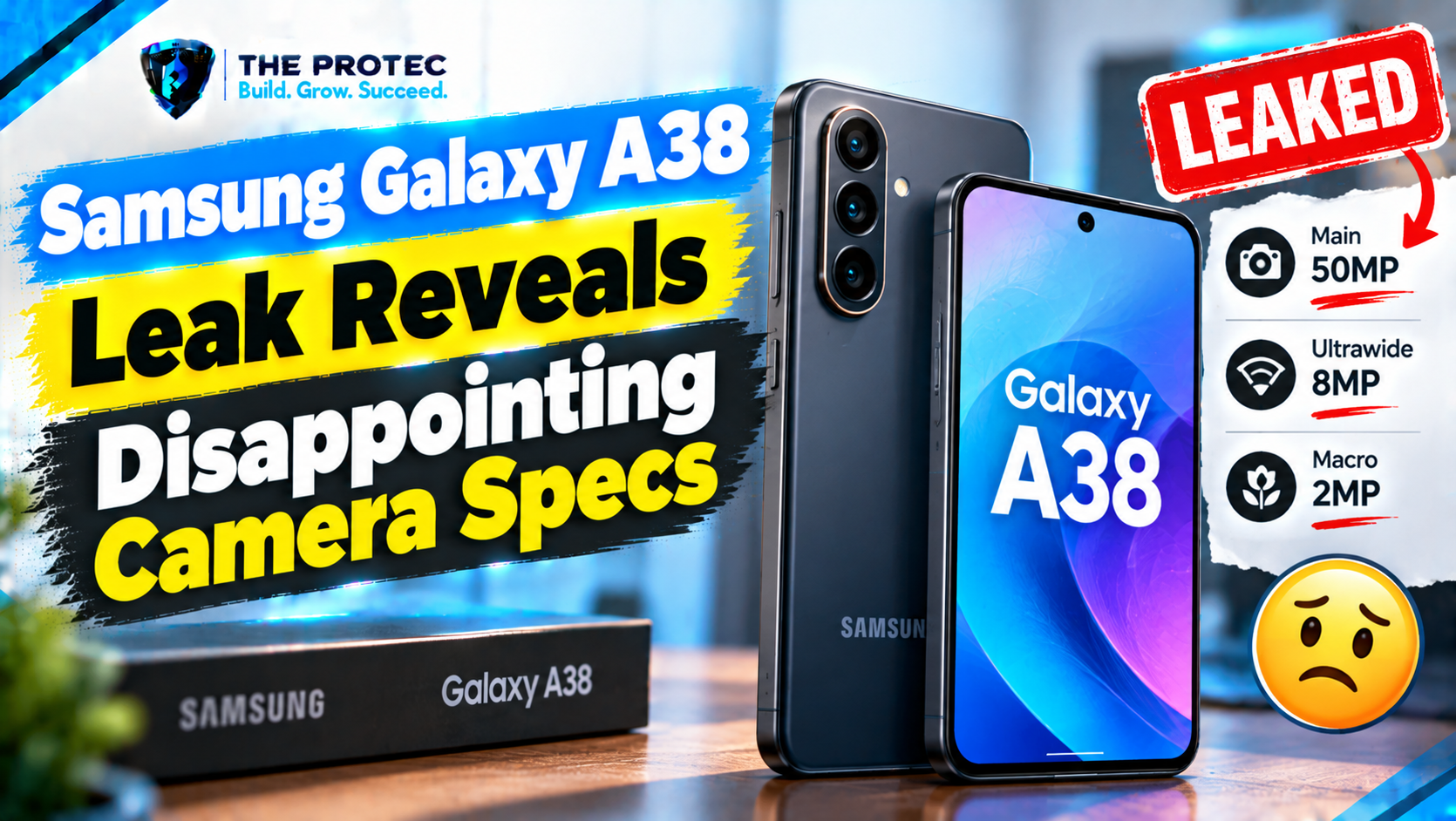
The latest Samsung Galaxy A38 leak is attracting attention for a reason Samsung may not welcome: its reported cameras sound remarkably familiar. Rather than introducing a meaningful photography upgrade, the upcoming midrange phone is rumored to retain a 50-megapixel main camera, an 8-megapixel ultrawide and a 5-megapixel auxiliary camera, accompanied by a 12-megapixel front-facing camera.
If accurate, that configuration would suggest another year of limited camera-hardware progress for one of Samsung’s most important affordable phone lines. The concern is not that these specifications are unusable. A well-optimized 50-megapixel camera can produce excellent everyday photographs. The problem is that buyers increasingly expect improvements to ultrawide quality, low-light performance, video and zoom—not merely a familiar collection of megapixel figures.
As of October 2026, Samsung has not confirmed the Galaxy A38 camera specs, release date, price or complete feature set. The information discussed here comes from unofficial reports and should be treated as provisional. Components, regional configurations and software features could change before the phone is announced.
What the Samsung Galaxy A38 leak claims
The circulating Samsung smartphone camera leaks point to a conventional triple-camera system on the back of the Galaxy A38. The reported hardware consists of:
- A 50-megapixel primary rear camera
- An 8-megapixel ultrawide rear camera
- A 5-megapixel secondary camera, widely expected to serve a macro or depth-related role
- A 12-megapixel front camera for selfies and video calls
Those numbers describe resolution, not the complete imaging system. The leak does not provide enough verified detail about sensor dimensions, pixel pitch, aperture, lens construction or stabilization to reach a final conclusion about Galaxy A38 photography performance. Optical image stabilization on the primary camera would be especially important, but prospective buyers should wait for Samsung’s official specification sheet rather than assume its inclusion from earlier models.
The most disappointing component is arguably the rumored 8-megapixel ultrawide. That resolution has become restrictive as competing Samsung budget Android phones and rival devices increasingly focus on sharper secondary cameras. An 8-megapixel sensor can be adequate in bright daylight, but it often has limited cropping flexibility and may struggle to preserve fine texture indoors or after sunset.
Why the Galaxy A38 camera sounds underwhelming
The reported camera array resembles hardware Samsung has used across previous Galaxy A-series generations. Reusing a proven setup can keep costs controlled and allow Samsung to refine its processing, but repeated carryover also makes each new model feel less ambitious.
Midrange buyers now use phone cameras for far more than occasional snapshots. Social media videos, food photography, travel images, scanned documents and family moments all place different demands on the imaging system. A strong main camera cannot completely compensate for a low-resolution ultrawide, limited zoom options or a low-value macro sensor.
The absence of a rumored telephoto camera is not surprising at this price level, although competitors have started using larger main sensors and high-resolution cropping to deliver more convincing 2x zoom. If the primary sensor itself is unchanged, Samsung will need better image processing to make the Galaxy A38 feel meaningfully different.
There is also a broader question about product priorities. Samsung may devote more of the Galaxy A38’s budget to its display, processor, battery life, update support or build quality. Those trade-offs could produce a balanced Samsung midrange smartphone, but they would not satisfy buyers specifically waiting for Galaxy A series camera upgrades.
Samsung Galaxy A38 vs Galaxy A37 camera expectations
A direct Samsung Galaxy A38 vs Galaxy A37 comparison requires caution because specifications can vary by market, and not every leak identifies exact sensor models. Based on the reported resolutions, however, the A38 does not appear positioned for a dramatic generational camera upgrade.
If the final phone uses the same 50-megapixel, 8-megapixel and 5-megapixel arrangement associated with recent models in this tier, the practical differences may come from the processor’s image signal processor and Samsung’s software tuning. Faster capture, improved portrait separation, more natural skin tones or cleaner night photographs could still make the newer phone better without changing the headline resolutions.
The rumored 12-megapixel selfie camera also appears conservative rather than regressive. Resolution alone should be sufficient for video calls and social posts, but users will want to know whether Samsung improves dynamic range, autofocus behavior, stabilization and low-light video. Those details matter more than a small increase in pixel count.
For reliable historical context, Samsung’s official information for the Galaxy A36 and A56 shows how the company has combined familiar camera resolutions with software-led imaging features. The A38 leak suggests that strategy could continue.
Is this really a Samsung Galaxy A38 camera downgrade?
Calling the rumored hardware a Samsung Galaxy A38 camera downgrade may be premature. A downgrade means that a meaningful element has become worse, not simply that it has failed to improve. Without confirmed sensor identities, apertures, stabilization details and output samples, it is impossible to establish that the A38 will produce poorer images than the Galaxy A37.
Nevertheless, standing still can feel like a downgrade when competitors are progressing. An unchanged ultrawide camera may become less competitive even if its image quality remains identical. The same applies to macro hardware that adds to the camera count but delivers limited practical value. Buyers may reasonably prefer a better ultrawide or larger primary sensor over a dedicated 5-megapixel macro camera.
The reported setup should therefore be described as a potential missed opportunity. It may not reduce quality, but it could leave photography-focused users with few reasons to upgrade from a recent Galaxy A-series device.
Why megapixels do not tell the whole story
A 50-megapixel label can sound impressive, yet resolution is only one part of smartphone image quality. Most high-resolution phone cameras combine groups of pixels through a process known as pixel binning, producing lower-resolution images with improved light collection. Final results depend on the complete camera pipeline.
- Sensor size: A larger sensor generally gathers more light and can improve detail, dynamic range and low-light performance.
- Lens quality: Sharp optics, a useful aperture and effective flare control influence clarity across the frame.
- Stabilization: Optical stabilization can reduce blur in dim conditions and make handheld video smoother.
- Image processing: Noise reduction, HDR merging, color science and sharpening can transform raw sensor data.
- Software optimization: Scene detection, portrait processing and night modes determine how consistently the camera performs.
- Processor capability: The chipset affects capture speed, multi-frame processing, video encoding and computational photography.
This is why the rumored 50-megapixel main camera could still improve even if its resolution is unchanged. A newer processor might combine frames more effectively, control highlights better or reduce motion blur. Conversely, an impressive sensor can disappoint when aggressive sharpening, slow shutter speeds or inconsistent color processing get in the way.
Samsung’s final camera software will consequently be as important as the leaked hardware. Independent reviews should examine full-resolution files, skin tones, moving subjects, nighttime scenes and video—not just bright outdoor samples.
What the rumored cameras could mean in daily use
For everyday snapshots, the Galaxy A38 camera may be perfectly capable. A stabilized 50-megapixel main sensor with mature Samsung processing could produce attractive daylight photographs, dependable HDR and shareable portraits. Most social platforms compress images heavily, so subtle sensor differences are not always visible after uploading.
Photography enthusiasts may notice the limitations more quickly. An 8-megapixel ultrawide offers relatively little room for cropping and may lose texture around the edges. It could also show a larger quality gap when users switch between the main and ultrawide lenses during video recording. Consistent colors and exposure across cameras will be important.
The rumored 5-megapixel camera is another potential weak point. If it is a fixed-focus macro camera, it may work only within a narrow shooting distance and in strong light. A higher-quality ultrawide with autofocus could handle close-ups while remaining useful for landscapes and group photographs, making it a more versatile investment.
Creators should also watch for confirmed video specifications. Resolution, frame rates, stabilization, microphone performance and lens-switching behavior can matter more than still-image megapixels when producing TikTok, Instagram or YouTube content.
How the Galaxy A38 may compare with midrange rivals
Competition in the midrange market is increasingly aggressive. Devices from Google, Xiaomi, Nothing, Motorola, OnePlus and other manufacturers may offer larger sensors, higher-resolution ultrawide cameras or stronger computational photography at similar prices. Some rivals prioritize camera hardware, while others compete through performance, charging speed or battery capacity.
Samsung retains important advantages. The Galaxy A series is known for widely available service, polished software, ecosystem integration and long update commitments. Those strengths can outweigh a modest camera specification sheet for buyers who want a dependable phone rather than the most ambitious imaging hardware.
Price will determine whether the rumored compromise is acceptable. There are Samsung Galaxy A38 price rumors, but no unofficial figure should be treated as settled. If Samsung keeps the price competitive, familiar cameras paired with better processing could make sense. A substantial price increase without stronger imaging hardware would be harder to justify.
What buyers should watch before the Galaxy A38 release
The Samsung Galaxy A38 release date remains unconfirmed, as do availability and regional variants. Before deciding whether to buy, prospective customers should look for the following details in Samsung’s announcement and independent testing:
- The exact primary and ultrawide sensor models and sizes
- Confirmation of optical image stabilization
- Ultrawide autofocus and low-light capabilities
- Supported video resolutions, frame rates and stabilization modes
- Real-world shutter speed and moving-subject performance
- Color consistency between the rear cameras
- Final pricing, storage options and promotional offers
- Processor, battery and software support details
Samsung’s official Galaxy website should be the primary source for confirmed Samsung Galaxy A38 specifications when the device is announced. Camera comparisons from independent reviewers will then reveal whether software improvements overcome the conservative-looking hardware.
Early verdict on the Samsung Galaxy A38 leak
The Samsung Galaxy A38 leak paints a picture of evolution rather than reinvention. A 50-megapixel main camera could remain dependable, but the reported 8-megapixel ultrawide and 5-megapixel auxiliary camera appear unambitious for a new-generation midrange phone.
That does not guarantee disappointing photographs. Better processing, stronger stabilization and refined software could deliver worthwhile gains. Until Samsung confirms the Galaxy A38 features and reviewers test the finished device, the fairest conclusion is that the rumored hardware raises legitimate concerns—but does not yet prove a camera downgrade.
Frequently asked questions
Are the Samsung Galaxy A38 camera specs official?
No. Samsung has not confirmed the leaked camera configuration. The 50-megapixel main, 8-megapixel ultrawide, 5-megapixel secondary and 12-megapixel selfie cameras are unofficial details and may change before launch.
Will the Galaxy A38 camera be worse than the Galaxy A37?
There is not enough verified information to conclude that it will be worse. The leaked resolutions suggest limited hardware progress, but sensor size, stabilization, processor improvements and Samsung’s image processing could still improve real-world results.
Why is the rumored 8-megapixel ultrawide disappointing?
An 8-megapixel ultrawide may capture adequate daylight images, but it offers less fine detail and cropping flexibility than higher-resolution alternatives. Ultrawide cameras with small sensors also tend to struggle in low light.
Does a 50-megapixel camera guarantee good image quality?
No. Megapixels measure resolution, not overall quality. Sensor size, lenses, stabilization, processing, autofocus and software optimization all influence the final photograph.
Should photography-focused buyers wait for the Galaxy A38?
Waiting for official specifications and independent camera tests is sensible. Buyers should compare main-camera consistency, ultrawide quality, night photography and video performance with similarly priced rivals before making a decision.