








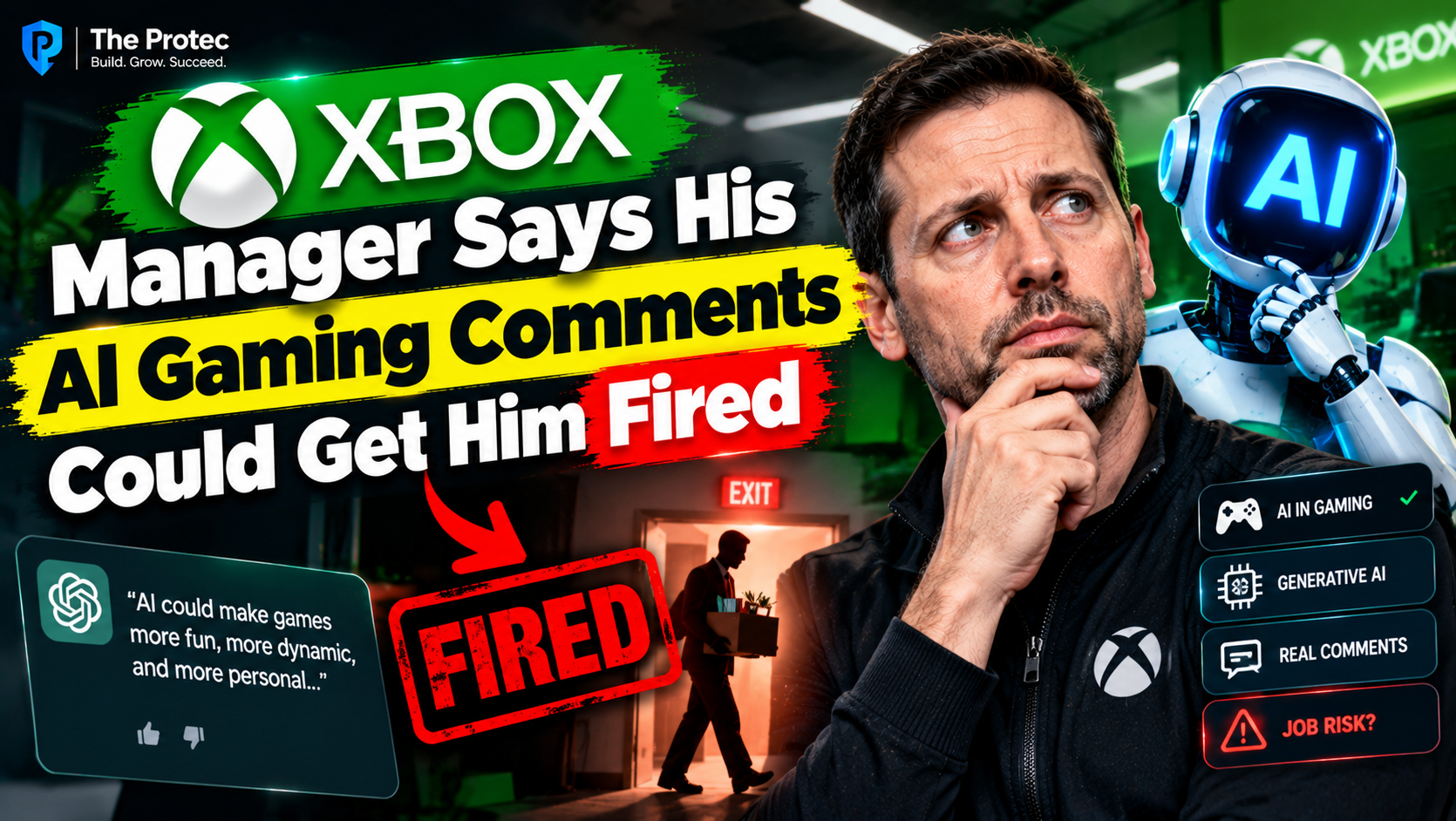
A Microsoft Xbox engineering manager Brandon Stirrup’s account of building a game prototype with artificial intelligence in roughly three hours has become a flashpoint in the gaming industry AI backlash. The technical experiment was provocative on its own, but Brandon Stirrup’s reported suggestion that he could be fired for openly discussing AI-assisted work made the story considerably more contentious.
The Brandon Stirrup Xbox AI comments touch several sensitive issues at once: whether companies are being candid about their use of generative AI, whether rapid prototypes are being mistaken for finished games, and whether AI game development tools will support professional creators or eventually displace them. They also arrive as Microsoft continues investing heavily in artificial intelligence while exploring new gaming technologies through Xbox.
Stirrup’s experiment offers a useful glimpse of how quickly developers can test an idea with modern coding assistants. It does not establish that AI can independently build, ship, and maintain the kind of polished game that players expect from a professional studio.
What Brandon Stirrup Reportedly Said About Xbox and AI
At the time of the reported comments, public professional information identified Brandon Stirrup as a Principal Software Engineering Manager working within Microsoft’s Xbox organization. Reports about his remarks said he described using AI-assisted development to create a small playable game experiment in approximately three hours. He also reportedly framed public discussion of AI use as professionally risky, suggesting that acknowledging it could get him fired.
That statement should be attributed to Stirrup rather than interpreted as proof of an official Microsoft policy. No publicly documented Xbox rule accompanying the comments established that employees would be dismissed merely for mentioning approved AI tools. Likewise, Microsoft did not publicly validate the experiment as evidence that AI could replace a development team or present it as a formal Xbox production project.
The distinction matters. An employee’s personal assessment of professional risk is not the same as a corporate threat, and a prototype made by an experienced engineer is not an autonomous AI-generated video game. Stirrup brought his own technical judgment, understanding of game systems, and ability to evaluate the output. The AI tool accelerated parts of the process, but a human still selected the goal, directed the workflow, reviewed results, and decided what counted as playable.
What the Three-Hour AI Game Experiment Actually Demonstrates
Available descriptions characterize the three-hour AI game experiment as rapid prototyping through prompting and AI-generated or AI-assisted code. This workflow is often called vibe coding: the creator describes desired behavior in natural language, runs the generated code, reports errors or unwanted behavior, and repeatedly asks the model to revise the project.
The public account should not be treated as a controlled benchmark. Without a complete development log, prompt history, model and version details, asset provenance, human edits, dependencies, and testing records, outsiders cannot precisely reproduce the result or calculate how much work the AI performed.
Even with that limitation, the experiment illustrates a genuine advantage of AI-assisted game development: speed at the earliest stage. A developer can move from a concept to a rough interactive demonstration without manually writing every line of boilerplate code. That can make it easier to test whether a movement mechanic feels interesting, whether a gameplay loop is understandable, or whether an unusual idea deserves further investment.
What it does not demonstrate is equally important. A prototype that runs for its creator is not necessarily secure, original, accessible, performant, legally cleared, enjoyable at scale, or maintainable by a team. It also says nothing by itself about commercial demand. The question “can AI build a video game?” therefore depends on what counts as a game. AI can help assemble a limited playable prototype, but shipping a reliable commercial product remains a far broader challenge.
How Vibe Coding and Generative AI Can Help Developers
Supporters of Brandon Stirrup’s AI gaming experiment argue that generative tools can remove friction without removing creativity. Used carefully, AI tools for indie game developers and large studios can assist with several practical tasks:
- Generating basic scripts, editor utilities, test scaffolding, and repetitive interface code.
- Explaining unfamiliar APIs or translating code between supported languages and frameworks.
- Suggesting likely causes of compiler errors, crashes, or unexpected gameplay behavior.
- Creating temporary systems for movement, inventory, combat, dialogue, or procedural levels.
- Comparing alternative implementations before developers commit to a production architecture.
- Producing rough prototypes that help designers communicate an idea to teammates or investors.
These uses are particularly attractive to solo creators who may understand design but lack deep expertise in every technical discipline. AI can also help experienced programmers avoid repetitive setup work and concentrate on architecture, game feel, and difficult engineering problems.
However, vibe coding video games works best when the person directing the model can recognize mistakes. A generated solution may appear convincing while using obsolete functions, introducing security weaknesses, mishandling save data, or creating dependencies that become expensive later. Fast output is useful only when someone is qualified to evaluate it.
Why a Prototype Is Not a Production-Quality Game
Commercial development involves considerably more than generating code that appears to work. Studios must support different hardware configurations, input devices, display settings, network conditions, languages, and accessibility needs. They must also ensure that updates do not break old save files or create new exploits.
Debugging and performance
AI-generated code may solve the immediate problem while concealing inefficient loops, memory leaks, race conditions, or fragile assumptions. Performance defects can remain invisible in a small test scene and emerge only after a project gains more characters, assets, systems, and players. Debugging unfamiliar generated code may ultimately take longer than writing a well-designed system manually.
Testing, accessibility, and platform requirements
A finished release needs systematic quality assurance, usability testing, certification work, and accessibility reviews. Features such as remappable controls, readable interfaces, subtitle options, color alternatives, and assistive settings cannot be reduced to a single prompt. They require consultation, implementation, and testing with people who have varied needs.
Originality and long-term maintenance
Generative tools often produce conventional solutions because they predict patterns from existing material. That tendency can result in generic mechanics or code whose origins and licensing implications are difficult to trace. Long-term maintenance creates another problem: a team must understand why a system was designed in a particular way, not merely know that an AI assistant generated something that happened to run.
These limitations are why Stirrup’s anecdote should not be presented as evidence of AI replacing game developers. The professional work begins, rather than ends, when a promising prototype appears.
Why Gamers and Developers Are Pushing Back
Many gamers against generative AI are not objecting to every form of automation. Their concerns frequently focus on labor, consent, disclosure, and the content included in a finished product. Developers worry that companies may use AI efficiency claims to justify layoffs or reduce opportunities for junior artists, writers, programmers, performers, and quality-assurance staff.
Creators also question whether models were trained on copyrighted games, artwork, music, performances, or writing without meaningful consent. The AI-generated game assets controversy becomes especially intense when a commercial product contains imagery, voices, dialogue, or music that imitates human work while offering no credit or compensation.
Supporters counter that the gaming industry has always adopted tools that automate labor. Engines, visual scripting, procedural generation, motion capture, and digital asset libraries all changed how games were made. From this perspective, generative AI in game development can broaden participation and allow small teams to attempt projects that would otherwise exceed their budgets.
Both positions can contain valid concerns. AI may reduce repetitive work and create new opportunities while also being deployed in ways that weaken jobs, conceal provenance, or flood storefronts with low-quality content. The outcome depends on business choices, labor protections, technical safeguards, and whether companies treat human creators as indispensable collaborators or disposable costs.
Transparency About AI in Video Games Matters
The Xbox manager AI controversy also shows why companies need more precise language. “Made with AI” can refer to fundamentally different activities. A programmer might privately use an approved coding assistant to explain an error, much as another developer consults documentation. Alternatively, a game might deliver AI-generated art, dialogue, voices, music, quests, or characters directly to players.
Internal coding assistance can still raise questions about security, licensing, and code quality, but it is not equivalent to shipping generated creative content. Player-facing material introduces additional concerns about authorship, training-data consent, moderation, predictability, and artistic coherence. Clear disclosures should identify the type of tool used, the stage at which it was used, whether generated material appears in the final game, and what human review occurred.
Microsoft publishes broader principles for responsible AI, but general commitments do not eliminate the need for product-specific explanations. Transparency can prevent routine coding assistance from being conflated with wholesale content generation while giving players enough information to make informed purchasing decisions.
Where Xbox Labs Fits—and Where It Does Not
Microsoft’s October 13, 2026 announcement of Xbox Labs gives the controversy timely context. The company described Xbox Labs as an initiative for exploring emerging technologies and new gaming experiences. That broad description may encompass experiments involving AI, but it does not by itself establish Xbox Labs as an AI-only division.
Unless Microsoft releases evidence confirming a narrower mandate, reports should not redefine the initiative as a dedicated generative AI studio. Readers can monitor official announcements through Xbox Wire rather than relying on speculative descriptions.
The announcement nevertheless highlights the strategic backdrop to Brandon Stirrup’s AI comments. Microsoft is exploring technologies that could alter how games are designed, tested, delivered, and played. The unresolved issue is not whether experimentation will continue, but how openly its purpose, methods, safeguards, and labor consequences will be explained.
Frequently Asked Questions
Did Brandon Stirrup create a complete game with AI in three hours?
Reports describe a small playable prototype produced with AI-assisted coding in roughly three hours, not a fully tested commercial release. The experiment demonstrates rapid prototyping speed, but it does not prove that an AI system can independently build, certify, market, and maintain a polished game.
Did Xbox say Stirrup would be fired for discussing AI?
Stirrup reportedly suggested that speaking openly about the work could create professional risk. That should not be converted into a confirmed Xbox threat without a direct company statement or documented policy. His characterization and Microsoft’s official position are separate matters.
Is Xbox Labs an artificial intelligence division?
Not based solely on Microsoft’s October 13 announcement. Microsoft presented Xbox Labs as an initiative exploring emerging technologies and new gaming experiences. Calling it an AI-only division would go beyond the confirmed description unless the company provides additional details.
Will AI replace professional game developers?
Current AI tools can accelerate code generation, troubleshooting, documentation, and prototyping. They still require substantial human direction and review, especially for performance, accessibility, originality, security, testing, art direction, and long-term maintenance. Their impact on jobs will depend heavily on how publishers and studios choose to deploy them.
What should studios disclose about AI-generated games?
Studios should distinguish internal AI coding assistance from generated art, voices, writing, music, or gameplay content delivered to players. Useful disclosure should explain where AI was used, whether its output appears in the finished product, how humans reviewed it, and what safeguards address rights, consent, and quality.
The Real Lesson From the Xbox AI Controversy
Stirrup’s reported experiment is noteworthy because it shows how dramatically generative tools can compress the distance between an idea and a playable sketch. It is controversial because speed can easily be marketed as substitution: if a prototype takes hours, companies may imply that entire teams are no longer necessary.
That conclusion is unsupported. Games are sustained creative and technical systems, not isolated code demonstrations. The most credible Microsoft AI gaming strategy would acknowledge both the practical value of AI-assisted experimentation and the people whose expertise transforms experiments into dependable experiences. Clear sourcing, careful disclosure, and honest limits will matter as much as faster code.