








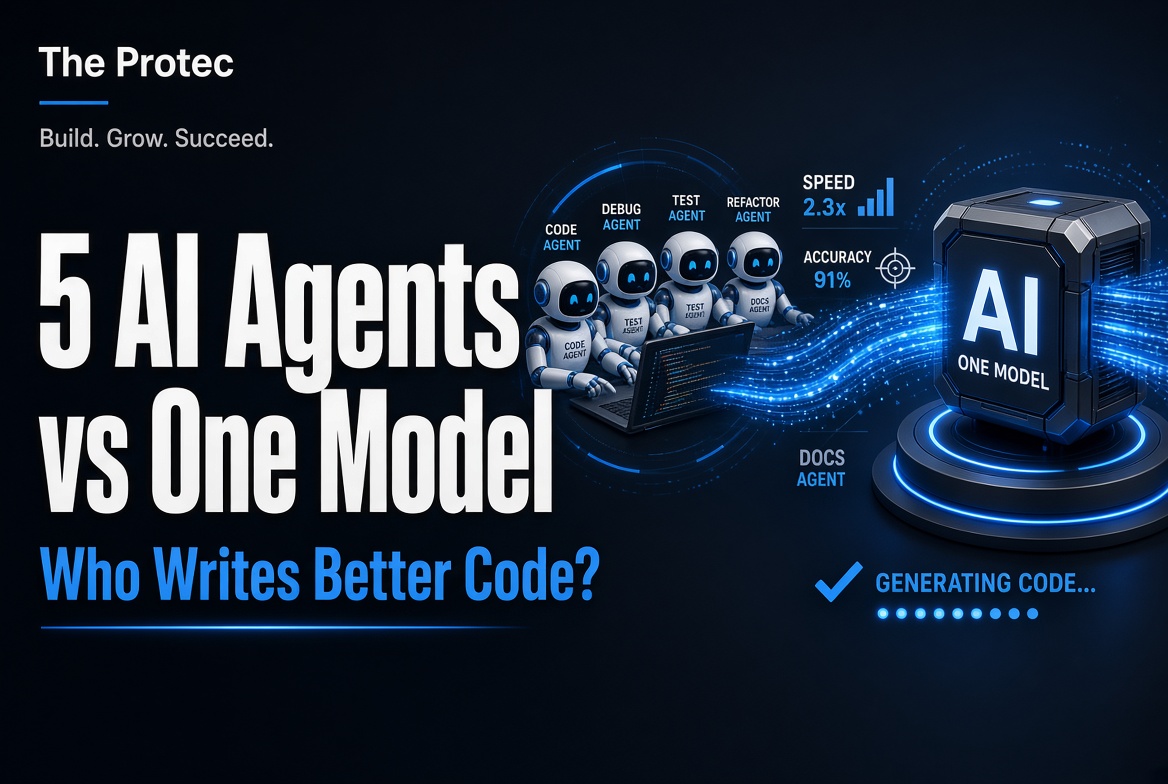
One strong model writes a solution in a single shot. Five smaller models divide the job into planning, proposing, solving, reviewing, and repairing. Which setup produces better code? A Memdoor experiment has put multi-agent AI coding in the spotlight by reporting a higher score for its five-role workflow than for one Fable 5 call. The result is interesting, but it is not a general verdict: the sample was small, the comparison was not run in one shared harness, and benchmark exposure cannot be excluded.
The practical takeaway is less dramatic and more useful. Role separation and repeated testing can improve an AI agent workflow, especially when they force a system to inspect its own assumptions. Whether five agents are better than one model still depends on the task, models, tools, latency budget, and definition of “better.”
What Memdoor’s experiment reportedly found
Memdoor’s write-up describes a team in which five agent roles contribute at different points in the coding process. Test scripts act as the final judge: code receives credit when it produces the expected result, not because an agent confidently says that it looks correct.
For the reported evaluation, the team worked on the first 10 problems from the Hard split of LiveCodeBench over five passes. Memdoor reported an average result of 9.8 out of 10 for the agent team. A single Fable 5 call was reported at 8.0 out of 10.
Those figures should be quoted with their methodology attached. The Fable 5 result was not generated in the same agent harness, so this was not a controlled head-to-head run with every condition held constant. The public account also does not establish that benchmark contamination is impossible. This article therefore preserves the source’s model label—Fable 5—without inferring unreported model versions or treating the numbers as a universal ranking.
The official LiveCodeBench repository describes a continuously updated benchmark designed to evaluate code-generation capabilities using contest problems and execution-based tests. Its Hard subset is useful because the problems demand more than syntax completion. Even so, no benchmark is automatically immune to leakage, memorization, or differences in prompting and execution infrastructure.
How the five-agent workflow operates
The central idea is not that five copies of a model vote on the same answer. Memdoor assigns responsibilities, creating checkpoints at which one agent’s work can be challenged or revised by another.
1. Planner
Interprets the problem, identifies constraints, and breaks the work into a solution plan.
2. Approach proposer
Develops candidate algorithms or implementation strategies instead of accepting the first idea automatically.
3. Solver
Turns the selected approach into executable code.
4. Reviewer
Looks for logical errors, missed edge cases, and inconsistencies between the plan and implementation.
5. Repair agent
Uses review findings and failed tests to modify the code before another evaluation.
From prompt to executable result
- Task received: The system reads the coding problem and its input-output requirements.
- Plan created: The planner decomposes the problem and highlights constraints.
- Approaches proposed: Candidate algorithms are compared for correctness and complexity.
- Solution written: The solver produces code based on the chosen plan.
- Code reviewed: A separate role inspects the implementation rather than relying on the author’s self-assessment.
- Tests executed: Scripts determine whether the output satisfies the benchmark cases.
- Failure repaired: Test feedback is routed to the repair role, and the code can be tested again.
This loop matters. Language models are often more reliable when a vague request is transformed into smaller, explicit decisions and when external tools provide objective feedback. AI-generated code testing can expose an off-by-one error or incorrect data structure that a prose-only reviewer might miss.
Why role separation might improve code
It creates useful disagreement
A one-call model generally commits to one interpretation and then writes code consistent with it. If the initial interpretation is wrong, a polished implementation may simply reinforce the mistake. Separate planning and review roles create opportunities to challenge that first assumption.
This does not guarantee genuine independence. Agents using related models, identical context, or the same prompt patterns can make correlated errors. Still, explicitly asking one role to criticize another can produce more scrutiny than asking a single call to “think carefully.”
It separates generation from verification
Writing and checking code are different activities. A solver optimizes for completing an implementation; a reviewer searches for reasons it may fail. In conventional engineering, developers use code review, static analysis, test suites, and continuous integration for the same reason: confidence is not evidence.
Multi-agent software development can encode this separation into the workflow. The strongest component may not be the number of agents at all. It may be the combination of specialized instructions, execution feedback, and permission to revise a failed answer.
Tests provide a concrete stopping rule
Without execution, an AI code review can approve code that merely looks plausible. Tests provide a harder signal. If the output is wrong, the workflow continues; if it passes the available cases, the system has at least demonstrated task-level correctness under those cases.
That qualification is crucial. Passing benchmark tests does not prove that a solution is secure, maintainable, readable, or correct for untested inputs.
The reported benchmark result, visualized carefully
Reported result: first 10 LiveCodeBench Hard problems
These bars reproduce the reported figures. They do not represent a definitive same-harness comparison.
A 1.8-point gap on a 10-problem set looks large, but the design does not support a broad claim that five smaller models always outperform one powerful model. Four limitations deserve attention.
1. Ten problems are a small sample
A difference of one or two solved problems can move the score substantially. The first 10 problems may not represent the broader Hard split, ordinary application development, debugging, repository navigation, or a team’s private codebase. A larger randomized sample would provide a more stable estimate.
2. Five passes change the opportunity structure
Running the team across five passes helps reveal consistency, but it also means the reported average comes from repeated evaluation. Researchers need the pass-level outcomes, prompts, stopping conditions, retry policy, and treatment of failures to interpret variance. If the baseline did not receive equivalent opportunities, the result may measure workflow budget as much as model capability.
3. The harnesses were different
Fable 5 was not tested within the same harness. Differences in prompt construction, context, tool access, test feedback, timeouts, sampling settings, or repair opportunities can affect results. A rigorous comparison would run both configurations through the same infrastructure with matched budgets and published settings.
4. Contamination cannot be ruled out
LiveCodeBench is designed to reduce contamination risks through time-based problem selection, but that does not prove a particular model never encountered a problem, solution, translation, or close derivative. Exact training cutoffs and datasets are often unavailable. The correct wording is therefore that contamination is not established, but it also cannot be excluded.
Correct code is not the same as good software
Execution-based coding benchmarks answer a narrow and valuable question: did the program produce accepted outputs within the evaluator’s constraints? Production teams must evaluate several additional dimensions.
- Maintainability: Can another developer understand, modify, and test the solution six months later?
- Security: Does the code introduce injection risks, unsafe deserialization, exposed secrets, weak authorization, or vulnerable dependencies?
- Readability: Are names, control flow, comments, and abstractions appropriate for the codebase?
- Reliability: Does the implementation handle malformed input, concurrency, partial failures, and operational edge cases?
- Latency: How long does the full planning-review-repair loop take compared with one model call?
- Total inference cost: How many input and output tokens, retries, test executions, and model calls are required per accepted result?
Five inexpensive AI coding agents may cost less than one frontier-model call—or considerably more after long contexts and repair loops. Model size alone does not settle the economics. Teams should measure cost per useful, reviewed outcome rather than price per individual call.
How developers can evaluate an AI agent workflow
The Memdoor result is best treated as a hypothesis worth testing locally. Build an evaluation set from work your team actually performs: bug fixes, API integrations, migrations, data transformations, and repository-specific changes. Remove confidential information, define success before testing, and keep a human-reviewed answer key where possible.
- Use a shared harness. Give the single model and agent team the same task definitions, tools, tests, timeouts, and environment.
- Match budgets. Compare equal cost, equal latency, or equal token budgets—not only raw pass rates.
- Run enough tasks. Include multiple languages, task types, and difficulty levels, then report uncertainty and failure categories.
- Preserve logs. Save prompts, model versions, tool calls, test results, and repair attempts so another team member can reproduce the run.
- Review quality beyond tests. Have experienced developers score security, maintainability, readability, and fit with project conventions.
Before adopting multi-agent AI coding, ask three direct questions: Does this workflow improve results on our own tasks? What is the total cost in money and time? Can another team reproduce the result? If those answers are unclear, a striking benchmark bar is not enough.
FAQ: AI agents and coding benchmarks
Did five AI agents definitively beat one powerful model?
No. Memdoor reported 9.8/10 for its five-role team and 8.0/10 for one Fable 5 call, but the experiment covered only the first 10 LiveCodeBench Hard problems, used five passes for the team result, and did not test Fable 5 in the same harness. It is a reported experiment, not a general proof.
Why can multiple AI coding agents outperform a single call?
They can divide planning, implementation, review, and repair into explicit stages. That creates more opportunities to catch faulty assumptions and use test failures constructively. The benefit may come from workflow design and additional computation rather than agent count by itself.
Does passing LiveCodeBench Hard mean code is production-ready?
No. A passing result demonstrates correctness against the available tests and execution limits. It does not establish security, maintainability, readability, dependency safety, or compatibility with a real production system.
What would make the comparison more convincing?
A stronger evaluation would use a larger randomized task set, identical harnesses, documented model versions, matched inference budgets, pass-level results, repeated independent runs, and reproducible prompts and logs. It should also include private or newly created tasks to reduce contamination risk.
The measured conclusion
Memdoor’s experiment offers a credible reason to explore role-based coding systems: planning, independent review, executable tests, and repair loops are sensible engineering mechanisms. Its reported 9.8/10 result is notable within the narrow setup described.
But the evidence does not crown a universal winner. One well-chosen model may be faster, cheaper, and easier to operate. A multi-agent team may deliver better task correctness when review and iteration catch errors. The only defensible conclusion is that the workflow performed better in the reported experiment—and that developers should reproduce the comparison on their own tasks before deciding which architecture writes better code.