







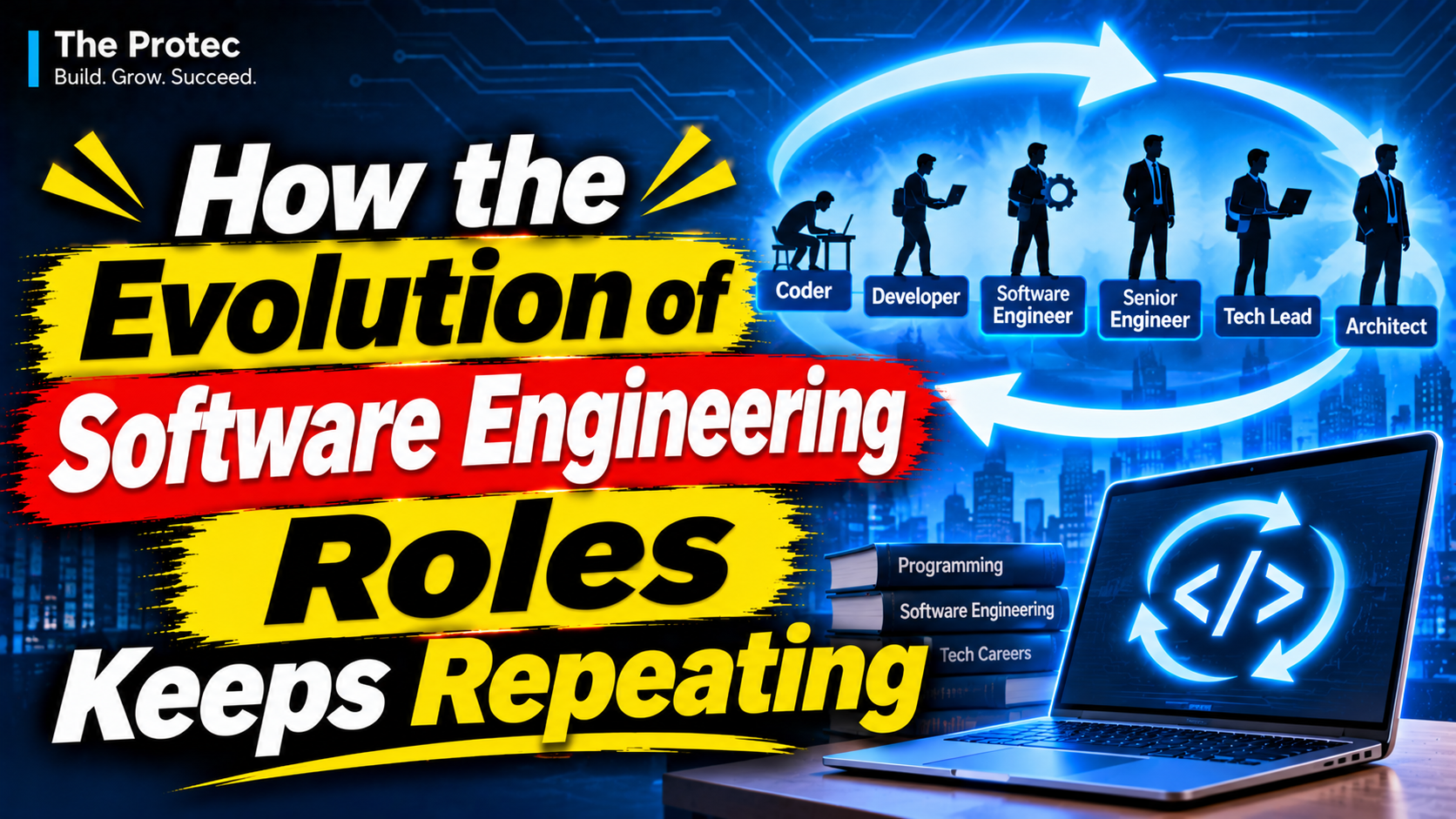
A software professional from one era may barely recognize the job titles of another, even when the underlying work looks familiar. The evolution of software engineering roles is partly a story of technical progress, but it is also a story of organizations repeatedly dividing, combining and renaming responsibilities. Computer operator became systems administrator; webmaster splintered into several specialties; frontend and backend reunited under full stack; and prompt engineer is already giving way to broader AI engineer roles.
Ian Miell’s interactive family tree of 104 software job titles offers a useful way to examine that pattern. Spanning the 1940s to the present, it shows how new technology, organizational scale and market fashion have reshaped the language of technical work. The larger lesson is not that every title has a single ancestor. It is that engineering organizations continuously redraw their boundaries around development, operations, data, quality, security and customers.
A family tree, not a definitive taxonomy
Miell’s interactive software job title family tree organizes the history of programming jobs into seven broad families:
- Development
- Analysis, architecture and leadership
- Operations and infrastructure
- Networks and security
- Data and AI
- Quality and testing
- Support and customer-facing roles
These families help reveal where responsibilities migrated or overlapped. They should not be read as rigid professional bloodlines. As Miell explains in his accompanying article, the dates are estimates of when titles became common, not rigorously sourced dates of first use. He also acknowledges missing roles and lineages that readers can reasonably debate.
That qualification matters. Software engineering job titles spread unevenly across governments, universities, vendors, startups and large enterprises. A title could be established in one community long before another adopted it. The chart is most valuable as a prompt for examining technology job evolution, not as a definitive historical taxonomy.
From computer operators and coders to software engineers
Early computing separated work according to the physical and procedural limits of the machines. Operators prepared equipment, loaded jobs and monitored execution. Coders translated mathematical or operational requirements into machine instructions. Analysts framed problems, while programmers increasingly designed the logical steps needed to solve them.
As stored-program computers, higher-level languages and reusable systems became common, programming developed into a broader discipline. The term software engineer signaled an ambition to treat software creation as systematic engineering rather than isolated coding. Requirements, architecture, maintenance, testing and team coordination became inseparable from producing instructions that a computer could execute.
The distinction never became universal. Programmer, developer and software engineer can still describe similar work, depending on the employer. Yet the change in vocabulary reflects a genuine expansion of scope: modern software developer roles commonly include design decisions, production ownership, collaboration and long-term system maintenance.
The webmaster’s rise, fragmentation and afterlife
The webmaster is one of the clearest examples of a title created by a new technical platform and later dismantled by its success. Early websites often had one person responsible for HTML, server configuration, publishing, links, basic design and sometimes editorial content. The title described ownership of a whole web presence because the surrounding organization had not yet developed specialized web teams.
As websites became applications and critical business channels, the role fragmented. Visual and browser-side work moved toward web designer and frontend developer positions. Server logic became backend development. Hosting and availability shifted toward systems administration, operations and later cloud engineering. Content strategy, search optimization and digital publishing formed their own disciplines.
Specialization eventually created another problem: too many handoffs. Full-stack development emerged as a way to restore end-to-end capability across browser, application and data layers. The full stack developer history therefore does not represent a simple return of the webmaster. Full-stack engineers usually work in a more complex environment, supported by separate specialists in security, infrastructure, product design and content.
Why DevOps, SRE and platform engineering overlap
Few areas illustrate title ambiguity better than operations and infrastructure. DevOps began primarily as a movement to improve cooperation between development and operations through shared responsibility, automation and faster feedback. Employers nevertheless turned the term into a job title. A DevOps engineer might manage deployment pipelines, cloud resources, observability, containers or all of the above.
Site reliability engineering, or SRE, applies software engineering methods to operational reliability. Common concerns include service-level objectives, incident response, automation and reducing repetitive operational work. In the DevOps vs SRE comparison, DevOps is often the broader organizational philosophy, while SRE is a more defined approach to reliability. Real job descriptions frequently blur that distinction.
Platform engineering responds to another recurring challenge: cognitive load. Rather than expecting every product team to assemble infrastructure and delivery systems independently, platform teams build supported internal capabilities such as deployment workflows, service templates and developer portals. The goal is usually a usable internal product, not merely centralized control.
These labels coexist because organizations start from different problems. One company needs cultural change, another needs measurable reliability, and a third needs a consistent developer platform. The responsibilities overlap because all three connect software creation with production operation. Renaming the work can clarify a new emphasis, but it can also conceal that the same engineers are still maintaining pipelines, infrastructure and services.
From data specialists to AI engineer roles
The data and AI family has followed a similar cycle of expansion and recombination. Database administrators, data warehouse specialists, data engineers, data scientists and machine learning engineers arose around different stages of storing, processing, analyzing and operationalizing data. Generative AI has added another set of boundaries involving models, retrieval systems, evaluation, safety and application design.
Prompt engineering briefly appeared to offer a distinct occupation centered on crafting model instructions. Prompt design remains useful, but the standalone title is being absorbed into broader AI engineering work. Production systems require more than polished prompts: engineers must manage context, tool access, retrieval, structured outputs, evaluation, latency, cost, permissions and failure handling.
That broader scope explains interest in titles such as AI agent engineer and context engineer. An AI Agent / Context Engineer may design how models receive information, invoke tools, preserve state and operate within defined controls. Whether this becomes a durable professional category remains uncertain. The responsibilities are real, but they may settle inside AI engineer, software engineer or machine learning engineer roles rather than forming a permanent branch of their own.
The forward-deployed engineer is new—and familiar
The forward-deployed engineer has become a prominent label for engineers who work closely with customers to adapt and deploy technically complex products. The role may combine software development, systems integration, product judgment, troubleshooting and on-site or embedded collaboration.
Its lineage is less novel than its current visibility suggests. Customer-facing systems engineers, field engineers, solutions architects and technical consultants have long translated between a product and a customer’s environment. The emerging title often implies more authority to modify the product or write production software. Its durability will depend on whether employers preserve that distinction or use it as a fashionable replacement for implementation consulting.
How AI coding tools may redraw team boundaries
AI coding tools can generate implementation drafts, tests, configuration, documentation and infrastructure definitions. Their more important organizational effect may be to change who performs each task. A product engineer may create a deployment workflow, a tester may prototype a fix, or an infrastructure specialist may build an internal application without waiting for another team.
This does not make specialized knowledge unnecessary. Generated code still has to fit architecture, security, reliability and product requirements. AI output can also create additional verification work when its assumptions are wrong or its behavior is difficult to reproduce. Quality engineering may move earlier in development, with greater emphasis on evaluation design, risk analysis and automated controls rather than only writing test cases after implementation.
The likely result is not the disappearance of software development careers but another renegotiation of boundaries. Some teams will become more generalist because AI lowers the cost of crossing disciplines. Others will create new specialties around model evaluation, AI security, data governance and agent operations. Both trends can occur simultaneously.
Title inflation and the job-description gap
New titles can help organizations name genuinely new constraints, but they also carry status and recruiting value. Adding senior, principal, architect or AI to a role may attract candidates without materially changing its authority or responsibilities. Conversely, an ordinary-sounding developer position may involve architecture, operations and customer work that another company assigns to three teams.
This inconsistency creates hiring confusion. Candidates cannot safely infer daily work, decision-making power or career level from a title alone. Employers may compare applicants against fashionable labels instead of transferable capabilities. Internally, inflated titles can obscure accountability when several people appear to own architecture, platforms or technical strategy.
The practical unit of analysis is therefore the responsibility: what systems the person changes, what outcomes they own, who uses their work and what happens when it fails. Titles are compressed organizational stories, not reliable specifications.
What the future of software engineering may look like
The future of software engineering is likely to produce more hybrids before stable categories emerge. AI may compress implementation work while increasing the importance of system design, evaluation, security and domain knowledge. Platform teams may absorb more operational complexity, while product engineers take broader ownership of customer outcomes.
If history is a guide, successful specialist roles will follow one of two paths: they will mature into durable disciplines, or their techniques will become expected skills inside larger jobs. Either way, the work rarely disappears when a title does. It moves, combines with neighboring responsibilities and returns under a name suited to the next organizational problem.
Frequently asked questions
Why do software engineering job titles change so often?
Titles change when new technologies create distinct responsibilities, when organizations reorganize ownership, or when employers want to signal a new priority. Market competition also encourages title inflation. A new name can represent meaningful change, but it may also repackage work previously handled by developers, operators, consultants or systems engineers.
What is the difference between DevOps, SRE and platform engineering?
DevOps broadly emphasizes collaboration and shared delivery responsibility. SRE applies engineering practices to reliability and operations, often using explicit service objectives. Platform engineering builds internal products that let development teams use infrastructure and delivery capabilities more easily. Actual responsibilities vary substantially by employer.
Will prompt engineering remain a standalone career?
Prompt design will remain an important skill, but prompt engineering alone is unlikely to define most long-term roles. Production AI systems require context management, evaluation, software integration, data controls, security and monitoring. Those responsibilities increasingly sit within broader AI engineering and software engineering positions.
Is AI agent engineer likely to become a permanent title?
It is too early to treat AI agent engineer as a settled professional category. Organizations clearly need people who can design tool use, context, state, permissions and evaluation for agentic systems. The title will endure only if that work remains sufficiently distinct from general AI engineering, platform engineering and application development.