








Why the biggest technology failures matter more than the successes
Technology headlines usually celebrate breakthroughs: faster chips, smarter AI, cleaner cloud stacks, and ever-more-connected devices. But the real education often comes from the opposite side of the story. The biggest technology failures expose the pressure points that teams, investors, and customers miss when a product looks exciting on paper but collapses in the real world.
That is why the conversation around technology failures 2026 is so important. The most visible failures this year did not happen because innovation stopped. They happened because the industry kept repeating familiar mistakes: shipping too early, assuming trust, ignoring complexity, and mistaking hype for readiness. In a year defined by AI everywhere, tighter security expectations, and more fragile supply chains, failed tech products became a mirror reflecting how the entire industry works.
This roundup is not about mocking bad launches. It is about understanding the patterns behind the damage. Whether it was an overpromised AI tool, a rushed hardware release, or a cloud service outage that exposed weak dependencies, each failure reveals something useful. The companies that learn from these moments will build stronger products. The ones that do not will keep creating the same IT industry mistakes under different branding.
The failures that defined the conversation
Not every tech stumble becomes a lasting lesson. Some disappear quickly because the product never had much traction. Others become industry-wide case studies because they affect millions of users, trigger regulatory scrutiny, or force a rethink of how technology is designed and deployed. In 2026, the failures that mattered most had one thing in common: they showed the gap between ambition and operational reality.
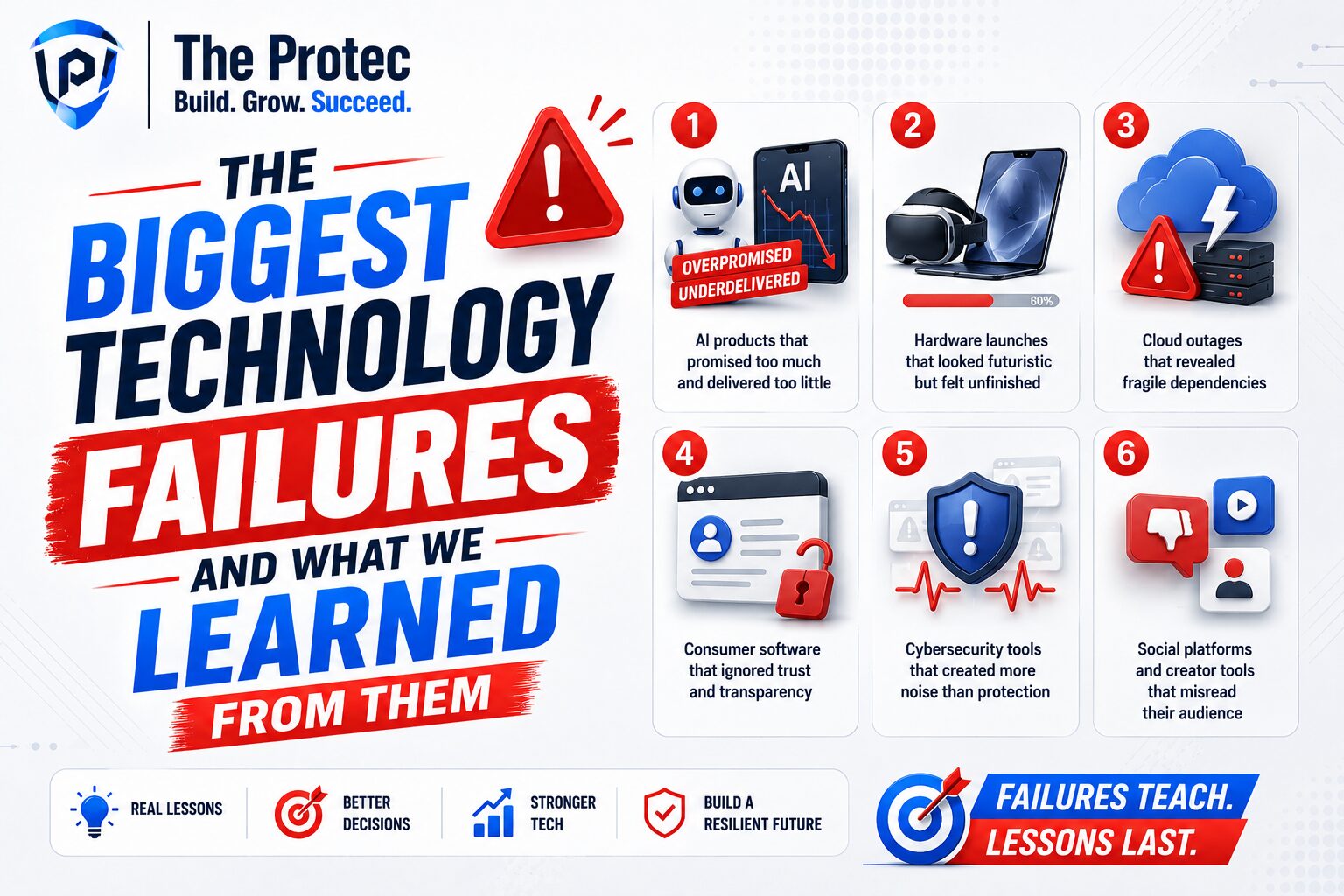
Below are the biggest categories of failure that stood out, along with what each one taught the market.
1. AI products that promised too much and delivered too little
No category has attracted more attention, investment, and disappointment than AI. By May 2026, the market is saturated with copilots, autonomous assistants, enterprise agents, and “smart” workflow tools. The problem is not that AI lacks value. The problem is that many vendors sold a vision of reliability that the products could not support.
Several high-profile failed tech products this year followed the same script: impressive demos, weak real-world performance, and a user experience that collapsed as soon as the system faced edge cases. In business settings, that meant inaccurate summaries, inconsistent actions, poor memory, and hallucinated outputs that looked polished enough to be dangerous.
What went wrong
- Teams prioritized launch speed over output quality.
- Product marketing overstated autonomy and underexplained limitations.
- Validation in controlled environments did not translate to messy enterprise workflows.
- Security and governance controls arrived too late, if at all.
What we learned
The lesson is not “AI failed.” The lesson is that AI without boundaries is brittle. The best AI products in 2026 are the ones that are narrow, auditable, and transparent about confidence levels. Buyers are no longer impressed by broad claims of automation. They want proof that the system is reliable when the stakes are high.
For businesses, the takeaway is simple: do not buy AI based on the demo alone. Ask how the model is monitored, how errors are flagged, and how human override works. If the vendor cannot answer those questions clearly, the product is not ready for serious use.
2. Hardware launches that looked futuristic but felt unfinished
Another recurring theme in 2026 has been flashy hardware that looked great on stage and struggled in daily life. Whether it was an expensive wearable, a mixed reality device, or a smart-home appliance with too many “intelligent” features, the same pattern kept appearing: too much design ambition, not enough usability.
Consumers have become far less forgiving of hardware that requires constant charging, frequent updates, or a steep learning curve just to perform basic tasks. In a market where phones, laptops, and wearables are expected to be seamless, any device that adds friction quickly becomes a cautionary tale.
What went wrong
- Battery life was sacrificed for form factor and marketing appeal.
- Software was treated as an afterthought, even though hardware success depends on it.
- Feature sets were overloaded with gimmicks instead of practical value.
- Pricing assumed early adopters would tolerate inconvenience forever.
What we learned
Hardware success still depends on the oldest rule in the book: solve a real problem better than anything else. A beautiful device that is annoying to use is not an innovation; it is a liability. The most successful hardware brands in 2026 are returning to basics—comfort, reliability, battery efficiency, and integration with existing ecosystems.
For product teams, the lesson is that industrial design cannot compensate for poor day-to-day utility. If users need a tutorial to understand why they should keep using the device, the market has already answered the question.
3. Cloud outages that revealed fragile dependencies
If there is one area where the modern tech stack still feels more fragile than it should, it is cloud infrastructure. In 2026, several incidents reminded businesses that “always on” is often more slogan than guarantee. A single vendor issue can ripple across unrelated apps, payment systems, authentication flows, and internal tools within minutes.
These outages were especially damaging because many organizations have spent years consolidating their infrastructure around a small number of cloud and SaaS providers. That consolidation improves efficiency until it creates a single point of failure. Once that point breaks, the entire system becomes a chain reaction.
What went wrong
- Overdependence on a small number of infrastructure providers.
- Poor multi-region resilience planning.
- Lack of realistic disaster recovery tests.
- Weak communication during incident response.
What we learned
The lesson from these IT industry mistakes is not to abandon the cloud. It is to design for failure instead of pretending failure is rare. Resilience has become a competitive advantage. Companies that can keep core services alive during a provider outage earn trust in a way no marketing campaign can match.
Businesses should be pressure-testing their architecture regularly, not just checking compliance boxes. If your uptime strategy depends entirely on one cloud region, one authentication service, or one vendor API, you do not have resilience—you have hope.
4. Consumer software that ignored trust and transparency
Some of the most frustrating failures in 2026 have involved software that quietly crossed the line from helpful to invasive. Consumers are increasingly aware of how their data is used, how permissions are granted, and how much of their digital life is being monetized behind the scenes. When software asks for too much, hides key settings, or changes behavior without clear consent, users leave quickly.
This year, several apps and platforms suffered backlash after unclear pricing, aggressive data collection, or hidden feature changes made users feel manipulated. Even when the product itself was technically sound, the trust relationship was broken.
What went wrong
- Privacy policies were technically compliant but practically unreadable.
- Pricing changes were rolled out without enough warning.
- User control was reduced in favor of monetization goals.
- Support channels failed to answer basic customer concerns quickly.
What we learned
Trust is now a product feature, not a legal footnote. People will tolerate bugs. They will not tolerate feeling tricked. The companies that keep users in 2026 are the ones that are honest about what the software does, how data is handled, and what changes are coming next.
For product leaders, the key lesson is that transparency is cheaper than churn. Clear settings, plain-language policies, and predictable behavior do more for retention than another round of growth hacks.
5. Cybersecurity tools that created more noise than protection
Security remains one of the most crowded and confusing categories in tech. In 2026, a number of security products failed not because the problem they targeted was unimportant, but because the product added complexity without enough benefit. Teams are under pressure to protect AI systems, identities, APIs, and distributed endpoints, but they do not have time for tools that generate endless alerts and little action.
Some failed tech products in security looked strong in demos but collapsed in real operations. They either flooded teams with false positives, required too much manual tuning, or offered overlapping features that duplicated existing tooling. In a market where security teams are already stretched, that kind of failure is fatal.
What went wrong
- Alert fatigue made the tools easy to ignore.
- Dashboards were complicated but not decision-friendly.
- Integration with existing workflows was weak.
- Vendors assumed buyers wanted more data instead of better prioritization.
What we learned
Security technology only works when it helps humans act faster and more accurately. Tools that make teams busier without making them safer are not solutions. They are liabilities with good branding.
The strongest lesson here is that security buyers now expect measurable outcomes. If a product cannot show reduced response times, fewer incidents, or better visibility into real threats, it will struggle no matter how advanced the underlying engine sounds.
6. Social platforms and creator tools that misread their audience
Another common failure pattern in 2026 has been platforms that changed too quickly and too aggressively. Social apps, publishing tools, and creator platforms are under enormous pressure to monetize, integrate AI, and keep users engaged. But every major change carries a risk: if the product stops serving its core audience, the audience leaves.
Several creators, small businesses, and niche communities responded badly to feature removals, algorithm changes, and monetization shifts that seemed designed for platform revenue rather than user success. These failures were especially visible because they spread quickly through public backlash.
What went wrong
- Core workflows were altered without enough user testing.
- Monetization was prioritized over ecosystem health.
- Algorithm changes reduced predictability and reach.
- Communication felt dismissive rather than collaborative.
What we learned
Platforms are ecosystems, not extraction engines. Once users believe a platform is extracting value without returning it, trust erodes fast. The winners in 2026 will be the platforms that treat creators and communities as partners instead of inventory.
This is one of the clearest lessons from the year: if the product depends on a community, every major change should be measured against community health, not just revenue projections.
The deeper pattern behind technology failures 2026
When you step back, the biggest failures this year are not random. They share a common DNA. Most were caused by one or more of the same five problems:
- Hype over evidence: Marketing ran ahead of product maturity.
- Speed over stability: Teams launched before the system was ready.
- Complexity over clarity: Products added features without improving outcomes.
- Control over trust: Vendors optimized for lock-in instead of transparency.
- Assumptions over testing: Real-world behavior was not validated enough.
These are not new mistakes. They are the oldest mistakes in technology, dressed up with newer interfaces and buzzwords. The difference in 2026 is that customers are less patient, regulators are more attentive, and competition is faster. A bad release does not just fail quietly anymore. It becomes public proof that your team did not respect the user.
What businesses should do differently now
The value of studying failed tech products is that they clarify what good strategy looks like. Businesses that want to avoid joining the next roundup should focus on a few practical habits.
- Test products in real workflows, not just controlled demos.
- Build rollback plans before launch, not after complaints begin.
- Measure trust, usability, and error rates alongside revenue.
- Limit feature creep and protect the core user experience.
- Design infrastructure assuming some layer will fail.
Leaders should also be more skeptical of the language used to describe innovation. If a vendor says a product is “fully autonomous,” ask what happens when it is wrong. If a hardware device is “revolutionary,” ask how long it lasts on a charge. If a cloud architecture is “resilient,” ask how it behaves during a regional outage. The best companies are the ones that answer those questions directly.
Final take: failure is the best product manager
The biggest technology failures of the year are useful because they strip away the marketing and show us what customers actually value. They want products that work, services they can trust, and systems that do not fall apart under pressure. That sounds obvious, but the tech industry keeps forgetting it.
As we move deeper into a world shaped by AI, automation, and ever-denser digital infrastructure, the cost of getting it wrong keeps rising. The good news is that the lessons are clear. Build more honestly. Test more aggressively. Communicate more transparently. And never confuse excitement with readiness.
In the end, the failures of 2026 may prove more valuable than the year’s biggest launches. Success tells us what people like. Failure tells us what they will not forgive.
FAQ
What are the biggest technology failures of 2026?
The biggest failures include overhyped AI products, unfinished hardware launches, cloud outages, privacy-backlash software, noisy cybersecurity tools, and platforms that misread their users.
Why do so many failed tech products look good at launch?
Many products are designed for demos, not daily use. They may look polished in controlled settings, but fail when faced with real data, real users, and real operational pressure.
What is the most common mistake in the IT industry?
One of the most common IT industry mistakes is launching too early and assuming marketing can cover weak reliability, poor usability, or missing safeguards.
How can businesses avoid repeating these mistakes?
They should test in real environments, prepare fallback plans, keep communication transparent, and focus on solving one important problem well instead of adding unnecessary complexity.
Are technology failures always bad for the industry?
Not necessarily. Failures often drive better standards, stronger governance, and more realistic expectations. The key is whether companies learn from them.