








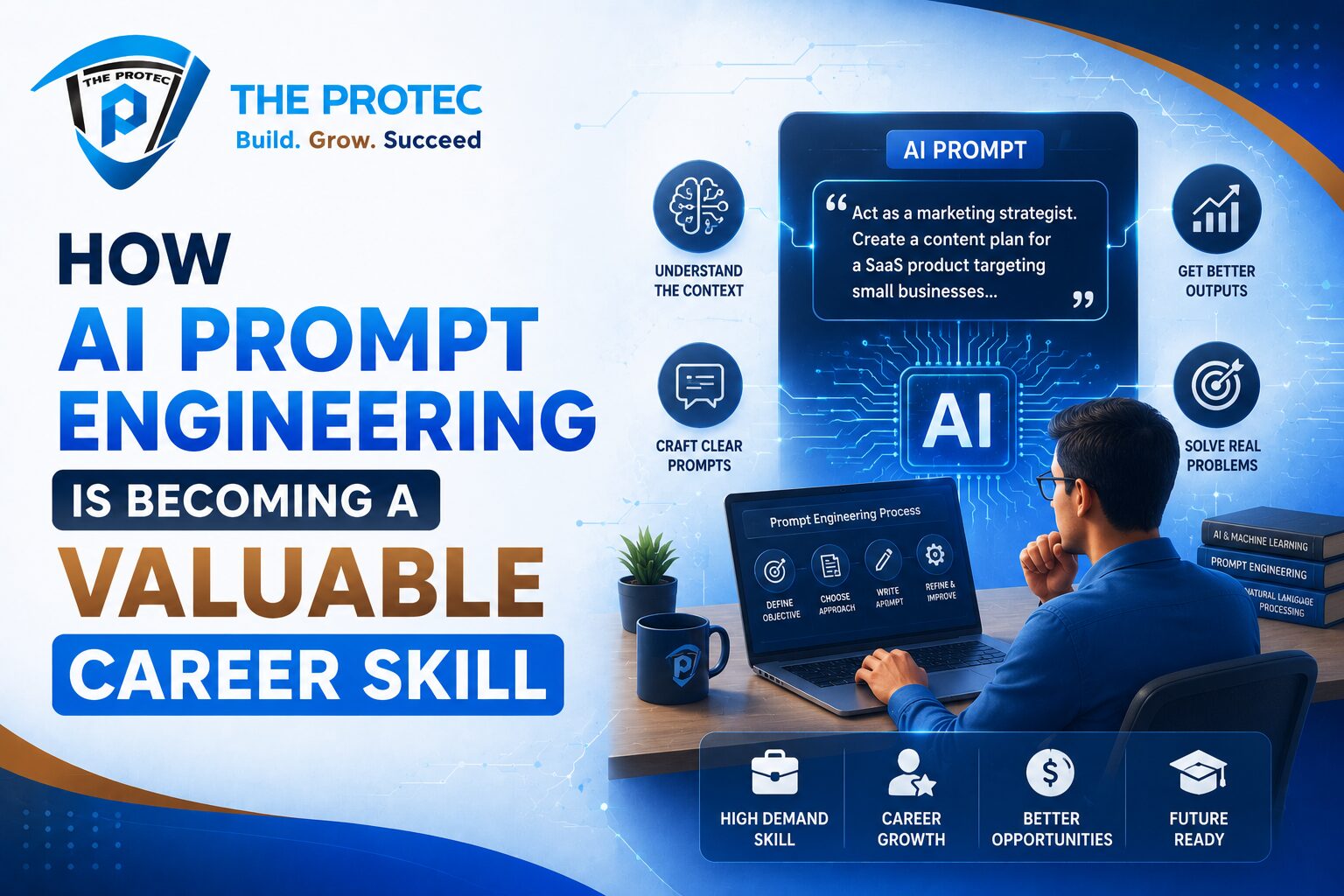
Why Prompt Engineering Is Suddenly a Serious Career Skill
Prompt engineering has moved far beyond novelty. What started as a clever way to get better answers from chatbots has become one of the most practical skills in modern AI careers. As companies deploy generative AI across customer support, software development, marketing, research, legal review, and internal operations, the ability to ask AI systems the right way has become a genuine business advantage.
This shift is happening because AI tools are no longer isolated experiments. They are embedded in workflows, connected to company data, and used to support real decisions. That means the quality of the output depends heavily on the quality of the prompt, the structure of the task, and the human judgment behind it. In many organizations, the difference between a useful AI assistant and a frustrating one is not the model itself, but the prompt strategy guiding it.
For job seekers, this creates an important opportunity. Prompt engineering is increasingly appearing as a standalone skill, a component of broader AI roles, and a differentiator in future tech jobs. It is especially valuable for professionals who can combine communication, domain knowledge, experimentation, and workflow design. In other words, prompt engineering is not just about writing clever prompts. It is about shaping how people and AI collaborate.
What Prompt Engineering Really Means Today
At its core, prompt engineering is the practice of designing instructions that help AI systems produce better, more reliable, and more context-aware outputs. In earlier stages of the generative AI boom, the focus was often on simple prompt wording. Today, the discipline is more mature and far more strategic.
Modern prompt engineering may include:
- Writing clear instructions for large language models
- Structuring inputs to reduce ambiguity
- Defining tone, format, constraints, and output style
- Designing multi-step workflows for complex tasks
- Testing and comparing prompts against measurable outcomes
- Integrating prompts into products, agents, and automated systems
This means the role is no longer limited to “prompting the chatbot.” In many teams, prompt engineering now overlaps with UX writing, product design, QA, data labeling, model evaluation, and AI operations. Professionals who understand these overlaps are becoming especially valuable because they can help teams move from isolated AI demos to dependable production use.
Why Companies Are Hiring for Prompt Engineering Skills
Organizations are under pressure to do more with less, and AI promises speed, scale, and efficiency. But the gap between AI potential and AI performance is still large. Poorly structured prompts can generate inaccurate answers, weak formatting, hallucinations, inconsistent style, or risky outputs. For companies adopting AI at scale, those problems can create financial, legal, and reputational damage.
That is why prompt engineering is attractive to employers. It helps teams:
- Improve output quality without retraining a model
- Reduce time spent rewriting or manually correcting AI responses
- Standardize brand voice and content quality
- Increase reliability in customer-facing and internal tools
- Build repeatable workflows for automation
In practice, businesses are hiring people who can translate business needs into AI instructions and then refine those instructions through testing. This is especially useful in teams that do not have deep machine learning expertise but still want to deploy AI effectively. Prompt engineering can act as a bridge between technical teams and non-technical stakeholders, making it one of the most transferable AI careers emerging right now.
Where Prompt Engineering Fits Into Future Tech Jobs
One reason prompt engineering is gaining momentum is that it is not confined to a single job title. Instead, it is becoming a cross-functional skill that can enhance many future tech jobs. Professionals in content strategy, software engineering, product management, customer experience, data analysis, sales enablement, and operations can use prompt engineering to work faster and make better decisions.
Common roles where prompt engineering matters
- AI product manager: Defines how prompts support product behavior and user experience
- Prompt specialist: Designs and tests prompts for internal or external tools
- AI workflow designer: Builds repeatable processes around generative AI systems
- Conversation designer: Shapes chatbot or agent interactions for clarity and usefulness
- Content strategist: Uses prompts to scale outlines, drafts, repurposing, and audience-specific messaging
- Automation consultant: Applies prompts within business process automation and agentic workflows
These roles reflect a broader trend: employers want people who can help AI systems perform in context, not just in demos. If you can create prompt frameworks, test outputs, and improve consistency across multiple use cases, you are likely building a skill set that will remain relevant as AI tools evolve.
How Prompt Engineering Supports Real-World Business Applications
Prompt engineering is valuable because it has direct, visible impact on how organizations operate. Unlike some abstract tech skills, its benefits can often be measured quickly. A better prompt can save time, improve quality, and reduce manual review. That makes it especially appealing for teams looking to prove ROI from AI adoption.
Customer support and service automation
Support teams use prompts to draft responses, summarize cases, classify tickets, and recommend next actions. When done well, prompt engineering can improve response speed while maintaining accuracy and tone. It can also help AI assistants handle common questions more consistently.
Marketing and content production
Marketers use prompt engineering to brainstorm campaigns, generate content variations, segment messaging by audience, and repurpose long-form assets into shorter formats. The goal is not to replace strategy, but to accelerate execution. Teams that know how to prompt effectively can move from one-off drafts to reusable content systems.
Software development and QA
Developers use prompts to generate code snippets, explain errors, create documentation, and support test case generation. QA teams can use prompts to identify edge cases, summarize bugs, or convert requirements into test scenarios. As software teams adopt AI assistants, prompt quality becomes part of developer productivity.
Operations and knowledge management
Internal teams use prompts to summarize meetings, extract action items, organize documents, and answer questions from company knowledge bases. Prompt engineering is especially useful when combined with retrieval-augmented generation systems, where the model must respond based on internal information. In these settings, prompt design helps ensure relevance, structure, and consistency.
Sales and customer success
Sales teams can use prompts to personalize outreach, summarize account history, draft follow-ups, and prepare for meetings. Customer success teams can use them to analyze account signals and create next-step recommendations. In both cases, the prompt becomes a tool for better human judgment, not a substitute for it.
What Prompt Engineering Salaries Look Like
Salary expectations for prompt engineering vary widely because the market is still evolving and job titles are not standardized. Some companies hire dedicated prompt specialists, while others fold these responsibilities into AI product, content, operations, or engineering roles. That makes compensation dependent on experience, technical depth, industry, and location.
In broad terms, professionals with prompt engineering skills can command strong salaries when they pair that knowledge with domain expertise. For example, a marketer who can design AI content systems may earn more than a generalist content producer. A product manager who understands prompt evaluation and AI behavior may be more competitive than peers without those skills.
According to labor market data from sources like the U.S. Bureau of Labor Statistics, technology roles tied to AI and software continue to show strong long-term demand, especially when linked to automation and productivity. Meanwhile, compensation benchmarks from platforms like Glassdoor often show that AI-adjacent positions can outpace traditional digital roles, particularly when they involve strategic ownership.
Because prompt engineering is still emerging, salaries often reflect the broader role rather than the prompt skill alone. That said, professionals who can demonstrate measurable outcomes—faster workflows, better conversion rates, higher customer satisfaction, or reduced error rates—are in a strong position to negotiate higher pay. Employers care less about the label and more about the business value.
The Skills That Make Prompt Engineering Valuable
Prompt engineering becomes much more powerful when combined with other capabilities. In fact, the most competitive candidates in AI careers usually bring a hybrid skill set rather than a single specialty.
- Clear writing: The ability to express instructions precisely and logically
- Analytical thinking: The ability to test prompts and compare outputs
- Domain expertise: Deep knowledge of a function, industry, or audience
- Workflow design: The ability to build repeatable processes around AI tools
- Basic technical literacy: Comfort with APIs, model settings, or automation tools
- Evaluation mindset: Understanding how to measure quality, consistency, and risk
These skills matter because prompt engineering is not static. Models change, interfaces change, and business needs change. The people who thrive in this field are usually those who can adapt quickly, learn from outputs, and refine systems over time. That makes prompt engineering a strong fit for professionals who enjoy experimentation and problem-solving.
How to Start Building Prompt Engineering Experience
You do not need a PhD in machine learning to begin developing prompt engineering expertise. In many cases, the best way to learn is by applying it to real work. Start by identifying a repetitive task in your current role that could benefit from AI assistance. Then design prompts, test variations, and measure which outputs save time or improve quality.
Practical ways to build experience
- Create prompt templates for common tasks in your job
- Document what works, what fails, and why
- Experiment with format constraints and style instructions
- Practice chaining prompts for multi-step workflows
- Compare outputs across different models and settings
- Build a small portfolio of use cases and results
A strong portfolio can be especially valuable because employers often want evidence of applied thinking. For example, showing how you improved response consistency in a support workflow or reduced drafting time in a marketing process can be more persuasive than listing tools on a resume.
It also helps to understand prompt safety and evaluation. AI systems can produce biased, misleading, or off-brand content if left unchecked. Professionals who know how to identify those issues and build guardrails will stand out in the job market.
Why Prompt Engineering Is Becoming a Long-Term Career Advantage
Some people assume prompt engineering is a temporary trend that will disappear as AI models improve. In reality, the skill is likely to evolve rather than vanish. As models become more capable, the nature of prompting may change from simple instruction writing to higher-level orchestration, evaluation, and workflow design. The human role shifts, but it does not disappear.
That is why prompt engineering is best understood as part of a broader AI literacy stack. It teaches people how to think clearly about inputs, constraints, outputs, and quality control. Those are durable skills that apply across tools and industries. Whether the interface is a chatbot, an AI agent, or a multimodal workflow, the ability to guide machine behavior with precision will remain valuable.
For workers navigating the future of work, this is encouraging. Prompt engineering offers a way to enter AI careers without waiting years to become a model researcher. It also gives experienced professionals a path to stay relevant as technology reshapes their field. In a labor market increasingly shaped by automation, adaptability is one of the most important assets a candidate can have.
The Future of Prompt Engineering in AI Careers
The future of prompt engineering will likely be less about one perfect prompt and more about systems thinking. Teams will rely on prompt libraries, evaluation frameworks, agent workflows, and structured human oversight. The most valuable professionals will be those who can design, test, and maintain these systems in production.
We are also seeing prompt engineering merge with adjacent disciplines. Conversation design, AI operations, product experimentation, and workflow automation are all becoming more connected. As companies adopt more sophisticated AI stacks, the demand for people who can translate business needs into reliable machine behavior will continue to grow.
For job seekers, the message is simple: prompt engineering is not just a niche skill for enthusiasts. It is becoming a practical career advantage across AI careers and future tech jobs. Whether you work in content, operations, engineering, or product, the ability to communicate effectively with AI can make you faster, more strategic, and more competitive.
FAQ
Is prompt engineering still a valuable career skill if AI keeps improving?
Yes. As AI systems improve, prompt engineering is evolving into broader AI workflow design, evaluation, and orchestration. The specific techniques may change, but the ability to guide AI effectively remains important.
Do you need coding skills for prompt engineering jobs?
Not always. Many prompt engineering tasks are non-technical and rely on clear writing, testing, and domain knowledge. However, basic technical literacy can help you stand out, especially in product, automation, or engineering-adjacent roles.
What industries use prompt engineering the most?
Prompt engineering is used heavily in marketing, customer support, software development, operations, education, finance, and healthcare. Any industry that uses generative AI can benefit from better prompt design.
How can I prove prompt engineering experience to employers?
Build a portfolio that shows real outcomes. Include examples of prompts you designed, the workflows they improved, and measurable results such as time saved, better consistency, or reduced manual editing.
Will prompt engineering become obsolete?
It is more likely to evolve than disappear. The field is moving toward prompt systems, AI evaluation, and agent workflow design, which means the core skill will remain relevant even as tools become more advanced.