






The Rise of AI-Native Databases: How Vector Search Is Changing Modern Applications
The database layer is undergoing one of the most meaningful shifts since the move from relational systems to cloud-native architectures. As AI becomes embedded in everyday products, teams are discovering that traditional database designs were never intended to power semantic retrieval, multimodal search, or retrieval-augmented generation (RAG) at scale. That gap has created demand for the AI-native database: a system designed not just to store records, but to serve embeddings, support vector search, and combine structured and unstructured retrieval in a single application workflow.
What makes this shift important is not just the rise of large language models. It is the way applications now need to understand meaning rather than exact matches. Users no longer search only with filters or keywords; they ask questions in natural language, search across documents, images, code, and conversations, and expect the application to know what is relevant even when the wording is different. Vector databases and hybrid retrieval architectures have become the backbone of that experience.
In this article, we will look at why AI-native databases are emerging, how vector search works, why embeddings matter, and how modern retrieval patterns are changing the way applications are designed. We will also explore where these systems fit into RAG, why hybrid retrieval is becoming the default, and what engineering teams should consider when choosing a database architecture for AI applications.
Why Traditional Databases Are Not Enough for AI Applications
Relational databases still excel at transactions, joins, constraints, and structured queries. Document databases are excellent for flexible schemas, while search engines are strong at text indexing and keyword-based retrieval. But AI applications introduce a different requirement: semantic relevance. When a user asks, “What are the compliance risks in our vendor contracts?” the system should find documents about indemnification, liability caps, and data-processing clauses even if those exact words are not repeated in the query.
That kind of retrieval depends on meaning, not string matching. Traditional indexing methods are not built for that task. They can rank by term frequency, match exact values, or filter by metadata, but they do not naturally capture relationships such as similarity, intent, or conceptual proximity. As a result, teams building AI products often had to chain together separate systems: one for structured data, one for search, one for embeddings, and one for model orchestration. That fragmentation makes development slower and operations more complex.
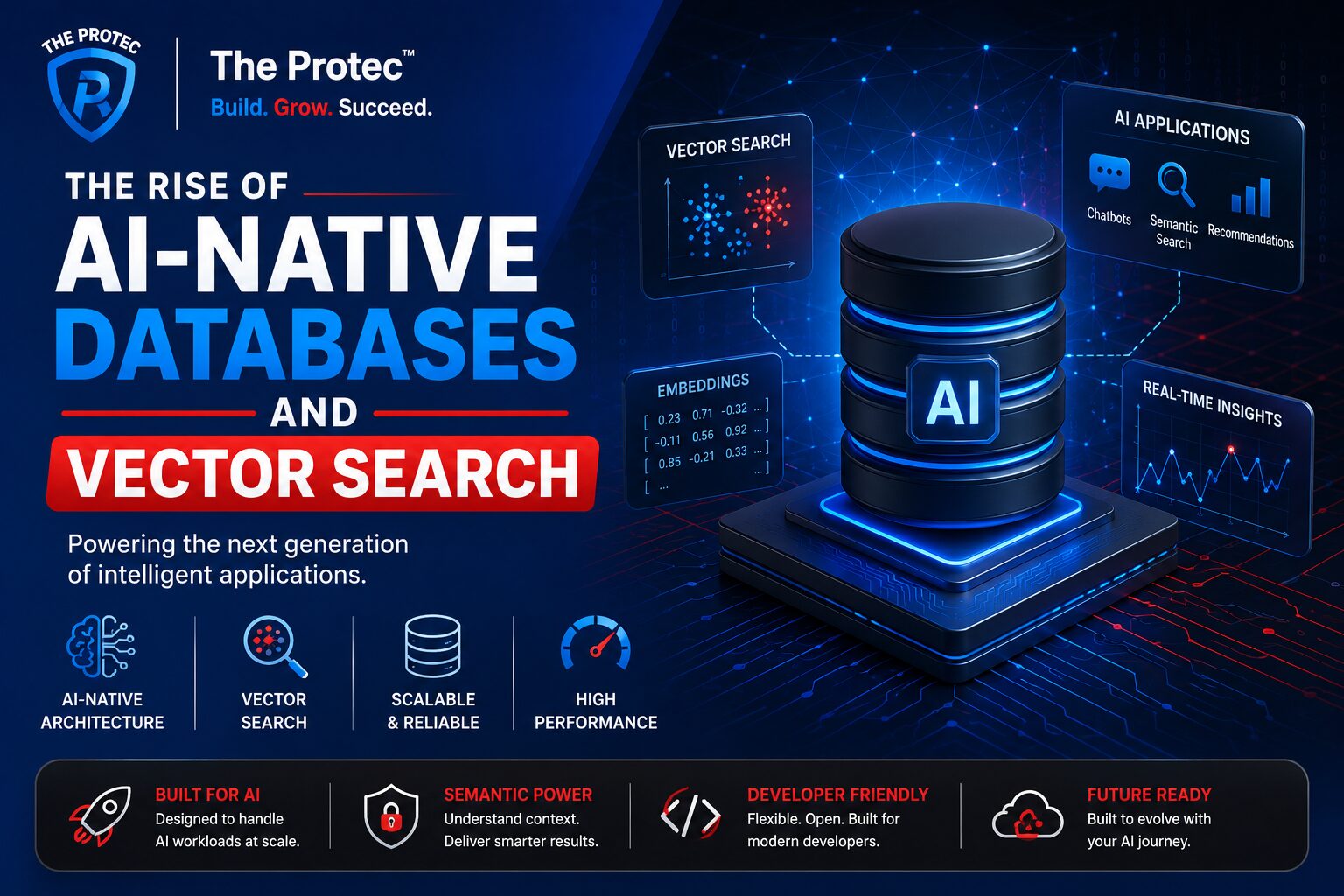
The rise of the AI-native database is a response to that complexity. Instead of treating vector data as an add-on, these systems are built to manage embeddings as first-class data. They support fast approximate nearest-neighbor search, efficient indexing strategies, and retrieval patterns that integrate structured filters, full-text search, and semantic ranking. For AI applications, that means the database becomes part of the intelligence layer rather than just a storage layer.
What Is an AI-Native Database?
An AI-native database is a data platform designed to support AI workloads from the start. It typically includes native support for vector embeddings, similarity search, metadata filtering, and often hybrid retrieval across multiple data types. In practical terms, this means developers can store structured fields, text, and vectors together, then query them in ways that align with how AI systems think about relevance.
Unlike traditional databases that bolt on vector capabilities later, AI-native systems are optimized around embedding workflows. They are built to handle large numbers of high-dimensional vectors efficiently, with indexes that can retrieve semantically similar items in milliseconds. Many also support operational features needed for production AI: replication, scaling, access control, observability, and integration with application frameworks.
This category is broad, and implementations vary. Some platforms are purpose-built vector databases. Others are relational or document databases that have evolved into AI-ready systems by adding vector search and hybrid query capabilities. The important distinction is architectural: the database must support the retrieval patterns that AI apps require, not just the storage patterns legacy systems were designed for.
How Vector Search Works
Vector search is the engine behind semantic retrieval. To understand it, it helps to start with embeddings. An embedding is a numerical representation of content such as text, code, audio, or images. Similar items are placed closer together in vector space, which allows the database to find related content by measuring distance rather than comparing exact words.
For example, the phrases “reset my password” and “I cannot log in to my account” may appear different in text, but their embeddings can be close enough that vector search treats them as related. The same concept works across many domains: product descriptions, support tickets, legal clauses, research papers, and multimodal assets can all be encoded into vectors and searched semantically.
Most vector databases rely on approximate nearest-neighbor algorithms to make retrieval fast at scale. Exact similarity search across millions or billions of vectors would be too slow, so the database uses specialized indexes to narrow the search space while preserving relevance. The result is a system that can return the most semantically similar results in real time, which is essential for chatbots, copilots, recommendation engines, and RAG pipelines.
Vector search is also becoming more practical because of improvements in embedding quality and model diversity. Modern embedding models are better at handling domain-specific language, multilingual content, and even multimodal inputs. This has made semantic retrieval much more useful in production than it was in earlier experimental systems.
Why Embeddings Are the New Retrieval Layer
Embeddings are not just another data format. They represent a new retrieval layer that sits between raw content and the AI model. In a traditional stack, an application might query a database, fetch records, and then send them to a model. In an AI-native stack, the application first converts data into embeddings, retrieves the most relevant pieces semantically, and then uses those results to ground the model response.
This shift matters because models are only as good as the context they receive. Without good retrieval, even advanced models can hallucinate, miss important details, or answer with generic information. Embeddings help narrow the context to the most relevant content, which improves factual accuracy, reduces token usage, and lowers latency.
Embeddings also make it possible to unify search across different content types. A support platform can search tickets, knowledge-base articles, chat transcripts, and product docs using the same semantic layer. A developer platform can search code snippets, API docs, and incident notes together. A media platform can search captions, transcripts, thumbnails, and metadata in one retrieval flow. This is why embeddings are now central to modern data architecture rather than just an ML preprocessing step.
Hybrid Retrieval Is Becoming the Default
Pure vector search is powerful, but it is rarely enough on its own. In many real-world applications, structured constraints still matter. Users may want results filtered by region, date, access permissions, content type, language, or product line. Keyword search can also be valuable when exact terms, identifiers, or rare entities are important. That is why hybrid retrieval has become the dominant pattern in AI-native systems.
Hybrid retrieval combines semantic search with lexical search and structured filtering. The database may first narrow the candidate set by metadata, then rank items using vector similarity, and finally blend in keyword relevance or reranking scores. This approach improves precision and recall, especially when queries contain both conceptual intent and exact terms.
For example, a legal assistant might need to find clauses related to “termination for convenience” while also restricting results to a specific jurisdiction and contract type. A product search experience might combine vector similarity with brand, price, and inventory filters. A customer support agent could search semantically across tickets but prioritize recent cases or premium customers. These are not edge cases anymore; they are the norm in AI-powered applications.
Hybrid retrieval is also important for trust. Users are more likely to rely on AI-generated answers when the system can show sourced evidence that was retrieved using both semantic and structured signals. This is one reason RAG systems increasingly depend on databases that can support multiple retrieval modes in a single query pipeline.
How AI-Native Databases Power RAG Systems
Retrieval-augmented generation has become one of the most practical ways to deploy generative AI. Instead of asking a model to answer from memory alone, RAG systems retrieve relevant context from a database, then pass that context into the model to generate a grounded response. The quality of the retrieval layer directly affects the quality of the output.
An AI-native database improves RAG in several ways. First, it stores chunked content alongside embeddings and metadata, which allows the system to retrieve the right passage instead of an entire document. Second, it supports semantic search that finds conceptually related content even when wording varies. Third, it enables filters and permissions so the model only sees content the user is allowed to access.
Modern RAG systems are moving beyond simple top-k retrieval. They often include multi-stage pipelines: initial vector search, lexical fallback, metadata filtering, reranking, and context assembly. Some systems also use query rewriting, multi-query expansion, and parent-child retrieval to improve relevance. These patterns are only practical when the database can serve as a flexible retrieval engine rather than a static data store.
As RAG adoption grows, so does the need for better retrieval observability. Teams want to know which chunks were retrieved, why they were selected, how filters affected the result set, and whether a query should have used semantic, lexical, or hybrid search. AI-native databases increasingly expose the hooks needed for that kind of debugging and evaluation.
Database Architecture Is Evolving Around AI Workloads
The rise of vector search is changing more than query syntax; it is changing database architecture itself. In older systems, the primary concern was how to normalize data, maintain consistency, and optimize transactional performance. In AI-native systems, architects also need to think about embedding generation, index maintenance, similarity scoring, retrieval freshness, and context orchestration.
One major architectural shift is the move toward unified data stores. Instead of maintaining a separate vector database, search index, and transactional database, many teams want a single platform that can handle operational data and semantic retrieval together. This reduces synchronization problems and keeps application logic simpler. It also makes it easier to update embeddings when source data changes.
Another shift is the growing importance of ingestion pipelines. Data must often be chunked, embedded, enriched with metadata, and indexed continuously. That requires careful design around batch processing, incremental updates, and backfills. In some cases, organizations use event-driven architectures so changes in source systems automatically propagate into the retrieval layer.
There is also a stronger focus on governance. AI-native databases often need to enforce row-level security, tenant isolation, auditability, and data retention controls. As AI applications become embedded in enterprise workflows, the retrieval layer must support compliance as well as speed. This is especially important when sensitive data is used in RAG, copilots, and internal search systems.
Key Use Cases Driving Adoption
Several application patterns have made vector databases and AI-native databases especially valuable.
Conversational search: Users ask natural-language questions and receive direct answers backed by semantically relevant sources.
RAG assistants: Internal and customer-facing assistants retrieve knowledge before generating responses.
Recommendation engines: Products, articles, jobs, or media items are matched based on semantic similarity and user behavior.
Code intelligence: Developers search codebases, API documentation, and incident logs using meaning-based retrieval.
Multimodal search: Applications search across text, images, audio, and video using shared embedding spaces.
Enterprise knowledge access: Employees find policies, manuals, research notes, and support records with semantic filters and permissions.
These use cases share a common need: the data layer must understand meaning, not just structure. That is why vector search is becoming a foundational capability rather than a specialized feature.
What to Evaluate When Choosing a Vector Database
Not every vector database is the same, and the right choice depends on the application. Teams evaluating an AI-native database should look beyond raw similarity performance and consider the full retrieval lifecycle.
Index quality and speed: Can it handle your scale while delivering low-latency search?
Hybrid query support: Can you combine vector search with metadata filters and keyword search?
Operational features: Does it support replication, backups, scaling, and observability?
Security and governance: Can you enforce permissions and audit access to retrieved content?
Update patterns: How does it handle inserts, deletes, re-embedding, and frequent content changes?
Developer experience: Are APIs and integrations practical for production workflows?
It is also worth considering whether the platform should be a dedicated vector database or an existing system extended with vector capabilities. Dedicated systems can be excellent for retrieval-heavy workloads, while unified databases may reduce architecture sprawl for teams that want transactional and semantic data together. The best choice depends on workload patterns, latency goals, and operational maturity.
Challenges and Tradeoffs to Watch
Despite the momentum behind AI-native databases, the architecture is not without tradeoffs. Vector search is powerful, but embeddings can drift as models change. Indexes need tuning. Chunking strategy affects retrieval quality. Hybrid ranking can be difficult to optimize. And if the retrieval layer is poor, the model will still generate weak answers.
Another challenge is evaluation. It is often easier to measure database latency than retrieval relevance. But in AI systems, relevance is what matters most. Teams need to test recall, precision, grounding quality, and answer usefulness, not just query performance. That often requires human review, golden datasets, and systematic experimentation.
There is also a risk of overengineering. Not every application needs a separate vector database from day one. Some workloads can start with vector support inside an existing database and evolve later. The key is to design for the retrieval patterns you expect to grow into, rather than bolting on semantic search as an afterthought.
Where the Market Is Heading
The future of databases is likely to be more semantic, more multimodal, and more retrieval-aware. As foundation models become more capable, the retrieval layer becomes the differentiator. Better context leads to better outputs. Better hybrid retrieval leads to more trustworthy applications. Better AI-native database design leads to faster iteration and lower operational overhead.
We are also seeing convergence across the stack. Search systems are becoming vector-aware. Databases are adding semantic retrieval. Data warehouses are supporting embeddings. Application frameworks are standardizing RAG workflows. The boundary between storage, search, and AI orchestration is starting to blur, and that is a sign of a maturing ecosystem.
For teams building modern applications, the implication is clear: semantic retrieval is no longer an experimental feature. It is becoming a core requirement. Whether the use case is support automation, enterprise search, recommendation, or intelligent assistants, the underlying data architecture must support vector search and hybrid retrieval from the beginning.
Conclusion
The rise of AI-native databases marks a structural change in how applications store, retrieve, and use information. Vector search has moved semantic retrieval from a research idea into a production-grade capability. Embeddings have become the connective tissue between raw content and model reasoning. Hybrid retrieval is now the practical standard for systems that need both precision and relevance.
For builders, this means the database is no longer just a backend utility. It is part of the AI experience itself. The systems that win will be those that treat retrieval as a first-class design problem and choose data architectures that support meaning, structure, governance, and speed together.
If your application depends on RAG, intelligent search, copilots, or multimodal understanding, now is the time to rethink the data layer. The move toward AI-native databases is not a passing trend. It is the foundation for the next generation of modern applications.
FAQ
What is an AI-native database?
An AI-native database is a database designed to support AI workloads such as embeddings, vector search, hybrid retrieval, and RAG. It treats semantic retrieval as a core capability rather than an add-on.
How is a vector database different from a traditional database?
A vector database is optimized to store and search high-dimensional embeddings using similarity metrics. Traditional databases are better suited for structured records, exact matches, and transactional operations.
Why is hybrid retrieval important for AI applications?
Hybrid retrieval combines vector search with keyword search and metadata filters. This improves relevance, supports exact constraints, and produces more trustworthy results in production AI systems.
How do embeddings improve RAG systems?
Embeddings let RAG systems retrieve content by meaning rather than exact wording. That helps the model receive more relevant context, which improves answer quality and reduces hallucinations.
Do all AI applications need a dedicated vector database?
No. Some applications can start with vector support in an existing database or search engine. A dedicated vector database becomes more valuable as retrieval scale, latency requirements, and AI complexity increase.
External references for further reading: Pinecone on vector search fundamentals and Google Cloud’s RAG architecture overview.