







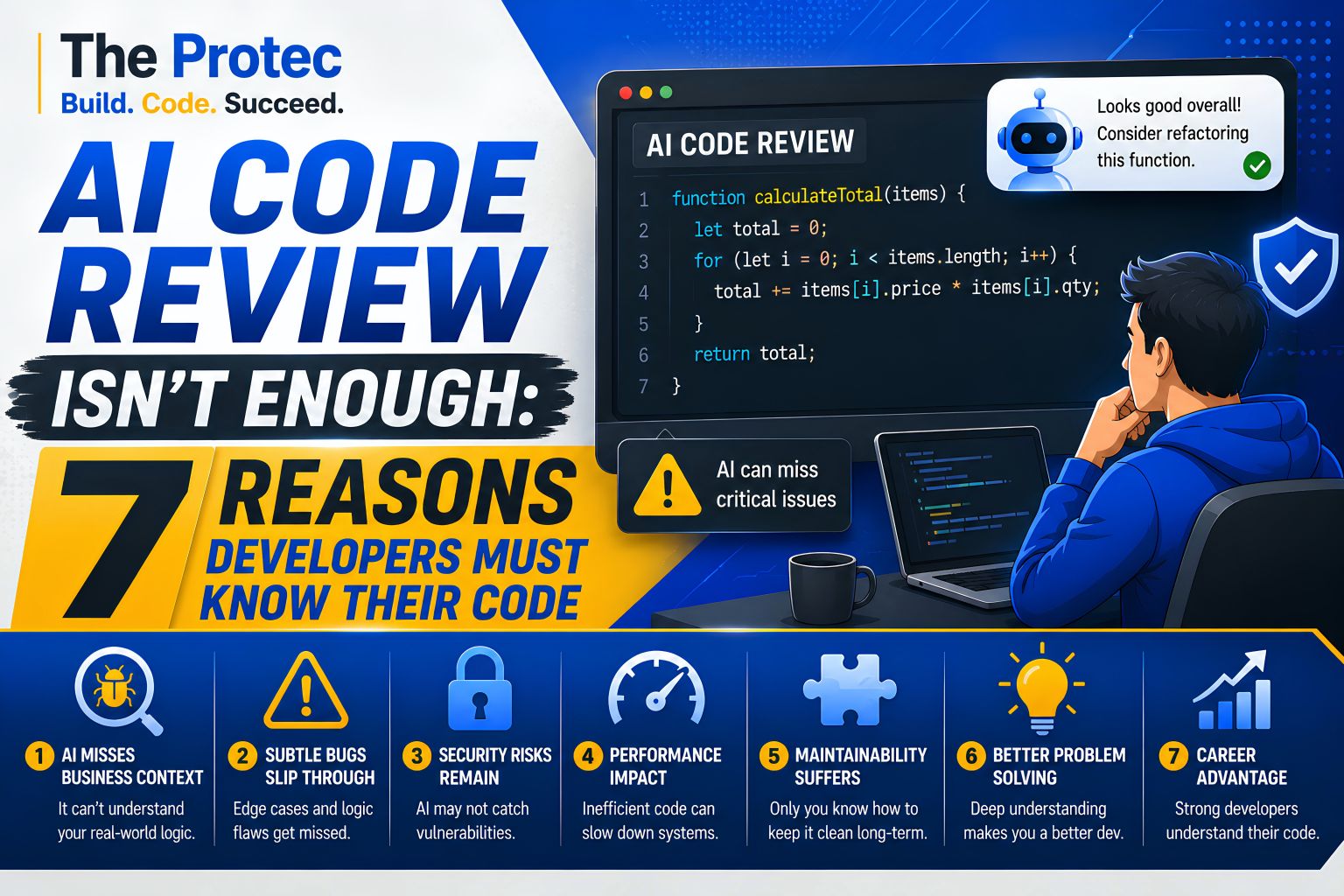
AI can now draft a feature, update several files, run tests, analyze a pull request, and suggest a fix before a human finishes reading the ticket. That speed is changing software development, but it is also creating a dangerous assumption: if an AI system wrote the code and another AI system reviewed it, the result must be safe to merge.
It is not. AI code review is useful precisely because it can scan large diffs, recognize familiar bug patterns, and enforce routine standards quickly. Yet a review can look thorough while missing the one detail that matters: whether the change actually fits the product, architecture, threat model, and operating environment.
As agentic development tools take on larger, repository-wide tasks, developers need deeper code comprehension rather than less. The essential question is no longer simply, “Does this code compile?” It is, “Can the engineering team explain what it does, how it fails, and why it belongs in the system?”
What AI Code Review Can and Cannot Do
Modern review tools can identify null handling issues, suspicious control flow, duplicated logic, missing tests, style violations, and known insecure patterns. Some can inspect a repository, execute tools, revise their own patches, and summarize risk across multiple files. These capabilities make AI review an effective first pass.
However, a model produces judgments from the context it receives and the patterns it learned. It does not possess operational ownership, product intent, or a complete mental model of the system. Limited context, ambiguous requirements, hidden dependencies, and convincing but incorrect explanations remain central AI coding risks.
1. AI Cannot Reliably Infer the Real Business Intent
Code can be syntactically correct, well tested, and still solve the wrong problem. A reviewer may confirm that a discount function calculates a percentage accurately without knowing that the business excludes subscription renewals, certain regions, or accounts under fraud review.
Requirements are often distributed across tickets, conversations, compliance policies, analytics definitions, and years of production behavior. Even repository-aware tools rarely receive all of that context. When requirements conflict, an AI reviewer may select the most statistically plausible interpretation rather than surface the ambiguity.
Developers must be able to trace each important branch back to a requirement and challenge behavior that appears reasonable but lacks a clear product justification. Understanding code means understanding the decision it implements, not merely the instructions it executes.
Using one model to generate a change and another to review it may feel like independent verification. In practice, both systems can favor similar abstractions, common implementation patterns, and familiar assumptions. If the original solution frames the problem incorrectly, the reviewer may critique details inside that frame instead of questioning the frame itself.
This correlated failure is particularly risky when AI generated code includes a confident explanation. Clear prose can make a weak design feel settled, encouraging reviewers to verify the explanation rather than inspect the behavior.
Human review should therefore begin with an independent question: “How would I expect this feature to work?” Developers should inspect changed interfaces, data flows, trust boundaries, and failure paths before accepting the generated summary. AI output is evidence to evaluate, not an authority to follow.
3. Debugging Requires Runtime Reasoning
Static review sees code; production incidents reveal systems. Race conditions, stale caches, clock differences, retry storms, memory pressure, partial network failures, and unusual data combinations may not be visible in a pull request. Tests can also pass while production behavior fails because the test environment lacks realistic concurrency, volume, configuration, or latency.
Strong debugging requires developers to form hypotheses, interpret logs and traces, reproduce conditions, inspect state transitions, and distinguish a root cause from a downstream symptom. An AI assistant can propose possibilities, but it may prioritize familiar causes or invent relationships unsupported by the telemetry.
Developers who do not understand the code cannot judge whether a suggested fix addresses the cause or merely suppresses an error. That gap leads to patches such as broader exception handling, longer timeouts, and indiscriminate retries—changes that hide failures while increasing operational risk.
4. Local Improvements Can Damage the Architecture
AI code review is often strongest at the line, function, or file level. Architecture operates across boundaries: service ownership, dependency direction, data consistency, deployment coupling, performance budgets, and long-term change costs.
A generated patch might remove duplication by creating a shared module, yet introduce tight coupling between teams. It might call a service directly instead of publishing an event, bypass an established domain boundary, or place business logic in a controller because that produces the shortest working diff.
Developers need enough architectural fluency to ask whether a change preserves system constraints. Who owns this capability? What becomes harder to deploy? Is the dependency allowed? What happens when the downstream service is unavailable? AI can compare code with documented rules, but humans must maintain those rules, resolve trade-offs, and recognize when a locally elegant solution weakens the whole system.
5. Security Depends on Threat Models, Not Pattern Matching
Automated reviewers are valuable for spotting exposed secrets, unsafe deserialization, injection patterns, weak cryptography, and missing validation. Security failures, however, frequently emerge from how legitimate components interact rather than from one obviously dangerous line.
An endpoint may validate every field and still allow unauthorized users to access another tenant’s records. A coding agent may follow malicious instructions embedded in repository content, an issue connected to prompt injection and excessive agency covered by the OWASP guidance for generative AI security. A generated workflow may also grant broad permissions simply because they make automation easier.
Developers must identify assets, actors, entry points, privileges, and abuse cases. They need to understand authentication versus authorization, tenant isolation, secret handling, secure defaults, and data exposure. AI code review can flag known patterns, but it cannot guarantee that the application’s trust boundaries match its real threat model.
6. Dependencies and Data Changes Create Hidden Risk
AI assistants frequently recommend packages or APIs that simplify an implementation. The suggestion may introduce an abandoned dependency, an incompatible license, a vulnerable transitive package, or functionality that already exists in the platform. Models can also reference outdated or nonexistent package versions unless their output is verified against current registries and documentation.
Database changes require similar caution. A migration that looks correct on an empty test database may lock a large production table, break an older application instance during a rolling deployment, or transform data in a way that cannot be reversed safely.
Developers should inspect dependency provenance, release activity, permissions, software bills of materials, migration plans, and rollback behavior. Secure development guidance such as the NIST Secure Software Development Framework reinforces the need for repeatable controls throughout the software lifecycle. A positive AI review does not replace those controls.
7. Teams Still Own Maintainability and Production Outcomes
When generated code fails, the model does not receive the incident call, explain the outage to customers, or maintain the feature two years later. The engineering team does. Ownership requires more than approving a plausible diff.
Developers need to understand control flow, invariants, state changes, error behavior, dependencies, and observability. If nobody can explain a block without asking the tool that produced it, the code is not ready. That is especially true for authentication, payments, infrastructure, concurrency, and destructive operations.
Code comprehension also protects future velocity. AI generated code can create unnecessary wrappers, inconsistent abstractions, verbose tests, and overlapping utilities at remarkable speed. Each addition increases the amount of software the team must reason about. Fast generation without disciplined simplification turns short-term productivity into long-term maintenance cost.
A Safer Workflow for AI-Assisted Development
The answer is not to reject AI code review. It is to place it inside an engineering process with clear human ownership and independent verification.
- Define intent first. Record acceptance criteria, constraints, trust boundaries, and expected failure behavior before generating code.
- Keep changes reviewable. Smaller diffs make it easier to detect architectural drift, suspicious dependencies, and unrelated edits.
- Review behavior before style. Confirm data flow, authorization, error handling, concurrency, and edge cases before polishing names or formatting.
- Run independent tools. Use compilers, linters, type checkers, tests, dependency scanners, secret detection, and static analysis rather than relying on a model’s claim that checks passed.
- Test negative paths. Exercise malformed input, denied permissions, service failures, retries, rollback scenarios, and realistic data volumes.
- Require a human explanation. The author should be able to describe why the implementation is correct and how it could fail without repeating an AI-generated summary.
- Escalate high-risk changes. Security-sensitive, financially significant, infrastructure, and data-migration changes deserve specialist review and stronger approval controls.
Teams should also measure outcomes instead of celebrating generated lines or faster pull requests. Useful signals include escaped defects, rollback frequency, security findings, review rework, incident recovery time, and maintenance burden. Speed matters only when it produces dependable software.
Frequently Asked Questions
Can AI code review replace human pull request review?
No. It can accelerate routine inspection, identify common defects, summarize large diffs, and suggest missing tests. Human reviewers are still needed to validate intent, architecture, security boundaries, operational impact, and maintainability. High-risk changes should never depend on AI approval alone.
What are the biggest AI coding risks?
Major risks include incorrect assumptions, fabricated APIs, insecure defaults, hidden dependency issues, weak authorization, architectural drift, insufficient tests, and confident explanations of faulty behavior. Agentic tools add risks because they can edit multiple files, execute commands, and interact with external systems at greater scale.
How should developers review AI generated code?
Start by ignoring the generated explanation and inspect the requirements and diff independently. Trace inputs, outputs, state changes, permissions, dependencies, and failure paths. Run deterministic checks, add adversarial tests, verify packages and APIs against primary sources, and reject any code the team cannot explain.
Will better models eliminate the need for code comprehension?
Better models will reduce some errors and automate more routine work, but broader autonomy increases the impact of mistakes. Developers will spend less time typing predictable code and more time specifying constraints, evaluating designs, debugging complex behavior, securing systems, and deciding whether generated changes should exist at all.
Understanding the Code Is the Final Control
AI code review is becoming an essential engineering tool, but it remains a tool—not an accountable teammate. It can detect patterns and accelerate feedback, while developers supply context, skepticism, architecture, threat modeling, and operational judgment.
The safest standard is straightforward: use AI to move faster, but never merge critical behavior that the team cannot explain, test, debug, and defend. Software is not trustworthy because two models agreed on it. It is trustworthy when responsible engineers understand why it works and are prepared for when it does not.