








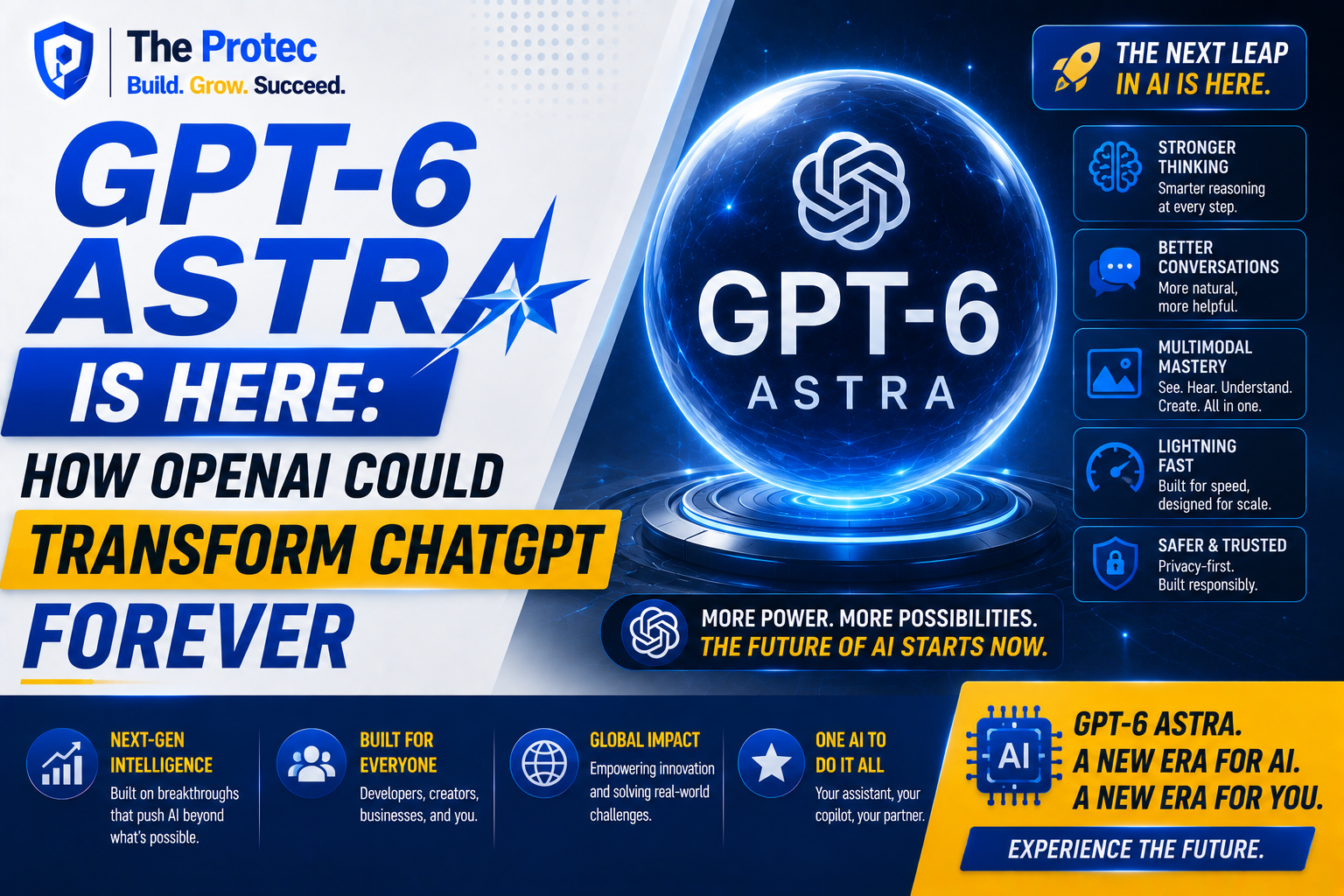
GPT-6 Astra is the name capturing attention across the AI world, and the excitement is easy to understand. A new flagship model from OpenAI would not simply give ChatGPT another performance boost. It could change what people expect an AI assistant to understand, create, remember, and accomplish on their behalf.
The most compelling possibility is that GPT-6 Astra represents a shift from a chatbot that responds to instructions into an adaptive system that can reason across information, interpret multiple types of media, use digital tools, and manage longer tasks. That would make ChatGPT feel less like a conversational search box and more like an intelligent workspace.
There is, however, an important distinction to make. Product names, codenames, rumored specifications, and staged rollouts often circulate before every detail appears in official documentation. Readers should verify availability, pricing, benchmarks, and model access through OpenAI’s official ChatGPT page. With that caveat in place, the capabilities associated with GPT-6 Astra offer a revealing look at where OpenAI may be taking ChatGPT next.
What Is GPT-6 Astra?
GPT-6 Astra is being discussed as OpenAI’s next-generation GPT-6 AI system and a potential successor to the models that pushed ChatGPT beyond basic text generation. The significance of the Astra label is not merely a higher model number. It suggests an AI designed around broader, more fluid intelligence: reasoning through complicated questions, understanding live visual and audio context, coordinating tools, and responding with less delay.
That combination matters because AI performance is no longer judged only by how well a model writes an essay or answers a trivia question. Users now expect models to analyze documents, inspect images, write and test code, conduct research, interpret speech, and carry context across a project. The new ChatGPT model will be measured by how consistently it can connect those abilities.
OpenAI has not always exposed every technical or product detail at the same moment. A GPT-6 Astra release could therefore arrive in phases, with different capabilities appearing across ChatGPT plans, developer services, enterprise products, or geographic markets. The model available to one user may not initially have the same tools or limits as the version available to another.
The GPT-6 Astra Features That Could Matter Most
The headline attraction is raw intelligence, but practical improvements will determine whether Astra feels truly different. The following areas are the ones most likely to reshape everyday ChatGPT use.
1. More Deliberate and Dependable Reasoning
Advanced reasoning remains one of the most important frontiers for OpenAI GPT-6. Earlier models could produce convincing answers while missing a hidden constraint, making an unsupported assumption, or losing track of a multistep problem. GPT-6 Astra could reduce those failures by planning before answering, checking intermediate conclusions, and choosing when a problem needs additional computation.
For users, better reasoning would show up in practical ways. ChatGPT could compare contracts without overlooking conflicting clauses, debug software across several files, evaluate competing business strategies, or explain a scientific problem while preserving the logic behind each step. The goal is not simply a longer answer. It is an answer built on a more coherent process.
2. A More Natural Multimodal ChatGPT
Multimodal AI can work with text, images, audio, video, and structured data rather than treating each format as a separate task. GPT-6 Astra could make these modes feel like parts of one continuous conversation.
A user might show ChatGPT a malfunctioning appliance through a camera, describe the symptoms aloud, and receive troubleshooting guidance based on both the visual details and spoken context. A marketing team could upload campaign graphics, audience research, and recorded feedback, then ask Astra to identify inconsistencies across all three sources. Students could discuss a diagram verbally while the AI follows their references in real time.
The major advance would be cross-modal reasoning: understanding how the information in one medium changes the meaning of another. That is more valuable than merely accepting several file types.
3. Faster Responses Without Sacrificing Depth
Speed affects whether an AI feels useful or intrusive. A highly capable model can still disrupt a workflow if every request involves a long wait. Astra may use more efficient model routing, improved inference, and adjustable reasoning depth to respond quickly to straightforward prompts while reserving greater computation for difficult ones.
This could make voice conversations smoother, coding assistance more immediate, and live visual interactions more believable. The ideal GPT-6 Astra ChatGPT experience would not apply maximum effort to every question. It would recognize when a concise answer is enough and when careful analysis is worth the extra time.
4. AI Agents That Can Complete Multistep Work
AI agents are moving ChatGPT from generating advice to taking controlled action. Instead of only explaining how to perform a task, an agent can potentially navigate approved services, gather information, update files, run code, or complete a defined workflow.
GPT-6 Astra could improve agents by giving them stronger planning, error recovery, and awareness of what has already been completed. For example, a travel-planning agent might compare routes, organize options around a budget, identify schedule conflicts, and prepare an itinerary. A workplace agent could summarize meeting notes, extract assignments, draft follow-up messages, and update a project tracker after receiving approval.
Reliable agency requires boundaries. Users need to see what an agent intends to do, which data it can access, and when confirmation is required. The most powerful agent is not the one with unlimited autonomy; it is the one that can make progress without hiding consequential actions.
5. Longer Context and More Useful Memory
Longer context would allow GPT-6 to work across larger collections of messages, documents, code, or research. Better memory could help ChatGPT retain approved preferences between conversations, such as a user’s writing style, accessibility needs, preferred tools, or recurring project requirements.
These features are related but not identical. Context is the information available during a particular interaction, while memory is information retained for later use. Astra will need clear controls for both. Users should be able to inspect, correct, disable, and delete remembered details rather than guessing what the assistant knows.
6. Better Reliability and Calibrated Answers
No generative model is automatically correct because it sounds confident. One of the most valuable GPT-6 Astra features would be better calibration: recognizing uncertainty, distinguishing evidence from inference, requesting missing information, and declining to invent an answer.
This is particularly important for research, finance, healthcare, law, and other high-stakes fields. An improved model should cite sources when tools are available, acknowledge conflicting evidence, and make it easier for users to verify a conclusion. OpenAI’s published model information and technical documentation should remain the reference point for confirmed capabilities; developers can monitor the company’s official model documentation for supported features and limits.
How GPT-6 Astra Could Change Everyday ChatGPT Use
The impact of a new model is clearest in ordinary tasks. For writers, Astra could maintain voice and factual consistency across an entire project instead of treating each prompt as an isolated request. Developers could give it a repository, an issue report, and test results, then ask it to trace a bug across components. Analysts could combine spreadsheets, presentation slides, and meeting transcripts in a single investigation.
Voice and vision could also make ChatGPT more accessible. A user might ask questions without typing, receive descriptions of visual information, or work through an unfamiliar interface with real-time guidance. Language learners could practice natural conversations while receiving corrections based on pronunciation, vocabulary, and context.
For households, the change may be subtle but significant: clearer product comparisons, adaptive tutoring, meal planning based on visible ingredients, help understanding paperwork, and better organization of personal projects. Astra’s success will depend on whether these interactions become more accurate and convenient without creating new privacy risks.
Why OpenAI May Position GPT-6 as a Major Leap
Model launches once revolved around benchmark scores and parameter counts. Those measures still matter, but the AI market is increasingly focused on complete systems. OpenAI must compete on model quality, response speed, multimodal interaction, tool support, safety, cost, and the usefulness of ChatGPT as a finished product.
That helps explain why GPT-6 Astra could be positioned as more than another language model. The strategic goal may be to unify capabilities that previously felt fragmented. Reasoning, memory, browsing, code execution, voice, vision, and agents become far more powerful when the assistant can select and coordinate them without forcing users to manage each component.
The result could be a ChatGPT that adapts its behavior to the task. It might respond instantly to a simple request, pause to reason through a complex decision, ask permission before using an external service, or present evidence when a claim needs verification.
The Challenges Behind the GPT-6 Astra Release
More capability creates higher expectations and greater risk. A multimodal model can process richer personal information. A persistent assistant can remember useful preferences but may also retain details a user did not intend to preserve. An agent can save time, yet a mistaken action may have consequences outside the conversation.
OpenAI will therefore be judged on safeguards as much as intelligence. Essential protections include transparent permissions, visible activity logs, confirmation before sensitive actions, strong data controls, enterprise governance, and defenses against malicious instructions hidden in websites or files.
Cost is another challenge. Deep reasoning and continuous multimodal processing can demand substantial computing resources. The practical GPT-6 Astra experience may involve usage limits, several performance tiers, or automatic routing between models. Those implementation details could matter more to users than a dramatic benchmark result.
What GPT-6 Astra Means for the Future of AI Assistants
If Astra delivers the expected combination of reasoning, multimodality, speed, memory, and agency, the traditional chatbot label will become increasingly inadequate. Future AI assistants will operate across conversations, applications, and media while helping people manage goals that unfold over time.
That does not mean human judgment becomes optional. The strongest use of GPT-6 AI will be collaborative: the system handles information-heavy work, offers alternatives, and carries out approved steps, while the user supplies objectives, context, and accountability. Trust will come from predictable behavior and transparent controls, not from an assistant pretending to be infallible.
For now, the smartest approach is curiosity paired with verification. Look beyond the GPT-6 Astra name and examine the actual model card, release notes, access conditions, privacy settings, and independent testing. If the technology matches the ambition surrounding it, ChatGPT may be on the verge of becoming a considerably more capable partner for both everyday and professional work.
Frequently Asked Questions About GPT-6 Astra
Is GPT-6 Astra an official OpenAI model?
The Astra name should be treated carefully until its branding, availability, and specifications are documented through official OpenAI channels. Online discussions may combine codenames, rumors, preview features, and confirmed product information. Check OpenAI’s model documentation and ChatGPT release information before assuming a particular feature is generally available.
What are the expected GPT-6 Astra features?
The most discussed areas include stronger multistep reasoning, integrated text, image, audio, and video understanding, faster responses, longer context, more useful memory, and AI agents capable of completing approved tasks. Exact features may vary by product tier, region, and rollout stage.
How could GPT-6 Astra improve ChatGPT?
Astra could help ChatGPT understand more complex requests, maintain context across larger projects, interact through voice and vision, and coordinate tools with less manual guidance. The practical benefit would be fewer fragmented steps between asking a question and completing a task.
Will GPT-6 Astra replace current ChatGPT models?
Not necessarily. OpenAI may continue offering multiple models optimized for different combinations of speed, cost, reasoning, and specialized work. ChatGPT could also route requests automatically so that simple tasks use a faster model while difficult problems receive more computational effort.
Can GPT-6 Astra operate as an autonomous AI agent?
Agent capabilities may allow it to plan and perform multistep actions, but responsible deployment should preserve user oversight. Access permissions, confirmation checkpoints, spending limits, and activity records will be essential whenever ChatGPT interacts with external tools or sensitive data.