








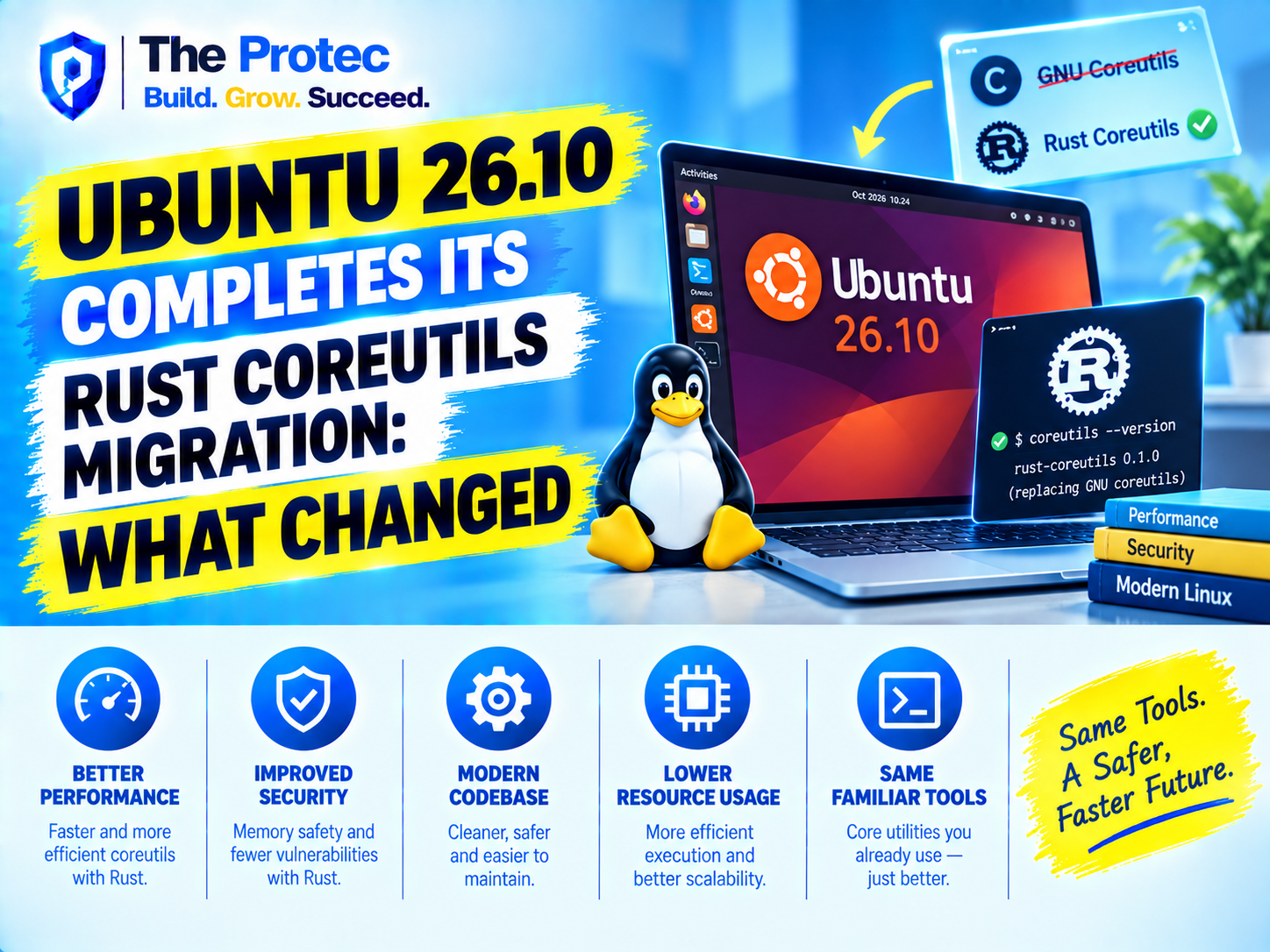
Ubuntu 26.10 has reached an important milestone in one of Canonical’s most consequential low-level software transitions: the migration of core command-line utilities toward Rust-based implementations. The work places Rust coreutils more firmly inside the operating system’s default environment, affecting commands that users, shell scripts, installers, containers, and system services rely on every day.
This is not a cosmetic language change. Linux coreutils sit near the foundation of a distribution. Familiar commands such as cp, mv, ls, cat, chmod, date, and sort are invoked constantly, often without users realizing it. Replacing or supplementing their traditional GNU implementations therefore requires extensive compatibility testing, packaging work, performance analysis, and careful handling of edge cases.
The completed Ubuntu 26.10 Rust migration does not mean that Ubuntu has rewritten the entire distribution in Rust, nor does it mean every GNU utility has disappeared. It means the integration work needed to make Rust-based coreutils part of Ubuntu’s supported system foundation has crossed a major threshold. Here is what actually changed—and what users and developers should expect next.
What Ubuntu 26.10 Changed in Its Core Utilities
The centerpiece of the migration is the adoption of utilities produced by the uutils coreutils project, an open-source effort to implement GNU-compatible core utilities in Rust. The project aims to provide familiar command names, options, output formats, and exit behavior while benefiting from Rust’s memory-safety model and modern development ecosystem.
For Ubuntu 26.10, completing the migration involved much more than compiling a collection of Rust binaries. Ubuntu’s developers had to integrate the utilities with distribution packaging, define how command links and executable paths are managed, validate installation and upgrade behavior, and test the commands against the enormous body of software that assumes GNU coreutils semantics.
The completed work includes several practical areas:
- Integration of Rust-based coreutils into Ubuntu’s package and image-building infrastructure.
- Validation of command names, symbolic links, executable paths, and package relationships.
- Compatibility testing for shell scripts, installers, build systems, and system services.
- Improved handling of behavioral differences discovered during earlier deployment and testing.
- Architecture-specific build and test coverage across Ubuntu’s supported hardware targets.
- Clearer fallback and coexistence strategies for software that still depends on GNU-specific behavior.
Calling the migration complete refers to this distribution-level integration milestone. It does not imply that uutils has achieved perfect, permanent parity with every GNU coreutils feature or obscure historical behavior. Compatibility remains an ongoing engineering process, especially as both projects continue to evolve.
Why Ubuntu Is Adopting Rust in Low-Level System Software
C and C++ remain essential to Linux, but their memory-management models make it possible to introduce classes of defects such as buffer overflows, use-after-free errors, invalid pointer access, and some forms of data races. Mature projects reduce these risks through review, testing, defensive programming, and hardening, yet the underlying language still permits unsafe memory operations.
Rust approaches the problem differently. Its ownership and borrowing rules prevent many memory-safety errors during compilation. Code can still use explicitly marked unsafe operations when necessary, but those operations are isolated and easier to audit.
That distinction matters for Ubuntu coreutils because these commands routinely process untrusted filenames, unusual byte sequences, large files, complex command options, and data supplied by scripts or remote workloads. A defect in a basic utility can affect far more than an interactive terminal session; it can surface in package installation, cloud initialization, container builds, backup jobs, or privileged maintenance tasks.
Rust also offers modern dependency management, strong type checking, expressive error handling, and integrated tooling. Those qualities can make low-level software easier to review and maintain, particularly as experienced contributors join projects without decades of familiarity with an older C codebase.
Memory Safety Is the Biggest Benefit—but Not the Only One
The security case for Ubuntu Rust coreutils is compelling, but memory safety should not be mistaken for complete security. Rust cannot automatically prevent faulty permissions logic, unsafe command usage, incorrect path handling, race conditions involving the filesystem, or a developer misunderstanding a specification. It substantially reduces certain defect classes; it does not eliminate the need for audits, fuzzing, regression tests, and careful design.
Reliability may be the more visible benefit for everyday users. Rust encourages explicit handling of optional values, conversion failures, integer boundaries, and errors that might otherwise be overlooked. For command-line utilities used inside unattended scripts, predictable failures and consistent exit codes are especially important.
The migration also creates an opportunity to consolidate tests around real behavior. To replace a mature implementation, developers must identify which semantics are required by standards, which are GNU extensions, and which have become de facto interfaces because scripts depend on them. That work can improve documentation and expose assumptions that previously lived only in legacy code or tests.
Will Rust Coreutils Make Ubuntu Faster?
Performance is more nuanced than claims that Rust is simply faster or slower than C. Both languages can produce highly optimized native binaries. The outcome depends on algorithms, memory allocation, filesystem access patterns, Unicode handling, compiler optimization, and the maturity of each implementation.
Some Rust-based utilities can match or outperform their GNU equivalents in particular workloads. Others may remain slower when GNU coreutils benefits from decades of optimization for sorting, copying, hashing, sparse files, or platform-specific system calls. Startup time and binary size also matter because simple commands are often launched repeatedly by shell scripts.
For most desktop users, individual differences measured in milliseconds will be difficult to notice. Performance matters more in large build pipelines, container image creation, data-processing scripts, and infrastructure that invokes core utilities millions of times. Ubuntu therefore has to examine whole-system behavior rather than relying on a single microbenchmark.
The realistic expectation is not an across-the-board speed boost. Ubuntu 26.10’s objective is to deliver acceptable or better performance without sacrificing compatibility and reliability. Where regressions appear, they can be profiled and addressed upstream. Rust provides strong optimization potential, but the migration is primarily about sustainable and safer system software.
Compatibility With Traditional GNU Coreutils
Compatibility is the hardest part of the Ubuntu Rust coreutils transition. GNU coreutils has accumulated decades of features, extensions, locale behavior, output conventions, and edge-case decisions. Although many commands look simple, real-world behavior can become complicated when symbolic links, unusual permissions, sparse files, extended attributes, invalid character sequences, or platform-specific filesystems are involved.
Scripts may also parse human-readable output even when they should not. A small difference in spacing, quoting, timestamps, error messages, or ordering can break automation. Other programs rely on GNU-only flags rather than portable POSIX syntax.
Ubuntu’s compatibility work consequently extends beyond checking whether cp source destination succeeds. Test suites must compare options, exit statuses, standard output, standard error, metadata preservation, locale handling, and failure modes. Package builds provide another valuable test: if thousands of source packages compile successfully with the Rust-based commands, developers gain evidence that common workflows remain intact.
Users should nevertheless distinguish compatibility from bit-for-bit identity. Rust GNU coreutils alternatives are designed to behave like their established counterparts, but internal implementation and occasional edge behavior can differ. Organizations with sensitive shell automation should test their own workloads during the Ubuntu 26.10 evaluation period rather than assuming every undocumented GNU behavior is reproduced.
What Users Will Actually Notice
Most users should notice very little. Commands retain their familiar names and broadly familiar syntax. Existing terminal habits are not supposed to change merely because the executable behind a command was written in Rust.
Differences are more likely to emerge in four areas:
- Rare command options: Uncommon combinations may expose incomplete compatibility or intentionally different validation.
- Error output: Wording, quoting, or ordering can vary even when the command fails correctly.
- Extreme workloads: Very large directory trees, files, or sorting jobs may reveal performance and memory-use differences.
- Nonportable scripts: Automation that parses presentation-oriented output or depends on undocumented behavior has the highest risk.
Ordinary file management and standard shell operations should remain familiar. If migration problems do appear, they are more likely to affect sophisticated automation than basic desktop use.
What Developers and System Administrators Should Check
Developers maintaining build scripts, CI pipelines, packages, or fleet automation should treat the Ubuntu 26.10 changes as a reason to improve portability. Start by checking scripts for GNU-specific options and commands whose output is parsed with fragile regular expressions. Prefer machine-readable interfaces where available, quote paths correctly, and verify exit codes rather than matching exact error text.
Administrators should test backup jobs, provisioning tools, image-build workflows, and storage scripts against representative data. Filesystem metadata deserves special attention, including ownership, permissions, hard links, symbolic links, timestamps, sparse allocation, and extended attributes.
When reporting a problem, include the exact command, input conditions, locale, filesystem type, expected behavior, actual behavior, and utility version. Reproducible reports help Ubuntu and uutils developers determine whether an issue is a bug, a missing GNU extension, or a deliberate standards-related difference.
Build Tooling and Maintenance Trade-Offs
Moving Ubuntu coreutils toward Rust introduces new maintenance considerations. Rust projects commonly use Cargo for dependency resolution and builds, while a Linux distribution needs reproducible source packages, controlled dependency versions, architecture support, security updates, and the ability to build without downloading code during compilation.
Ubuntu must package or vendor the required Rust crates under distribution policies, track security advisories across the dependency graph, and keep compiler versions aligned with project requirements. Rust’s rapid release cycle is useful for language improvements, but it can increase pressure on long-term maintenance compared with small C projects that build on much older toolchains.
Binary size and compile time are additional trade-offs. Rust monomorphization and static linking choices can produce larger artifacts, while compiling a substantial crate graph may consume more resources. Distribution engineers can mitigate these costs through feature selection, link-time optimization, shared packaging infrastructure, and careful dependency review.
On the positive side, a shared Rust ecosystem can reduce duplicated implementation work. Strong compiler diagnostics, formatting, linting, testing, and dependency metadata give maintainers a consistent toolchain. The challenge is ensuring those conveniences remain compatible with Ubuntu’s reproducibility, security, and long-term support expectations.
Rust’s Growing Role Across Linux
Ubuntu’s migration is part of a broader shift toward memory-safe languages in system software. Rust support has entered the upstream Linux kernel, where the official kernel documentation now covers infrastructure for writing selected components in Rust. Rust is also increasingly visible in networking tools, service managers, cryptographic software, command-line applications, and security-sensitive platform components.
This does not signal the imminent removal of C from Linux. The kernel, GNU ecosystem, libraries, and hardware support stack contain vast, mature C codebases that will remain critical. Instead, Rust is becoming a practical option for new components and carefully selected replacements where memory safety and maintainability justify migration costs.
Ubuntu’s approach is significant because coreutils are universal rather than optional. Successful deployment demonstrates that Rust-based system tools can move beyond experimental packages and operate inside a mainstream distribution’s default environment.
What Is Complete and What Still Comes Next
As of the September Ubuntu 26.10 development milestone, the major integration and transition work for Rust-based coreutils is complete. Packaging, command exposure, image integration, and broad compatibility validation have moved beyond the initial experimental phase.
That does not mean Ubuntu 26.10 itself has no remaining release work, or that coreutils development has stopped. Final image testing, bug fixing, architecture validation, security review, and performance tuning continue as part of the normal release process. Upstream uutils will also keep adding compatibility fixes and optimizations.
Future plans may extend Rust into more low-level Ubuntu components, but those possibilities should not be confused with completed work. Ubuntu has not converted the kernel or the whole user space to Rust. Each migration requires an independent technical and maintenance case.
FAQ: Ubuntu 26.10 Rust Coreutils
Is Ubuntu 26.10 replacing GNU coreutils completely?
No. Ubuntu’s migration makes Rust-based core utilities a central part of the default system environment, but GNU coreutils remains relevant for compatibility, packaging, testing, and workloads that require specific GNU behavior. The transition is not equivalent to deleting every GNU implementation from the Ubuntu archive.
Will existing shell scripts continue to work?
Most scripts using standard, documented command behavior should continue to work. Scripts that parse human-readable output, rely on exact error messages, use rare GNU extensions, or depend on undocumented edge cases should be tested carefully.
Are Rust coreutils more secure?
They reduce exposure to many memory-safety vulnerabilities by using Rust’s ownership and type systems. However, logic errors, filesystem races, configuration mistakes, and unsafe code can still create security problems. Rust improves the baseline; it does not replace security engineering.
Will Ubuntu 26.10 feel faster after the migration?
Not necessarily. Some utilities or workloads may improve, while others may perform similarly or show regressions that require optimization. The main goals are safety, reliability, maintainability, and compatibility rather than a universal speed increase.
Does this mean Ubuntu will eventually be written entirely in Rust?
No such conclusion follows from the coreutils migration. Ubuntu combines software written in many languages, and mature C components will remain fundamental. Rust is being adopted selectively where its benefits outweigh transition and maintenance costs.
A Foundational Change Designed to Be Unremarkable
The best outcome for Ubuntu 26.10’s Rust coreutils migration is that most users barely notice it. Core commands should continue doing familiar jobs while the distribution gains a safer implementation language, a modern maintenance model, and a stronger foundation for future development.
Behind that uneventful user experience is a difficult engineering achievement. Replacing decades-old utilities requires more than translating code: it demands behavioral compatibility, performance discipline, reproducible builds, architecture support, and coordination between Ubuntu and upstream developers. The migration’s completion shows that Rust Linux software has progressed from promising experiments to infrastructure capable of supporting everyday systems.