







AI agents are moving from controlled demonstrations into customer support, finance, healthcare and other production environments where a plausible but incorrect answer can have real consequences. That shift has created an urgent infrastructure problem: companies need to know not only whether an agent is online, but whether it is behaving correctly.
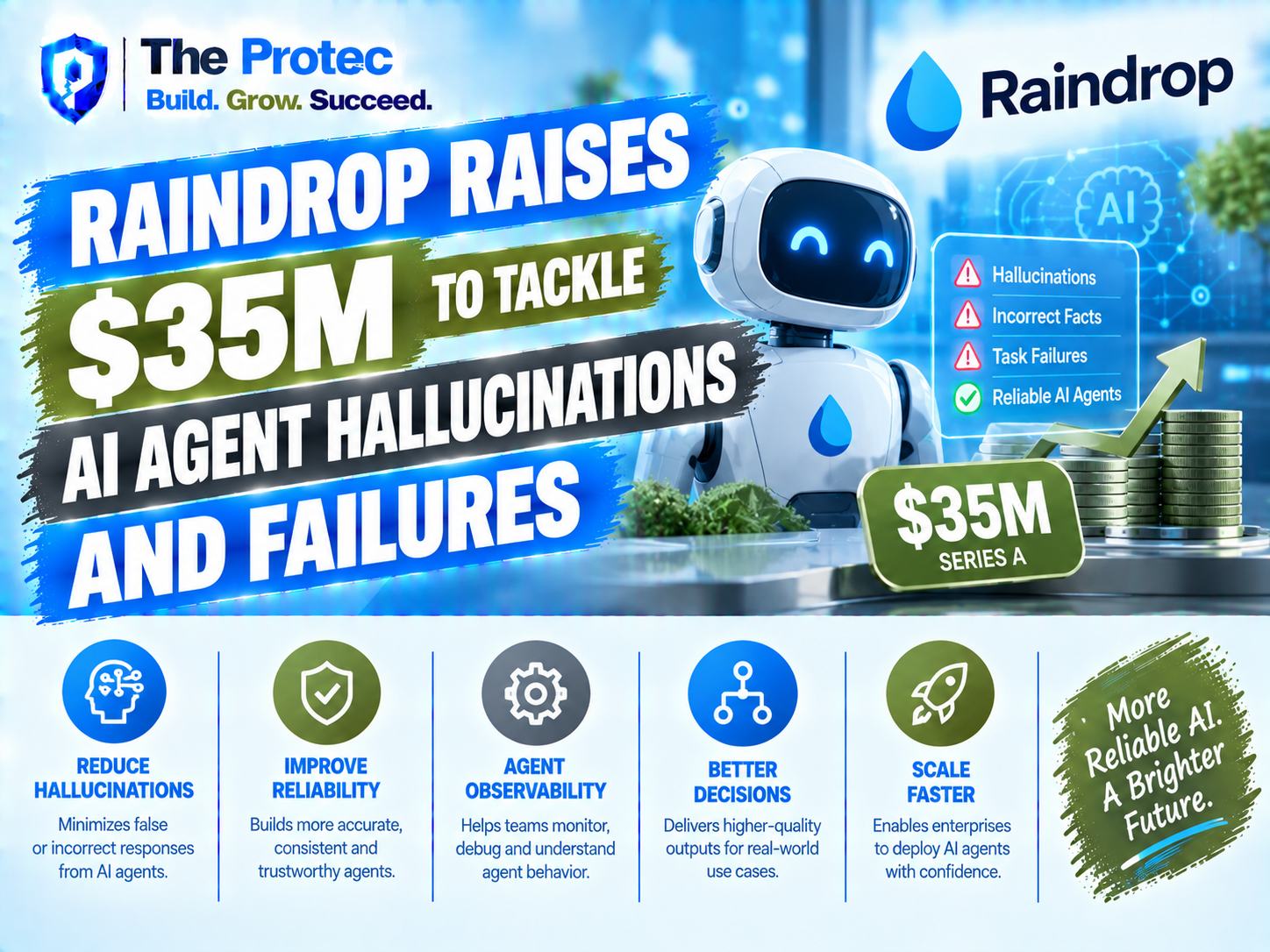
Raindrop AI is addressing that gap with a monitoring and observability platform designed specifically for increasingly autonomous AI agents. The company has raised a $35 million Series A, bringing its total funding to $50 million. The new capital reflects growing demand for systems that can detect AI agent hallucinations, tool misuse, unexpected behavior changes and other semantic failures that conventional application monitoring frequently overlooks.
As of September 2026, AI agent reliability has become one of the central challenges in deploying agentic software at scale. Raindrop’s approach focuses on analyzing complete production trajectories and testing proposed changes against real traffic patterns before those changes reach users.
Why Raindrop’s $35M Series A Matters
The Raindrop funding round arrives as companies are giving AI agents more authority to make decisions and take actions. Early chatbots mainly generated text. Modern autonomous AI agents can search databases, retrieve account information, call APIs, update records, initiate workflows and coordinate with other agents.
That expanded capability increases the potential value of an agent, but it also enlarges the failure surface. A model might invent a policy, select the wrong tool, pass incorrect parameters or complete a task that should have required human approval. An agent can remain technically available throughout the incident, leaving traditional uptime dashboards green.
Raindrop raises $35M at a point when organizations are recognizing that models, prompts and tools cannot be evaluated only before launch. Production environments introduce ambiguous requests, changing data, new integrations and unusual sequences that test suites rarely capture. The company’s $50 million in total funding positions it to expand an AI infrastructure category built around continuous behavioral monitoring rather than basic system health.
How Raindrop AI Monitors Production Agent Trajectories
Raindrop AI examines agent trajectories: the sequence of steps an agent follows from an initial request to its final response or action. A trajectory can include user messages, reasoning states, retrieved context, model outputs, tool selections, API calls, retries and handoffs.
Looking at the whole trajectory matters because an individual event may appear harmless. A database query can succeed, an API can return a valid response and the model can produce fluent text. Yet the completed workflow may still be wrong because the agent misunderstood the request, retrieved irrelevant information or used a tool in an inappropriate context.
Raindrop’s AI agent observability layer is intended to identify patterns across these production traces. Instead of relying exclusively on fixed error codes, it analyzes behavior for semantic signs of failure. These can include unsupported claims, incorrect task completion, inappropriate tool use and changes in behavior after a model, prompt or workflow update.
This approach also helps teams find recurring failure clusters. Thousands of superficially different conversations may share the same underlying issue, such as a prompt ambiguity or a retrieval problem. Grouping related incidents gives engineering and product teams a clearer view of what is failing, how frequently it occurs and which users are affected.
Why Traditional Software Monitoring Misses AI Agent Failures
Conventional observability was built around deterministic software. Engineers track latency, error rates, CPU usage, logs and request traces because the expected behavior of a standard application can usually be defined precisely. If an endpoint returns a server error, the problem is visible and measurable.
Generative systems fail differently. An AI agent can return a successful HTTP status, complete every tool call and respond within the latency target while producing a dangerous or nonsensical result. The infrastructure works, but the outcome does not.
Another challenge is variability. The same model may respond differently to similar requests, while a minor prompt or model change can alter behavior across a wide range of cases. Static assertions are useful, but they cannot anticipate every production interaction. AI observability therefore needs to evaluate meaning, context and intent in addition to technical execution.
Traditional application performance monitoring remains essential for operational health. Raindrop is aimed at the layer above it: determining whether an agent’s actions make sense and remain aligned with the expected business process. Together, infrastructure telemetry and semantic AI safety monitoring provide a more complete view of production risk.
The Failure Modes Raindrop Is Designed to Detect
Reliable AI agents require visibility into several distinct categories of failure. Raindrop’s production-focused model targets problems such as:
- Hallucinations: The agent presents fabricated or unsupported information as fact, potentially misleading a customer or employee.
- Tool misuse: The agent chooses an inappropriate tool, calls the correct tool with incorrect parameters or acts without sufficient authorization.
- Incomplete task execution: The agent claims success even though one or more required workflow steps were skipped.
- Unexpected behavior changes: A new model, prompt, policy or integration causes a measurable shift in how the agent responds or acts.
- Reasoning and routing errors: The agent misinterprets intent, retrieves the wrong context or sends a request to the wrong subsystem.
- Boundary violations: The agent attempts actions outside its approved role, data scope or operational policy.
These categories overlap with AI agent security because unsafe behavior can emerge from both accidental errors and malicious inputs. Guidance such as the OWASP Top 10 for LLM Applications highlights risks including prompt injection, insecure output handling and excessive agency. Continuous monitoring helps teams see when those risks produce observable behavior in production.
Raindrop Simulations Tests Changes Against Production Traffic
Monitoring can reveal an incident after a system is deployed, but engineering teams also need a way to prevent regressions. Raindrop’s new Simulations product addresses that requirement by allowing teams to replay production traffic against proposed model or agent changes before deployment.
This is especially important for agentic applications because changing one component can produce unexpected effects elsewhere. Replacing a foundation model may improve answer quality but increase tool-selection errors. A stricter system prompt might reduce hallucinations while causing more abandoned tasks. Updating a tool description can alter when and how often the agent calls it.
With production replay, teams can compare current behavior against a candidate version using interactions that reflect how people actually use the system. They can examine whether the change introduces new failure clusters, shifts completion rates or creates unusual trajectories. That gives AI agent testing a more realistic foundation than a small collection of hand-written evaluation prompts.
Simulations can also support safer release processes. Teams may use the results to block a deployment, revise a prompt, choose a different model or narrow an agent’s permissions. It does not eliminate the need for live AI production monitoring, since new situations will always arise, but it creates an important checkpoint between development and release.
Continuous Monitoring Becomes Critical in High-Impact Workflows
The case for AI agents monitoring becomes stronger as agents gain access to sensitive data and consequential tools. A customer service agent may issue credits or explain contractual terms. A financial agent may analyze transactions or prepare account information. A healthcare workflow may summarize clinical records, route requests or support administrative decisions.
In these settings, accuracy alone is not enough. Organizations need to understand how an outcome was produced, whether the agent used approved information and whether it stayed within operational boundaries. They also need evidence that controls continue to work after models, prompts and data sources change.
Continuous AI safety monitoring supports that objective by turning production behavior into an ongoing source of evaluation. It can surface rare edge cases, reveal gradual drift and show whether safeguards perform under real conditions. This aligns with the broader risk-management principles described in the NIST AI Risk Management Framework, including measurement, monitoring and governance throughout the system lifecycle.
AI Observability Is Also a Security and Governance Layer
AI agent security is often discussed in terms of access controls, model protections and prompt-injection defenses. Those safeguards are necessary, but preventive controls can fail. Observability provides a detective layer that helps teams identify abnormal actions even when the underlying request did not trigger a known rule.
Trajectory analysis can reveal repeated attempts to access restricted tools, unexplained increases in high-risk actions or behavior that deviates from the agent’s intended role. It can also give security, compliance and engineering teams a shared record for investigating incidents.
That record becomes increasingly valuable as organizations operate multiple agents across different models and business units. Without a dedicated AI observability layer, evidence can remain fragmented across application logs, model providers and third-party tools. A unified view makes it easier to assign ownership, measure risk and establish approval processes for material changes.
What Teams Should Learn From Raindrop’s Approach
The rise of platforms such as Raindrop suggests that organizations should treat agent reliability as a continuous operational discipline. Before deploying autonomous AI agents, teams should define acceptable behavior, prohibited actions and escalation paths. They should also capture enough trajectory data to understand how each outcome was reached.
Strong programs combine several practices:
- Evaluate agents with realistic tasks before launch.
- Replay representative production traffic when models, prompts or tools change.
- Monitor semantic outcomes alongside latency, availability and cost.
- Set alerts for hallucinations, tool misuse and meaningful behavior shifts.
- Apply least-privilege access to tools and sensitive information.
- Route uncertain or high-impact decisions to human reviewers.
- Use production incidents to expand evaluation suites and improve safeguards.
No monitoring product can guarantee that an agent will never fail. The practical objective is to make failures visible, measurable and actionable before they spread. Raindrop’s emphasis on production trajectories and simulation reflects that reality.
Raindrop Funding Signals a Larger AI Infrastructure Shift
The $35 million Series A is more than an AI startup funding milestone. It signals that reliability tooling is becoming a core part of the agentic technology stack. As model capabilities become easier to access, competitive differentiation increasingly depends on whether companies can operate agents safely and consistently in real environments.
That creates room for an AI safety startup focused on the gap between model evaluation and traditional software monitoring. Raindrop is betting that every serious agent deployment will need semantic observability, production replay and continuous failure detection. If autonomous systems continue gaining authority, those capabilities may become as fundamental as logging and application performance monitoring are today.
Frequently Asked Questions
What is Raindrop AI?
Raindrop AI is an AI agent monitoring and observability company. Its platform analyzes production agent trajectories to identify semantic failures, including hallucinations, tool misuse, incomplete tasks and unexpected behavioral changes.
How much funding has Raindrop raised?
Raindrop has raised a $35 million Series A, bringing its total funding to $50 million. The investment supports its work on reliability infrastructure for production AI agents.
What is Raindrop Simulations?
Simulations is a product that lets teams replay production traffic against proposed model, prompt or agent changes before deployment. It helps reveal regressions and behavior shifts using realistic interactions rather than relying only on static test cases.
Why cannot traditional monitoring detect every AI agent failure?
Traditional monitoring measures technical signals such as uptime, latency and error codes. An AI agent can satisfy all those metrics while returning false information or taking an inappropriate action. Detecting those failures requires semantic analysis of the complete trajectory and outcome.
Does AI agent observability replace human oversight?
No. Observability helps teams detect, investigate and prioritize failures, but high-impact decisions may still require human review. The strongest systems combine monitoring, testing, access controls, policy enforcement and clear escalation procedures.
The Bottom Line
Raindrop’s funding reflects a growing realization that autonomous agents need more than capable models. They need a production control layer that can explain behavior, detect semantic failures and test changes before release. By combining AI agent monitoring with production-traffic simulations, Raindrop is building infrastructure for a world in which reliability must be continuously measured rather than assumed.