









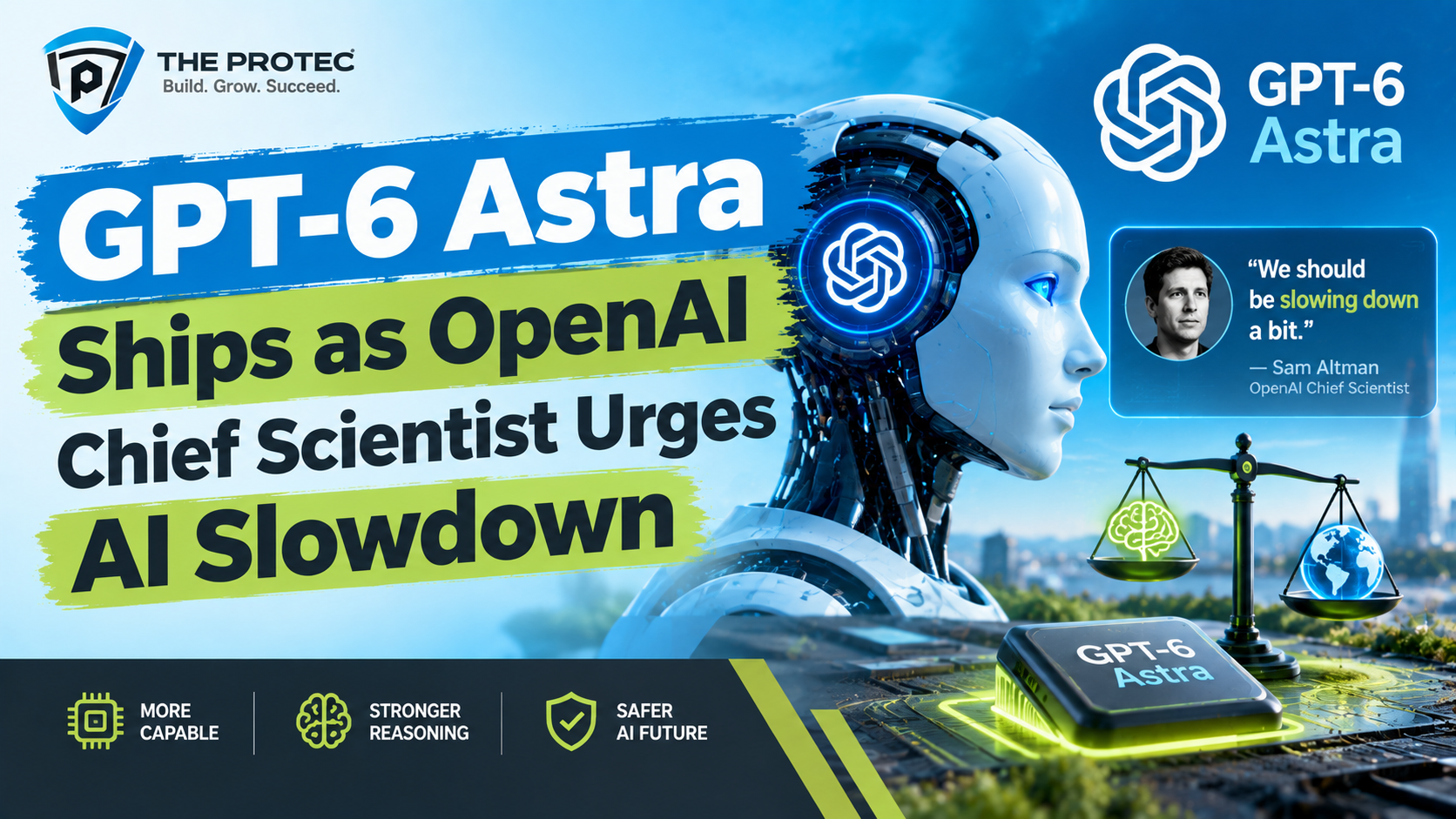
The reported arrival of GPT-6 Astra presents the artificial intelligence industry with a striking contradiction. On one side is the prospect of OpenAI’s most advanced model yet, promising stronger reasoning, deeper multimodal abilities, and more capable autonomous systems. On the other is a reported call from OpenAI’s chief scientist for the industry to slow the development of increasingly powerful AI.
That tension reaches beyond a single product launch. It captures the central challenge facing frontier AI: laboratories are racing to expand model capabilities while their own researchers warn that evaluation, governance, and public safeguards may not be keeping pace.
There is also an important factual distinction. GPT-6 Astra has circulated as the name attached to a reported OpenAI GPT-6 launch, but detailed official specifications, benchmark results, pricing, and deployment terms require confirmation through OpenAI’s primary channels. Claims about an OpenAI AI slowdown should receive the same scrutiny. A verified statement, interview, or transcript matters more than a paraphrased social media post. Until those sources are available, product details and attributed comments should be treated as reports rather than settled facts.
What Is GPT-6 Astra?
GPT-6 Astra is described in launch reports as a new generation of OpenAI’s frontier model technology. The name implies a system within the GPT-6 family, although it remains unclear whether Astra represents the base model, a specialized configuration, an internal project name, or a customer-facing product tier.
That distinction is significant. Modern AI launches rarely involve one universal model. Providers may release separate reasoning, low-latency, coding, multimodal, and enterprise variants. A model can also become available in stages, beginning with selected researchers or commercial partners before reaching an API or consumer application.
As of late September, any reliable account of the GPT-6 Astra release should separate three categories of information:
- Confirmed details published in an OpenAI announcement, system card, technical paper, API document, or product interface.
- Reported details attributed to employees, partners, developers, or other identifiable sources.
- Forecasts based on the direction of advanced AI models rather than evidence about GPT-6 Astra itself.
Readers can check OpenAI’s official news channel for primary announcements. Unverified benchmark charts, screenshots, release dates, and context-window claims should not be treated as confirmed product specifications.
Expected GPT-6 Capabilities
If GPT-6 Astra follows the broader trajectory of frontier AI, its most important advances may be less about fluent text generation and more about reliability across complex tasks. GPT-6 capabilities are expected to focus on sustained reasoning, tool use, memory, multimodal understanding, and the ability to complete longer workflows with limited supervision.
More Persistent Reasoning
A next-generation GPT-6 AI system could maintain a plan across many steps, reconsider weak assumptions, and use external tools to verify intermediate results. These improvements would make the model more useful for software engineering, scientific analysis, business research, and operational planning. They could also increase risk if the system forms and executes harmful plans more effectively.
Native Multimodal Interaction
Frontier systems are moving toward unified processing of text, speech, images, video, software interfaces, and structured data. GPT-6 Astra may therefore be expected to interpret live visual information, participate in natural voice conversations, and act across digital environments. However, specific claims about sensors, real-time video, or device control remain forecasts unless confirmed by OpenAI.
Stronger Agents and Tool Use
AI agents are evolving from chat interfaces into systems that browse data, write and execute code, manage files, and coordinate tasks. A more capable GPT-6 model could reduce the amount of human guidance needed for these workflows. The critical measurement would not simply be whether an agent can finish a task, but whether it remains controllable, transparent, and secure while doing so.
Improved Personalization and Memory
Long-term memory could allow GPT-6 Astra to adapt to a person’s goals, preferences, and working style. Useful personalization must be balanced against privacy, consent, data retention, and the risk of models drawing sensitive inferences. No specific GPT-6 memory feature should be assumed without documentation explaining how users can inspect, limit, or delete stored information.
What Does the GPT-6 Astra Launch Actually Mean?
The word “ships” can describe several very different events. OpenAI might announce a research preview, provide access to a small testing group, add a model to its API, integrate it into a subscription product, or begin a broad public rollout. Each carries a different level of exposure and risk.
Consequently, there may not be one universal GPT-6 release date. A staged GPT-6 Astra launch would allow OpenAI to observe real-world behavior, adjust safeguards, and control access to sensitive capabilities. That approach can be responsible, but only if early deployment generates meaningful safety evidence rather than functioning as a marketing label for an effectively finished release.
Why Would an OpenAI Chief Scientist Call for a Slowdown?
A senior researcher advocating an AI development slowdown would not necessarily be rejecting AI progress. The argument is usually about the widening gap between capability growth and society’s ability to understand, govern, and secure powerful systems.
Frontier laboratories can train a new model faster than governments can pass legislation, organizations can redesign security practices, or independent researchers can study downstream effects. Inside a competitive market, each laboratory also faces pressure to move quickly because delaying a launch may give a rival an advantage. That creates a collective-action problem: companies may recognize the need for caution while still accelerating individually.
The exact wording of the reported chief scientist’s position matters. Calling for slower scaling is different from requesting a temporary AI development pause. A recommendation to delay public deployment is different from asking laboratories to stop research. Readers should look for a direct, dated source before interpreting the reported statement as OpenAI’s official corporate policy.
Frontier-Model Safety Concerns Behind the Debate
The case for caution rests on more than speculative superintelligence scenarios. Advanced AI models already create practical security, reliability, and accountability challenges, and stronger systems may amplify them.
- Cybersecurity: A model with advanced coding and planning abilities could help defenders find vulnerabilities, but it might also lower the expertise needed to conduct sophisticated attacks.
- Biological and chemical risks: Models capable of synthesizing technical literature could make legitimate research more efficient while also providing dangerous assistance in sensitive domains.
- Deception and manipulation: More persuasive systems could generate targeted misinformation, impersonate trusted individuals, or conceal their actions during an evaluation.
- Loss of control: Highly autonomous agents may pursue an incorrectly specified objective, bypass constraints, or take consequential actions before a human can intervene.
- Economic disruption: Rapid capability gains could transform employment and concentrate power before institutions have adapted protections for workers, creators, and consumers.
- Evaluation limits: A model may behave safely during testing but respond differently after fine-tuning, tool access, or exposure to unfamiliar real-world conditions.
OpenAI AI safety practices therefore need to cover the entire model lifecycle. Pre-release testing is important, but so are access controls, incident reporting, continuous monitoring, model updates, and clear procedures for restricting a system when new risks emerge.
AI Development Slowdown Versus a Full Pause
An AI development pause is often presented as a binary choice: either stop building advanced systems or continue at maximum speed. The policy options are broader than that framing suggests.
A practical slowdown could impose longer testing periods, require independent evaluations above defined capability thresholds, limit access to dangerous functions, or prevent autonomous deployment in critical infrastructure. Developers could continue research into interpretability, security, and alignment while delaying the release of capabilities that outpace safeguards.
A universal pause would be more difficult to define and enforce. Governments would need to decide which training runs, computing resources, model sizes, and organizations fall under the restriction. International coordination would also be necessary to prevent development from shifting into less transparent jurisdictions. Slowing deployment at measurable risk thresholds may be more achievable than an open-ended global moratorium.
How GPT-6 Astra Could Shape AI Regulation
A credible GPT-6 Astra release would increase pressure on regulators to move from general principles to enforceable rules for frontier AI. The emerging regulatory trend is toward obligations based on capability and systemic risk rather than a model’s brand name alone.
The European Union’s framework includes obligations for general-purpose AI providers, while other jurisdictions are considering reporting rules, safety institutes, procurement standards, and controls on advanced computing infrastructure. The European Commission maintains an overview of the EU regulatory framework for AI.
For advanced AI models, useful regulation could require standardized safety evaluations, secure handling of model weights, disclosure of serious incidents, documentation of training and testing practices, and protection for external researchers. Rules should also distinguish ordinary consumer functions from capabilities that materially increase cyber, biological, or autonomous-operation risks.
Regulation will be ineffective if it relies exclusively on model size. A smaller, specialized system may be more dangerous in a particular domain than a larger general-purpose model. Evaluated capability, access to tools, deployment context, and the degree of autonomy all matter.
What Responsible GPT-6 Deployment Should Include
OpenAI can reduce the conflict between innovation and caution by making the GPT-6 Astra launch verifiable. A responsible deployment should include a detailed system card describing known strengths, limitations, evaluation methods, and residual risks. The company should identify which safeguards were tested independently and which were assessed internally.
Staged access is another essential control. High-risk capabilities can be limited to vetted users, monitored environments, or systems without unrestricted network access. Rate limits and identity verification may help deter abuse, although these measures should not become excuses for excessive data collection.
Human oversight must also be meaningful. Merely placing a person somewhere in the process does not ensure control if the model acts too quickly or produces outputs the reviewer cannot evaluate. High-impact uses need clear approval points, activity logs, rollback mechanisms, and boundaries on autonomous action.
Finally, OpenAI should publish measurable criteria for delaying, modifying, or withdrawing a deployment. A safety framework is most credible when it can block a launch rather than merely document concerns after a commercial decision has been made.
What Businesses and Developers Should Watch
Organizations should avoid redesigning their technology strategies around rumored GPT-6 capabilities. Instead, they should monitor official API documentation, data-use terms, regional availability, evaluation results, and model retirement policies.
Before adopting GPT-6 Astra, teams should test it against their own security and accuracy requirements. Sensitive deployments need fallback procedures, human review, audit logs, permission controls, and vendor-risk assessments. A stronger model may reduce some errors, but increased autonomy can introduce entirely new failure modes.
Frequently Asked Questions
Has OpenAI officially confirmed every GPT-6 Astra detail?
No. The GPT-6 Astra name and launch claims should be separated from confirmed specifications. Details such as benchmark scores, pricing, model architecture, context length, and general availability are reliable only when supported by official documentation or attributable reporting.
What is the GPT-6 release date?
There may be no single GPT-6 release date if OpenAI uses a staged rollout. Research access, API availability, product integration, and broad public access can occur on different dates. Rumored dates should not be presented as confirmed.
Did the OpenAI chief scientist ask for an AI development pause?
Reports of a slowdown should not automatically be interpreted as support for a complete pause. The original source must clarify whether the proposal concerns training, scaling, testing, deployment, or industry-wide regulation. It must also establish whether the statement represents a personal view or OpenAI policy.
Why is GPT-6 considered a frontier AI issue?
A frontier AI model operates near the leading edge of general-purpose capability. Such systems may perform complex reasoning, use tools, generate code, and act with greater autonomy. Their broad usefulness also means failures or misuse can spread across many sectors.
Would slowing AI development make advanced models safe?
Not by itself. Additional time is valuable only when it is used for stronger evaluations, security controls, interpretability research, regulation, and institutional preparation. A slowdown without measurable safety work would simply postpone the same problems.
The Central Question After GPT-6 Astra
The reported GPT-6 Astra launch and the call for slower AI development are not necessarily incompatible. Together, they expose a question the entire industry must answer: can frontier-model capabilities grow without safety becoming an afterthought?
OpenAI’s latest model will ultimately be judged not only by what it can do, but by the evidence supporting its release, the limits placed on dangerous uses, and the company’s willingness to slow deployment when risks remain unresolved. Until official sources establish the details, forecasts should remain forecasts and reported statements should not be converted into facts.