







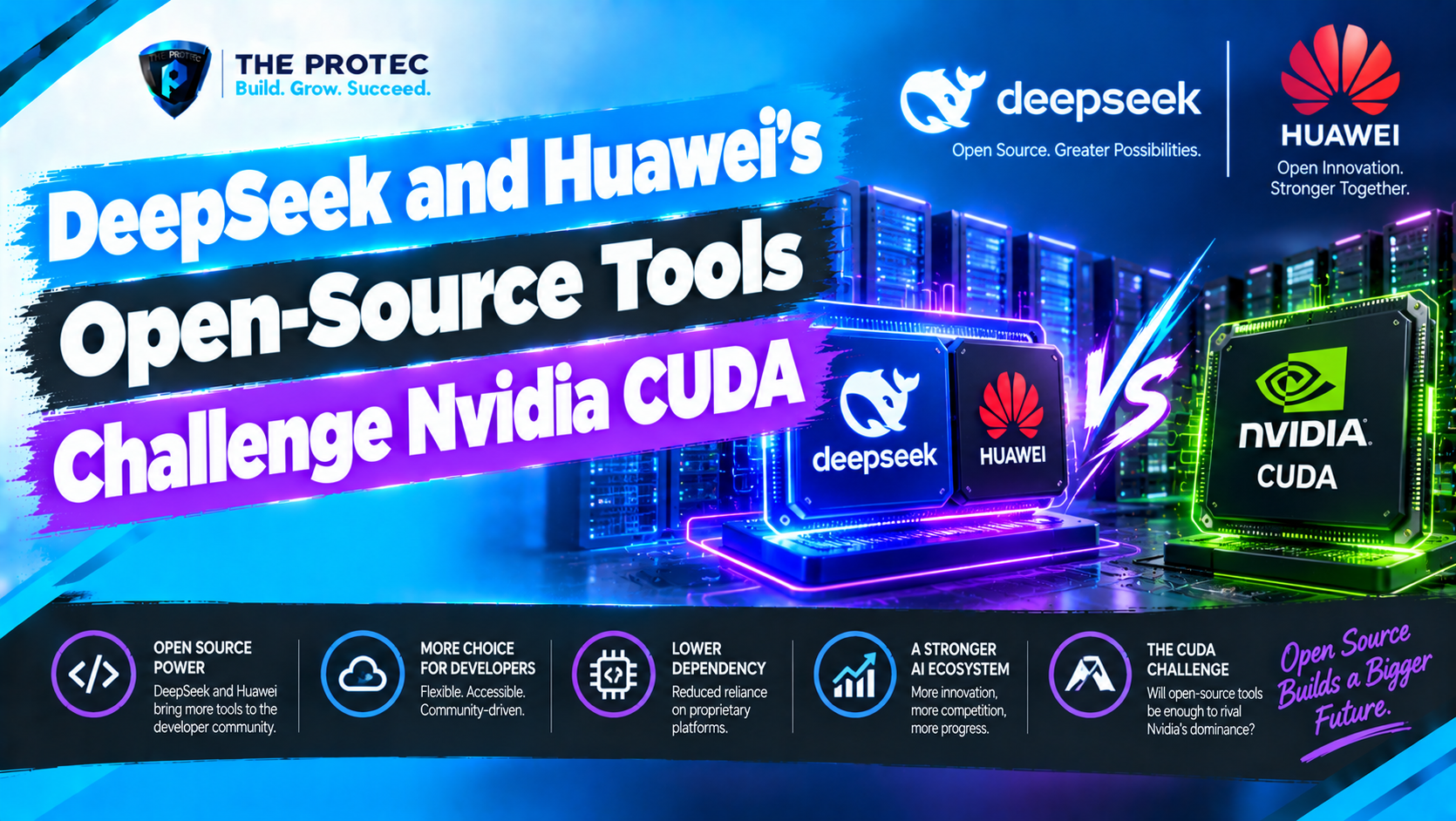
For years, the contest for artificial intelligence infrastructure has been described largely through processor specifications: memory bandwidth, floating-point performance, interconnect speed and energy efficiency. DeepSeek and Huawei are now drawing attention to a harder problem—giving developers the software required to turn capable silicon into useful AI systems.
The release of DeepGEMM-Ascend, DeepEP-Ascend and support for Huawei Ascend 950 in TileLang represents a coordinated push toward a more accessible, open-source AI software stack. Together, these projects address three important layers of AI accelerator programming: high-performance matrix multiplication, communication for Mixture-of-Experts models and a higher-level language for writing optimized kernels.
This does not instantly make Huawei Ascend AI chips a universal substitute for Nvidia GPUs. CUDA has benefited from years of compiler development, optimized libraries, documentation, debugging tools and community knowledge. However, the DeepSeek Huawei AI programming tools show how an alternative ecosystem could become practical: preserve familiar interfaces where possible, expose performance-critical components as open source and reduce the work required to move models between hardware platforms.
Why AI chip programming matters more than specifications
An AI accelerator is only as useful as the software developers can run on it. A processor may offer impressive theoretical throughput, but real workloads depend on optimized kernels, compilers, communication libraries, framework integrations, profilers and reliable deployment tools. These components determine whether a model trains efficiently, serves requests at predictable latency and scales across hundreds or thousands of devices.
Nvidia CUDA remains the reference point because it is more than a programming interface. It is the center of a mature AI hardware ecosystem that includes cuBLAS, cuDNN, NCCL, TensorRT, debuggers, profilers and extensive integrations with popular machine learning frameworks. Developers also benefit from a large community that has already solved many common performance and deployment problems.
For any Nvidia CUDA alternative to gain traction, matching hardware performance is not enough. It must make AI chip programming understandable, portable and repeatable. DeepSeek’s open-source tools and Huawei’s Ascend AI software ecosystem are attempting to close that gap from the workload outward rather than relying only on chip-level claims.
How the DeepSeek Huawei Ascend software stack fits together
The three projects address different bottlenecks within AI compute infrastructure:
- DeepGEMM-Ascend targets the matrix multiplication operations at the core of transformer training and inference.
- DeepEP-Ascend focuses on expert-parallel communication for large Mixture-of-Experts workloads.
- TileLang with Ascend 950 support provides a higher-level route for developers to write, tune and maintain custom AI kernels.
This layered approach matters. Fast matrix operations alone cannot solve inefficient device communication, while a powerful chip remains difficult to adopt if every optimized kernel must be written through low-level, hardware-specific code.
DeepGEMM-Ascend brings optimized matrix multiplication to Ascend
General matrix multiplication, commonly abbreviated as GEMM, is one of the most important operations in modern AI. Transformer layers repeatedly multiply matrices when computing attention, processing feed-forward networks and projecting model states. Small improvements in GEMM efficiency can therefore produce meaningful gains in model throughput and infrastructure utilization.
DeepGEMM-Ascend adapts DeepSeek’s high-performance matrix kernel work to Huawei Ascend AI chips. Its purpose is not merely to make matrix multiplication function on another accelerator. The more valuable goal is to account for the hardware’s memory hierarchy, data formats, execution units and scheduling behavior so operations run efficiently.
Opening this work gives infrastructure teams an opportunity to inspect optimization strategies, test kernels against their own models and contribute improvements. It can also reduce dependence on opaque vendor libraries when organizations need to understand why a workload behaves differently across shapes, batch sizes or numerical formats.
API familiarity is another important element. If DeepGEMM-Ascend retains interfaces and programming patterns close to those used by DeepSeek’s existing kernels, developers can port selected workloads without redesigning every surrounding component. That is source-level convenience rather than automatic binary compatibility, but it can still lower migration costs considerably.
DeepEP-Ascend targets Mixture-of-Experts communication
Mixture-of-Experts models activate only a subset of their available expert networks for each token. This design can increase model capacity without requiring every parameter to participate in every computation. The trade-off is a complex routing and communication problem: tokens must be dispatched to experts that may reside on different accelerators and then returned to the correct position.
DeepEP-Ascend is intended to optimize that expert-parallel data movement on the Ascend platform. In large deployments, the efficiency of dispatch, combine and all-to-all communication can determine whether the theoretical benefits of a Mixture-of-Experts architecture translate into real throughput. Poor communication can leave expensive accelerators waiting for data even when their compute units are underused.
The project is especially relevant because DeepSeek’s model designs have helped make efficient MoE systems a central topic in AI infrastructure. Porting expert-parallel communication techniques to Ascend gives operators another path for evaluating large sparse models beyond CUDA-centered clusters.
DeepEP-Ascend also illustrates why an alternative AI stack must extend beyond isolated kernels. Matrix multiplication may dominate computational work, but distributed inference and training depend on the entire system: accelerator links, host networking, topology-aware routing, memory management and communication scheduling. Open implementation details make those interactions easier to profile and improve.
TileLang Ascend 950 support makes custom kernels more approachable
TileLang offers a higher-level method for expressing AI kernels through tiled computations rather than forcing developers to manage every hardware instruction manually. Tiling breaks operations into blocks that can be mapped efficiently across an accelerator’s compute and memory resources. It is a common optimization concept, but implementing it well can require significant hardware expertise.
Support for Huawei Ascend 950 expands TileLang’s role as a bridge between portable kernel logic and platform-specific optimization. Developers can describe computations using familiar abstractions while the toolchain handles more of the scheduling, memory placement and code generation required by the target accelerator.
This could be particularly useful for research teams creating fused operators, specialized attention mechanisms, quantization routines or model-specific inference kernels. Instead of waiting for every new operation to appear in a vendor library, teams can experiment at a productive level of abstraction and optimize where measurements show that it matters.
TileLang does not eliminate hardware differences. A kernel designed for one architecture may still need changes to achieve good performance on another because memory capacity, vector units, supported data types and execution models vary. Its value is in making those differences manageable without requiring every AI engineer to become a low-level compiler specialist.
API compatibility could ease movement beyond CUDA
One of the strongest aspects of the DeepSeek CUDA alternative strategy is its emphasis on familiar development workflows. Organizations rarely migrate infrastructure by rewriting an entire software estate at once. They begin with specific models, operators or serving tasks where the benefits justify the engineering effort.
Compatible APIs and recognizable abstractions can let teams preserve more of their model code, benchmarking harnesses and deployment logic. A developer might replace a matrix kernel backend, adapt an expert-communication layer and recompile custom operations through TileLang while leaving higher-level model behavior largely unchanged.
That does not mean CUDA code can simply be copied to Ascend and expected to deliver identical results. API compatibility may cover function signatures or programming concepts without guaranteeing equivalent numerical behavior, memory usage or speed. Successful porting still requires correctness tests, profiling and hardware-specific tuning. Even so, reducing conceptual and source-code differences can turn a prohibitive migration into a bounded engineering project.
Why this is not yet a drop-in Nvidia CUDA replacement
The new tools are best understood as an emerging alternative, not proof that the full CUDA ecosystem has been replicated. CUDA supports a vast range of applications and includes mature libraries for dense computation, sparse operations, image processing, scientific computing, collective communication and inference optimization. Many enterprise systems also depend on third-party extensions tested primarily on Nvidia hardware.
DeepGEMM-Ascend and DeepEP-Ascend target strategically important workloads, but they do not address every operator, framework extension or deployment environment. TileLang can improve kernel portability, yet developers still need reliable compilers, diagnostics, packaging, version management and production support around it.
Performance claims also need workload-specific validation. Results can change with model architecture, sequence length, precision, batch size, communication topology and software version. A kernel that excels in a controlled benchmark may encounter different bottlenecks in an end-to-end serving system. Organizations evaluating Nvidia CUDA alternatives should compare complete applications rather than isolated peak numbers.
Wider implications for AI infrastructure competition
The releases shift competition toward hardware-software integration. Huawei can design increasingly capable processors, but broader adoption of Huawei Ascend 950 will depend on whether developers can build and optimize real applications without excessive friction. DeepSeek contributes practical knowledge from developing and operating large models, helping prioritize tools connected to actual bottlenecks.
An open-source approach can accelerate that feedback loop. Researchers can inspect DeepSeek AI kernels, hardware teams can identify inefficient compiler behavior and operators can report performance issues based on production-like workloads. Contributions from universities, cloud providers and independent developers may expand coverage more quickly than a closed toolchain could.
The effect may extend beyond Huawei. More credible GPU programming alternatives put pressure on every accelerator vendor to improve documentation, portability and framework support. They may also encourage AI labs to design software with replaceable backends rather than allowing model infrastructure to become inseparable from one processor family.
For enterprises, a broader market could improve supply resilience and purchasing flexibility. For governments and regional cloud providers, it could reduce dependence on a single hardware-software stack. These benefits will materialize only if alternative platforms prove dependable at scale.
Practical challenges the Ascend ecosystem must solve
- Documentation: Developers need accurate installation guides, architecture explanations, optimization examples and migration instructions. Open code without usable documentation remains difficult to adopt.
- Tooling maturity: Compilers, profilers, debuggers and error messages must work consistently. Kernel speed is less valuable when diagnosing a failure takes days.
- Hardware availability: Developers need access to Ascend systems for testing, continuous integration and performance tuning. Limited availability can prevent an open-source community from forming around the code.
- Performance validation: Independent, reproducible benchmarks should cover training, inference, MoE communication, latency and power efficiency across realistic model configurations.
- Framework integration: PyTorch and other AI frameworks need stable operator coverage, distributed execution support and predictable upgrade paths.
- Ecosystem support: Enterprises require security updates, compatibility policies, troubleshooting resources and vendors capable of supporting production deployments.
Developers can follow DeepSeek’s public projects through its official GitHub organization and review Huawei’s platform resources through the Ascend developer portal. Repository activity, issue response times, release cadence and external contributions will be useful indicators of whether the tools are developing into a durable community stack.
What to watch next
As of October 2026, the key question is no longer whether alternatives to CUDA can be created. It is whether they can become dependable enough for routine development and production deployment. Watch for broader operator coverage, upstream framework integrations, independent Ascend 950 benchmarks and evidence that teams outside DeepSeek and Huawei can maintain high-performance kernels.
If that happens, DeepGEMM-Ascend, DeepEP-Ascend and TileLang may represent more than individual releases. They could become the foundation of an open-source AI chip software ecosystem in which hardware competition is decided as much by developer experience as by silicon.
Frequently asked questions
What are the new DeepSeek Huawei AI programming tools?
DeepGEMM-Ascend provides optimized matrix multiplication for Ascend accelerators, DeepEP-Ascend handles expert-parallel communication for Mixture-of-Experts workloads, and TileLang’s Ascend 950 support helps developers write and optimize custom AI kernels using higher-level tiled abstractions.
Is DeepSeek’s Ascend stack a complete Nvidia CUDA alternative?
No. It offers important components for modern model workloads, but CUDA still has broader library coverage, more mature tools and a larger developer community. The Ascend stack is an emerging alternative that must be evaluated for each application.
Can existing CUDA workloads run unchanged on Huawei Ascend AI chips?
Generally, no. Familiar APIs and workflows can reduce porting work, but hardware-specific kernels, dependencies and communication code may require changes. Teams must also validate numerical correctness and end-to-end performance on Ascend hardware.
Why is open-source AI software important for accelerator adoption?
Open-source software allows developers to inspect implementations, adapt kernels, diagnose bottlenecks and contribute support for new workloads. It can build trust and accelerate optimization, provided the projects also offer strong documentation, governance and production-quality tooling.