




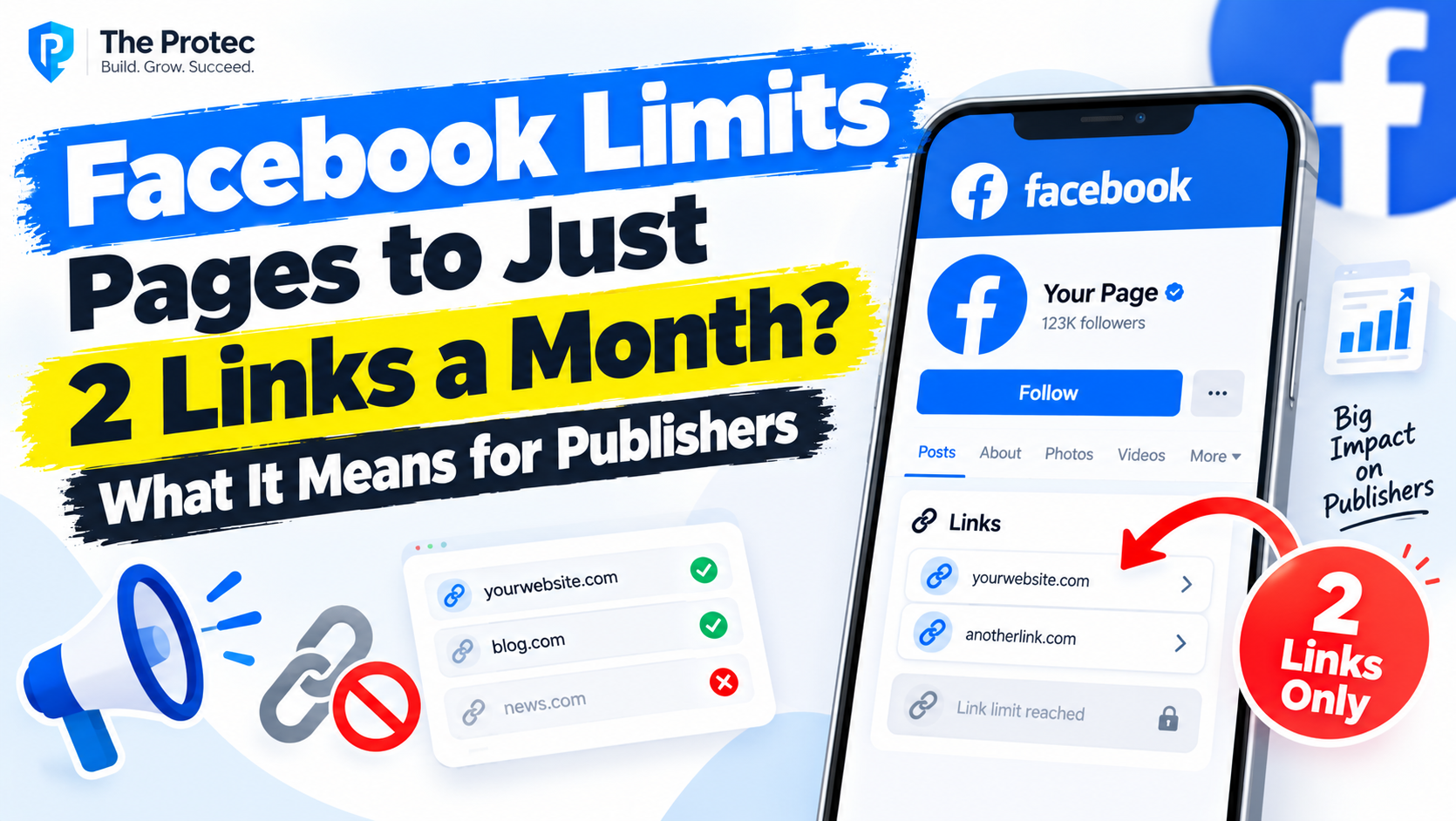
Imagine publishing two articles every day but being able to share only two clickable links on Facebook page for the entire month. Instead of promoting roughly 60 new stories, reviews, videos, or product pages, you would have to choose just two. Every other link post could require a paid subscription due to facebook limits, or stay off your Page entirely.
That startling scenario is at the center of a limited Facebook test involving selected Pages and professional-mode profiles. Accounts included in the experiment have reportedly been told that they can publish only two organic posts containing external links per month unless they subscribe to Meta Verified.
The distinction matters: the Facebook two links per month rule is not a confirmed platform-wide policy. Meta has described it as a limited test, and the company reportedly says recognized publishers are excluded. Nevertheless, the experiment offers a revealing glimpse at how Meta may package distribution tools as paid features—and why businesses that rely on Facebook referral traffic should prepare for further change.
What is the Facebook link posting limit test?
Selected administrators have reported seeing notices in Facebook’s publishing interface showing how many link posts remain in their monthly allowance. Under the test, an affected Page or professional-mode profile can publish up to two organic posts with external links during the month. Publishing more requires an eligible Meta Verified subscription.
The reported Facebook external link limit concerns organic posts that send people away from Facebook. It should not be interpreted as a universal ban on URLs, a limit imposed on every account, or a restriction affecting all paid advertising. Meta has not released a comprehensive public specification covering every post format, destination, country, or account type.
When a participating Page reaches its allowance, the test interface reportedly prompts its administrator to subscribe rather than allowing another standard external-link post. Existing posts are not understood to disappear, and the restriction does not mean that the destination website itself is blocked. It is a publishing limit applied at the account level within the test.
Administrators should also avoid assuming that adding a URL to an image caption, comment, Reel, or other format will be a reliable workaround. Meta can classify and display URLs differently across surfaces, and tactics designed to evade a restriction can create a poor user experience. The safer approach is to examine the account’s own dashboard and treat its on-screen notice as the controlling information.
Which Facebook Pages appear to be affected?
Reports indicate that the Facebook Page link restrictions are being shown to a subset of Pages and profiles using professional mode. Inclusion appears to be account-specific, so two similar businesses may see different publishing options. Meta has not announced a complete list of participating markets or a permanent eligibility formula.
Crucially, Meta has told reporters that publishers are not part of the test. That statement reduces the immediate threat to established news organizations and other accounts Facebook formally recognizes as publishers. It does not eliminate every concern, however. Independent bloggers, niche publications, local news projects, newsletter operators, and small editorial teams may not know whether Meta’s systems classify them as publishers.
A company that regularly produces articles is not necessarily treated as a news publisher by the platform. A retailer with a blog, a local events website, a nonprofit newsroom, or a creator operating through professional mode could fall into a less obvious category. The most reliable way to know whether an account is affected is to check Page notifications and attempt to create a link post—not to rely on another Page’s experience.
As of October 2026, Meta has not announced that Facebook links per month restrictions will apply to all Pages. The reported two-link allowance, publisher exclusion, and subscription prompt should therefore be discussed as elements of a selected-account test, not as settled global policy.
For accounts included in the experiment, the reported answer is yes: publishing beyond the free allowance requires Meta Verified. Accounts outside the test can continue using the options available to them without subscribing.
Meta Verified is not simply a fee for unlimited links. Depending on the account and region, it can bundle verification, impersonation protection, support, profile enhancements, and other benefits. Meta’s official Meta Verified overview explains the product, while business plans and available features can vary by market.
Payment alone may not guarantee access. Eligibility commonly depends on factors such as account type, supported location, account history, minimum activity, two-factor authentication, and successful identity or business verification. Professional-mode creators may face different checks from companies enrolling business assets. Prices, included profiles, and benefits can also differ, so administrators should review the exact offer displayed in their account.
This makes the Facebook Page subscription test more complicated than a simple paywall. An affected Page could want additional link posts but be unable or unwilling to complete verification. Organizations should not budget for a subscription until they have confirmed that their Page is eligible and that extra link publishing is explicitly included in the displayed plan.
Why the test could reshape traffic for publishers
Facebook organic traffic decline is not a new problem. Over the years, feed ranking has shifted toward posts from friends, recommendations, video, Reels, groups, and content that keeps users inside Meta’s apps. Many websites now receive less Facebook referral traffic than they did during the platform’s link-heavy era.
A hard allowance would be different from an algorithmic decline. Reduced reach means a Page can still publish a link even if few followers see it. A Facebook limit on external links prevents or monetizes the publishing action itself after the allowance is used. That removes a distribution option before ranking even begins.
The consequences would vary by organization:
- Independent publishers could lose a low-cost channel for promoting daily stories, especially if they are not covered by Meta’s publisher exemption.
- Bloggers and creators might have to choose between paying for Meta Verified and sending followers to only their most commercially valuable articles.
- Small businesses could find it harder to share booking pages, product launches, menus, event registrations, or educational blog content.
- Local and online news sites could face uncertainty if their publisher status is unclear, even when Facebook is important during breaking events.
- Affiliate and review sites might lose timely clicks tied to discounts, launches, or seasonal buying decisions.
For organizations already dealing with weak Facebook organic reach for websites, a two-post ceiling would make social media traffic planning even less predictable. It could also favor larger companies that can absorb another subscription expense while placing disproportionate pressure on volunteer-run and independent operations.
Why would Meta test paid link publishing?
The most obvious explanation is Meta’s monetization strategy. Subscription products create recurring revenue and reduce dependence on advertising. Extra link publishing could make Meta Verified more attractive to businesses and professional creators who do not see enough value in verification alone.
There are also defensible product reasons to experiment. Low-quality link posts can lead to spam, scams, repetitive affiliate promotions, misleading headlines, and poor mobile landing pages. Limiting volume may reduce some abuse and encourage Pages to share fewer, more useful destinations. Meta also has an incentive to prioritize native posts that generate comments, video views, and longer sessions within Facebook.
Yet charging for additional links does not automatically measure quality. A verified spammer can still post weak content, while a small community publisher may share valuable reporting without being able to justify a subscription. If distribution depends on payment rather than relevance, users may see fewer links from smaller organizations and a narrower range of sources.
The test may ultimately be measuring subscriber demand rather than preparing a universal restriction. Meta routinely tests features with limited groups, changes the terms, or ends experiments without a broad rollout. Publishers should take the signal seriously without presenting the experiment as an accomplished platform-wide change.
How publishers can reduce dependence on Facebook traffic
The best response is not to abandon Facebook overnight. It is to make sure no single platform controls access to the audience. These alternatives to Facebook referral traffic can create a more durable distribution mix.
Email provides a direct, permission-based connection with readers. Offer clear signup opportunities, explain what subscribers will receive, and send consistently. Segmenting subscribers by topic can improve clicks without overwhelming everyone with every story.
Invest in sustainable search traffic
Search remains valuable for evergreen guides, original reporting, comparisons, and answers to specific questions. Publishers should improve technical performance, demonstrate first-hand expertise, use descriptive headings, update aging articles, and avoid producing pages solely to capture keywords. Search platforms can change too, so SEO should be one channel rather than the entire strategy.
Create direct audience habits
Encourage readers to bookmark the site, install a web app where appropriate, enable carefully managed browser notifications, or visit a dependable daily briefing page. Strong brands earn direct visits because audiences remember them rather than discovering every article through an intermediary.
Keep RSS available
RSS is open, portable, and especially useful for journalists, researchers, power users, and newsletter curators. A clean full-site feed plus topic-specific feeds can help content travel without requiring a proprietary recommendation algorithm.
LinkedIn may suit professional analysis, Pinterest can support visual and evergreen discovery, Reddit can work for genuine community participation, and decentralized platforms such as Mastodon or Bluesky may reach highly engaged niches. YouTube, podcasts, Threads, and messaging communities can also build awareness. Choose platforms based on audience behavior instead of copying every post everywhere.
Measure business outcomes, not raw clicks
Track newsletter signups, returning visitors, subscriptions, purchases, leads, and engaged reading time by source. If Facebook link posts for businesses produce little value, paying solely to increase their volume may not make sense. If they drive high-quality conversions, a verified plan could be evaluated like any other distribution cost.
What affected Pages should do now
- Check Page and professional-dashboard notices for an actual monthly link counter or subscription prompt.
- Confirm whether Meta classifies the account as a publisher and document any response received from support.
- Review Meta Verified eligibility, total cost, included assets, and cancellation terms before subscribing.
- Reserve limited link posts for high-value destinations rather than routine announcements.
- Use native Facebook posts to build recognition while directing loyal audiences toward newsletters, RSS, and direct visits through approved profile features.
- Annotate analytics when restrictions appear so traffic changes are not mistaken for editorial or SEO problems.
- Follow official updates through Meta’s Facebook newsroom, since test conditions can change quickly.
Frequently asked questions
Is Facebook limiting every Page to two links per month?
No. The Facebook link posting limit is a reported test involving selected Pages and professional-mode profiles. Meta has not confirmed a permanent, universal two-link restriction for every Facebook Page.
Are news publishers included in the test?
Meta has reportedly said publishers are excluded. The unresolved issue is how the platform identifies a publisher, particularly when dealing with independent bloggers, local outlets, nonprofit newsrooms, and businesses that publish editorial content.
What happens after an affected Page uses both links?
The reported interface prompts the Page to subscribe to Meta Verified before publishing additional organic external-link posts that month. Meta has not publicly documented how every Facebook format is handled, so administrators should rely on the notices shown within their own account.
Does Meta Verified automatically remove the link limit?
Only an offer shown to an affected, eligible account should be treated as authoritative. Subscription benefits vary, and an account may have to satisfy identity, security, activity, location, or business-verification requirements before enrollment.
Should publishers stop using Facebook?
Not necessarily. Facebook can still support community engagement, brand recognition, video distribution, and referral traffic. The lesson is to avoid depending on it. Email, search, RSS, direct audiences, and a carefully chosen mix of other platforms provide stronger protection against sudden policy changes.
The bigger message behind the two-link test
The immediate story is not that Facebook has banned publishers from sharing links. It has not. The important development is that Meta is testing whether additional external-link publishing can become a paid benefit for selected professional accounts.
For recognized publishers, the stated exclusion offers reassurance. For bloggers, small businesses, and independent sites with uncertain classification, the experiment is a warning to inspect account notices and strengthen channels they own. Whether the test expands, changes, or disappears, relying on rented social distribution is becoming an increasingly fragile traffic strategy.