






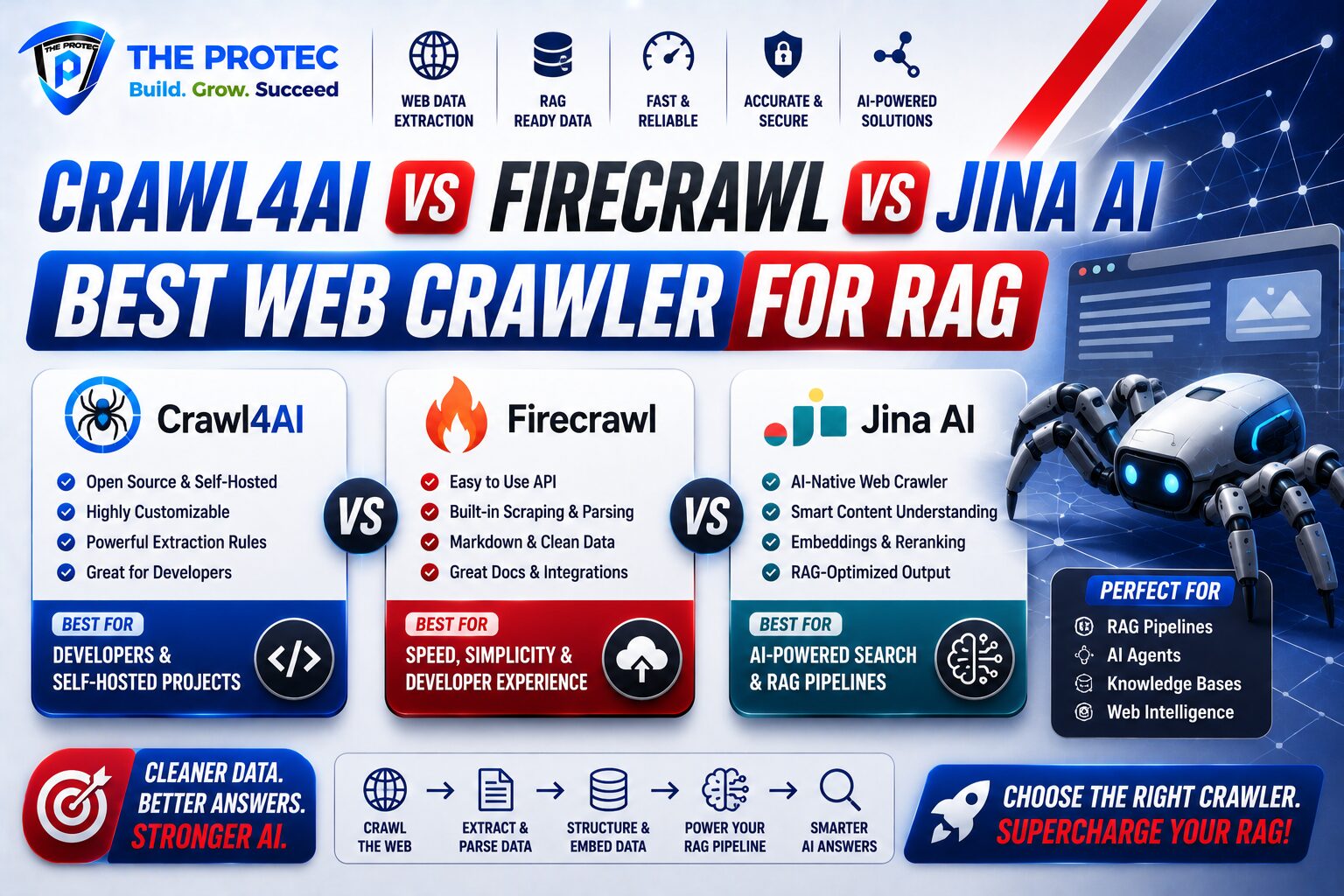
Why AI web crawling matters for RAG applications
Retrieval-augmented generation has made web data more valuable than ever. Instead of relying only on static document uploads, teams now want fresh, structured, and source-aware content that can feed LLMs, vector databases, and AI agents in near real time. That is where the modern AI web crawler comes in.
The challenge is no longer just “can I scrape this page?” It is “can I collect clean, semantically useful, deduplicated, and citation-ready data at scale?” For RAG data collection, the best tool is not always the fastest crawler or the easiest API. It is the one that balances extraction quality, JavaScript handling, markdown fidelity, metadata capture, cost, and operational simplicity.
Among the current generation of AI-first crawling tools, Crawl4AI, Firecrawl, and Jina AI stand out because they are designed with LLM workflows in mind. Each takes a different approach: Crawl4AI is developer-friendly and flexible, Firecrawl focuses on productized crawling and structured outputs, and Jina AI offers a lightweight, model-friendly way to transform web pages into useful text for downstream retrieval.
If you are building a RAG pipeline, an autonomous research agent, or a document enrichment workflow, choosing the right crawler can affect everything from embedding quality to citation accuracy. This comparison breaks down how each tool performs, where it fits best, and which one is the best AI web crawler for your use case.
What makes a great AI web crawler for RAG data collection
Traditional scraping tools were built to extract HTML, not knowledge. RAG pipelines need more than raw page content. They need page structure, headings, clean text blocks, links, tables, and often metadata like canonical URLs, author names, publication dates, and crawl timestamps.
A strong AI web crawler for RAG data collection should do most of the following well:
- Handle modern JavaScript-heavy websites
- Render pages reliably without brittle selectors
- Convert content into clean text or markdown
- Preserve headings and hierarchy for chunking
- Extract metadata and source URLs for citations
- Support crawl rules, sitemaps, and pagination
- Deduplicate near-identical pages
- Scale without excessive latency or maintenance
In practice, no single tool is perfect at all of these. That is why the Crawl4AI vs Firecrawl vs Jina AI decision depends on whether you value control, convenience, or lightweight transformation more.
Crawl4AI overview: flexible and developer-centric
Crawl4AI has become a popular choice among engineers who want an open, Python-native crawler designed specifically for AI workflows. Its appeal is simple: it gives you direct control over crawl behavior while making it easier to convert web pages into formats that are useful for LLM ingestion.
Unlike generic scraping frameworks, Crawl4AI is oriented toward AI web crawling tasks such as readable text extraction, markdown generation, and structured content capture. It is especially attractive to teams that want to run crawling inside their own infrastructure, customize browser behavior, and integrate tightly with Python-based RAG pipelines.
Strengths of Crawl4AI
- Good control over crawl logic and extraction behavior
- Well suited to Python stacks and agent workflows
- Useful for converting pages into markdown-like content
- Flexible enough for custom filters, traversal rules, and data shaping
- Often easier to adapt for internal tooling than fully managed platforms
Limitations of Crawl4AI
- Requires more engineering effort than a hosted API
- Operational reliability depends on your own setup
- Not as “plug-and-play” as managed crawling services
- May need extra work for scaling, scheduling, and monitoring
For teams that want to own the pipeline end to end, Crawl4AI is compelling. It is a good fit when you care about how the data is collected and processed, not just the final output.
Firecrawl overview: the managed AI crawling workflow
Firecrawl has positioned itself as a modern, managed AI web crawler for developers building applications around LLMs, RAG, and agentic retrieval. Its biggest advantage is that it reduces the amount of crawl engineering required. You send a URL or a crawl request, and it returns content in an LLM-friendly format, often with structured text, markdown, metadata, and crawl outputs that are easier to plug directly into a retrieval pipeline.
Firecrawl is especially attractive if your team wants speed to production. Instead of spending time on browser automation, anti-bot handling, and output normalization, you can focus on embeddings, retrieval quality, and product features. In many teams, that trade-off is worth paying for.
Strengths of Firecrawl
- Fast onboarding with a hosted, API-first workflow
- Strong fit for RAG data collection and content indexing
- Useful structured outputs for downstream processing
- Less infrastructure and maintenance burden
- Good choice for teams building production applications quickly
Limitations of Firecrawl
- Less control than a self-managed crawler
- Pricing and usage limits may matter at scale
- Advanced crawling logic may require workarounds
- Vendor dependency can be a concern for some teams
Firecrawl shines when you want a dependable, developer-friendly AI web crawler without running your own browser farm. It is one of the cleanest options for teams that need high-quality data fast.
Jina AI overview: lightweight extraction for LLM pipelines
Jina AI approaches web data from a different angle. Rather than positioning itself primarily as a full crawling stack, it is often used as a content transformation layer that turns web pages into text optimized for retrieval and generative models. For teams that need concise, semantically meaningful page representations, Jina AI is a practical option.
Jina AI is particularly appealing when you want to reduce noise and give the model a cleaner reading of the source page. That matters because raw HTML is rarely ideal for embeddings. If your RAG pipeline benefits from compact text with less boilerplate, a Jina AI-based workflow can be highly effective.
Strengths of Jina AI
- Simple and model-friendly content transformation
- Useful for cleaning and compressing web content
- Good fit for retrieval-focused applications
- Can complement other crawlers as a post-processing layer
- Often lightweight to integrate into AI workflows
Limitations of Jina AI
- May not replace a full-featured crawler for complex sites
- Less emphasis on deep crawl orchestration
- Not always the best standalone choice for large-scale site mapping
- May require pairing with another crawler for broader coverage
In short, Jina AI is often less of a full crawler and more of an intelligent web-to-text utility for AI systems. That makes it valuable, but in a different way from Crawl4AI and Firecrawl.
Setup comparison: which tool gets you running fastest?
Setup is often the first real differentiator in a Crawl4AI vs Firecrawl vs Jina AI decision. Teams underestimate how much time is spent configuring headless browsers, handling timeouts, and normalizing outputs for downstream use.
Crawl4AI setup
Crawl4AI usually appeals to Python developers comfortable with local or self-hosted environments. The setup is relatively straightforward if you already work in Python, but you are still responsible for runtime dependencies, browser components, and deployment details. That gives you flexibility, but it also means more maintenance.
Firecrawl setup
Firecrawl is typically the fastest path to production. As a hosted service with an API-centric workflow, it removes much of the crawling infrastructure burden. For product teams, this can be the difference between launching in days instead of weeks. The trade-off is that you are depending on an external platform for core retrieval infrastructure.
Jina AI setup
Jina AI is usually lightweight to adopt, especially if you are integrating it into an existing retrieval or processing flow. It works best when you already have crawling or page discovery handled elsewhere and need a better way to transform pages into usable text. In other words, it is easy to bring into a pipeline, but it may not solve the entire crawling problem on its own.
Performance comparison: rendering, speed, and data quality
Performance in AI web crawling is not only about requests per second. For RAG applications, quality often matters more than raw speed. A faster crawler that misses navigation content or returns noisy text can hurt retrieval quality more than a slightly slower one with cleaner output.
Rendering and JavaScript handling
All three tools are designed with modern web content in mind, but they differ in how much control and reliability they offer. Crawl4AI can be a strong option when you need explicit browser control and custom behavior. Firecrawl tends to provide a smoother operational experience, especially for typical content sites and documentation pages. Jina AI works well as a content simplifier, but it is not always the best fit for sites that require extensive crawl orchestration.
Content quality for embeddings
For embeddings, the best output is usually clean, well-structured, and minimally noisy text. Firecrawl often performs very well here because it is built to return content in a form that is ready for LLM and vector workflows. Crawl4AI can match or exceed it when carefully configured, especially if you need custom extraction logic. Jina AI is useful when you want a concise textual representation that trims web clutter and focuses on the main content.
Scale and reliability
When you are collecting data from dozens or hundreds of pages, reliability becomes crucial. Firecrawl generally has the advantage for teams that want a managed service with less operational burden. Crawl4AI can scale well if you build the infrastructure around it, but you must own that complexity. Jina AI is best seen as a complementary layer in a retrieval stack rather than the main crawl orchestrator for very large projects.
Best use cases for each tool
The right tool depends on the job. Here is the simplest way to think about the three.
Choose Crawl4AI if you need control
Crawl4AI is a strong choice for engineering teams that want to own the pipeline and customize every step. Use it when you need:
- Self-hosted crawling inside your own environment
- Fine-grained crawl logic and extraction tuning
- Python-native integration with data pipelines
- Custom preprocessing before chunking and embedding
It is especially useful in internal knowledge systems, research tooling, and bespoke RAG workflows where flexibility matters more than convenience.
Choose Firecrawl if you need speed to production
Firecrawl is ideal when you want a managed AI web crawler that gets you structured content quickly. Use it when you need:
- Fast setup and minimal infrastructure overhead
- API-first crawling for product development
- Reliable content extraction for documentation and knowledge bases
- Teams that prefer managed services over self-hosted tooling
It is a strong default for startups and product teams building RAG-enabled assistants, support bots, and internal search tools.
Choose Jina AI if you need cleaner text for retrieval
Jina AI is best when your main concern is text quality rather than crawl orchestration. Use it when you need:
- Web pages converted into compact, model-ready text
- A lightweight transformation step in a broader pipeline
- Cleaner inputs for embeddings and semantic search
- An additional processing layer after discovery or crawling
It works well for teams that already have a source discovery process and need to improve the signal-to-noise ratio before indexing.
Which AI web crawler is best for RAG applications?
There is no universal winner, but there is a best fit for each type of team.
If your priority is control and customization, Crawl4AI is the best fit. If your priority is speed, convenience, and production readiness, Firecrawl is often the strongest choice. If your priority is clean, compact content for retrieval, Jina AI is a smart addition, especially as part of a hybrid workflow.
For pure RAG data collection, Firecrawl is often the most practical default because it lowers implementation overhead while still producing usable structured outputs. Crawl4AI becomes more attractive when you need bespoke crawling logic or self-hosting. Jina AI is excellent when content normalization is the bottleneck, but it is less likely to be your only crawler if you need deep site traversal.
In real-world systems, the best architecture is often hybrid. For example, you might use Firecrawl or Crawl4AI to discover and fetch pages, then use Jina AI to clean or compress the text before chunking and embedding. That layered approach can improve retrieval quality while keeping maintenance manageable.
Practical recommendation by team type
- Solo developer or prototype: Firecrawl for quick results
- Python-heavy engineering team: Crawl4AI for flexibility
- Retrieval-focused pipeline: Jina AI as a transformation layer
- Enterprise knowledge system: Firecrawl for managed speed, or Crawl4AI for self-hosted control
- AI agent workflow: Crawl4AI or Firecrawl depending on whether the agent needs control or convenience
If you are uncertain, start with the tool that minimizes your time to a usable dataset. Once you have a retrieval benchmark, compare chunk quality, citation accuracy, and answer faithfulness. In RAG, the crawler is not just infrastructure; it directly shapes model performance.
SEO-friendly takeaway
The debate around Crawl4AI vs Firecrawl vs Jina AI is really a debate about operating style. Crawl4AI is the builder’s tool, Firecrawl is the product team’s tool, and Jina AI is the text-quality enhancer. All three are relevant to modern AI web crawler workflows, but they solve different parts of the RAG data collection problem.
For most teams, the decision comes down to how much control you need versus how quickly you want clean, ingestible content. If you are building serious RAG applications, choose the crawler that makes your retrieval layer more accurate, more maintainable, and easier to trust.
FAQ
Is Crawl4AI better than Firecrawl for RAG?
Not always. Crawl4AI is better if you want control, custom logic, and self-hosting. Firecrawl is usually better if you want a managed AI web crawler that gets you structured data faster with less setup.
Can Jina AI replace a full web crawler?
Usually no. Jina AI is best viewed as a content transformation layer for cleaner retrieval inputs. It can help a lot in RAG data collection, but it may not fully replace a crawler that discovers and traverses pages.
Which tool is best for AI agents that browse the web?
Firecrawl and Crawl4AI are the strongest options for agent workflows. Firecrawl is easier to operationalize, while Crawl4AI offers more flexibility if the agent needs custom browsing behavior or tight Python integration.
What matters most when choosing an AI web crawler?
For RAG applications, prioritize content quality, metadata accuracy, JavaScript rendering, and how easily the output can be chunked and embedded. Speed matters, but retrieval quality matters more.
Should I use more than one tool?
Yes, in many cases. A hybrid setup often works best: one tool for crawling and discovery, another for cleaning or transforming text. That is especially useful when building high-quality RAG pipelines.