









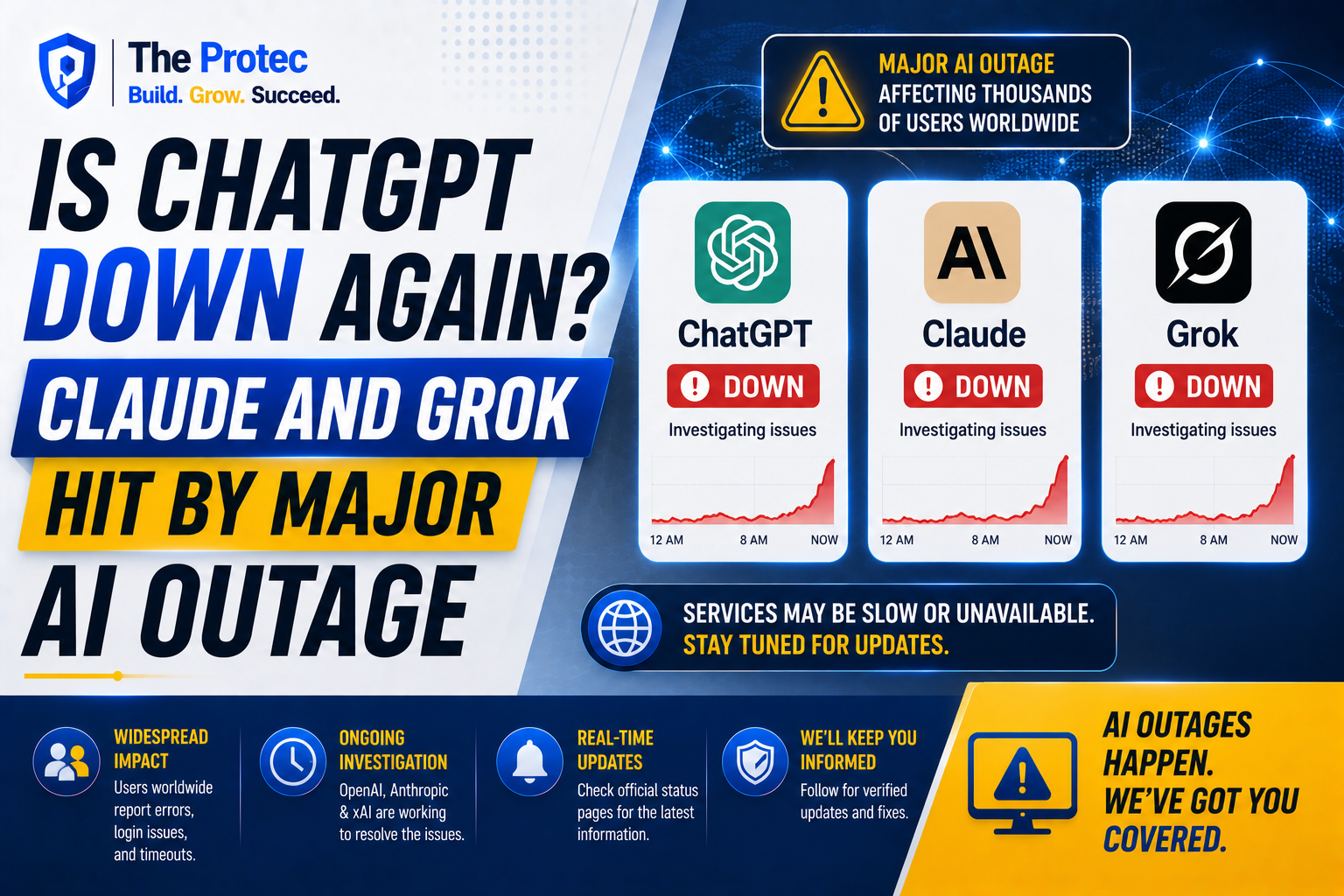
ChatGPT users are once again asking a familiar and increasingly consequential question: is ChatGPT down? A surge of reports involving failed prompts, blank conversation histories, login problems, and unusually slow responses suggests that the latest disruption is more than an isolated browser issue. At the same time, some users have reported difficulty accessing Claude and Grok, raising concerns about a broader AI services outage affecting several major platforms.
The disruption appears uneven rather than universal. Some people can open ChatGPT but cannot generate an answer, while others encounter error messages before reaching the interface. Claude and Grok reports show a similarly inconsistent pattern, with certain features functioning while chats, authentication, or model responses fail. That distinction matters: a service does not need to disappear completely to experience a major AI outage.
Here is what users are experiencing, what official status information can reveal, why several AI platforms may encounter problems around the same time, and what to do when ChatGPT is not working.
Is ChatGPT Down Again?
Current reports indicate that ChatGPT is experiencing a widespread but potentially partial service disruption. The most commonly reported problems involve prompts failing to complete, conversations freezing during generation, generic error notices, missing chat histories, and difficulties signing in. API customers may also encounter elevated error rates, timeouts, or delayed responses even when the consumer website remains accessible.
A partial ChatGPT outage can be confusing because the homepage may load normally. The interface and the underlying models rely on multiple systems, including authentication, conversation storage, file processing, web search, voice features, model routing, and inference infrastructure. One component can fail while others remain available.
Location, account type, selected model, and device can also affect the experience. A user may get a response through the mobile app while the web version fails, or a lightweight model may work while a more advanced model remains unavailable. These differences explain why some people insist ChatGPT is operating normally while thousands of others report that ChatGPT is down again.
What Users Are Experiencing During the ChatGPT Outage
The latest ChatGPT outage reports cover several failure modes rather than one consistent error. Common symptoms include:
- Prompts remaining stuck on a loading or generating indicator
- Messages such as “Something went wrong” or “An error occurred”
- Blank pages, failed page loads, or repeated refresh loops
- ChatGPT login problems and unexpected account sign-outs
- Conversation history temporarily disappearing
- Files, images, voice mode, or web-connected tools failing to start
- Slow responses followed by timeouts or incomplete answers
- API requests returning server errors or rate-limit messages
These symptoms do not necessarily mean user data has been lost. Conversation histories can disappear temporarily when account or storage services are unavailable and return once those systems recover. Repeatedly submitting the same prompt may also create duplicate requests when service is restored, so waiting before retrying is often the better approach.
Are ChatGPT, Claude, and Grok Fully or Partially Down?
The available evidence points more strongly to partial outages than a permanent, simultaneous shutdown of all three services. ChatGPT, Claude, and Grok each operate separate infrastructure, but every platform is composed of multiple dependencies. Authentication may fail while existing sessions continue working, or text generation may remain available while uploads and advanced tools stop responding.
Reports of Claude down typically include failed message sends, capacity warnings, login loops, or conversations that stop before producing a response. During a Claude outage, the website may still open because its front-end delivery system is functioning even though model inference or account services are impaired.
Users reporting Grok down have described delayed generation, blank responses, feature errors, or difficulty accessing the assistant through X and related interfaces. A Grok outage can also affect users differently depending on subscription access, regional routing, and whether they are using an integrated or standalone experience.
Because availability can change minute by minute, one successful prompt does not prove that an incident is over. Reliable recovery usually means error rates, latency, logins, and connected tools have all returned to normal for a sustained period.
What Official Status Pages and Outage Reports Indicate
Official status pages are the best starting point when determining whether ChatGPT is not working because of a platform incident. OpenAI uses its service status page to publish notices about elevated errors, degraded performance, login failures, API problems, and recovery work. Incident updates commonly move through investigating, identifying, monitoring, and resolved stages.
Anthropic provides similar information through the Claude status page, where users can review the condition of Claude.ai, the API, and related systems. Grok availability updates may appear through its associated service channels, while user-generated outage reports can reveal regional or account-specific problems before a formal notice is published.
Status pages should not be treated as real-time guarantees. Automated monitoring must first detect a pattern, and engineers need time to confirm whether a spike is caused by the platform, a third-party provider, or a limited deployment. As a result, user reports may rise several minutes before an official OpenAI outage or Claude outage notice appears.
Conversely, a status page marked operational does not mean every request is succeeding. It can reflect overall availability even when a subset of users, models, or regions remains affected. The strongest evidence comes from combining official notices with consistent reports across different networks and devices.
Why Would Several Major AI Services Fail at Once?
There is no confirmed reason to assume that the ChatGPT, Claude, and Grok disruptions share one cause. Similar timing can result from coincidence, traffic shifts, or dependencies used across the technology industry. Until providers publish incident reviews, claims of a cyberattack or coordinated shutdown should be treated cautiously.
Several technical factors could explain a major AI outage:
- Demand spikes: Breaking news, product launches, workplace deadlines, and viral trends can create abrupt increases in inference traffic.
- Cloud or network failures: AI services depend on data centers, internet routing, content delivery networks, and domain name systems that can affect multiple companies.
- Deployment errors: A software, configuration, or model-routing update may introduce failures that require a rollback.
- Authentication problems: A malfunctioning identity service can block access even when model servers remain healthy.
- Capacity constraints: Advanced models require substantial accelerator capacity, and unexpected demand can increase queues and timeouts.
- Third-party dependencies: Payments, search tools, storage systems, security services, and observability platforms can become shared points of disruption.
- Security incidents: Distributed denial-of-service activity is possible, but it should not be presented as the cause without confirmation.
Modern AI products are distributed systems, so the visible error may originate far from the model itself. A failed ChatGPT login does not necessarily mean OpenAI’s models are offline, just as a blank Grok response does not establish that its entire platform has failed.
What to Do When ChatGPT Is Not Working
If ChatGPT fails during an outage, repeated troubleshooting will not repair a server-side incident. A few checks can still determine whether the problem is local or widespread:
- Review the official status page before changing account or browser settings.
- Wait several minutes and retry once rather than continuously refreshing.
- Open a new conversation if only one chat thread appears frozen.
- Try the official mobile app or web interface to compare results.
- Disable a VPN temporarily or switch networks if no wider incident is reported.
- Use a private browser window to test whether extensions or cached data are interfering.
- Avoid uploading the same file repeatedly while processing systems are unstable.
- Copy important prompts and unfinished work into a local document.
Users should be wary of unofficial “fixes” requesting passwords, API keys, browser extensions, or software downloads. A genuine OpenAI outage cannot be repaired by giving credentials to a third party. Businesses should also avoid routing confidential information into an unapproved alternative simply because their primary assistant is unavailable.
The AI Outage Exposes Growing Platform Dependence
The larger story is not simply that ChatGPT is down again. AI assistants have moved from experimental tools into everyday infrastructure for programming, customer support, research, document analysis, education, and content production. When ChatGPT becomes unavailable, workflows can stop as abruptly as they would during a cloud, email, or payment outage.
Reports of Claude down and Grok down at roughly the same time reinforce the risk of assuming that another public chatbot will always provide immediate redundancy. Organizations may use several AI products, yet those services can still depend on overlapping cloud regions, network providers, identity systems, or external tools.
Resilient AI adoption requires more than keeping a second browser tab open. Teams should document which tasks depend on a particular model, preserve source material outside chat histories, create manual fallback procedures, and decide which alternative providers are approved for sensitive data. API-based systems should implement timeouts, queues, retry limits, and graceful error messages instead of allowing one failed model call to break an entire application.
The incident also highlights the importance of transparent status reporting. As AI platforms become essential business services, customers need component-level information, timely incident updates, and clear post-incident explanations. Reliability is now part of the product, not merely an engineering detail.
How to Tell When the AI Services Outage Is Over
An incident notice marked resolved is encouraging, but recovery may occur gradually. Backlogged requests, cached errors, or regional routing changes can continue affecting a subset of users. Test the service with a simple, noncritical prompt before resuming important work.
Signs of stable recovery include successful logins, normal response times, restored conversation history, working uploads, and no new incident updates. API operators should monitor error rates and latency rather than relying only on the consumer interface. If problems continue after an official resolution, signing out once, clearing site-specific cache, or starting a fresh session may help.
Frequently Asked Questions
Is ChatGPT down for everyone?
Not necessarily. The current ChatGPT outage appears capable of affecting specific regions, accounts, models, or features. Some users may receive normal responses while others encounter login failures, timeouts, or blank chats. That pattern is typical of a partial outage.
Why does ChatGPT load but not answer prompts?
The website interface and model-generation systems are separate components. The page can load from a content delivery network while inference, authentication, conversation storage, or model-routing services are degraded. This is why ChatGPT can look online but remain unusable.
Are the Claude outage and Grok outage connected to OpenAI?
There is no automatic connection simply because the reports occurred around the same period. The companies operate distinct platforms. Shared cloud or networking dependencies are possible, but coincidence and unrelated internal incidents are also plausible until official technical findings are released.
Will refreshing or reinstalling the app fix the outage?
Refreshing once can clear a temporary browser error, but reinstalling an app will not resolve a platform-wide incident. Check service notices first. Aggressive refreshing may create more failed requests and can make it harder to tell when the service has genuinely recovered.
What is the safest alternative during a major AI outage?
Use an organization-approved service or return to a documented manual workflow. Do not paste confidential material into an unfamiliar chatbot simply to keep working. Keep local copies of prompts, drafts, sources, and critical outputs so one provider’s downtime does not erase progress.
What This Major AI Outage Means
The latest disruption shows that even the largest AI platforms remain vulnerable to capacity problems, software failures, and infrastructure dependencies. Whether users are searching for “is ChatGPT down,” reporting a Claude outage, or discovering that Grok is not responding, the practical lesson is the same: AI availability can no longer be taken for granted.
Official status updates remain the most reliable source of confirmation. Until all affected components stabilize, users should preserve their work, avoid risky third-party fixes, and maintain realistic fallback plans for AI-dependent tasks.