








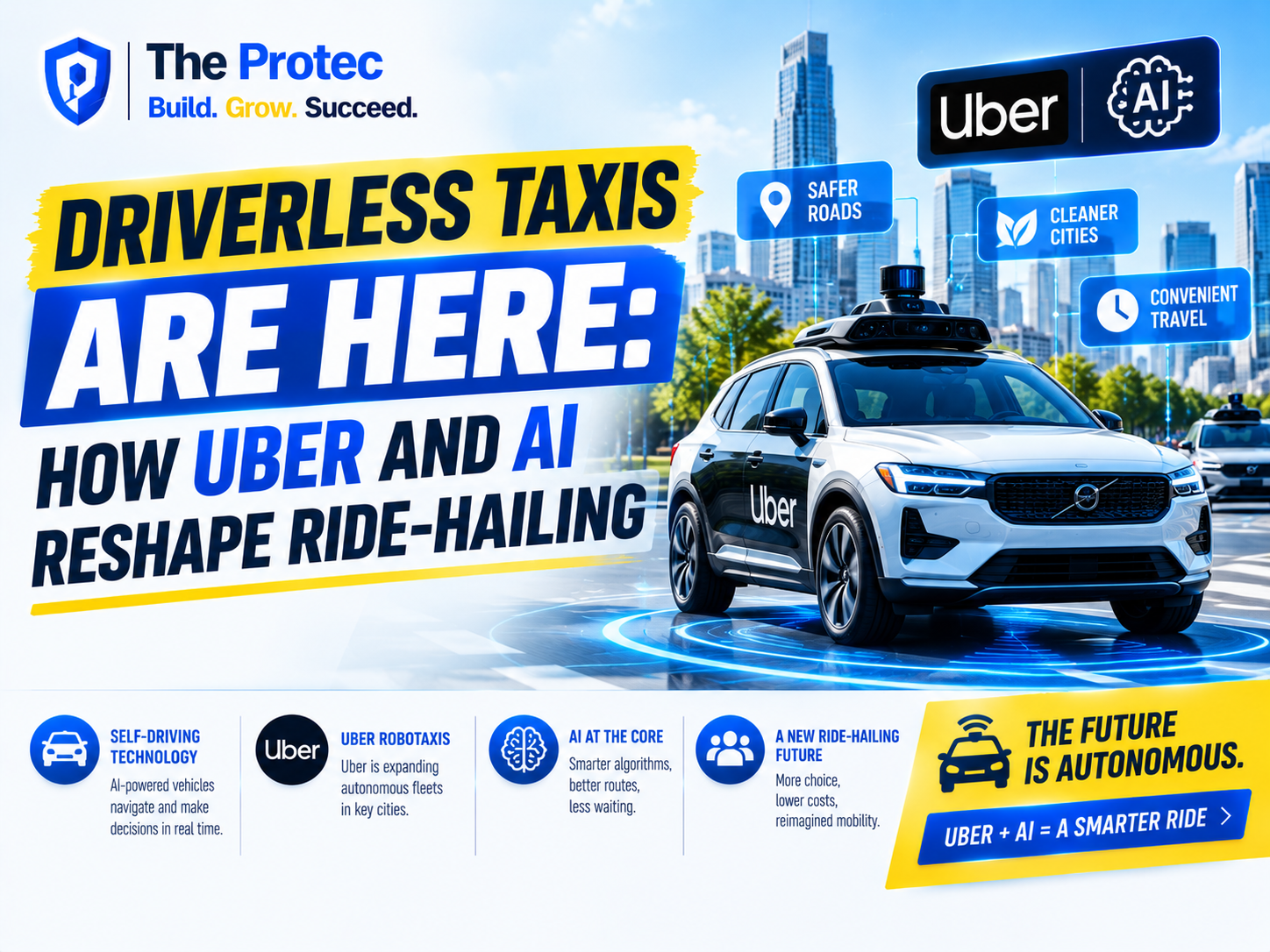
Driverless taxis are no longer confined to technology demonstrations or carefully staged concept videos. They are becoming bookable transportation services, appearing alongside conventional cars in ride-hailing apps and navigating increasingly complex city streets.
Uber’s partnership with British autonomous-driving company Wayve marks an important step in that transition. Their initial London service is supervised, meaning a trained safety operator remains in the vehicle rather than leaving passengers alone with the driving system. Even with that limitation, placing a Wayve robotaxi on Uber’s familiar platform brings autonomous driving closer to everyday travelers.
As of September 2026, Wayve, Waymo and Tesla represent three distinct approaches to AI self-driving cars. Meanwhile, Uber is positioning itself as the marketplace connecting passengers, autonomous-vehicle developers and fleet operators. Together, these developments raise a bigger question: Will autonomous ride-hailing simply add another vehicle option, or fundamentally change how cities move?
Why Uber Driverless Taxis in London Matter
London offers a demanding environment for autonomous vehicles. Its roads combine historic street layouts, multilane junctions, roundabouts, bus lanes, cyclists, pedestrians and frequent construction. Weather and inconsistent road markings create additional challenges. A system that performs reliably there must handle far more than predictable highway driving.
Uber and Wayve’s London rollout is therefore both a transportation service and a real-world test. Riders can encounter autonomous technology through an app they already understand, while the companies gather operational experience involving pickups, traffic behavior, passenger support and unexpected road conditions.
The word driverless needs context, however. The initial service remains supervised by a safety operator who can intervene if necessary. It is not yet equivalent to a fully autonomous taxi operating without anyone in the driver’s seat. This distinction matters because supervised deployment is a bridge between testing and commercial autonomy—not proof that every technical and regulatory challenge has been solved.
The project builds on a broader relationship between the two companies, documented through the official Uber Newsroom. For Uber, London is an opportunity to test how autonomous vehicles fit into its marketplace. For Wayve, it provides access to real passenger demand and one of the world’s best-known ride-hailing platforms.
How AI-Powered Self-Driving Taxis Work
A human driver combines sight, experience, judgment and physical control almost instinctively. An autonomous vehicle (driverless taxis) must reproduce those capabilities through sensors, computing hardware, software and continuous decision-making.
Perception and environmental awareness
Cameras, radar and, in many systems, lidar collect information about the vehicle’s surroundings. AI perception software identifies pedestrians, traffic lights, road boundaries, bicycles, vehicles and other objects. It must also estimate their speed, direction and likely behavior—even when visibility is poor or something is partially hidden.
Prediction, planning and control
After understanding the scene, the system predicts what other road users may do. A pedestrian near a crossing might step into the road, while a vehicle in an adjacent lane may merge. Planning software evaluates possible paths and chooses a maneuver that balances safety, legality and passenger comfort. Control systems then translate that plan into steering, acceleration and braking.
Safety layers and human oversight
Autonomous taxis also require redundant braking, power, communications and computing systems. Fleet monitoring can detect technical problems or connect a vehicle with remote assistance, although remote personnel generally provide guidance rather than continuously driving the car. In supervised services such as the initial London launch, an onboard operator provides another safety layer.
The hardest situations are unusual ones: temporary hand signals from police, an awkward construction diversion, debris in the road or a passenger requesting an unsafe drop-off. The future of taxis depends as much on solving these edge cases as on completing ordinary journeys.
Why Uber Is Partnering Instead of Building Every Robotaxi
Uber once operated a major in-house autonomous-driving division, but developing a complete self-driving system requires enormous investment, specialized engineers, vehicle hardware and years of safety validation. No single technical approach is guaranteed to dominate every market.
Its current strategy treats autonomy as a platform opportunity. Companies such as Wayve and Waymo develop driving technology, vehicle owners or fleet specialists handle physical operations, and Uber supplies rider demand, dispatch, payments, customer support and marketplace management.
This partnership model gives Uber several advantages:
- It can work with different autonomous-vehicle developers rather than betting on one system.
- It can introduce Uber robotaxis gradually in cities where technology and regulation permit them.
- Autonomous cars can be matched with an established pool of passengers instead of requiring a new app to build demand from scratch.
- Uber can continue serving areas with human drivers when autonomous vehicles cannot operate because of weather, geography or regulation.
The model also creates complexity. Uber must coordinate vehicle availability, maintenance, cleaning, charging, insurance and incident response across multiple partners. Riders may encounter different vehicle designs and operating rules from one market to another. Uber’s advantage will depend on making those differences feel simple inside a consistent app experience.
Wayve, Waymo and Tesla Robotaxi Strategies Compared
The leading autonomous-taxi (driverless taxis) programs share a goal but differ sharply in how they pursue it. Those differences affect where they can launch, how quickly they may expand and what evidence they must provide to regulators.
Wayve robotaxi: AI designed to generalize
Wayve emphasizes an embodied-AI approach trained to interpret driving environments and make decisions from experience. Rather than relying exclusively on extensive, hand-engineered rules for each city, its technology is intended to adapt across different vehicles and locations.
That flexibility is central to the Uber partnership. If Wayve can transfer its driving intelligence between cities with less location-specific engineering, it could support broader expansion through Uber’s network. London is an especially valuable proving ground because it tests whether that generalization works amid dense, irregular urban traffic.
Waymo robotaxi: mapped and geofenced operations
Waymo has focused on fully autonomous commercial service within defined operating areas. Its vehicles use a rich sensor suite and detailed knowledge of approved locations, supported by substantial simulation and road testing. This geofenced approach prioritizes deep validation before territory expands.
The Waymo robotaxi model has demonstrated that passengers can take paid trips without a human driver in selected markets. Waymo has also worked with Uber to make autonomous rides available through Uber’s app in certain US cities, showing how a technology developer and ride-hailing marketplace can complement each other.
Tesla robotaxi: camera-first autonomy and scale
Tesla takes a camera-led approach connected to the driving data generated by its large consumer fleet. Its long-term Tesla robotaxi vision includes purpose-built vehicles and the possibility that privately owned cars could eventually participate in a shared network.
Tesla’s potential advantage is manufacturing scale: it designs vehicles, software and computing systems within one organization. Its challenge is proving that a camera-first system can deliver dependable unsupervised operation across its intended environments. Tesla’s consumer driver-assistance products and a genuinely autonomous ride-hailing service should not be treated as interchangeable; the latter carries much higher safety and operational requirements.
How Autonomous Taxis Could Change Everyday Travel
If self-driving taxis become reliable at scale, their most visible benefit may be availability. Autonomous fleets could operate for long periods without driver shifts, potentially improving service late at night or in areas with inconsistent demand. Better fleet positioning could reduce waiting times, while smoother driving may improve comfort and energy efficiency.
Autonomous taxis could also help passengers who cannot drive, including some older adults and people with disabilities. Achieving that benefit requires more than removing the driver. Vehicles need accessible designs, dependable voice and app controls, and support for passengers who need help entering or exiting.
Lower prices are possible, but not automatic. Removing driver labor changes operating costs, yet autonomous fleets still require expensive vehicles, sensors, insurance, remote support, charging, maintenance and cleaning. Pricing will also reflect demand and competition.
For professional drivers, the transition is unlikely to happen everywhere at once. Driverless cars will initially serve limited territories and conditions, while people continue handling complex routes, specialized assistance and markets where autonomy is not economical. Over time, however, fleet supervision, maintenance and customer-support roles may grow as conventional driving work changes.
The Roadblocks Facing Autonomous Ride-Hailing
Technical capability alone does not create a trusted taxi service. Regulators need credible evidence covering crash risk, cybersecurity, software updates, data handling and responsibility when something goes wrong. The UK’s Automated Vehicles Act created a legal framework for authorized self-driving vehicles, with government information available through its overview of automated-vehicle regulation.
Public confidence will depend on transparent safety reporting and responsible responses to incidents. A system can be statistically safer overall while still making mistakes that appear strange to human observers. Companies must explain what their vehicles can do, where they can operate and when human supervision remains necessary.
There are practical obstacles too. A robotaxi needs to identify safe pickup locations, recognize the correct passenger, manage blocked curbs and respond when someone leaves an item behind. Cities must also decide whether autonomous fleets reduce private-car ownership or simply add more vehicles to congested streets.
What Comes Next for Uber Autonomous Vehicles?
The near-term future is likely to be hybrid. Human-driven cars, supervised autonomous vehicles and fully driverless taxis will share the same ride-hailing networks. Availability will vary by neighborhood, weather, road type and local regulation.
Uber’s role is evolving from managing a marketplace of drivers to orchestrating a mixed transportation network. Wayve offers a potentially adaptable AI model, Waymo brings experience in fully autonomous geofenced service, and Tesla is pursuing tightly integrated vehicles and software. The winner may not be one company or one technical stack. Passengers may instead use whichever safe vehicle Uber assigns, barely noticing which autonomous system is underneath.
Frequently Asked Questions
Are Uber driverless taxis fully autonomous in London?
No. Uber and Wayve’s initial London service is supervised, with a trained safety operator present to monitor the vehicle and intervene if required. It is an important step toward autonomy, but it should not be described as unrestricted, operator-free service.
What is the difference between a robotaxi and a self-driving car?
A self-driving car refers broadly to a vehicle capable of automating driving tasks. A robotaxi is an autonomous vehicle used specifically for on-demand passenger transportation. Some self-driving features still require human supervision, while a fully autonomous robotaxi can complete approved trips without a driver.
Will driverless taxis make rides cheaper?
They could reduce some labor costs and increase vehicle utilization, but lower fares are not guaranteed. Autonomous fleets have significant hardware, maintenance, insurance, charging, cleaning and remote-support expenses. Competition and local demand will also influence prices.
Which company is leading autonomous ride-hailing?
There is no simple leader across every category. Waymo has extensive experience with driver-free, geofenced commercial rides. Wayve is testing an AI approach designed to generalize across locations, while Tesla is pursuing camera-first autonomy and manufacturing scale. Uber may become a leading distribution platform by bringing multiple autonomous providers into one marketplace.