




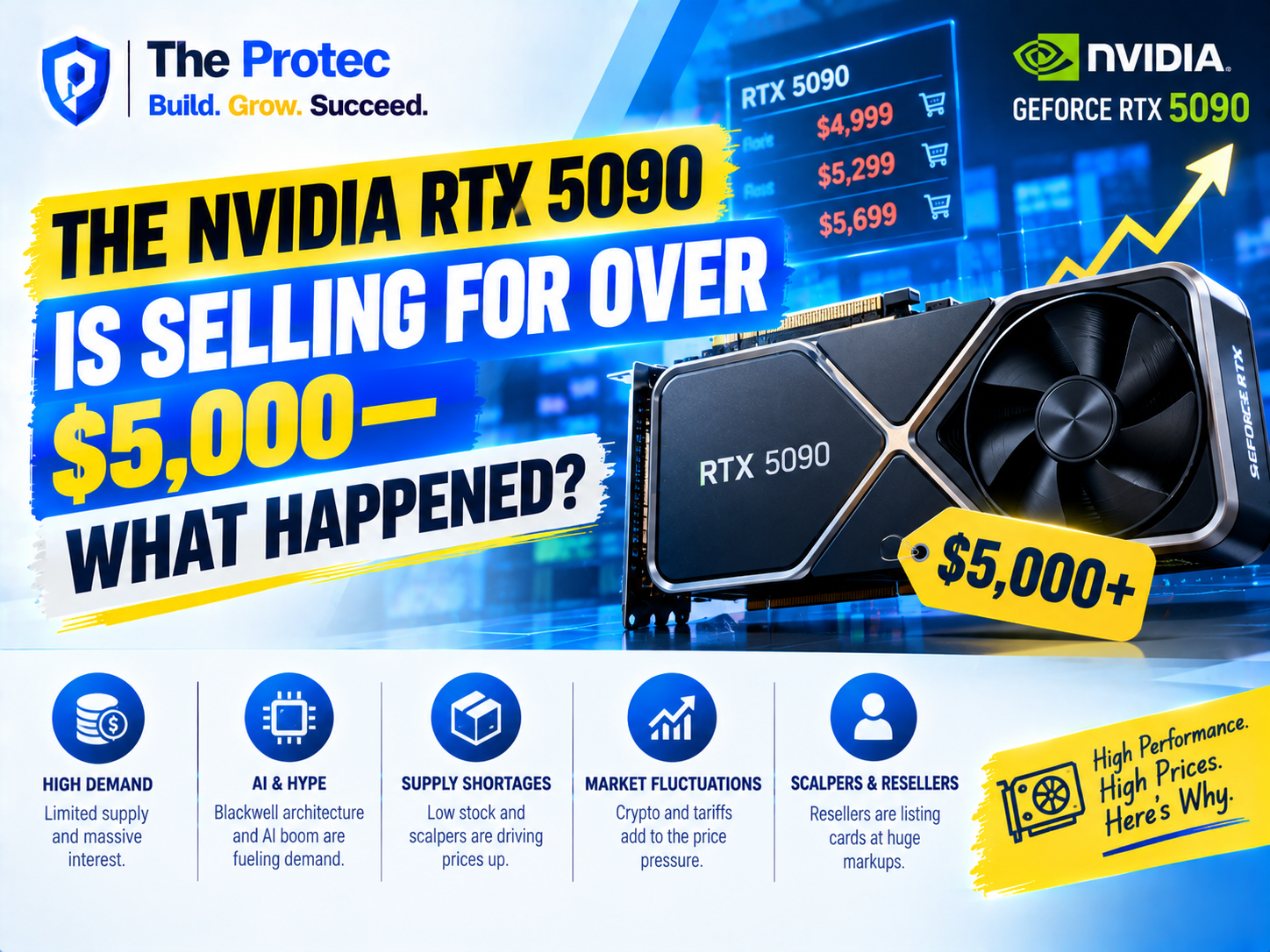
A graphics card with a $1,999 launch price should not normally cost as much as a complete premium gaming PC. Yet U.S. shoppers searching for the Nvidia RTX 5090 are encountering prices above $5,000, with some premium models and third-party listings approaching $5,700 before tax. That is nearly three times the official RTX 5090 MSRP.
The obvious explanation is scarcity, but the full story is more complicated. Limited supply, concentrated demand, expensive board-partner designs, reseller activity and Nvidia’s increasingly aggressive high-end positioning have combined to distort the market. Marketplace listings can also blur the distinction between a seller’s asking price and the amount buyers are actually willing to pay.
There is no question that the GeForce RTX 5090 is an exceptionally powerful consumer GPU. Its 32GB of GDDR7 memory, strong ray-tracing performance and AI capabilities make it attractive to gamers, creators and machine-learning users alike. The harder question is whether any of those advantages can justify an RTX 5090 price of $5,000 to $5,700.
How a $1,999 GPU Reached $5,000 or More
Nvidia introduced the RTX 5090 Founders Edition with an official U.S. MSRP of $1,999. That figure remains the most important reference point, but MSRP does not guarantee that retailers will have meaningful quantities available at that price. It applies most directly to Nvidia’s own Founders Edition and selected baseline partner cards.
Custom RTX 5090 graphics card models can legitimately cost more. Manufacturers may add oversized coolers, factory overclocks, reinforced frames, elaborate lighting, liquid-cooling hardware or premium power-delivery systems. These features raise production costs, but they do not explain a jump of roughly $3,000. Once prices reach $5,000, scarcity premiums and seller markups are doing far more work than the cooler or circuit board.
It is also essential to separate three different numbers:
- MSRP: Nvidia’s suggested launch price for the reference configuration.
- Retail price: The price charged by an authorized store for a specific Founders Edition or board-partner model.
- Marketplace price: An asking price posted by a reseller, scalper or third-party merchant, which may not represent a completed sale.
A screenshot showing an RTX 5090 at $5,700 proves that someone listed it at that amount. It does not automatically prove broad demand at $5,700. Completed-sale data, retailer inventory and the length of time a listing remains active provide a more accurate picture of the real market.
The RTX 5090 Shortage Is the Main Pressure Point
RTX 5090 availability has remained uneven because the card sits at the top of a complex global supply chain. Nvidia must allocate advanced silicon, GDDR7 memory, packaging capacity and manufacturing resources across gaming, workstation and highly profitable data-center products. Even when the company produces more chips, board partners still need memory, voltage-regulation components, coolers and qualified production capacity to ship complete cards.
Demand is unusually broad for a flagship gaming product. Enthusiasts want the fastest GeForce card, creators need large memory pools, and independent AI developers view the RTX 5090 32GB configuration as an accessible alternative to professional accelerators. That means gamers are not competing only with other gamers.
Regional distribution adds another layer. A country can receive a healthy allocation overall while individual retailers get small, irregular shipments. Inventory may disappear within minutes when stock alerts reach thousands of buyers simultaneously. This creates the appearance of permanent scarcity even if cards continue entering the channel.
When supply is thin and replacement stock is uncertain, some retailers also price defensively. They may increase prices to slow sales, cover distributor costs or preserve margins on inventory that will be expensive to replace. Those factors contribute to an RTX 5090 price increase, although they still do not make every extreme listing reasonable.
Scalpers and Resellers Magnify the Price Gap
High-demand hardware is an ideal target for automated purchasing tools. Resellers monitor product feeds, use instant checkout systems and buy limited inventory before ordinary customers can finish entering payment details. The cards then reappear on marketplaces at substantial premiums.
The RTX 5090 is especially attractive to scalpers because its buyers are less price-sensitive than mainstream shoppers. A professional whose rendering workstation generates revenue may accept a large markup to avoid weeks of downtime. An enthusiast building a no-compromise system may also prioritize immediate ownership over value. A small number of such buyers can support inflated completed-sale prices even when most shoppers refuse them.
Marketplace fee structures make the numbers look worse. Sellers may account for commissions, payment-processing charges, insured shipping, return risk and taxes when setting prices. Those costs explain part of the markup, but the buyer ultimately receives the same GPU. Paying more does not unlock additional cores, memory or warranty coverage.
Third-party purchases can introduce further risks, including opened boxes, substituted products, invalid receipts and warranties that do not transfer. Before considering an RTX 5090 $5000 listing, buyers should confirm the seller’s history, return policy, serial number status and manufacturer warranty terms.
Nvidia’s High-End GPU Pricing Strategy Matters
The shortage exists within a broader shift in Nvidia GPU prices. Flagship GeForce cards are no longer positioned solely as premium gaming components. They are multipurpose compute devices capable of 3D rendering, video processing, generative AI and local model inference. Nvidia prices the top product according to that wider utility and its commanding performance position.
The $1,999 RTX 5090 MSRP was already significantly above traditional enthusiast-card pricing. It established a high floor that board partners, distributors and resellers could build upon. With no direct consumer rival matching the complete combination of performance, memory, CUDA support and software compatibility, normal competitive pressure is limited at the top of the market.
Nvidia’s official GeForce RTX 5090 product page outlines the card’s intended capabilities, but it cannot guarantee street pricing. The market price ultimately reflects how many cards reach buyers and how urgently those buyers want them.
Can RTX 5090 Performance Justify the Premium?
For uncompromised 4K gaming, the RTX 5090 performance level is formidable. It is designed for high-refresh-rate play, demanding ray tracing and visually intensive games that can overwhelm lesser GPUs. It also benefits from Nvidia’s reconstruction, frame-generation and latency-reduction technologies.
However, performance does not scale with a $5,000 price. A card selling for two and a half times its MSRP does not become two and a half times faster. In many games, the practical experience may also be constrained by the processor, game engine, display refresh rate or poor optimization rather than raw GPU capability.
That makes RTX 5090 gaming at an extreme resale price difficult to defend on value alone. It may be the fastest option, but “fastest” and “worth any price” are different claims. Even affluent buyers should compare the additional frame rate with the cost of upgrading an entire display, processor or system.
What About DLSS 5?
DLSS can materially improve perceived performance through AI-based upscaling, ray reconstruction and frame generation, but buyers should be careful with retailer language surrounding RTX 5090 DLSS 5 support. DLSS is an evolving software platform rather than extra physical hardware that makes an overpriced card more valuable. Feature availability and image quality also vary by game.
Shoppers should verify current naming and support through Nvidia’s official DLSS information page, especially when a marketplace listing uses “DLSS 5” as a promotional claim. No DLSS version can turn a $5,700 purchase into a sensible value if the same card becomes available near MSRP later.
Why 32GB of VRAM Changes the Equation for AI Users
The RTX 5090 32GB memory capacity is one of its strongest advantages. Modern games generally do not require the full allocation, but large 3D scenes, high-resolution video projects and local AI workloads can benefit substantially. More VRAM allows larger models, higher batch sizes and complex assets to remain on the GPU instead of spilling into slower system memory.
For a developer, researcher or small studio, the RTX 5090 GPU may generate measurable productivity gains. CUDA compatibility and broad application support can make it easier to integrate than a gaming-focused alternative from another vendor. In that context, the RTX 5090 worth it calculation should be based on revenue, time saved and workload fit rather than gaming benchmarks.
Even professional utility has limits. GeForce products do not automatically provide the certified drivers, support contracts, error-correcting memory or enterprise features associated with professional accelerators. Spending $5,000 on a consumer card may put it uncomfortably close to workstation options that offer better support or memory capacity for specific tasks.
Power Consumption and the True Cost of Ownership
RTX 5090 power consumption is another factor that a headline price overlooks. The card carries a total graphics power rating around 575 watts, and premium partner variants may permit higher limits. A suitable build needs a high-quality power supply, appropriate cabling, strong case airflow and enough physical clearance for a very large cooler.
Sustained AI training or rendering can keep the GPU near full load for hours. Electricity costs and heat output therefore matter more than they do during intermittent gaming. Buyers may also need a larger case, additional cooling or a power-supply upgrade, pushing the true platform cost beyond the card’s already inflated price.
Power connectors must be installed carefully, with the plug fully seated and the cable routed without severe bending near the socket. A $5,000 GPU should not be paired with a marginal power supply or improvised adapter arrangement.
Should You Buy, Wait or Choose an Alternative?
For most buyers, waiting is the rational response to a $5,000-plus asking price. Shortages can persist, but reseller premiums tend to weaken when retail drops become more frequent, demand is satisfied or buyers shift attention to later products. Set stock alerts with authorized sellers, establish a firm maximum price and avoid making decisions from fear of missing out.
Alternatives depend on the workload:
- GeForce RTX 5080: A strong option for high-end gaming when the 5090’s 32GB memory and maximum compute performance are unnecessary.
- Used RTX 4090: Still capable for 4K gaming and CUDA workloads, provided the price, condition, connector and remaining warranty are carefully checked.
- Current Radeon flagships: Potentially attractive for rasterized gaming and value, though buyers should verify ray-tracing, creator-app and AI-framework support.
- Professional GPUs or cloud compute: Better choices for some revenue-generating workloads that need certified drivers, larger memory pools or occasional access to extreme compute.
Searches for the best high-end GPU 2026 may naturally point toward the RTX 5090 on raw performance, but the best product is not automatically the best purchase. At $5,000 to $5,700, the card crosses from luxury hardware into a specialized business expense.
The Bottom Line
The Nvidia RTX 5090 price has moved far above its $1,999 MSRP in parts of the U.S. market because supply remains tight while demand spans gaming, content creation and AI. Premium board designs add some cost, but reseller activity, marketplace fees and scarcity explain much of the leap to $5,000 or more.
The RTX 5090 graphics card delivers extraordinary performance, 32GB of fast memory and an excellent software ecosystem. None of that makes a threefold markup good value for a typical gamer. Unless immediate access will produce enough income to offset the premium, buyers should wait for authorized retail stock or choose a less expensive high-end GPU.
Frequently Asked Questions
What is the official RTX 5090 MSRP?
The U.S. launch MSRP for the Nvidia GeForce RTX 5090 Founders Edition is $1,999. Custom board-partner models can have higher suggested prices because of upgraded cooling, power delivery and factory overclocks.
Why are some RTX 5090 cards listed for $5,000 to $5,700?
Limited inventory, strong gaming and AI demand, reseller markups, marketplace fees and expensive premium models all contribute. Some figures are asking prices rather than confirmed sale prices, so they should not be treated as the universal market value.
Is the RTX 5090 worth it at $5,000?
For gaming, generally no. The performance uplift cannot justify paying roughly two and a half times the official MSRP. A professional may reach a different conclusion if the GPU immediately accelerates billable AI, rendering or video work.
Will RTX 5090 availability improve?
Availability should improve as more cards move through the supply chain and early demand declines, although timing varies by region and model. Buyers should monitor authorized retailers rather than relying on high-priced marketplace inventory.
Does the RTX 5090 need a new power supply?
Possibly. Its roughly 575-watt graphics power rating requires a high-quality, appropriately sized power supply and correctly installed cabling. The processor and other system components must also be included when calculating total capacity.