







The first phase of the generative AI boom was defined by training: bigger clusters, more parameters, and an urgent search for enough GPUs to build frontier models. The next phase is being shaped by what happens after those models are trained. Every chatbot response, generated video, coding suggestion, search summary, and autonomous agent action requires AI inference—and those requests never stop.
That shift changes the hardware equation. Training remains strategically important, but inference is becoming the larger, more persistent operating expense. It rewards low latency, high throughput, ample memory, predictable performance, and energy efficiency rather than raw computational power alone. As AI workloads expand, the industry is discovering that the best training processor is not automatically the most economical inference processor.
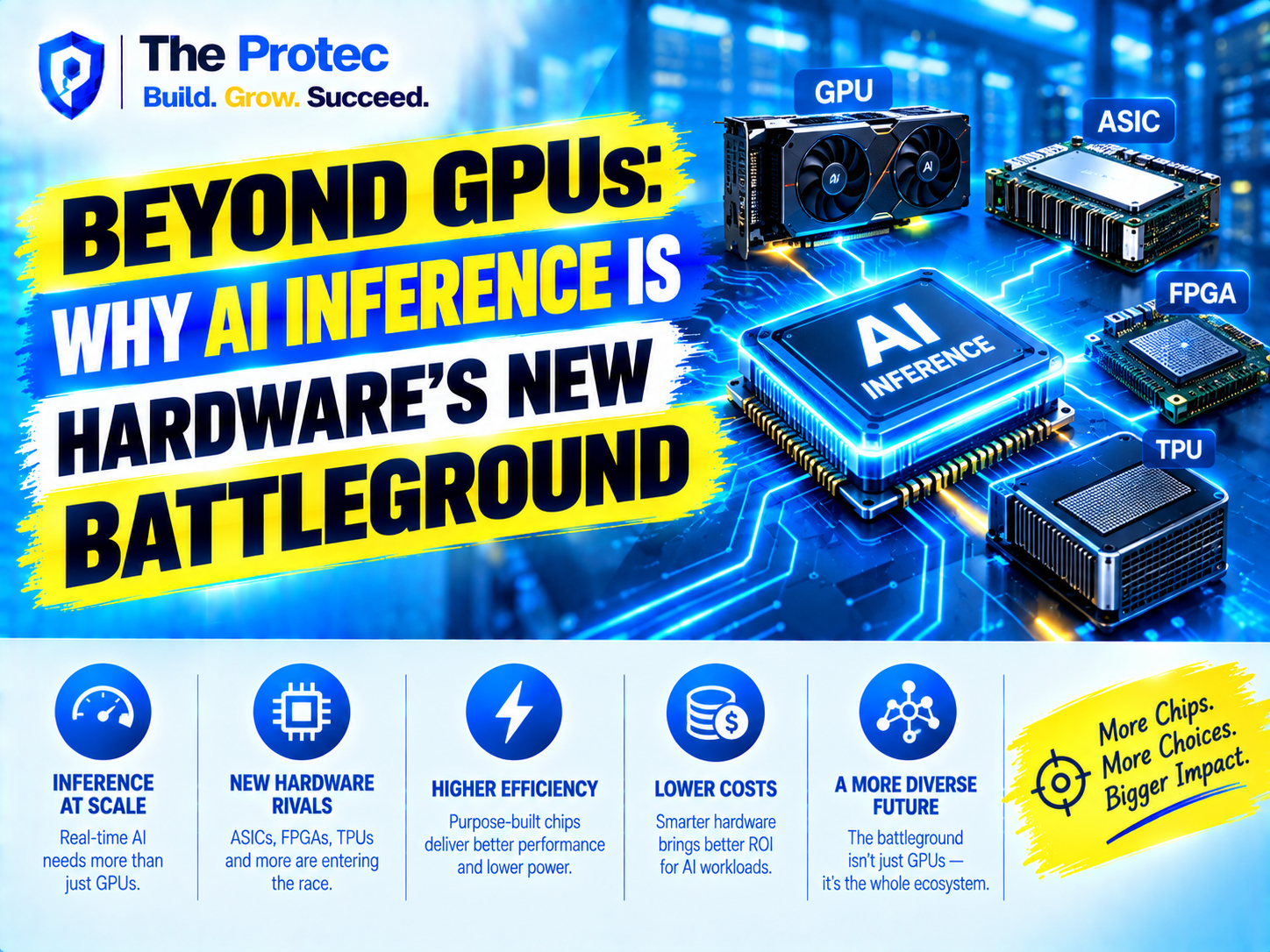
GPUs will remain central to AI infrastructure, but they are no longer competing only with other GPUs. NVIDIA now faces specialized AI hardware from Groq, Cerebras, cloud providers, and emerging inference-chip companies. The result is a broader contest to define the architecture, software, and economics of production AI.
The AI Inference Hardware Landscape in 2026
Training creates a model by repeatedly processing large datasets and adjusting billions or trillions of parameters. Inference uses the finished model to produce an answer from new input. One training run may occupy a cluster for weeks, while a successful model can serve billions of inference requests throughout its useful life.
This makes AI inference hardware a utilization business. Providers must keep expensive systems busy while meeting service-level targets during unpredictable traffic. An accelerator that produces an impressive benchmark under ideal batching may be less useful if it struggles with bursty requests, long contexts, mixed models, or strict latency limits.
The AI inference hardware 2026 market therefore extends beyond individual chips. It includes memory, interconnects, networking, cooling, compilers, model-serving software, and rack-scale design. Vendors increasingly sell complete computing systems because performance depends on how all these components work together.
AI Inference vs. Training: Different Hardware Demands
AI inference vs. training is not simply a comparison between smaller and larger workloads. Training generally favors massive parallel computation, synchronized clusters, high numerical precision where needed, and the ability to keep thousands of accelerators working on one job. Throughput matters more than the response time of any single operation.
Inference is more varied. A consumer assistant may require an immediate first token. A coding model must sustain a fluid stream of output. An enterprise batch job may prioritize total throughput, while an AI agent can make dozens of sequential model calls before completing one task.
Large language model serving also has two distinct stages. During prefill, the system processes the prompt and builds the model’s key-value, or KV, cache. This stage can be compute intensive. During decoding, the model generates tokens sequentially and repeatedly retrieves model weights and cached context. Decoding is often constrained by AI memory bandwidth rather than arithmetic capacity.
This is why an AI inference GPU can appear underutilized even while delivering all the tokens its memory subsystem can support. More compute units do not solve every bottleneck. Effective LLM inference hardware must balance computation with memory capacity, bandwidth, interconnect speed, and scheduling.
The Metrics That Determine Inference Performance
Peak operations per second reveal only part of an AI accelerator’s value. Production buyers increasingly evaluate several connected metrics:
- Time to first token: How quickly the user sees an initial response after submitting a prompt. This is critical for search, voice, coding, and interactive applications.
- Inter-token latency: How smoothly tokens arrive after generation begins. Poor consistency can make an otherwise fast model feel slow.
- Throughput: The number of tokens or requests a system can complete in a given period. Batching can increase throughput, although aggressive batching may raise latency.
- Memory capacity: Model weights and KV caches must fit somewhere. Longer context windows and more simultaneous users can consume enormous amounts of high-bandwidth memory.
- Performance per watt: Power availability is now a hard constraint for many data centers. Tokens per joule can matter as much as tokens per second.
- Tail latency: Providers must control the slowest requests, not merely advertise a favorable average. Consistent performance is essential for enterprise service guarantees.
GPU memory bandwidth remains especially important because transformer decoding moves large volumes of data for each generated token. Quantization reduces the number of bits used for model weights, improving effective capacity and bandwidth. Techniques such as speculative decoding, prefix caching, continuous batching, and disaggregated prefill and decode can further raise utilization. The winning AI inference architecture will combine capable silicon with sophisticated serving software.
How NVIDIA Is Defending the Inference Market
NVIDIA’s advantage extends far beyond the GPU itself. CUDA, optimized libraries, TensorRT-LLM, networking, NVLink, and broad framework support make its platform familiar to developers and infrastructure teams. Blackwell and Blackwell Ultra systems added lower-precision formats, larger memory configurations, and rack-scale connectivity aimed directly at generative AI inference. The Rubin roadmap continues that emphasis on tightly integrated compute, memory, networking, and software.
The NVIDIA inference strategy is increasingly system oriented. NVL rack architectures allow many GPUs to behave like a large shared computing fabric, while serving software can separate prompt processing from token generation and assign each stage to suitable resources. This flexibility lets one platform support training, fine-tuning, multimodal models, and inference.
That versatility is also the source of the challenge. General-purpose GPUs contain capabilities that a narrowly designed inference chip may not need. Specialized competitors argue that eliminating unnecessary components can deliver lower latency or better performance per watt. NVIDIA counters with scale, rapid software optimization, model compatibility, and the ability to deploy new architectures without replacing the entire programming stack.
Groq, Cerebras, and Specialized AI Accelerator Chips
Groq and Deterministic Token Generation
Groq’s Language Processing Unit takes a compiler-driven approach built around deterministic execution and large amounts of on-chip memory. Instead of relying heavily on dynamic scheduling and traditional cache hierarchies, the compiler plans data movement in advance. The objective is predictable, low-latency token generation with minimal scheduling overhead.
The NVIDIA-Groq comparison illustrates two philosophies. NVIDIA offers a flexible platform with a mature ecosystem and broad workload coverage. Groq focuses more tightly on inference speed and consistency, scaling its AI inference chips through interconnected systems. Its opportunity is strongest where fast token delivery materially improves the product, although model size, capacity planning, software support, and total system cost remain important considerations.
Cerebras Inference and Wafer-Scale Computing
Cerebras uses a wafer-scale processor containing vastly more compute cores and on-chip memory than a conventional individual chip. Its architecture reduces the distance data must travel and avoids some of the communication overhead created by dividing a model across numerous smaller devices.
Cerebras inference targets extremely fast generation for large models, supported by systems designed to stream weights efficiently and keep computation close to memory. The approach demonstrates that inference performance can be rethought at the physical scale of the processor rather than improved only through incremental GPU changes.
Cloud and Emerging Inference Chips
Hyperscalers are also developing custom AI chips, including Google TPUs, AWS Inferentia and Trainium, Microsoft Maia, and Meta MTIA. Their motivation is economic: a cloud operator running enormous, relatively stable workloads can justify silicon optimized for its own software and data centers.
Companies such as SambaNova, Tenstorrent, d-Matrix, Etched, and other accelerator developers are exploring dataflow computing, compute-near-memory designs, transformer-specific silicon, and alternative memory systems. Not every architecture will achieve broad adoption. Software maturity, manufacturing capacity, model compatibility, and access to customers can be as decisive as chip specifications. Independent results such as MLPerf Inference benchmarks help buyers compare systems, but real application testing remains indispensable.
AI Agents Will Multiply Inference Demand
AI agents could make inference growth even more dramatic. A conventional chatbot may answer one prompt with one generation. An agent may interpret a request, create a plan, call tools, inspect results, revise its approach, and ask another model to verify the final output. One user action can therefore trigger many inference passes.
Reasoning models compound the effect by generating additional internal or visible tokens before producing an answer. Multimodal applications add image, audio, and video processing, while real-time voice systems require consistently low latency. The relevant unit of demand is shifting from requests to total tokens and model operations per completed task.
This favors heterogeneous infrastructure. A powerful model may handle difficult planning, while smaller models perform routing, classification, retrieval, or verification. Data centers may combine GPUs, inference chips, CPUs, and specialized media accelerators rather than standardizing on one processor.
How Inference Is Reshaping AI Data Center Hardware
At scale, inference economics are determined at the rack and facility levels. Power delivery, liquid cooling, network topology, storage, and accelerator utilization all affect the final cost per token. A chip that uses less power can enable more capacity inside a constrained facility, potentially making energy efficiency more valuable than a modest gain in peak speed.
Memory is another strategic constraint. Longer contexts create larger KV caches, and high concurrency multiplies that footprint. Operators are experimenting with cache compression, tiered memory, model parallelism, and disaggregated serving. Faster interconnects can pool resources, but moving data between chips or racks consumes energy and introduces latency.
The result is a new generation of AI data center hardware built around workload orchestration. Schedulers must place models intelligently, route requests by latency and cost, and keep accelerators occupied without overwhelming memory. Observability must track tokens per second, cache usage, queue time, energy consumption, and quality—not merely GPU utilization.
Choosing Between GPUs and Specialized AI Hardware
There is no universal winner. GPUs remain attractive when workloads change frequently, teams need mature tools, or the same infrastructure must support training and inference. Specialized AI accelerator chips can be compelling when request volume is predictable and gains in latency or efficiency justify a narrower platform.
Buyers should test representative prompts, context lengths, batch sizes, model types, and traffic patterns. The useful comparison is total cost per successful task at the required quality and latency—not the purchase price of an AI accelerator or its theoretical compute rating. Portability, vendor stability, security, and deployment lead time belong in the calculation as well.
The New AI Hardware Battleground
GPUs are not being replaced wholesale. They are being challenged, complemented, and pushed toward more inference-specific designs. NVIDIA’s integrated platform, Groq’s deterministic architecture, Cerebras’ wafer-scale systems, and custom cloud silicon each address a different part of the problem.
As inference becomes the dominant recurring cost of AI, the market will reward systems that move data efficiently, deliver predictable responses, and maximize useful work per watt. The next AI hardware leader may not be the company that trains the largest model fastest. It may be the one that serves the most valuable intelligence at the lowest sustainable cost.
Frequently Asked Questions
What is AI inference hardware?
AI inference hardware is the computing infrastructure used to run trained models and generate predictions or content. It includes GPUs, ASICs, inference chips, memory, networking, and serving systems optimized for latency, throughput, and energy efficiency.
Why is memory bandwidth important for LLM inference?
During token generation, an LLM repeatedly accesses model weights and KV-cache data. If memory cannot supply that information quickly enough, compute units wait. Higher bandwidth, efficient caching, and lower-precision weights can increase token throughput.
Will AI inference chips replace GPUs?
Not entirely. GPUs offer flexibility, strong software support, and the ability to handle training and inference. Specialized chips may capture workloads where predictable latency, efficiency, or high-volume economics outweigh the benefits of a general-purpose platform.
What should companies measure when evaluating inference hardware?
Companies should measure time to first token, inter-token latency, throughput, tail latency, memory capacity, power use, model quality, and total cost per completed task under realistic traffic. Benchmark results should be validated with the organization’s own models and applications.