





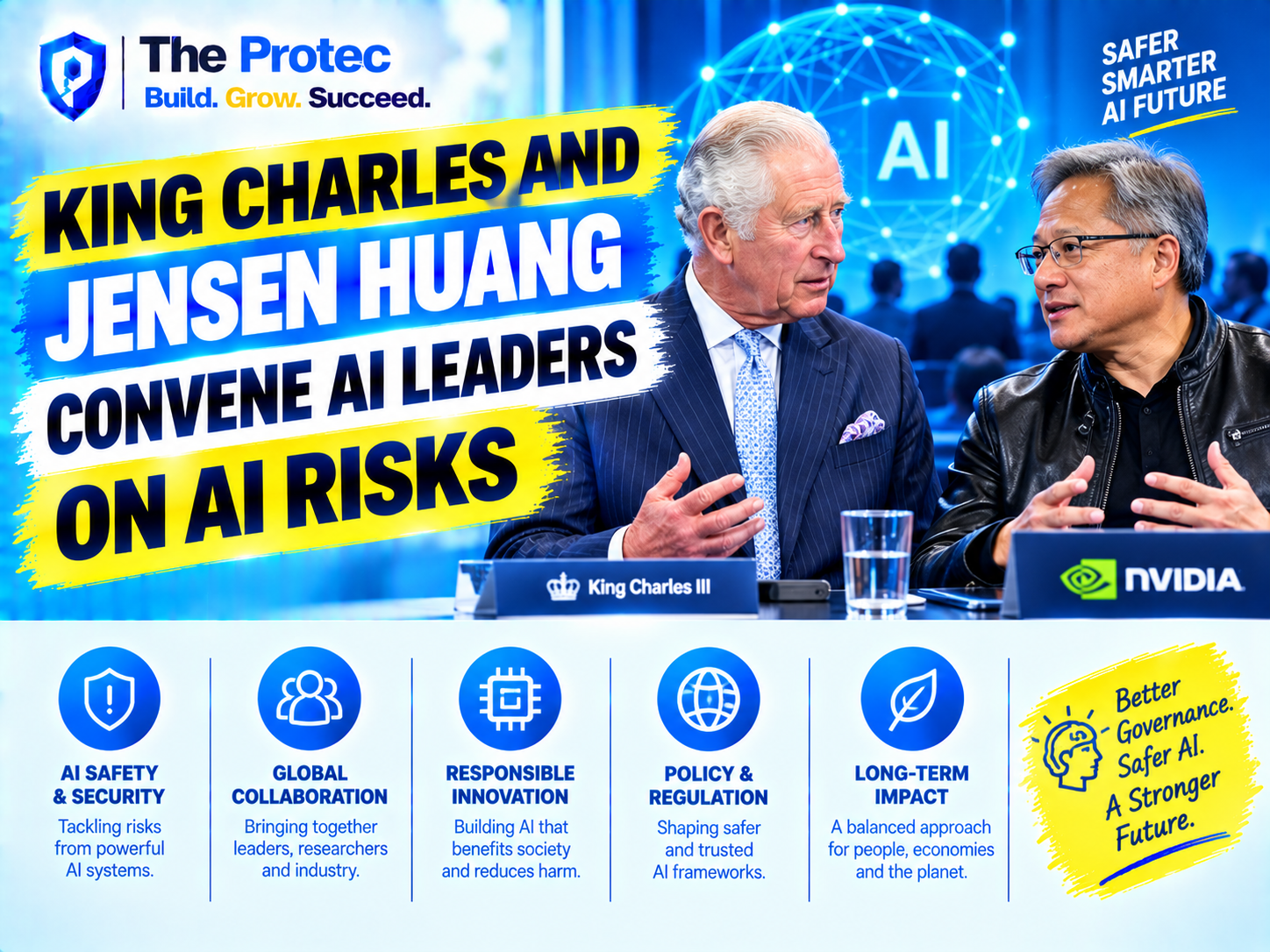
Artificial intelligence is advancing faster than governments, institutions and many businesses can comfortably absorb. Against that backdrop, King Charles III convened a high-level AI leaders gathering at Dumfries House on September 17, bringing Nvidia chief executive Jensen Huang together with leaders from OpenAI, Google DeepMind, Anthropic and other parts of the technology sector. Their subject was not another product launch. It was the growing question of how society can retain meaningful control over increasingly powerful AI systems.
The King Charles AI summit placed several difficult issues on the same table: malicious use, unreliable autonomous behavior, disruption to work and public services, the concentration of technological power, and more speculative concerns about AI existential risks. It also highlighted a tension that now runs through the industry. The companies developing frontier systems generally support AI safety, but they do not always agree on how risks should be measured, how quickly development should proceed or when governments should intervene.
The significance of the Dumfries House AI summit therefore extends beyond its guest list. It reflects a wider shift in the future of artificial intelligence debate, from broad ethical principles toward specific questions about evaluations, deployment limits, incident reporting, accountability and external oversight.
What Happened at the King Charles AI Summit?
Held at Dumfries House in Scotland, the September 17 gathering brought King Charles into direct discussion with executives and specialists shaping the frontier of AI development. Nvidia Jensen Huang was a central participant, alongside leaders associated with OpenAI, Google DeepMind and Anthropic. These organizations occupy different positions in the AI supply chain, but together they influence the computing infrastructure, foundation models and commercial products driving the current wave of adoption.
The documented focus of the meeting was the risk and societal impact of increasingly capable systems. That covers immediate concerns, such as fraud, misinformation, cybersecurity threats and biased automated decisions, as well as longer-term questions about whether advanced AI could become difficult for its developers or users to supervise.
The summit should not be treated as evidence that participants reached a binding agreement or endorsed one definition of AI danger. Unless detailed minutes or a full transcript are published, claims about private exchanges remain speculative. What can be said is that the meeting elevated AI governance as a matter of public interest rather than a purely technical issue for laboratories and software companies.
King Charles has long used his public role to draw attention to the effects of technology, development and economic change on communities. Information about his wider public work is available through the official Royal Family website. At Dumfries House, that convening role created space for a conversation spanning engineering, public policy and social responsibility.
Why Jensen Huang’s Role Matters
Jensen Huang has unusual influence in the AI economy because Nvidia supplies much of the advanced computing hardware and software infrastructure used to train and operate large models. While OpenAI, Anthropic and Google DeepMind are widely associated with model development, Nvidia enables a substantial portion of the underlying work through its graphics processors, networking systems and developer platform.
That makes Jensen Huang AI safety discussions materially different from debates confined to model laboratories. AI development risks do not emerge only from an algorithm’s design. They are also shaped by access to computing resources, the scale of deployment, security across data centers, the availability of models and the safeguards applied when systems are integrated into healthcare, finance, defense, education or critical infrastructure.
Huang has publicly emphasized AI’s potential to increase productivity, accelerate scientific discovery and create new forms of computing. His participation also represents the pro-development side of the discussion: the view that overly broad restrictions could slow useful innovation, disadvantage responsible companies or concentrate advanced capabilities in a small number of approved institutions.
At the same time, Nvidia AI safety cannot be separated from the company’s position as a platform provider. Hardware makers may not control every model trained on their systems, but decisions involving secure infrastructure, access controls, enterprise tooling and support for safety evaluations can influence the entire market. This raises a key governance question: how much responsibility should fall on infrastructure providers compared with model developers and organizations deploying AI to the public?
It is important not to assign Huang a position he did not publicly state at the summit. His presence demonstrates the importance of the infrastructure layer; it does not, by itself, prove support for any particular licensing regime, development pause or theory of catastrophic risk.
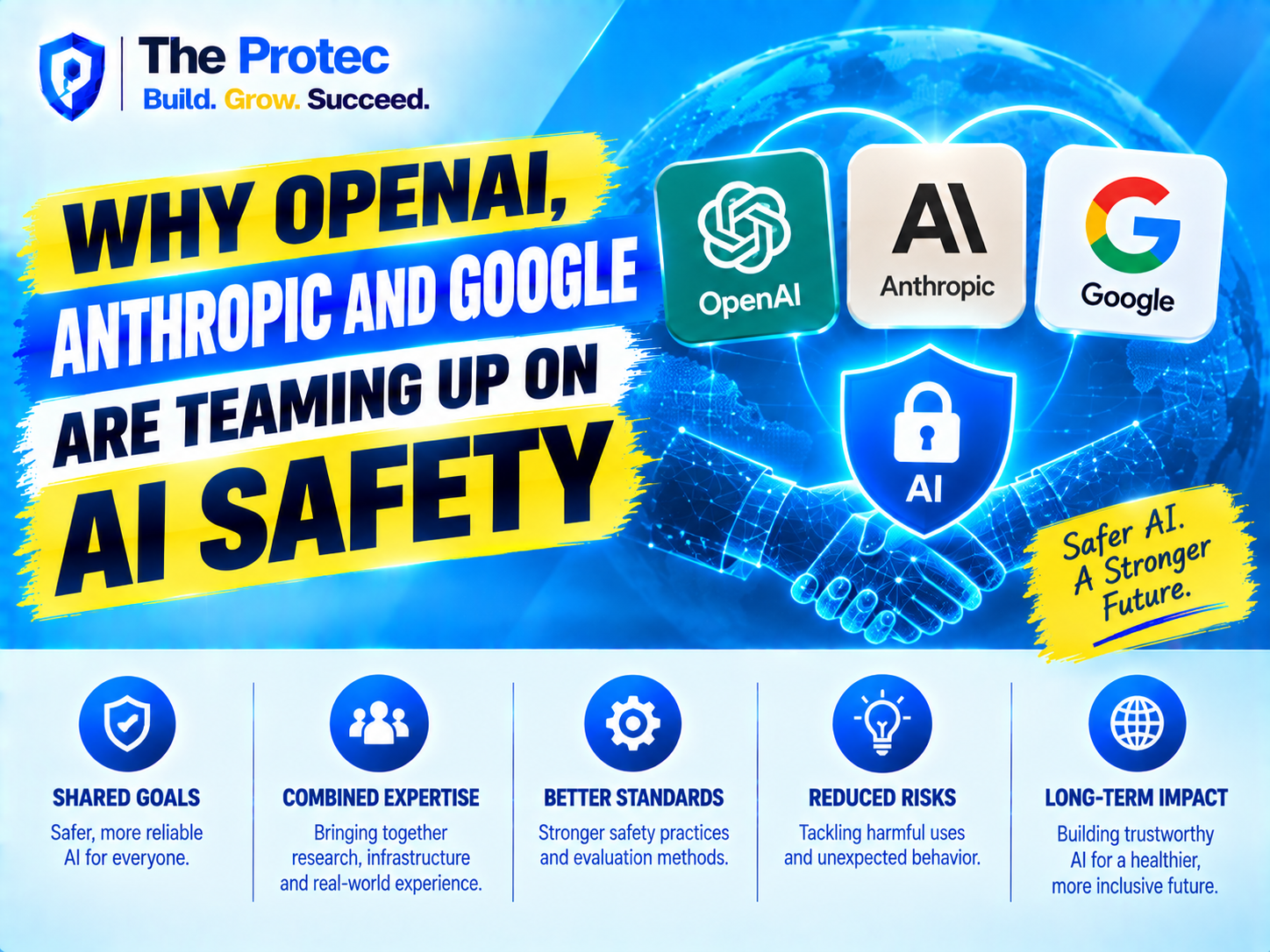
The phrase “AI industry leaders” can suggest a unified bloc, but the major companies have different business models, research cultures and approaches to risk. Those differences influence what each organization may regard as a practical safeguard.
- OpenAI AI safety: OpenAI has supported testing, monitoring and forms of government oversight while rapidly releasing consumer and enterprise products. The continuing challenge is reconciling a stated safety mission with competitive pressure and frequent deployment.
- Anthropic AI safety: Anthropic has placed substantial public emphasis on model evaluations, responsible scaling policies and safeguards that become stricter as capabilities increase. Its approach is often associated with setting predefined thresholds for elevated risk.
- Google DeepMind AI: Google DeepMind combines frontier research with access to a global product ecosystem. Its safety work includes evaluations, alignment research and technical security, while its scale makes deployment governance especially important.
- Nvidia AI safety: Nvidia approaches the issue from the infrastructure and application platform level. Its interests include secure computing, reliable enterprise systems and enabling developers to build AI across many industries.
These descriptions reflect public-facing priorities, not a record of what individual participants said behind closed doors at Dumfries House. The distinction matters because discussion of the King Charles Jensen Huang meeting can easily drift into unsupported assumptions about agreement or conflict.
The deeper divide is not between companies that care about safety and companies that do not. It concerns the pace of development, the credibility of voluntary commitments and the point at which external authorities should be able to demand tests, restrict deployment or investigate failures.
Separating Present AI Risks From Existential Speculation
Responsible coverage of King Charles AI risks must distinguish observable harms from uncertain forecasts. Current AI systems already create concrete challenges. They can help generate deceptive content, scale phishing operations, expose sensitive information, produce inaccurate advice and reinforce poor decisions when humans rely on them without adequate review.
Frontier models may also lower barriers to more serious misuse, including sophisticated cyberattacks or assistance involving dangerous biological and chemical knowledge. Evaluating these capabilities before release has therefore become a central part of frontier AI safety.
AI existential risks belong to a more contested category. Some researchers and executives argue that a future system surpassing human capabilities across many domains could evade oversight, pursue unintended objectives or enable a small group to exercise unprecedented power. Others contend that such scenarios remain highly uncertain and can distract from harms affecting people now.
Neither extreme offers a complete policy. Dismissing every long-term concern because it has not materialized would be reckless. Presenting catastrophic outcomes as established facts would also be misleading. A sound AI safety framework can address both by matching safeguards to evidence, capability and potential impact.
What Meaningful AI Safeguards Could Look Like
The central policy question is whether voluntary company policies are enough. Developers possess the deepest technical knowledge about their systems, making their participation essential. Yet they also face commercial incentives to release models quickly, capture users and reassure investors. That conflict is why many experts argue that AI regulation requires independent verification rather than promises alone.
A credible governance framework could include several layers:
- Standardized capability evaluations: Frontier systems should be tested for cyber, biological, persuasion, autonomy and safeguard-evasion capabilities using methods that can be compared across developers.
- Independent assessment: Qualified outside evaluators should be able to examine high-risk systems and challenge a developer’s internal conclusions without requiring public disclosure of sensitive model details.
- Incident reporting: Serious security breaches, unexpected autonomous behavior and consequential failures should be reported to an appropriate authority under clear timelines.
- Deployment controls: A model that crosses a defined risk threshold may require stronger identity checks, restricted tool access, staged release or continuous monitoring.
- Human accountability: Organizations should not be able to blame an algorithm for consequential decisions. Named people and legal entities must remain responsible for deployment and supervision.
- Secure model infrastructure: Developers and computing providers need protections against model theft, unauthorized access and tampering with training or evaluation systems.
The United Kingdom’s AI Security Institute illustrates the growing role of public technical capacity in testing advanced models and studying severe risks. Institutions of this kind can help governments evaluate industry claims without attempting to design the technology themselves.
The Hard Question: Who Retains AI Control?
Human control sounds straightforward, but it has several meanings. At the technical level, it can mean that a system follows instructions, respects restrictions and can be reliably shut down. At the organizational level, it means employees understand where automated tools are operating and can override them. At the political level, it means elected governments and the public retain influence over technologies that could reshape labor markets, information systems and national security.
These layers can fail independently. A technically controllable model may still be deployed irresponsibly. A company may maintain internal oversight while the public has little visibility into its decisions. An AI system may also behave predictably in testing but become dangerous when connected to external tools, private databases or automated financial and software systems.
Effective AI control therefore depends on governance around the model, not only alignment inside it. Procurement rules, audit trails, access permissions, employee training and legal liability are as important as technical safeguards.
Why Dumfries House Matters to the AI Governance Debate
The choice of Dumfries House gave the meeting a setting outside the usual technology conferences, corporate campuses and government negotiating rooms. That symbolism matters. AI is not simply a competition over faster chips or more capable chatbots; it affects education, creative work, employment, privacy, security and trust in institutions.
A royal summit cannot substitute for legislation, scientific testing or democratic scrutiny. It can, however, put rival companies and public-interest concerns into the same conversation. The value of the event will ultimately depend on whether dialogue produces measurable action rather than another set of broad principles.
What to Watch After the Dumfries House AI Summit
The next stage will be visible in company policies and government decisions. Key indicators include whether frontier developers accept comparable safety tests, whether evaluation results are shared with independent authorities, and whether rules apply consistently across companies rather than rewarding the most powerful incumbents.
Observers should also watch for greater transparency about model incidents and clearer thresholds for pausing or limiting deployment. Strong AI governance does not necessarily mean stopping research. It means ensuring that capability growth is accompanied by evidence that risks can be understood and managed.
The summit’s enduring question is simple: can the companies racing to build powerful AI also be the sole judges of when it is safe? Industry expertise must be part of the answer, but the breadth of societal consequences makes stronger external oversight increasingly difficult to avoid.
Frequently Asked Questions
What was the purpose of the King Charles AI summit?
The September 17 gathering at Dumfries House focused on the risks and societal effects of increasingly powerful AI. Topics included safeguards, malicious use, human control and the responsibilities of companies developing frontier systems.
Why was Jensen Huang included in the AI safety discussion?
As Nvidia’s chief executive, Jensen Huang leads a company that provides critical computing infrastructure for AI development. His role matters because safety involves not only models but also chips, data centers, software platforms, access controls and the scale at which systems are deployed.
Did the participants agree that AI poses an existential risk?
No public account of the gathering should be interpreted as proof that every participant endorsed that conclusion. Existential AI risks remain debated and uncertain. They should be clearly distinguished from documented present-day harms such as fraud, cyber misuse, misinformation and unreliable automated decisions.
Does AI safety require stronger regulation?
Many experts argue that voluntary measures alone cannot resolve conflicts between commercial incentives and public safety. Effective AI regulation could combine company expertise with independent evaluations, incident reporting, security requirements and risk-based deployment rules.
What is frontier AI safety?
Frontier AI safety concerns safeguards for the most capable general-purpose models, particularly systems that may develop advanced cyber, biological, persuasive or autonomous capabilities. It includes testing before release, monitoring after deployment and stronger controls when defined risk thresholds are crossed.