






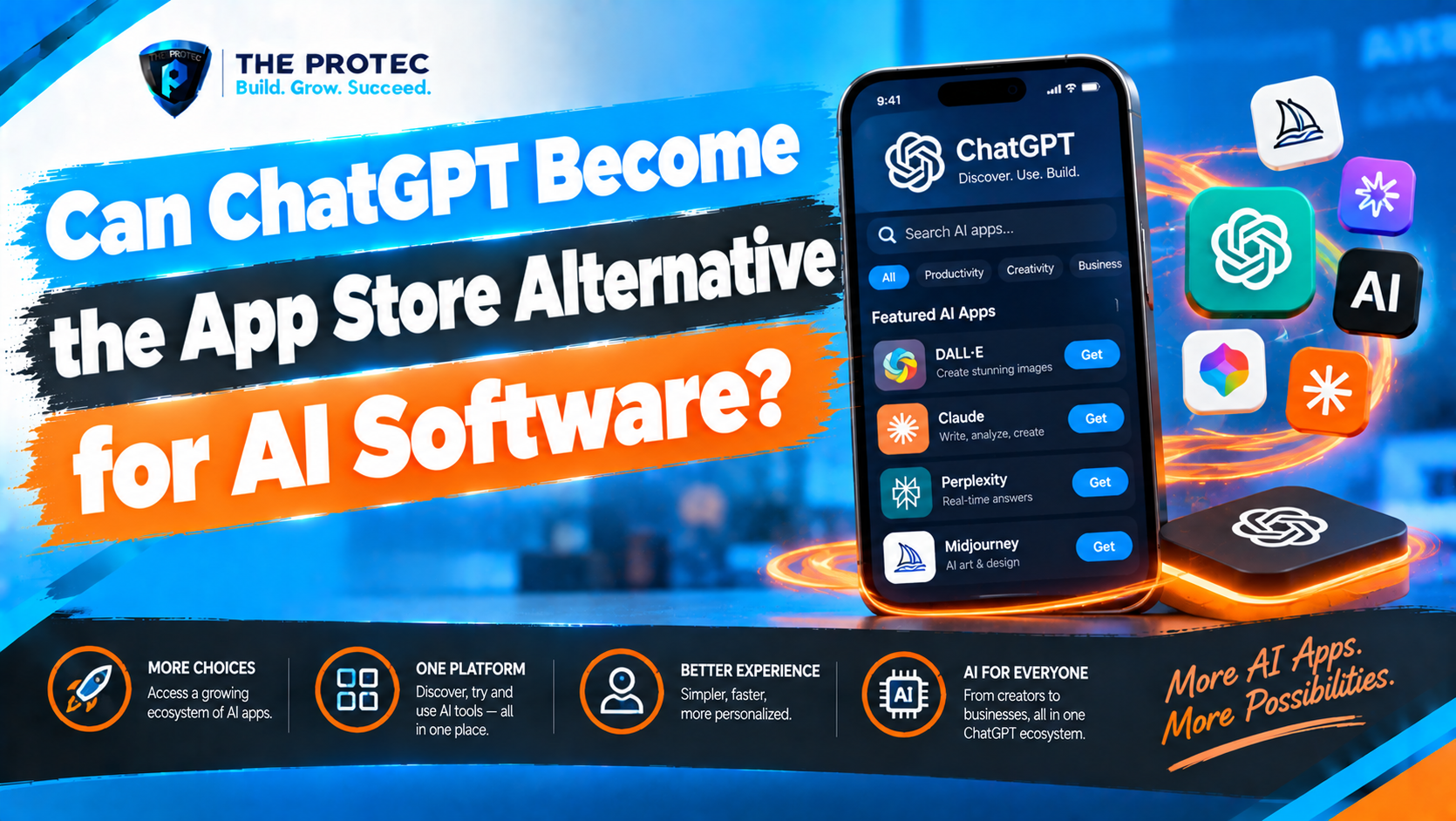
For nearly two decades, finding software has followed a familiar pattern: search the web or open an app store, compare listings, install a product, create an account and learn its interface. OpenAI’s ChatGPT wants to compress that journey into a conversation as an Alternative to App Store.
The company’s emerging vision is for ChatGPT to become more than an assistant that answers questions. Through ChatGPT apps, plugin-style extensions, interactive interfaces, AI agents, ChatGPT Sites and identity tools such as Sign in with ChatGPT, it is building the pieces of a software distribution platform. Instead of deciding which application to open before starting a task, a user could describe the desired outcome and let ChatGPT identify, launch or interact with the appropriate service.
That makes the idea of a ChatGPT app store alternative significant. OpenAI is not simply recreating rows of downloadable icons inside a chatbot. It is exploring a model in which software is discovered at the moment of need, accessed within an ongoing conversation and coordinated by an AI agent. The result could reshape how developers reach customers—and place ChatGPT between users and a growing share of digital services.
OpenAI’s Vision Goes Beyond a Conventional App Store
A traditional app store is primarily a catalog and transaction system. Users browse categories, search by product name, inspect ratings and install software that runs through its own interface. ChatGPT can approach distribution differently because it already understands natural-language intent and conversational context.
Someone planning a trip, for example, may not ask for a particular booking application. The person might ask ChatGPT to compare destinations, build an itinerary and find suitable lodging. A connected travel service could appear exactly when inventory or booking functionality is required. The application becomes a capability inside the workflow rather than a separate destination.
OpenAI DevDay 2026 reinforced this broader platform direction by emphasizing developer tools, app experiences and agent-driven interaction around ChatGPT. The important shift is from “Which app should I download?” to “What am I trying to accomplish?” If ChatGPT can route the second question to trusted third-party software, it becomes both an interface and a distribution channel.
The Components of the ChatGPT App Ecosystem
No single feature turns ChatGPT into an OpenAI app store. The strategy depends on several layers that can work together.
ChatGPT Apps and Plugin-Style Extensions
ChatGPT third-party apps can expose specialized data, actions or services within a conversation. This model builds on lessons from earlier ChatGPT plugin extensions, but newer integrations are expected to offer richer interfaces, stronger tool calling and more structured permission controls.
A useful distinction is that the original plugin concept often focused on connecting an external API to the model. A mature ChatGPT app ecosystem requires more: discovery, authentication, visual components, state management, safety reviews, billing options and clear explanations of what an app can do.
Dedicated Interactive Applications
Conversation works well for intent, but it is not ideal for every interaction. Comparing a dozen products, editing a design or reviewing a financial chart may require buttons, forms, maps, tables and other visual controls. ChatGPT interactive applications can combine natural-language guidance with dedicated interfaces, allowing users to move between dialogue and direct manipulation.
This hybrid approach is central to OpenAI’s software ambitions. It avoids forcing every task into a stream of text while preserving ChatGPT as the coordinating layer.
ChatGPT Sites
ChatGPT Sites extend the idea toward persistent, shareable or purpose-built experiences associated with ChatGPT. Depending on implementation and developer access, these experiences could give applications a more durable presence than a temporary conversation. They may also provide an entry point from the open web while retaining ChatGPT-native functionality.
However, ChatGPT Sites should not automatically be treated as a fully developed public marketplace. Their strategic importance is that they can connect conversational creation, hosted experiences and software distribution. The exact rules for ranking, publishing, monetization and portability will determine whether they become a meaningful alternative to websites or app listings.
Sign in with ChatGPT
Identity is another essential layer. Sign in with ChatGPT could reduce the friction of creating separate accounts while helping third-party services recognize users and maintain preferences. For developers, a widely adopted identity option could improve conversion. For users, it could make launching a service from a conversation feel immediate.
The trade-off is platform concentration. If a ChatGPT identity becomes the key to many services, account security, consent and data separation become especially important. Users must be able to see what information is shared and revoke access without losing control of unrelated products.
AI Agents and Apps
AI agents make this model fundamentally different from a static marketplace. An agent can potentially select tools, ask for missing details and perform a sequence of authorized actions across multiple services. Rather than merely recommending accounting software, for example, an agent might collect receipts, send data to a compatible bookkeeping app and return a categorized report.
That possibility remains broader than the capabilities available in every ChatGPT integration today. Reliable autonomous action requires explicit permissions, dependable APIs, confirmation steps and mechanisms for correcting errors. Still, AI agent software discovery is likely to become one of the defining features of the platform.
How ChatGPT App Discovery Could Work
App discovery usually depends on keyword search, rankings, advertisements, editorial collections and brand recognition. ChatGPT app discovery can add intent matching. The system may understand that a request requires diagramming, document signing or restaurant booking even when the user does not mention an app category.
This creates three potential discovery paths:
- Users deliberately browse or search a ChatGPT app marketplace.
- ChatGPT recommends relevant apps during a conversation.
- An AI agent invokes an approved service as one step in a larger workflow, subject to user consent.
Contextual recommendations could help smaller developers compete with established brands. A focused application with the best capability for a specific request may surface even if it lacks a large advertising budget. But the ranking system will matter enormously. Developers will want to know whether recommendations favor relevance, popularity, commercial partnerships, price, safety or OpenAI’s own products.
Transparent labels will also be necessary. Users should be able to distinguish an organic recommendation from a sponsored placement and understand why a particular service was selected.
ChatGPT Versus App Stores and the Open Web
Conventional app stores offer mature payment infrastructure, device-level integration, review systems and a familiar installation model. They are effective for software used repeatedly, especially applications that need notifications, sensors, offline access or deep operating-system capabilities.
The open web has different strengths. Browser-based software is reachable through links, works across many devices and is not necessarily subject to one marketplace’s approval. Search engines, social platforms and direct referrals all contribute to discovery.
A ChatGPT developer platform introduces a third model built around delegated intent. Its potential advantages include:
- Distribution inside an assistant that already has a large audience.
- Discovery based on the user’s goal rather than an exact product name.
- Lower onboarding friction through embedded interfaces and shared identity.
- Workflows that combine several services without constant app switching.
- Personalized assistance before, during and after an app interaction.
It also creates new dependencies. A developer may become reliant on ChatGPT’s recommendation algorithm, technical standards and access policies. Unlike web traffic, which can arrive from many sources, traffic mediated by one assistant can change quickly if ranking rules or model behavior changes. This resembles existing app-store dependence but adds an AI layer whose decisions may be harder to inspect.
Why Developers May Embrace OpenAI’s Software Ecosystem
The strongest attraction is distribution. Developers can potentially reach users at the exact moment they express a relevant need. Instead of paying to attract someone to a landing page, a company could make its functionality available directly within a high-intent conversation.
OpenAI developer tools may also reduce the work required to add conversational controls, agent-compatible actions and generated interfaces. Developers can review current platform capabilities through the official OpenAI developer documentation.
Yet success will require more than connecting an API. Applications must clearly define actions, validate model-generated inputs and return results that ChatGPT can explain. Developers should design confirmation screens for consequential tasks, maintain logs and assume that users may arrive without prior knowledge of the brand.
Monetization remains a decisive question. Possible models include subscriptions, usage-based fees, transaction commissions, sponsored discovery and revenue sharing. OpenAI could process payments centrally, allow developers to bill customers directly or support both. Each option affects customer ownership, margins, refunds and regulatory responsibility.
Announced Capabilities Versus Future Possibilities
It is important not to treat every logical extension of OpenAI’s strategy as an available feature. ChatGPT already supports developer-built integrations, tool use, interactive experiences and increasingly agentic workflows. OpenAI has also signaled a stronger focus on identity, hosted experiences and software distribution.
What remains uncertain is whether these components will consolidate into a universal OpenAI app store with standardized payments, public rankings and broad autonomous access across third-party services. It is also too early to assume that ChatGPT will replace native mobile apps, web browsers or existing marketplaces.
The more plausible near-term outcome is coexistence. ChatGPT may become the starting point for selected tasks while native apps handle deeper, repeated engagement. A service might be discovered and tried through ChatGPT, then used through its website or mobile application when advanced controls are needed.
Approval, Privacy and Permission Challenges
An AI-powered software distribution system needs strict safeguards because applications may receive conversational context and permission to take action. OpenAI will need to define what qualifies for listing, how apps are tested and how harmful or deceptive behavior is handled.
Key unresolved questions include:
- What data can an app access from the conversation?
- Are permissions granted once, per session or for each sensitive action?
- Who is responsible when an agent chooses the wrong app or completes an incorrect transaction?
- How will OpenAI review apps that operate in finance, healthcare or other regulated fields?
- Can developers appeal rejection, removal or reduced visibility?
- Will users be able to export data and move relationships to another platform?
Permission requests must be specific and understandable. “Allow access to your account” is insufficient if an app only needs to read a calendar or submit one order. High-impact actions should require a clear preview and confirmation, while users should have a central dashboard for reviewing connected services.
Privacy is equally critical. ChatGPT may know why a user needs a tool, not merely that the person opened it. That context can improve results, but it can also reveal sensitive intentions. Data minimization and boundaries between OpenAI and third-party apps will influence trust.
Will Users Treat ChatGPT as Their Software Starting Point?
User adoption will depend on convenience, reliability and control. People may welcome a system that eliminates repetitive searches, registrations and interface switching. The value becomes especially clear when ChatGPT can coordinate several products while maintaining context across a complex task.
But users will resist if recommendations feel promotional, permissions are confusing or agent actions are unpredictable. They may also prefer familiar specialist software for tasks requiring precision and extensive customization.
The future of app stores is therefore unlikely to be a simple replacement story. ChatGPT could become a powerful software access layer sitting above websites, APIs and native applications. If OpenAI gets discovery, trust and developer economics right, the software icon may matter less than the capability available at the moment a user asks for it.
Frequently Asked Questions
Is ChatGPT already an app store?
ChatGPT has app-like integrations, developer tools and interactive experiences, but it should not yet be viewed as a complete replacement for conventional app stores. Important marketplace elements, including universal payments, standardized approval rules and consistent public discovery, are still evolving.
How are ChatGPT apps different from plugins?
Plugins primarily connected ChatGPT to external services and APIs. ChatGPT apps can build on that foundation with richer interfaces, persistent experiences, identity, more structured actions and deeper integration with AI agents.
Could ChatGPT replace mobile applications?
It may replace the need to open separate apps for some short or cross-service tasks. Native applications will remain valuable when software requires offline operation, device hardware, complex interfaces or frequent specialized use.
What is the biggest risk for developers?
Platform dependence is a major risk. Developers may gain access to a large audience but become reliant on OpenAI’s policies, recommendation systems, technical interfaces and commercial terms. Maintaining direct customer relationships and alternative distribution channels will remain important.