








LPDDR6 RAM Explained: Why the Next Memory Standard Matters
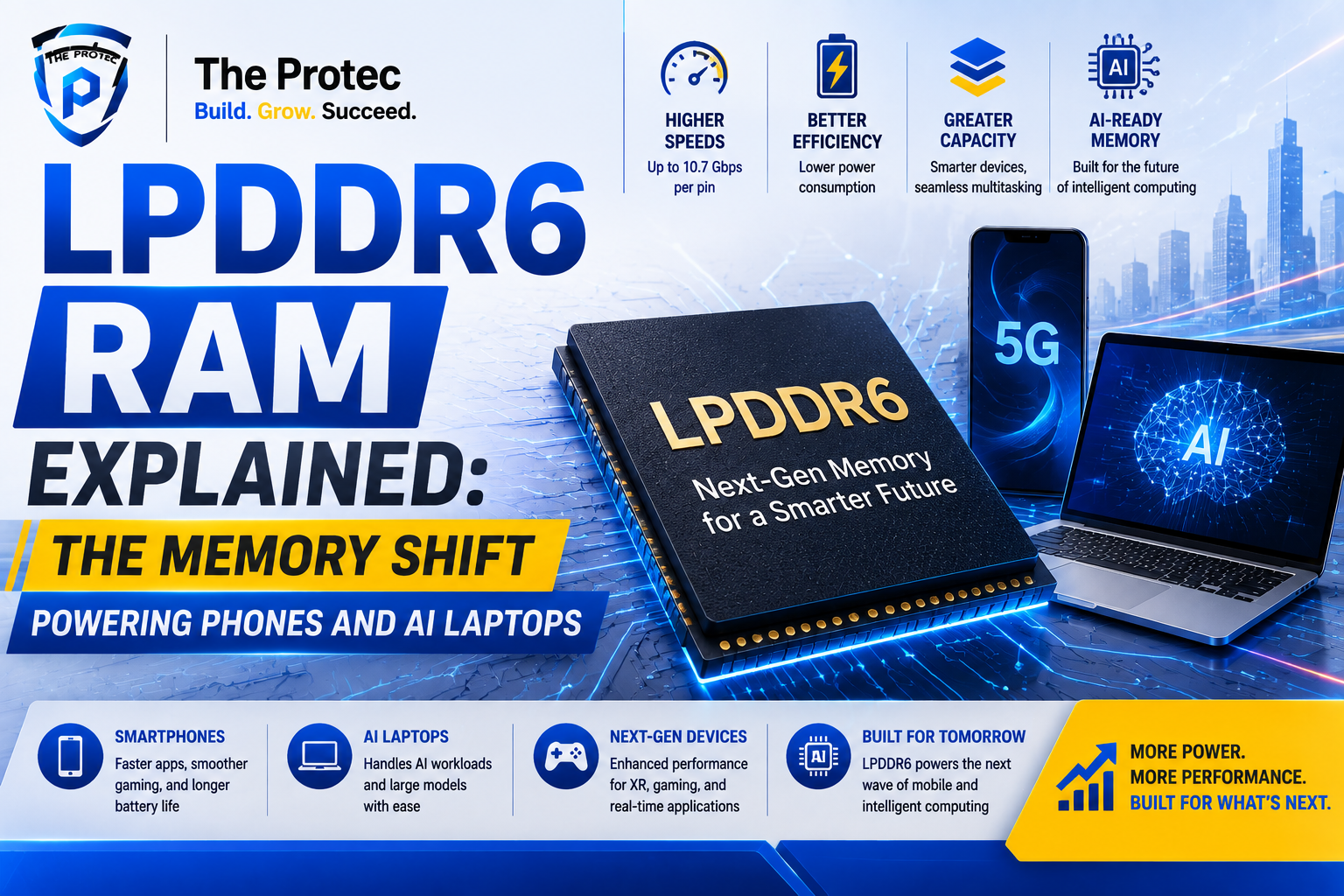
LPDDR6 RAM is shaping up to be one of the most important hardware upgrades for the next wave of smartphones and thin-and-light laptops. While processors and neural engines often get the spotlight, memory is what keeps those chips fed with data. When memory bandwidth is too limited, even a powerful CPU or AI accelerator can stall. That is why LPDDR6 matters: it is expected to deliver higher throughput, better power efficiency, and stronger support for on-device AI workloads than today’s mainstream mobile memory.
As phones and laptops take on more demanding tasks such as generative AI assistants, real-time translation, advanced image processing, and multi-app multitasking, the need for faster and more efficient memory becomes harder to ignore. LPDDR6 vs LPDDR5X is not just a specification debate. It is a look at how mobile devices will balance performance and battery life as AI features move from cloud dependence to local execution.
This article breaks down what LPDDR6 RAM is, how it is expected to improve over current standards, why it matters for future laptop memory, and when users may start seeing it in premium devices.
What Is LPDDR6 RAM?
LPDDR stands for Low Power Double Data Rate, a family of memory standards designed for mobile devices where energy efficiency matters as much as speed. Unlike desktop DDR memory, LPDDR is optimized for lower power draw, compact package design, and sustained performance in smartphones, tablets, ultrabooks, foldables, and embedded AI hardware.
LPDDR6 RAM is the next-generation step after LPDDR5X, and it is expected to build on the strengths of mobile memory while addressing the growing demands of AI-heavy devices. Although final implementation details can vary by manufacturer, the broad goal is clear: more bandwidth, less wasted power, and better responsiveness under pressure.
For everyday users, that could mean smoother app switching, faster camera processing, improved gaming performance, and more capable on-device AI features without draining the battery as quickly.
LPDDR6 vs LPDDR5X: What Could Actually Change?
The most useful way to understand LPDDR6 vs LPDDR5X is to focus on three areas: bandwidth, efficiency, and real-world responsiveness. LPDDR5X already pushed mobile memory to impressive speeds and became common in flagship phones and premium laptops. LPDDR6 is expected to move the ceiling higher again.
1. Higher memory bandwidth
Memory bandwidth determines how quickly data can move between the processor and RAM. That matters for everything from launching apps to editing 4K video to running local AI models. LPDDR6 is expected to offer a significant bandwidth increase over LPDDR5X through faster signaling and architectural refinements. In practice, that means devices can feed modern chips faster, reducing bottlenecks when multiple workloads compete for memory access.
2. Better power efficiency
Modern users want more performance, but not at the expense of battery life. LPDDR memory has always been designed with power savings in mind, and LPDDR6 should continue that trend by improving data transfer efficiency and reducing wasted energy during idle or burst workloads. That is especially important in phones, where every milliamp matters, and in AI laptops, where users want all-day productivity.
3. Stronger support for AI workloads
On-device AI is one of the biggest drivers behind the demand for future laptop memory and mobile RAM upgrades. AI models need fast access to weights, prompts, and intermediate data. If memory is slow or too limited, the AI engine becomes less useful. LPDDR6 should help by giving NPUs and GPUs faster access to the data they need, enabling more responsive local AI features.
Why Memory Bandwidth Is Becoming a Bigger Deal
A few years ago, memory speed was mostly discussed by power users and gamers. Today, it is central to how modern devices feel in daily use. Smartphones now capture huge photos, process video in real time, and run background AI features that were once cloud-only. Laptops increasingly depend on integrated graphics, AI accelerators, and shared memory systems that serve the CPU, GPU, and NPU at once.
When all of those components share the same memory pool, bandwidth becomes a critical resource. If the processor is powerful but memory is not fast enough, the system can feel less responsive than expected. That is why LPDDR6 RAM could be such an important upgrade: it is designed for the era of always-on AI and data-heavy mobile computing.
For example, a phone using LPDDR6 may be better able to handle simultaneous tasks such as live transcription, camera enhancement, and messaging without the lag or heat buildup that can occur when memory becomes a bottleneck. Similarly, a laptop with future laptop memory based on LPDDR6 could maintain smoother performance when running productivity apps, browser tabs, local AI chat tools, and background syncing at the same time.
How LPDDR6 Could Improve On-Device AI
On-device AI is quickly becoming one of the most important reasons to care about memory standards. Today’s AI features are no longer limited to cloud servers. Many tasks are moving directly onto phones and laptops for privacy, speed, and offline access. That shift changes the memory requirement dramatically.
AI models need rapid access to large datasets and parameters. Even when the compute engine is strong, slow memory can limit how quickly the model responds. LPDDR6 is expected to help in several ways:
Faster prompt and context handling: Local AI assistants need quick access to conversation history and model data.
Better multitasking: AI features can run alongside normal apps without starving the system of memory bandwidth.
Lower energy cost per task: More efficient transfers mean less power wasted during repeated AI operations.
Improved thermal behavior: Efficient memory can reduce the pressure on cooling systems in slim devices.
This matters not only for chat-style assistants, but also for real-time translation, photo cleanup, document summarization, voice enhancement, and smart search. In many cases, the difference between a feature that feels instant and one that feels sluggish is memory performance, not raw compute alone.
LPDDR6 RAM in Phones: What Users Can Expect
Smartphones will likely be one of the first major consumer categories to benefit from LPDDR6 RAM. Flagship phones already use advanced memory to support high-refresh displays, large camera sensors, and generative AI features. LPDDR6 could take those experiences further.
Here is what may improve in future smartphones:
Faster app loading and switching: More bandwidth can reduce delays when moving between heavy apps.
Smarter camera pipelines: Computational photography, HDR, and low-light processing can benefit from quicker memory access.
More responsive AI assistants: Local voice features and context-aware tools may feel more immediate.
Better gaming consistency: Mobile games with complex assets and high frame rates may see fewer memory-related slowdowns.
Improved battery efficiency: If the memory subsystem is more efficient, the phone may conserve power during demanding use.
It is important to be realistic, though. LPDDR6 alone will not transform a midrange phone into a flagship. Performance still depends on the SoC, storage, display, thermal design, and software optimization. But as a core component, LPDDR6 could help premium phones become faster and more capable without giving up battery life.
Future Laptop Memory: Why LPDDR6 Could Reshape Thin-and-Light PCs
The phrase future laptop memory is increasingly tied to LPDDR rather than traditional replaceable SO-DIMM modules. That shift is driven by the need for thinner designs, better efficiency, and tighter integration with modern chips. LPDDR6 fits this direction well, especially in AI laptops and premium ultrabooks.
In a laptop, LPDDR6 could enable:
Smoother AI workflows: Local copilots, summarization tools, and creative assistants can operate with less memory contention.
Longer battery life: Power-efficient memory helps extend unplugged usage during office work and content consumption.
Better integrated graphics performance: Shared memory systems often depend heavily on bandwidth.
More compact designs: Soldered LPDDR memory can support thinner and lighter chassis.
For many users, this will matter more than raw benchmark numbers. A laptop that stays cool, lasts longer, and handles AI features smoothly is more valuable than one with a slightly faster peak score but weaker efficiency.
There is also a broader industry trend here: as AI processing moves closer to the user, memory becomes part of the AI experience itself. A laptop with LPDDR6 may be able to handle more local inference and less cloud dependence, which can improve privacy and reduce latency.
What About Gaming, Multitasking, and Creative Work?
Although LPDDR6 is designed with mobility and efficiency in mind, it can still influence broader performance categories. Gamers on phones and thin laptops increasingly expect console-like visuals, high frame rates, and fewer pauses when loading assets. Creative users want seamless editing of photos, short-form video, and design files without stutter.
LPDDR6 may help by keeping data flowing more consistently to the processor and graphics engine. That does not replace a dedicated GPU in a high-end workstation, but it can noticeably improve the experience in portable devices that rely on integrated graphics or mobile-class accelerators.
For multitaskers, the benefits can be even more obvious. Large browser sessions, video calls, AI tools, and productivity apps all compete for memory. A faster and more efficient memory subsystem can reduce slowdowns when switching between them.
When Will LPDDR6 RAM Reach Consumer Devices?
Adoption of new memory standards usually starts at the high end of the market. That means the first LPDDR6 devices are likely to appear in flagship smartphones, premium AI laptops, and possibly specialized mobile workstations or compact tablets before trickling into broader product lines.
The exact rollout depends on several factors: final JEDEC standardization, controller support from chip designers, manufacturing readiness, and OEM design cycles. In practice, memory transitions often begin in enthusiast and premium segments before becoming more common across mainstream devices.
For buyers, the key point is this: LPDDR6 will not replace LPDDR5X everywhere overnight. But once top-tier phones and AI laptops begin shipping with it, competitors will quickly follow. That has been the pattern with several previous mobile memory generations.
If you want to track the broader memory ecosystem, the JEDEC standards organization is the best primary source for official memory specifications: JEDEC. For mobile chip trends and integration examples, semiconductor vendors such as Samsung Semiconductor also provide helpful technical overviews.
LPDDR6 vs LPDDR5X: Which One Should Matter to Buyers?
For most consumers, the answer is simple: if you are buying a device today, LPDDR5X remains excellent and will continue to power many top products. But if you are evaluating the next generation of premium phones or AI laptops, LPDDR6 is worth watching closely.
The practical decision comes down to your needs:
Choose LPDDR5X devices now if you need a phone or laptop immediately and want strong performance today.
Wait for LPDDR6 devices if you prioritize AI-heavy workflows, longer battery life under load, and the latest mobile performance platform.
Focus on the full system because memory is only one part of the user experience.
In other words, LPDDR6 RAM is not just about bigger numbers on a spec sheet. It is about enabling the next step in mobile computing, where local AI, advanced imaging, and always-on multitasking become normal expectations rather than premium extras.
What LPDDR6 Means for the Future of Mobile Computing
LPDDR6 represents a broader shift in how devices are built. Phones and laptops are no longer just general-purpose computers with better screens and batteries. They are becoming AI-native systems that need memory capable of supporting constant data movement, local inference, and efficient multitasking.
That is why this memory standard matters. Higher bandwidth can unlock smoother performance. Better efficiency can preserve battery life. Stronger support for on-device AI can make devices more private, faster, and more useful offline. And for future laptop memory, LPDDR6 could help define the next generation of ultra-portable AI PCs.
As manufacturers race to add smarter features without increasing thickness or power draw, memory will be one of the quiet but decisive battlegrounds. LPDDR6 may not be the most visible spec in a product launch, but it could be one of the most influential.
FAQ: LPDDR6 RAM
What is LPDDR6 RAM?
LPDDR6 RAM is the next generation of low-power mobile memory expected to improve bandwidth, efficiency, and support for AI-focused smartphones and laptops.
How is LPDDR6 vs LPDDR5X different?
LPDDR6 vs LPDDR5X mainly comes down to higher expected bandwidth, better power efficiency, and improved handling of demanding workloads such as on-device AI and multitasking.
Will LPDDR6 improve battery life?
It should, especially in devices that are designed to take advantage of its efficiency improvements. Better memory efficiency can reduce power use during heavy and repeated data transfers.
Is LPDDR6 important for AI laptops?
Yes. AI laptops rely on fast memory to support local AI features, integrated graphics, and multitasking. LPDDR6 could be a major upgrade for future laptop memory designs.
When will phones with LPDDR6 RAM be available?
Premium devices are likely to adopt LPDDR6 first, with broader availability depending on chipset support, manufacturing readiness, and OEM launch cycles.