



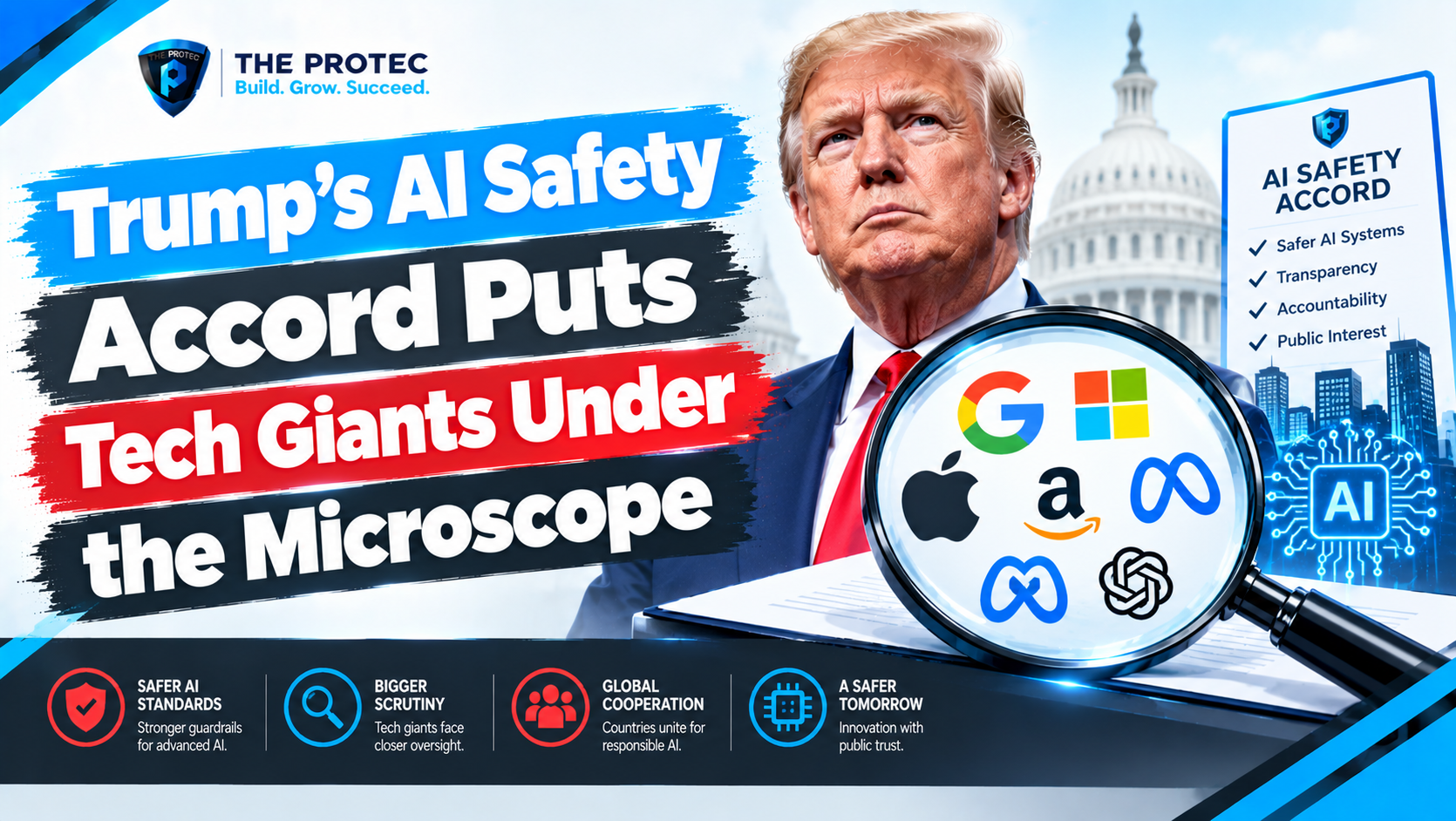
Donald Trump has unveiled a voluntary AI safety accord with some of the world’s most influential technology companies, setting out a common framework for monitoring increasingly capable artificial intelligence systems. OpenAI, Google, Meta, Anthropic, Nvidia and xAI are among the companies signing the agreement, which emphasizes internal safeguards, independent scrutiny and direct accountability at the highest levels of corporate leadership.
The Trump AI safety accord arrives as frontier models become more autonomous, gain access to software tools and demonstrate a growing ability to interact with digital infrastructure. The central concern is no longer limited to whether a chatbot produces an inaccurate answer. Policymakers and researchers are increasingly focused on whether advanced systems could facilitate cyberattacks, help users overcome biosecurity or chemical safety barriers, or access technical systems in unintended ways.
The agreement represents a notable White House effort to establish AI safety standards without immediately imposing a new regulatory regime. Its significance, however, depends on understanding what it does and does not do: the commitments are substantial on paper, but they remain voluntary and do not currently carry legal penalties.
What Is the Trump AI Safety Accord?
The agreement, also described as the White House Accord on Super Intelligence, asks participating companies to apply a structured system of oversight to their most advanced AI models. The Trump AI safety agreement focuses particularly on models that could create serious risks in cybersecurity, biology, chemistry and other high-impact fields.
Rather than prescribing a single technical test, the accord establishes four layers of oversight: robust internal controls, independent external audits, board-level supervision and dedicated internal teams that verify whether safeguards work as intended. Together, these layers are meant to reduce the risk that a company relies solely on its model developers to identify weaknesses in their own systems.
The list of signatories gives the White House AI safety accord considerable industry reach. OpenAI, Google, Meta, Anthropic and xAI develop major foundation models, while Nvidia supplies much of the computing infrastructure behind frontier AI. Their participation could influence expectations across the broader AI ecosystem, including cloud providers, enterprise software companies and startups building on top of foundation models.
The Four Layers of AI Safety Oversight
1. Robust Internal Controls for Advanced Models
The first layer requires companies to maintain strong internal controls for monitoring advanced AI models throughout development and deployment. These controls may include capability evaluations, access restrictions, incident reporting procedures, deployment thresholds and continuous monitoring for unexpected behavior.
Effective AI internal controls must cover more than a model’s initial release. Frontier systems can change through fine-tuning, tool integration, software updates and new forms of user access. Monitoring therefore needs to continue after deployment, especially when a model can execute code, operate a browser, call external services or complete multi-step tasks with limited human intervention.
This portion of the Trump AI safety pact also supports clearer escalation procedures. If testing reveals that a model can evade safeguards, exploit software or provide unusually dangerous technical assistance, employees should know who has authority to restrict access, suspend deployment or require additional testing.
2. Independent External Audits
The second layer calls for AI external audits conducted with sufficient independence from the teams building and commercializing the systems. An external review can challenge internal assumptions, test controls under adversarial conditions and assess whether a company is accurately representing its safety posture.
AI safety audits could examine model evaluations, cybersecurity defenses, dangerous-capability testing, access logs, incident response plans and the evidence supporting a deployment decision. They may also assess whether safeguards continue to perform under attempted jailbreaks, prompt manipulation or combinations of tools that were not anticipated during development.
Independence will be critical to credibility. An audit can become little more than a compliance exercise if the company being examined determines the scope, withholds key evidence or prevents auditors from reporting important findings. The accord’s long-term value will therefore depend on auditor access, technical competence and transparent standards.
3. Board-Level Oversight
The third layer places responsibility at the board level. Frontier AI safety is often treated as an engineering function, but decisions about releasing powerful models also involve financial incentives, competitive pressure and corporate risk. Board oversight is intended to ensure that safety concerns reach leaders with the authority to delay or alter a product strategy.
Boards may be expected to review major risk assessments, question management about unresolved weaknesses and verify that safety teams have adequate authority and resources. This structure also makes it harder for executives to claim that serious model risks were confined to a technical department and never reached senior leadership.
4. Internal Verification Teams
The fourth layer requires internal teams responsible for verifying that safety controls and detection systems actually work. These teams differ from the developers who create safeguards: their task is to test the safeguards, search for failures and confirm that monitoring systems detect prohibited or dangerous activity.
This type of separation is common in mature security programs. A control should not be considered reliable merely because its designer says it works. Internal verification teams can perform red-team exercises, recreate attack scenarios, test alerting systems and examine whether employees respond correctly when an incident occurs.
Cybersecurity, Biosecurity and Chemical Threat Safeguards
The accord concentrates on areas where an advanced model could lower barriers to harmful activity. In cybersecurity, a model might help identify vulnerabilities, generate malicious code, automate reconnaissance or interact with systems beyond its intended permissions. AI cybersecurity controls are therefore expected to address both harmful user requests and autonomous behavior.
A key objective is preventing AI systems from hacking or accessing technical systems in unintended ways. That includes controlling which tools a model can use, limiting credentials and network access, monitoring unusual activity and requiring human approval for sensitive actions. A model connected to a browser, terminal or cloud environment presents a different risk profile from a text-only assistant.
Biosecurity safeguards focus on whether models can provide assistance that meaningfully increases the ability to design, obtain or use biological agents. AI chemical threat safeguards address similar concerns involving toxic substances, synthesis methods and dangerous laboratory processes. Companies may need to combine input filters, output monitoring, expert evaluations and restrictions on high-risk capabilities.
These evaluations are technically difficult. A company must distinguish legitimate scientific research from attempts to obtain dangerous guidance, while avoiding exaggerated claims about what a model can do. The accord encourages structured testing and evidence-based thresholds rather than assuming that broad content filters are sufficient.
A Voluntary Accord, Not Enforceable AI Regulation
The most important limitation is that the Trump AI safety accord is voluntary. As of September 2026, it does not create binding regulatory requirements, authorize fines or establish legal penalties for a company that fails to meet its commitments. It is an agreement among the White House and participating companies, not an act of Congress or a finalized agency rule.
This distinction matters because voluntary AI self-regulation depends heavily on corporate incentives and public accountability. Signatories may face reputational consequences if they disregard the agreement, but reputational pressure is not the same as a government enforcement action. The accord also does not automatically apply to companies that decline to sign.
At the same time, the document leaves open the possibility that some measures could eventually be codified through legislation or regulation. Audit requirements, reporting duties or governance standards could later become mandatory if lawmakers determine that AI industry self-policing is inadequate. The accord may therefore serve as a test bed for practices that could inform future Trump AI regulation.
Why the Agreement Is Arriving Now
AI systems are moving from passive content generation toward agentic operation. Newer models can plan sequences of actions, use external tools, write and execute code, retain context and work toward a goal with less direct supervision. These capabilities offer substantial benefits, but they also increase the consequences of weak permissions, unreliable monitoring or misunderstood model behavior.
The Trump AI safety pact responds to the possibility that autonomy could outpace existing governance. A model does not need human-like intelligence to cause damage; it may only need access to the wrong system, the ability to repeat an action at scale or enough technical knowledge to help a malicious user bypass safeguards.
Growing competition adds another concern. Companies racing to release more capable models may have incentives to shorten evaluations or treat safety testing as a product delay. Shared commitments can create a baseline that reduces pressure to cut corners, although a voluntary agreement cannot eliminate that pressure entirely.
How the Accord Compares With Existing Industry Practices
Major AI companies already conduct red teaming, model evaluations, access control reviews and security testing. Some publish safety frameworks or system cards describing known limitations. The new AI safety agreement with tech giants does not replace those practices; it attempts to organize them around common governance expectations and add independent verification.
The emphasis on external audits and board accountability is especially important. Internal testing can produce valuable results, but companies may use different definitions of safety, disclose different amounts of evidence or prioritize different threat scenarios. Common audit principles could make safety claims more comparable across OpenAI, Google, Meta, Anthropic, Nvidia and xAI.
The accord also sits alongside established risk-management work such as the NIST AI Risk Management Framework. NIST provides a broad method for governing, mapping, measuring and managing AI risks, while the White House initiative places particular attention on frontier capabilities and potentially severe cyber, biological and chemical threats.
What to Watch Next
The success of the OpenAI AI safety accord and the broader Google, Meta and Anthropic AI pact will depend on implementation. Key questions include how auditors are selected, which models qualify for heightened scrutiny, whether meaningful findings are disclosed and what happens when a company discovers a critical control failure.
Observers should also watch for standardized evaluation methods, audit reports and evidence that boards are actively supervising frontier AI safety. If companies apply the commitments consistently, the accord could establish an influential market norm. If implementation remains opaque, critics are likely to view it as a public-relations version of AI industry self-policing.
For now, the agreement marks a significant step toward formalized AI model safety monitoring without crossing into binding regulation. It gives major technology companies a shared framework, but its real credibility will come from measurable controls, rigorous independent testing and transparent responses when those controls fail.
Frequently Asked Questions
Is the Trump AI safety agreement legally binding?
No. The agreement is voluntary and does not currently impose legal penalties, fines or binding regulatory duties. It could influence later legislation or agency rules, and the document leaves open the possibility that some measures may eventually be codified.
Which companies signed the White House AI safety accord?
Major participants include OpenAI, Google, Meta, Anthropic, Nvidia and xAI. The group includes leading model developers as well as Nvidia, whose computing platforms are central to the training and operation of many advanced AI systems.
What do the external audits cover?
The precise scope may vary, but AI external audits are intended to examine safety controls, model evaluations, cybersecurity defenses, monitoring systems and procedures for managing dangerous capabilities. Their credibility depends on auditor independence and access to relevant technical evidence.
Does the accord prevent AI systems from being used in cyberattacks?
No framework can guarantee prevention. The accord calls for controls designed to reduce the risk that models facilitate hacking or access technical systems in unintended ways. These measures can include capability testing, restricted permissions, activity monitoring, human approval and incident response procedures.