







Contents
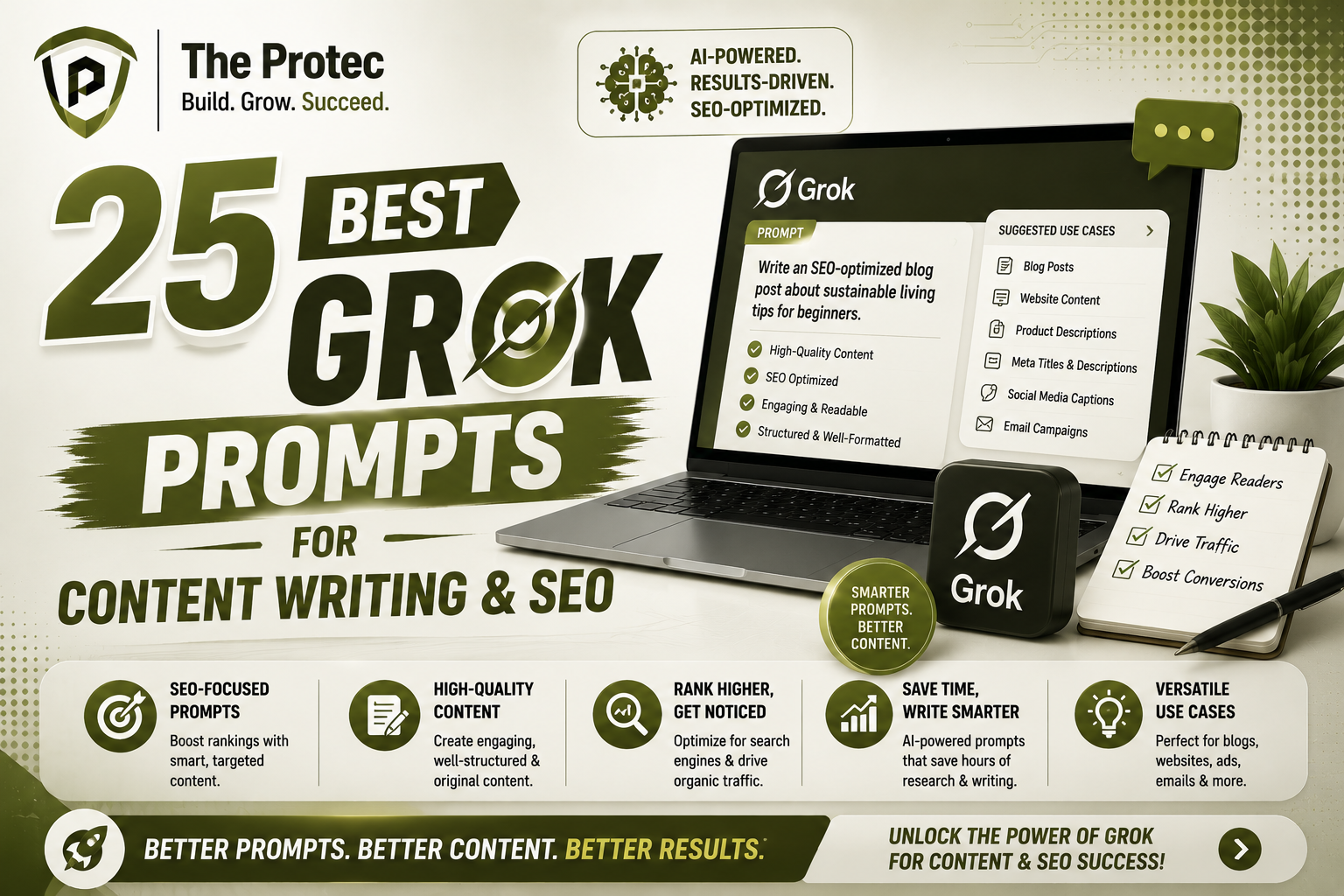
- 1 25 Best Grok Prompts for Content Writing and SEO
- 2 Why Grok Prompts Matter for Content and SEO
- 3 How to Get Better Results from Grok
- 4 25 Best Grok Prompts for Content Writing and SEO
- 4.1 1. Blog Topic Brainstorm Prompt
- 4.2 2. Keyword-to-Topic Mapping Prompt
- 4.3 3. Search Intent Analysis Prompt
- 4.4 4. SEO Content Brief Prompt
- 4.5 5. Blog Outline Prompt
- 4.6 6. Hook and Introduction Prompt
- 4.7 7. SEO Title Generator Prompt
- 4.8 8. Meta Description Prompt
- 4.9 9. FAQ Generator Prompt
- 4.10 10. Entity and Subtopic Expansion Prompt
- 4.11 11. Competitive Content Gap Prompt
- 4.12 12. Content Refresh Prompt
- 4.13 13. Rewrite for Clarity Prompt
- 4.14 14. Tone Adaptation Prompt
- 4.15 15. Listicle Expansion Prompt
- 4.16 16. Comparison Article Prompt
- 4.17 17. Buyer-Focused SEO Prompt
- 4.18 18. Internal Linking Opportunity Prompt
- 4.19 19. FAQ Schema Drafting Prompt
- 4.20 20. Content Repurposing Prompt
- 4.21 21. Content Angle Generator Prompt
- 4.22 22. Statistics and Evidence Prompt
- 4.23 23. FAQ Answer Expansion Prompt
- 4.24 24. Editing and Quality Control Prompt
- 4.25 25. Content Strategy Prompt
- 5 Best Practices for Using Grok Prompts for SEO
- 6 How to Customize These AI Content Prompts
- 7 Final Thoughts
- 8 FAQ
25 Best Grok Prompts for Content Writing and SEO
AI has changed how content is planned, written, optimized, and refreshed. But the real advantage does not come from using AI alone. It comes from using the right prompts. For bloggers, marketers, and SEO professionals, the best Grok prompts can speed up research, improve content quality, and help produce pages that are both useful for readers and competitive in search.
Grok has become especially useful for content teams because it can respond quickly, handle conversational instructions, and adapt to different content goals. Whether you need a blog outline, a keyword cluster, a meta description, or a content refresh plan, strong prompts make the difference between generic output and publish-ready material. In this guide, you will find 25 practical Grok prompts for SEO and content writing that you can use right away.
These prompts are written for real workflows: ideation, keyword mapping, content briefs, optimization, repurposing, and editing. They are designed to support modern SEO practices, including search intent alignment, topical depth, helpful content, entity coverage, and user-first formatting. If you want better results from AI content prompts, start here.
Why Grok Prompts Matter for Content and SEO
Good content is no longer just about writing well. It is about writing with strategy. Search engines now reward pages that show clarity, depth, relevance, and usefulness. That means your content workflow needs more than speed; it needs precision. Grok prompts for SEO help you guide the model toward exactly the output you want, instead of forcing you to edit heavily afterward.
The best Grok prompts do three things well:
- They define the audience and content objective clearly.
- They provide enough context for relevant, accurate output.
- They ask for a structured deliverable that saves editing time.
When you use AI content prompts strategically, you can move faster on research, improve consistency across your content, and create assets that match user intent more closely. That is especially valuable in 2026, when content competition is intense and search results are increasingly shaped by topical authority, useful formatting, and clear expertise.
How to Get Better Results from Grok
Before the prompt list, it helps to know what makes a prompt effective. The most useful prompts include the topic, audience, tone, desired format, length, and SEO objective. The more specific your instruction, the more useful the response.
For example, instead of asking Grok to “write a blog post about SEO,” ask it to “create a detailed blog outline for beginner ecommerce brands explaining technical SEO fixes that improve crawlability and conversion.” The second version gives the model direction and purpose.
When possible, add:
- Target keyword
- Search intent
- Audience level
- Content type
- Desired structure
- Brand voice or tone
These details help Grok produce more usable drafts, better headlines, and stronger SEO recommendations.
25 Best Grok Prompts for Content Writing and SEO
1. Blog Topic Brainstorm Prompt
Prompt: Generate 20 blog post ideas for a [niche] website targeting [audience]. Focus on high-intent topics, common pain points, and informational search queries. Group the ideas by beginner, intermediate, and advanced difficulty.
This is one of the best Grok prompts for early-stage ideation. It helps you uncover topic clusters that support topical authority and content planning.
2. Keyword-to-Topic Mapping Prompt
Prompt: Take this keyword list: [paste keywords]. Group them into primary topics, supporting subtopics, and related article ideas. Recommend the best content format for each keyword based on likely search intent.
This prompt is ideal for building content silos. It turns raw keyword lists into a more strategic SEO plan.
3. Search Intent Analysis Prompt
Prompt: Analyze the search intent behind this keyword: [keyword]. Explain whether the intent is informational, commercial, transactional, or navigational. Then suggest the best content angle and page structure to match it.
Understanding search intent is essential for ranking. This prompt helps you align your content with what users actually want.
4. SEO Content Brief Prompt
Prompt: Create a complete SEO content brief for the keyword [keyword]. Include target audience, search intent, article goal, suggested H2s and H3s, related terms, FAQs, internal section ideas, and a recommended word count.
Use this when you want a clear roadmap before writing. It is one of the most practical AI content prompts for teams and freelancers.
5. Blog Outline Prompt
Prompt: Write a detailed blog outline for the topic [topic]. Make it engaging, logically ordered, SEO-friendly, and designed to answer the reader’s primary question as quickly as possible.
This prompt is useful when you already know the topic but need a strong structure. A good outline often improves the final article more than any other editing step.
6. Hook and Introduction Prompt
Prompt: Write 5 compelling introductions for an article about [topic]. Each introduction should hook the reader quickly, establish relevance, and lead naturally into the main article.
Strong introductions improve engagement and reduce bounce. This prompt helps you test different opening styles before choosing one.
7. SEO Title Generator Prompt
Prompt: Generate 15 SEO-friendly headlines for [topic]. Make them clickable, clear, and optimized for search. Include a mix of list-style, how-to, question-based, and benefit-led options.
Titles matter for both CTR and clarity. This prompt helps you create options that are both appealing and keyword-aware.
8. Meta Description Prompt
Prompt: Write 10 meta descriptions for [topic] using the keyword [keyword]. Keep each one under 160 characters, persuasive, and aligned with the page intent.
Meta descriptions do not directly boost rankings, but they can improve click-through rates. This prompt makes the drafting process faster and more consistent.
9. FAQ Generator Prompt
Prompt: Generate 10 frequently asked questions related to [topic]. Focus on questions real users would ask before, during, or after reading the article. Include concise answer angles for each one.
FAQ sections are useful for depth, clarity, and long-tail visibility. They also help content feel more complete.
10. Entity and Subtopic Expansion Prompt
Prompt: For the topic [topic], list the most important related entities, subtopics, tools, concepts, and examples that should be included in a high-quality article. Explain why each one matters.
This is one of the best Grok prompts for SEO when you want to improve topical coverage and semantic depth.
11. Competitive Content Gap Prompt
Prompt: Compare the likely content coverage for [topic] against top-ranking pages in this niche. Identify missing angles, weak sections, and opportunities to create a more useful article.
This prompt is excellent for refining a draft before publishing. It helps you think like an editor and search strategist at the same time.
12. Content Refresh Prompt
Prompt: Review this article text: [paste content]. Identify outdated claims, weak sections, missing subtopics, and opportunities to improve SEO, clarity, and usefulness. Then suggest a refresh plan.
Refreshing older posts is one of the fastest ways to protect and improve traffic. This prompt makes updates more systematic.
13. Rewrite for Clarity Prompt
Prompt: Rewrite this paragraph to make it clearer, more concise, and more engaging while keeping the original meaning. Improve readability for a general audience.
Use this when a draft is technically correct but not easy to read. Clarity often leads to better engagement and stronger content performance.
14. Tone Adaptation Prompt
Prompt: Rewrite this content in a [tone: expert, friendly, authoritative, conversational, bold] style for a [audience] audience while keeping it accurate and natural.
Different brands need different voices. This prompt helps you match tone without losing SEO value or message accuracy.
15. Listicle Expansion Prompt
Prompt: Expand this list of [number] items about [topic]. For each item, provide a clear explanation, practical use case, and a short implementation tip.
This is useful for article formats that perform well in search because they are scannable and easy to compare.
16. Comparison Article Prompt
Prompt: Create a comparison framework for [option A] vs [option B]. Include use cases, pros and cons, decision criteria, and which choice is better for different audience types.
Comparison content attracts high-intent visitors. It is especially valuable for product-led content and affiliate SEO.
17. Buyer-Focused SEO Prompt
Prompt: Write a content angle for [topic] that targets buyers who are close to making a decision. Focus on pain points, objections, practical benefits, and decision-making factors.
This prompt is ideal for commercial content and lead-generation pages. It helps move beyond generic educational writing.
18. Internal Linking Opportunity Prompt
Prompt: Based on the topic [topic], suggest internal linking opportunities to other related articles on a [website type] site. Explain what anchor text would make sense for each link.
Internal linking supports site structure and helps users discover more relevant content. It also strengthens topical relationships across your site.
19. FAQ Schema Drafting Prompt
Prompt: Turn these FAQs about [topic] into concise, helpful answers that are suitable for FAQ schema. Keep the responses direct, natural, and useful.
Schema-ready content can save time during publishing and support better formatting for search visibility.
20. Content Repurposing Prompt
Prompt: Repurpose this blog post into 5 social posts, 3 email subject lines, 1 LinkedIn post, and 1 short newsletter summary while keeping the core message consistent.
One article can power multiple channels. This prompt helps you stretch your content further without starting from scratch.
21. Content Angle Generator Prompt
Prompt: Give me 10 unique content angles for the topic [topic]. Include beginner-friendly, advanced, contrarian, and data-driven angles.
Sometimes the topic is good, but the angle is what makes it competitive. This prompt helps you stand out in crowded search results.
22. Statistics and Evidence Prompt
Prompt: Suggest the types of statistics, benchmarks, or evidence that would strengthen an article about [topic]. Include the best places to use them in the content.
Evidence makes content more credible. It is especially important when writing about SEO, marketing, or technical subjects.
23. FAQ Answer Expansion Prompt
Prompt: Take this FAQ question: [question]. Write a thorough, helpful answer in 2 to 4 paragraphs with practical advice and a clear conclusion.
This prompt is useful when you want FAQ answers that add depth instead of sounding rushed or repetitive.
24. Editing and Quality Control Prompt
Prompt: Review this article for SEO, readability, duplication, weak transitions, and missing context. Suggest improvements that would make it more helpful, more engaging, and easier to rank.
This is one of the most valuable Grok prompts for content writing because it improves the final draft rather than only generating new text.
25. Content Strategy Prompt
Prompt: Build a 30-day content strategy for a [niche] brand targeting [audience]. Include blog topics, SEO goals, content formats, and priority keywords. Organize it by funnel stage.
This prompt turns Grok into a planning assistant. It is useful for teams that want to connect SEO, editorial planning, and business goals.
Best Practices for Using Grok Prompts for SEO
Prompts work best when you treat them like part of a workflow, not a one-click solution. The strongest content teams use AI to accelerate planning, drafting, and optimization, then apply human judgment for accuracy, originality, and brand fit.
Keep these best practices in mind:
- Always include a clear keyword and audience.
- Ask for a specific format, such as outline, table, list, or brief.
- Request search intent alignment when the content is meant to rank.
- Edit the output for originality, examples, and brand voice.
- Use AI to support expertise, not replace it.
For more guidance on modern search optimization principles, Google’s own SEO Starter Guide is a useful reference: Google Search Central SEO Starter Guide. For broader AI writing workflows and prompt design ideas, OpenAI’s prompting resources are also helpful: OpenAI Prompting Guide.
How to Customize These AI Content Prompts
The prompts above are templates. To get the best results, adapt them to your niche, audience, and business goal. A prompt for a SaaS blog will not look exactly like a prompt for an ecommerce store, a local business, or a media site.
Here is a simple formula you can use:
- Role: Ask Grok to act like an SEO strategist, editor, or content marketer.
- Objective: Tell it whether you need ideas, a brief, a draft, or an optimization pass.
- Audience: Specify who the content is for.
- Output: Request the exact structure you want.
- Quality bar: Ask for practical, specific, and non-generic responses.
When you customize prompts this way, the output becomes easier to trust and far more useful in real publishing workflows.
Final Thoughts
The best Grok prompts are not just shortcuts. They are a way to think more clearly about content goals, SEO structure, and reader intent. If you use Grok well, it can help you move from scattered ideas to organized, search-friendly content that performs better across the funnel.
For bloggers, marketers, and SEO professionals, the real value comes from combining AI speed with human strategy. Use these prompts to brainstorm better topics, build stronger briefs, create more relevant outlines, and improve the quality of every draft. In a crowded search landscape, that edge matters.
Start with a few of the prompts above, refine them for your niche, and build your own prompt library over time. That is how AI content prompts become a lasting advantage instead of a temporary productivity trick.
FAQ
What are the best Grok prompts for SEO?
The best Grok prompts for SEO are the ones that help with keyword mapping, search intent analysis, content briefs, title generation, meta descriptions, and content optimization. Prompts that clearly define audience, goal, and output format usually produce the most useful results.
Can Grok help with content writing?
Yes. Grok can help generate ideas, build outlines, draft intros, improve clarity, expand FAQs, and repurpose content across channels. It works best when you provide detailed instructions and then edit the output for accuracy and voice.
How do I make AI content prompts more effective?
Make them more effective by adding context, specifying the audience, naming the target keyword, and requesting a clear format. The more specific your prompt, the better the response will usually be.
Are Grok prompts useful for blog SEO?
Absolutely. Grok prompts can help you create stronger blog structures, cover related subtopics, and align your content more closely with search intent. They are especially useful for planning and optimization.
Should I publish Grok-generated content without editing?
No. AI-generated content should always be reviewed, fact-checked, and refined by a human editor. The strongest results come from combining AI efficiency with subject-matter judgment and brand-specific editing.