








The New Era of Mobile Gaming Is Here
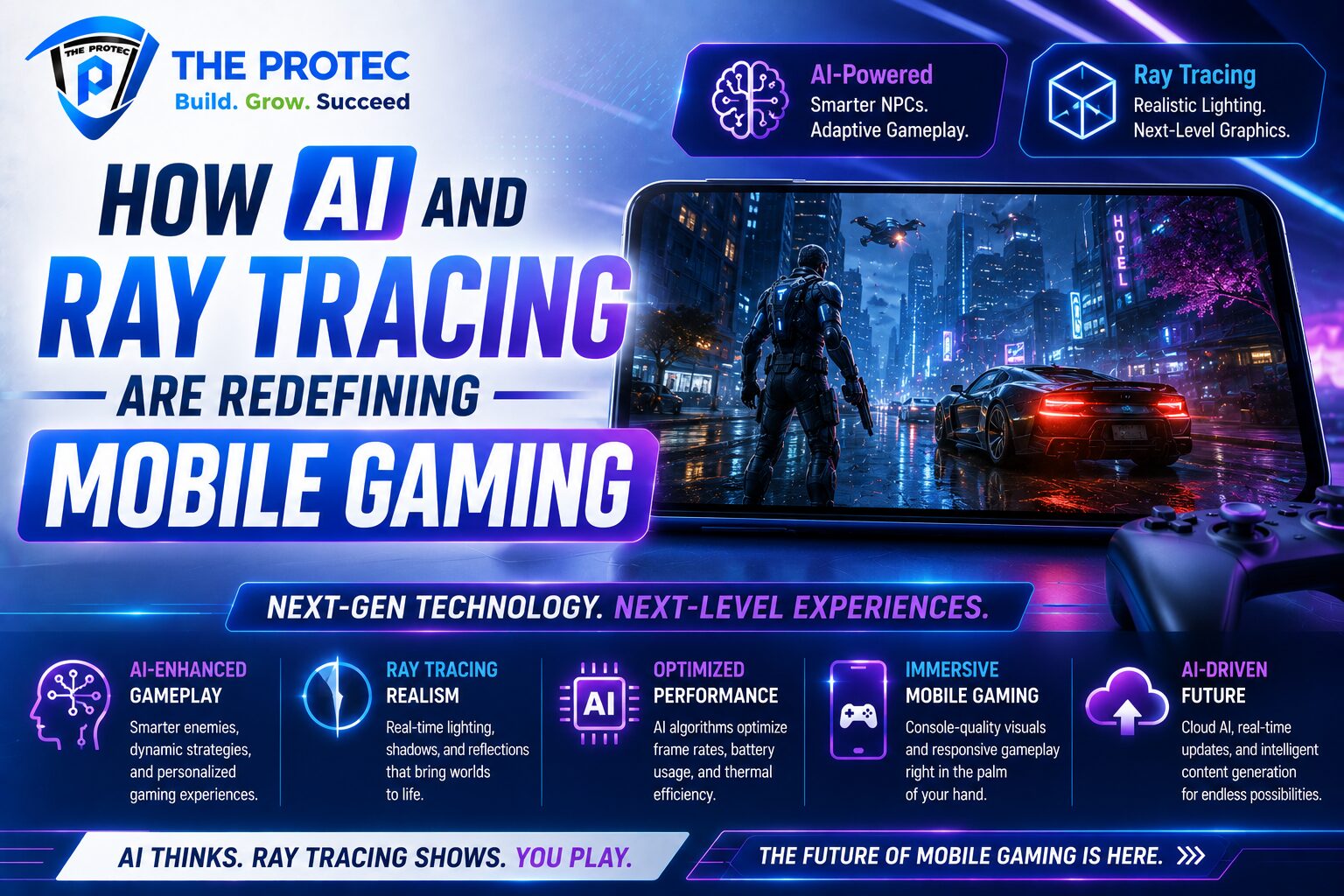
Mobile gaming is no longer defined by simple puzzle games, short session titles, or watered-down versions of console hits. Smartphones now sit at the center of a major shift in gaming hardware, and the latest wave of mobile gaming technology is changing what players expect from a device in their pocket. Two forces are leading this transformation: AI-powered rendering and smartphone ray tracing. Together, they are pushing visuals, performance, and immersion to levels that once seemed reserved for dedicated consoles and gaming PCs.
This shift is especially visible in modern gaming phones, which are now built around advanced chipsets, larger vapor chambers, high-refresh OLED displays, and software systems designed to keep frame rates stable during demanding gameplay. The result is a mobile platform that can handle console-like gaming experiences without sacrificing portability. What used to be a compromise is quickly becoming a premium gaming ecosystem of its own.
At the core of this change is a simple idea: modern smartphones are not just becoming faster, they are becoming smarter. Instead of relying only on raw brute-force graphics power, new mobile processors use AI-assisted upscaling, frame generation, scene prediction, thermal optimization, and efficient power management to create smoother and more visually ambitious gameplay. Add real-time lighting effects through smartphone ray tracing, and the difference becomes immediately apparent.
Why Mobile Gaming Technology Is Advancing So Quickly
Several trends have converged to accelerate mobile gaming technology. First, smartphone chipmakers have dramatically improved GPU performance, making it possible to run more complex graphical workloads on a thin, battery-powered device. Second, mobile display technology has matured, with 120Hz, 144Hz, and even higher refresh rates becoming common on premium devices. Third, game developers are increasingly designing mobile titles with sophisticated engines that can scale across a wide range of hardware.
But perhaps the biggest reason for the current leap is competition. Smartphone brands are no longer treating gaming as a niche feature. Gaming phones, flagship phones, and even upper mid-range devices now compete on performance metrics, cooling systems, and AI capabilities. This pressure has created a race to deliver better graphics, lower latency, and longer sustained performance.
Today’s devices can also take advantage of improved memory bandwidth, faster storage, and more efficient chip architectures. That matters because mobile gaming is not only about peak frame rate. It is about how long a phone can sustain performance before throttling, how quickly a game loads, and how consistently it maintains responsiveness during high-action scenes.
GPU Improvements Are Making Smartphones More Powerful
The biggest driver behind the rise of console-like gaming experiences on smartphones is the GPU. Mobile GPUs have evolved from basic graphics processors into highly capable parallel engines that can handle advanced lighting, physics, post-processing, and high-resolution textures. These improvements are not just theoretical; they are visible in the way modern games look and feel.
Recent flagship chipsets from leading mobile silicon vendors have focused heavily on GPU efficiency and stability. Rather than chasing short bursts of performance only, the newest designs emphasize sustained gaming sessions. That is critical for players who spend 30 minutes or more in graphically intense titles. A powerful GPU is only useful if the phone can keep it cool and feed it data quickly enough to avoid stutter.
As a result, gaming phones now often include large cooling chambers, graphite layers, metal frames, and software tools that optimize the balance between performance and thermals. Some devices even let players choose between performance modes that prioritize frame rate, battery life, or temperature control. This ecosystem shows how mobile gaming technology is evolving beyond raw specs into a more complete performance platform.
What improved mobile GPUs mean for players
- Higher and more stable frame rates in demanding games
- Better visual effects such as shadows, reflections, and particle detail
- Faster rendering of complex environments and characters
- More efficient power use during extended play sessions
- Improved support for high-refresh-rate displays
Smartphone Ray Tracing Brings Console-Like Lighting to Mobile
Smartphone ray tracing is one of the most exciting developments in mobile graphics. In simple terms, ray tracing simulates how light behaves in the real world, producing more realistic reflections, shadows, and global illumination. For years, this level of graphical fidelity was too demanding for phones. That barrier is now breaking down.
Modern mobile chipsets are beginning to support hardware-accelerated ray tracing, and game engines are adapting accordingly. The effect is most obvious in reflective surfaces, wet roads, glass, polished metal, and dynamic shadows that react naturally as the camera moves. These details add depth and realism that make games feel more immersive, especially on OLED displays with strong contrast and vibrant colors.
Of course, ray tracing remains expensive from a performance standpoint, even on smartphones. That is why developers often use it selectively. Instead of applying ray tracing to every asset, they may enable it for specific reflections or lighting effects while relying on conventional rendering elsewhere. This hybrid approach provides a strong visual upgrade without overwhelming the device.
For players, the difference is significant. Smartphone ray tracing helps bridge the gap between mobile and console graphics, creating a visual identity that feels premium rather than scaled down. It is one of the clearest signs that gaming phones are becoming genuine high-end gaming platforms.
AI Rendering Is Transforming Performance and Visual Quality
If ray tracing is the visual headline, AI rendering is the performance engine underneath. Artificial intelligence is being used in mobile gaming technology in several ways, from upscaling lower-resolution images to generating frames and optimizing how the GPU allocates resources. This is where smartphones gain a major advantage: they can intelligently do more with less.
AI upscaling allows games to render at a lower internal resolution and then reconstruct a sharper image for display. This can preserve detail while reducing the workload on the GPU. The benefit is straightforward: smoother gameplay, lower power consumption, and less heat. For mobile devices, that is a major win.
AI frame generation is also becoming increasingly relevant. By predicting motion and creating additional frames between rendered ones, phones can make gameplay feel smoother without requiring the GPU to render every frame from scratch. While this technology is still evolving, it is already influencing how smartphone makers think about performance.
Beyond graphics, AI is improving the overall gaming experience in subtle but important ways. It can identify thermal hotspots, adjust CPU and GPU frequencies in real time, manage background tasks, optimize network conditions for online games, and even learn a player’s habits to improve responsiveness. In other words, AI rendering is not just about better visuals. It is about building a smarter gaming phone.
How AI helps mobile gaming technology
- Upscales graphics for sharper visuals at lower power cost
- Improves frame pacing and smoothness
- Reduces heat by balancing workloads more efficiently
- Enhances battery life during gaming sessions
- Optimizes performance in real time based on game demand
Gaming Phones Are Becoming Specialized Entertainment Devices
The modern gaming phone is no longer a novelty. It is a category built around deliberate engineering choices that prioritize gaming performance while still serving as a daily driver. What separates gaming phones from standard flagships is the combination of hardware, software, and accessories designed specifically for play.
These devices often include shoulder triggers, advanced vibration systems, high-sensitivity touch sampling, and game dashboards that let users fine-tune CPU and GPU behavior. Some even support external cooling fans or dock-style accessories for longer sessions. The design language is also more aggressive, with bold styling and accent lighting that reflects the gaming-first identity.
But the deeper story is that gaming phones are becoming more practical. They are not only for enthusiasts. Because GPU improvements and AI rendering are now part of mainstream smartphone silicon, even non-gaming-branded phones can deliver excellent gaming performance. The distinction is blurring, and that is good news for consumers. More devices now offer premium gaming features without requiring a specialized handset.
Another reason gaming phones matter is their role in pushing the industry forward. The demand for better thermal performance, higher refresh rates, faster touch response, and advanced graphics features helps drive innovation across the entire smartphone market. In many cases, features tested in gaming phones eventually appear in mainstream flagships.
Console-Like Gaming Experiences Are Now Possible on Smartphones
One of the most important changes in mobile gaming is the rise of console-like gaming experiences on smartphones. This is not just a marketing phrase. It is a real shift in what games look like, how they control, and how long they can be played without compromise.
Cloud gaming has played a role in this evolution, but local hardware improvements are just as important. Thanks to stronger GPUs, AI-assisted optimization, and smartphone ray tracing, many modern titles can render rich environments at high refresh rates with surprisingly low input latency. Paired with a Bluetooth controller or integrated touch controls, the experience can feel closer to a portable console than a traditional phone game.
Game developers are also designing mobile titles with more ambition. Open-world adventures, competitive shooters, racing games, and action RPGs are now built with detailed graphics and long play sessions in mind. The line between mobile and console game design is narrowing because the hardware is finally capable of supporting it.
This does not mean smartphones are replacing consoles. Instead, they are creating a new category of play: a truly portable, always-connected gaming platform that combines mobility, power, and convenience. For many players, that flexibility is more valuable than a dedicated handheld.
What This Means for Game Developers
For developers, the rise of AI rendering and smartphone ray tracing opens up new creative possibilities. It allows teams to target premium mobile hardware with richer lighting, more detailed assets, and more ambitious visual effects. At the same time, it forces developers to think carefully about scalability, battery use, and thermal constraints.
Smart development now means building engines that can dynamically adjust to device capabilities. A game might use ray tracing on high-end phones, AI upscaling on midrange models, and traditional rendering on older devices. This kind of adaptability is essential in a fragmented mobile market.
It also means developers need to pay attention to frame pacing and optimization more than ever. A game that looks beautiful but stutters will not satisfy mobile players. The best mobile titles are those that combine advanced graphics with responsive controls and consistent performance.
The benefit for players is a richer library of mobile games that can exploit modern hardware without alienating users on less powerful devices. This balance is likely to shape the next generation of mobile gaming technology.
The Future of Mobile Gaming Technology
The future of mobile gaming will likely be defined by deeper integration between AI and graphics hardware. We can expect more sophisticated upscaling, smarter frame generation, better thermal prediction, and increasingly realistic lighting effects. As mobile GPUs continue to improve, smartphone ray tracing may become more common and more efficient, especially as game engines are optimized for it.
We are also likely to see more cross-platform game design. Many major titles already share technology across PC, console, and mobile, and that trend will continue. As a result, players will enjoy more unified experiences across devices, with progress, graphics settings, and social features all tied together.
Battery technology and thermal design will remain important limits, but even there, progress is steady. More efficient chip manufacturing, smarter software, and better cooling systems are helping smartphones sustain heavy workloads longer than ever before. That means future gaming phones will not just be faster at launch; they will be better at staying fast.
Perhaps the most important long-term change is that players will increasingly expect premium gaming quality from everyday smartphones. That expectation will force manufacturers to keep improving, which in turn will accelerate the pace of innovation across the entire industry.
Conclusion
The new era of mobile gaming is being shaped by a powerful combination of GPU improvements, AI rendering, and smartphone ray tracing. Together, these technologies are turning gaming phones and mainstream flagships into serious gaming machines capable of delivering console-like gaming experiences on the go. What was once a modest entertainment category is now one of the most innovative parts of the smartphone market.
As mobile gaming technology continues to mature, the gap between mobile and dedicated gaming hardware will keep narrowing. Players can expect smoother performance, better visuals, smarter optimization, and more ambitious games built specifically for advanced smartphones. The future of gaming is increasingly mobile, and it is arriving faster than many expected.
FAQ
What is smartphone ray tracing?
Smartphone ray tracing is a graphics technique that simulates realistic light behavior to create more natural reflections, shadows, and lighting effects in mobile games. On capable devices, it can significantly improve visual quality.
How does AI improve mobile gaming technology?
AI improves mobile gaming technology by upscaling graphics, generating frames, optimizing power use, managing heat, and adjusting performance in real time. This helps smartphones deliver smoother gameplay with less strain on the hardware.
Are gaming phones still worth it if regular smartphones are powerful now?
Yes, gaming phones can still be worth it if you play demanding games frequently. They often include better cooling, higher sustained performance, gaming-specific controls, and software features that make long sessions more comfortable and stable.
Can smartphones really deliver console-like gaming experiences?
In many cases, yes. While they do not fully replace consoles, modern smartphones can now offer high frame rates, advanced graphics effects, responsive controls, and rich visual detail that feel much closer to console gaming than older mobile titles did.
Will ray tracing drain smartphone batteries faster?
Generally, yes. Ray tracing is demanding, so it can increase power use and heat. That is why many mobile games use it selectively, and why AI optimization and good cooling are so important on gaming phones.
External Resources
Learn more about ray tracing from NVIDIA: NVIDIA Ray Tracing Technology
Explore Android graphics and game performance guidance: Android Games Developer Resources