









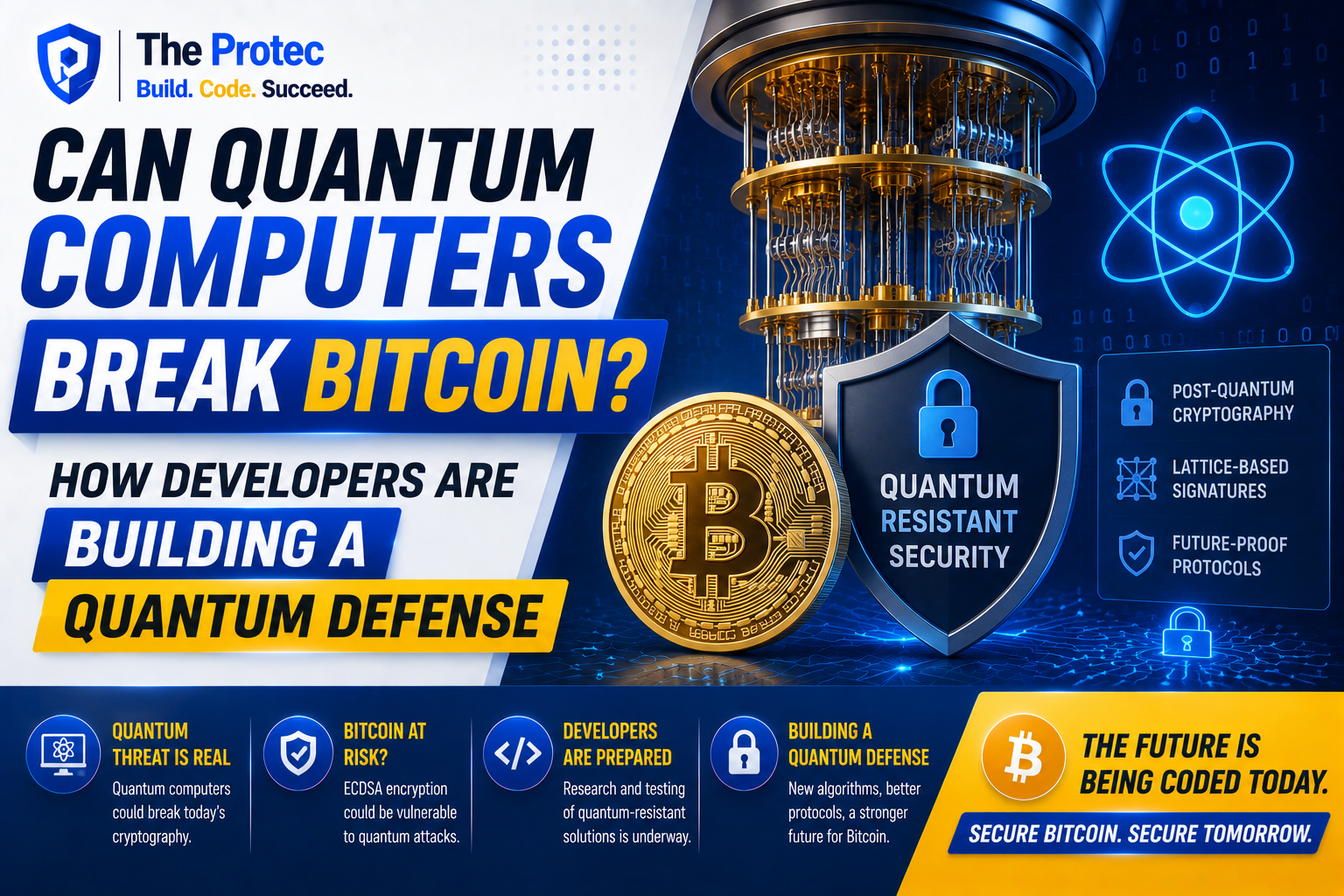
Bitcoin has survived exchange failures, mining bans, software bugs, market crashes, and repeated claims that its technology is obsolete. Quantum computing presents a different kind of question. A sufficiently powerful quantum computer would not merely process transactions faster. It could attack the mathematical assumptions behind the digital signatures that prove who owns bitcoin.
That possibility deserves serious research, but not panic. Today’s quantum machines cannot break Bitcoin cryptography, and useful quantum error correction remains extraordinarily difficult. The responsible question is whether Bitcoin quantum security can be upgraded before capable machines arrive. Developers, cryptographers, wallet providers, and standards bodies are already studying the tools, migration paths, and protocol trade-offs involved.
How Bitcoin Cryptography Protects Ownership
Bitcoin security relies on several cryptographic components rather than one universal lock. SHA-256 is used in proof-of-work mining and transaction identifiers. Many addresses also use cryptographic hashes to conceal a public key until funds are spent. Ownership, however, is enforced through digital signatures generated with a private key.
Traditional Bitcoin transactions generally use the Elliptic Curve Digital Signature Algorithm, or ECDSA, on the secp256k1 curve. Taproot introduced Schnorr signatures using the same elliptic curve. These signature systems differ in important ways, but both depend on the difficulty of the elliptic-curve discrete logarithm problem. With conventional computers, calculating a private key from its public key is considered computationally infeasible.
A cryptographically relevant quantum computer could change that calculation. Shor’s algorithm can solve integer factorization and discrete logarithm problems far more efficiently than known classical algorithms. If implemented on a sufficiently large, fault-tolerant machine, it could derive a Bitcoin private key from an exposed public key and then create a valid signature. ECDSA and Schnorr signatures would both be vulnerable; Taproot does not provide Bitcoin quantum resistance by itself.
Which Bitcoin Wallets Would Face the Greatest Quantum Risk?
A quantum attack would not affect every unspent transaction output in exactly the same way. Exposure depends heavily on the output type and whether its public key is already visible on the blockchain.
- Early pay-to-public-key outputs expose a complete public key. Many coins mined during Bitcoin’s early history use this format, making those unspent outputs obvious long-term targets for a machine capable of running Shor’s algorithm.
- Reused addresses can expose public keys after an earlier transaction is spent. If a user later receives more bitcoin to the same key, an attacker may already possess the information needed to begin a quantum key-recovery attempt.
- Taproot outputs publish a tweaked, x-only public key directly in the output. Their privacy and scripting advantages do not hide the key from a future quantum adversary.
- Pay-to-public-key-hash and pay-to-witness-public-key-hash outputs conceal the public key behind a hash until spending begins. That provides an additional layer, although the public key appears when the transaction enters the network.
The last case creates a potential mempool race. An attacker would have to observe a legitimate transaction, recover its private key, construct a conflicting transaction, and get that replacement confirmed before the original spend. Accomplishing all of this within minutes would require an exceptionally fast, error-corrected quantum computer. It is not a realistic threat from current hardware, but it matters when designing a complete quantum-resistant Bitcoin strategy.
Could Quantum Computing Break Bitcoin Mining?
Quantum computing is often portrayed as a universal speed boost, but quantum algorithms do not make every computation effortless. Grover’s algorithm could theoretically search a hash space in roughly the square root of the classical work. Applied to SHA-256, that reduces the idealized security level from 256 bits to approximately 128 bits, which remains formidable. Real-world quantum search would also require massive coherent circuits, error correction, and repeated sequential operations.
A quantum miner would not automatically rewrite the blockchain or generate unlimited bitcoin. It would still compete under the network’s consensus rules, block interval, and difficulty adjustment. Specialized classical ASICs are extremely efficient, while a fault-tolerant quantum system would carry enormous overhead. Bitcoin’s signature system is therefore generally considered the more direct quantum concern.
Hashes with shorter outputs deserve separate analysis. HASH160, used by common address constructions, combines SHA-256 with RIPEMD-160. A generic quantum preimage search could offer about 80 bits of idealized resistance. That is a smaller margin, but it still requires capabilities far beyond today’s machines and is not equivalent to instantly applying Shor’s algorithm to an exposed public key.
How Close Is a Quantum Attack on Bitcoin?
As of September 2026, no publicly demonstrated quantum computer can recover a secp256k1 private key or threaten Bitcoin signatures. Existing systems contain noisy physical qubits, while a cryptographic attack would require a large population of stable logical qubits. Each logical qubit may require many physical qubits for error detection and correction, depending on hardware quality and the chosen code.
Estimates for attacking elliptic-curve cryptography vary because they depend on circuit design, gate speed, error rates, connectivity, and acceptable runtime. Announcements based only on physical-qubit totals reveal little about practical Bitcoin quantum computing risk. Logical-qubit performance, fault-tolerant operations, and the ability to run a deep algorithm continuously are more meaningful measurements.
The uncertainty is still important. Cryptographic migrations can take years, especially in a decentralized network where users control their own keys. Developers do not need to predict an exact quantum breakthrough date to justify testing defenses now.
Building Quantum-Resistant Bitcoin Security
There is no single switch that makes Bitcoin quantum-resistant. A durable defense must select a secure signature scheme, add consensus support, update wallets and hardware, and move vulnerable funds without dividing the network.
Evaluating Post-Quantum Signature Standards
The most mature starting point comes from the NIST post-quantum cryptography program. NIST has standardized ML-DSA, a lattice-based digital signature algorithm, and SLH-DSA, a stateless hash-based alternative. These algorithms are designed to resist known classical and quantum attacks. ML-KEM is also standardized, but it is a key-encapsulation mechanism rather than the transaction-signature tool Bitcoin primarily needs.
Standardization does not make an algorithm an automatic fit for Bitcoin. Post-quantum signatures and public keys are typically much larger than secp256k1 equivalents. Developers must study blockchain growth, transaction fees, validation speed, denial-of-service risks, implementation complexity, and performance on constrained hardware wallets.
Adding New Signature Paths Gradually
A likely migration path would introduce a new output type, witness version, or verification rule that supports post-quantum signatures. If designed as a backward-compatible soft fork, older nodes could continue following the chain while upgraded nodes enforce the additional conditions. Exact deployment mechanics would require extensive review and broad consensus.
Hybrid outputs are another option. They could require both a conventional secp256k1 signature and a post-quantum signature during a transition period. This protects against an unexpected weakness in a new algorithm while also defending against future quantum attacks. The cost is larger transactions, more complicated wallets, and higher fees.
Creating a Safe Migration Window
Supporting quantum-resistant Bitcoin addresses only protects funds moved into them. Coins left in outputs secured solely by ECDSA or Schnorr would remain exposed after a true cryptographic breakthrough. Developers therefore need migration tools that let exchanges, custodians, institutions, and individual holders rotate funds well before an emergency.
The hardest issue involves dormant or lost coins. Once Shor-capable hardware exists, an attacker could produce valid signatures for old outputs with exposed keys. Under current rules, nodes would be unable to distinguish the attacker from the original owner. Freezing, expiring, or recovering legacy outputs would introduce major technical, legal, and philosophical disputes. Early voluntary migration is far less disruptive.
Testing Before Mainnet Activation
Researchers can benchmark candidate schemes, publish test vectors, audit implementations, and experiment on isolated networks before proposing mainnet changes. Testing must include malformed signatures, memory use, verification under heavy load, side-channel resistance, multisignature policies, backups, and hardware-wallet behavior. Ongoing technical discussion can be followed through resources such as Bitcoin Optech’s quantum-resistance coverage.
By September 2026, Bitcoin has not activated a post-quantum signature scheme on mainnet, and there is no universally accepted migration proposal. That is not evidence of neglect. It reflects the absence of an immediate cryptographic emergency and the high standard of review required for changes affecting global digital assets.
Protocol Trade-Offs Developers Must Solve
Bitcoin quantum resistance must preserve more than mathematical security. A rushed upgrade could increase centralization, make self-custody harder, or create consensus failures. Any serious proposal must balance several competing goals:
- Compact data: Larger keys and signatures increase fees, bandwidth requirements, and blockchain storage.
- Fast verification: Every validating node must process signatures without opening denial-of-service opportunities.
- Conservative assumptions: New cryptography needs independent analysis, secure implementations, and contingency plans.
- Wallet usability: Address formats, backups, signing devices, multisignature setups, and recovery processes must remain manageable.
- Fair migration: Holders need adequate notice without revealing a precise deadline that creates a race for vulnerable coins.
Algorithm agility may be particularly valuable. Instead of treating one post-quantum scheme as permanent, a carefully designed framework could make future signature upgrades easier. Yet excessive flexibility can add complexity to consensus code. Bitcoin development traditionally favors narrow, reviewable changes because a subtle defect can have irreversible financial consequences.
What Bitcoin Holders Can Do Today
There is no reason to move funds into unproven quantum products or abandon Bitcoin because of speculative timelines. Basic key hygiene already reduces exposure and improves ordinary Bitcoin security.
- Avoid reusing addresses or public keys.
- Generate a fresh receiving address for each payment.
- Keep wallet software and signing devices updated.
- Follow reviewed protocol proposals rather than marketing claims.
- Plan for future key rotation, especially when managing long-term institutional custody.
Users should be skeptical of services claiming to offer guaranteed quantum-resistant Bitcoin without a Bitcoin consensus upgrade. A proprietary wallet cannot change the signature rules enforced by the network. Meaningful protection requires compatible outputs, reliable software, and broad validation across the ecosystem.
Frequently Asked Questions
Can quantum computers break Bitcoin right now?
No. Current quantum computers cannot derive Bitcoin private keys, forge secp256k1 signatures, or overpower Bitcoin mining. Breaking Bitcoin signatures would require a large, stable, fault-tolerant system capable of running Shor’s algorithm at a cryptographically useful scale.
Are all Bitcoin addresses equally vulnerable?
No. Outputs that reveal public keys, including early pay-to-public-key and Taproot outputs, would be more directly exposed to Shor’s algorithm. Hash-based address formats conceal public keys until spending, although public-key revelation can create a future mempool attack window.
Would a post-quantum upgrade require a new cryptocurrency?
Not necessarily. Bitcoin could potentially add quantum-resistant signature rules through a carefully designed consensus upgrade. New output types and staged wallet adoption could preserve the existing ledger and monetary policy without launching a replacement coin.
What is the biggest obstacle to quantum-resistant Bitcoin?
The challenge is not simply finding an algorithm. Developers must integrate larger post-quantum signatures, prevent implementation flaws, coordinate wallet support, and migrate legacy funds. Handling old coins whose owners cannot or will not move them is likely to be the most contentious policy issue.
Will Bitcoin be able to upgrade before quantum computers become dangerous?
No one can guarantee the timing, but Bitcoin has a major advantage: the threat is visible before it is practical. Post-quantum standards already exist, testing can begin without an emergency, and gradual migration is possible. Continued research and conservative engineering offer a credible path to quantum-resistant Bitcoin without sacrificing the network’s core principles.