








The New Arms Race in Smartphone AI Chips
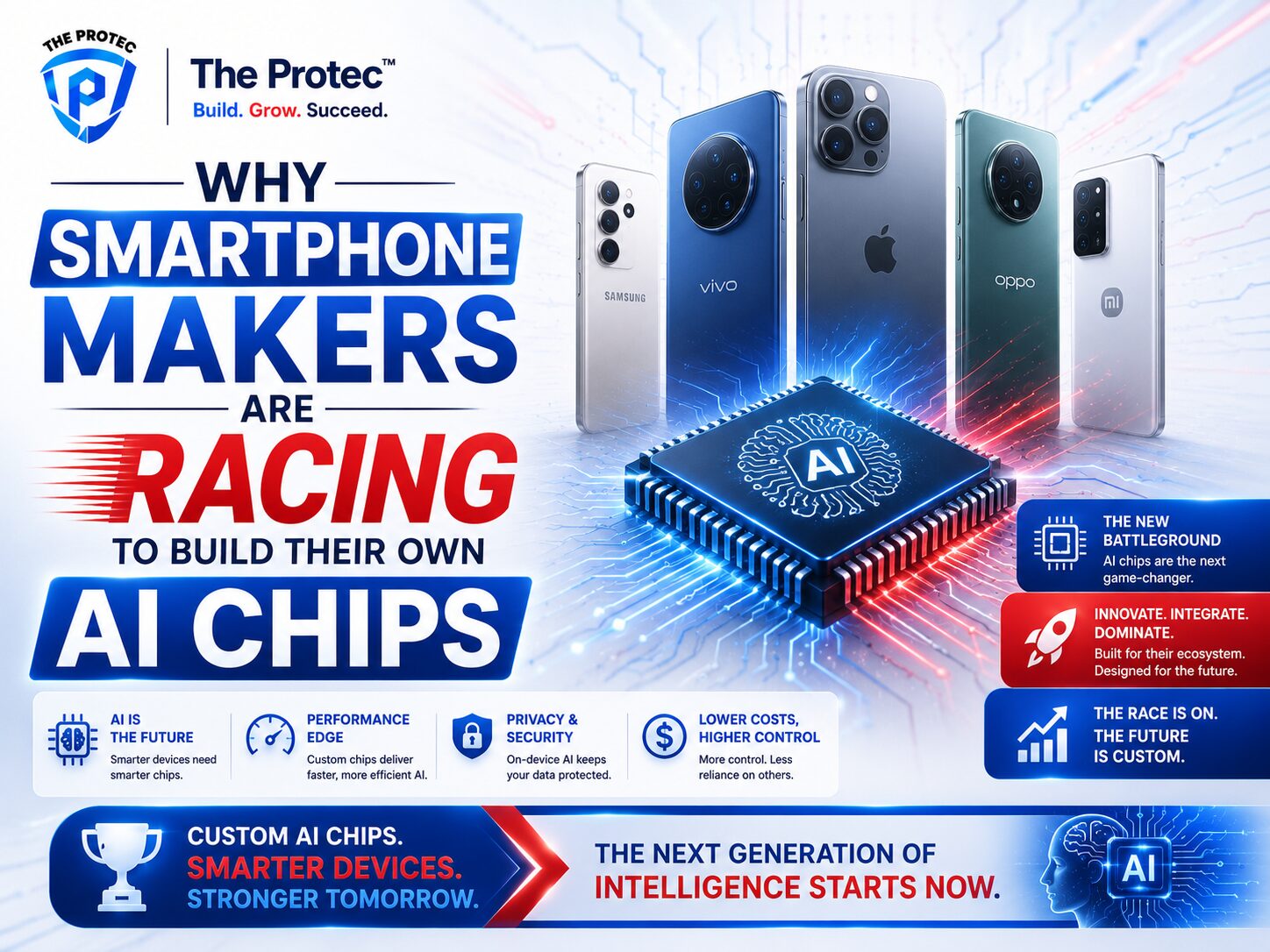
The smartphone industry is entering a new phase of competition, and it is no longer just about camera quality, display brightness, or battery size. The real battleground is now AI hardware. Apple, Google, and Qualcomm are all moving aggressively toward custom silicon because the next generation of phones will depend on how well they can run intelligence directly on the device.
This shift is not a marketing exercise. It is a structural change in how smartphones are designed, built, and experienced. Tasks such as live translation, image generation, voice assistance, call screening, photo editing, spam detection, and personal automation are increasingly handled by on-device models instead of distant cloud servers. That means the companies behind the most advanced phones need smartphone AI chips that can process massive workloads quickly, efficiently, and securely.
For years, mobile processors were optimized around general performance: app launch speed, graphics, and power efficiency. Today, the priority is different. AI features require dedicated neural engines, better memory bandwidth, tighter software-hardware integration, and chip architectures that can handle large language models and multimodal workloads without draining the battery. That is why the race to build custom AI silicon has accelerated so quickly.
Why AI Has Become the Center of Mobile Processor Design
Smartphones have reached a point where raw CPU gains alone no longer create meaningful differentiation. Camera sensors are excellent, displays are already premium across flagship devices, and network speeds are improving through wider 5G adoption and emerging 6G planning. The most visible innovation now comes from AI-driven experiences.
Modern users expect phones to understand context, summarize content, edit media intelligently, and respond instantly to voice or text prompts. To deliver those features well, a phone must run AI models locally whenever possible. Cloud inference is still useful, but it introduces latency, requires connectivity, and raises privacy concerns. On-device AI lowers those barriers.
That is why smartphone makers are redesigning their mobile processors around AI-specific workloads. The chips need to support:
- High-throughput matrix operations for neural networks
- Low-power inference for always-on features
- Fast memory access for large model parameters
- Secure processing for personal data
- Efficient thermal behavior during sustained AI use
In other words, the chip is no longer just a component. It is becoming the product strategy.
Apple’s Strategy: Tight Hardware and Software Integration
Apple has long been the clearest example of why custom silicon matters. Its A-series and M-series chips proved that designing hardware around software requirements can create major advantages in performance, efficiency, and product consistency. Now that same logic is being applied to AI.
Apple’s newer iPhone chips continue to expand neural engine capabilities, while iOS features increasingly rely on local intelligence for tasks such as photo cleanup, text summarization, transcription, and personalization. Apple’s broader AI push is built around the idea that sensitive and latency-sensitive operations should happen on-device whenever possible.
This approach gives Apple several benefits:
- Privacy: personal data can stay on the device instead of being sent to the cloud.
- Speed: on-device inference reduces delays in everyday interactions.
- Battery life: custom accelerators can perform AI tasks more efficiently than general-purpose compute.
- Product control: Apple can tune the silicon, operating system, and apps together.
Apple also benefits from the ability to shape the developer experience. When a company controls both the chip and the software stack, it can expose AI features in a way that feels seamless rather than bolted on. That is especially important now that mobile AI is moving from novelty features to core platform capability.
For Apple, the race is not simply about adding a bigger neural engine. It is about building a platform where AI is deeply embedded in the device architecture, allowing the iPhone to act more like a private, always-available personal assistant than a traditional smartphone.
Google’s Tensor Approach: AI Hardware as a Product Identity
Google entered the custom silicon race for a different reason: it wanted to turn its software strengths into a differentiated hardware experience. The Tensor line was built to optimize Pixel phones for machine learning, photography, speech recognition, and assistant features. Unlike many competitors that prioritize benchmark wins, Google focuses on making AI useful in daily scenarios.
That strategy has become even more important as Google pushes deeper into generative AI and multimodal experiences. Pixel phones now showcase features such as real-time transcription, advanced photo editing, call assistance, and context-aware responses that depend heavily on AI accelerators inside the device.
Google’s main advantage is that it controls the AI stack from top to bottom. It develops the models, the cloud services, the operating system, and the device software. Custom smartphone AI chips let Google align those layers in a way that general-purpose mobile processors cannot easily match.
That alignment matters because AI workloads are changing fast. Early mobile AI was mostly about image enhancement and speech recognition. Now phones are expected to run small language models, summarize content, assist with writing, identify objects in real time, and handle multiple inputs simultaneously. Those tasks require more than a powerful CPU. They require specialized AI hardware that can keep up with the software roadmap.
Google also uses custom silicon to better balance cloud AI and on-device AI. Not every task belongs on the phone, and not every task should be sent to the cloud. Tensor chips help Google decide which workloads stay local and which are offloaded, improving responsiveness while maintaining a strong privacy story.
Qualcomm’s Role: The Platform Powering the Broader Market
While Apple and Google build chips mainly for their own devices, Qualcomm sits at the center of the wider Android ecosystem. Its Snapdragon platform powers a huge share of premium smartphones, and the company has become increasingly aggressive about AI-specific design across its mobile processors.
Qualcomm understands that the next wave of premium smartphones will be judged by how well they handle AI features in real time. That means its chips need strong CPU and GPU performance, but also a robust neural processing pipeline capable of running advanced AI models efficiently. The company has responded by emphasizing dedicated AI acceleration, better power management, and tighter integration between compute blocks.
For Qualcomm, the challenge is broader than building one exceptional chip. It must create a platform that works across many phone brands, software skins, and market segments. That makes its AI hardware strategy particularly important because it has to be flexible enough for different OEM requirements while still delivering a unified performance advantage.
Qualcomm’s push into custom AI silicon is also a defensive move. If Apple’s silicon continues to outperform in efficiency and Google’s Tensor chips keep improving in AI-first features, Qualcomm must prove that Android phones can still compete on intelligence, battery life, and sustained performance. That is why each new Snapdragon generation increasingly highlights AI throughput as a headline feature.
What Makes Smartphone AI Chips Different from Traditional Mobile Processors
It is tempting to think of AI chips as just faster processors, but that misses the point. A traditional mobile processor is built for general computing. Smartphone AI chips are built for a very specific workload pattern: repeated mathematical operations on large amounts of data, often under strict power and heat constraints.
That design shift changes the hardware in several ways:
- More specialized accelerators: neural engines and matrix engines handle AI tasks more efficiently than CPUs.
- Improved memory architecture: AI models need fast access to weights and activations, which places pressure on memory bandwidth.
- Better thermal control: sustained AI inference can generate heat, so the chip must remain efficient over time.
- Lower latency pathways: the chip must move data quickly between camera, sensor, storage, and compute blocks.
These changes are critical because AI features are no longer occasional add-ons. They are becoming daily-use functions. A phone that can summarize a meeting, rewrite a message, edit a photo, or identify a landmark instantly is far more valuable than one that only performs those tasks slowly or inconsistently.
That is why the industry is moving away from one-size-fits-all mobile processors and toward highly tuned AI hardware architectures. The winner will be the company that can balance speed, efficiency, and software support better than everyone else.
Why On-Device AI Is Reshaping Consumer Expectations
Consumers may not always notice what kind of chip is inside their phone, but they absolutely notice the experience it enables. If a feature works instantly, respects privacy, and does not wreck battery life, it feels magical. If it is slow, unreliable, or dependent on a cloud connection, it feels like a gimmick.
This is why smartphone makers are investing so heavily in on-device intelligence. The user experience changes dramatically when AI happens locally:
- Voice assistants respond faster and more naturally
- Photos can be edited in seconds instead of minutes
- Calls and messages can be screened with minimal delay
- Personal data can remain under user control
- Features continue working even in weak-network conditions
As more users become comfortable with AI-assisted workflows, expectations rise. The phone is no longer just a communication device. It is becoming a personal computing layer that understands context and acts on behalf of the user. That is only possible if the underlying smartphone AI chips are strong enough to support those tasks locally.
The Business Case Behind Custom AI Silicon
There is also a clear commercial reason for this race. Custom silicon creates differentiation in a market where hardware specs alone are increasingly hard to distinguish. If every flagship has a fast screen, premium camera, and all-day battery, AI performance becomes a major selling point.
Custom chips also create tighter ecosystem lock-in. Apple’s silicon helps keep users inside the Apple ecosystem. Google’s Tensor chips reinforce Pixel identity. Qualcomm’s platform strategy helps Android OEMs compete while still relying on a shared technology base. In each case, the chip becomes part of the brand story.
There are supply chain benefits as well. Owning more of the chip design allows companies to optimize for availability, feature timing, and long-term roadmaps. It can also reduce dependency on generic designs that may not match a company’s AI ambitions.
At a strategic level, custom AI hardware is a way to future-proof the smartphone business. As AI becomes the interface layer for search, messaging, photography, productivity, and personal assistance, the chip at the center of the phone will define the user experience more than ever.
Challenges Ahead for Smartphone AI Chips
Despite the momentum, building high-performance AI hardware is not easy. The biggest challenge is balancing capability with efficiency. A chip can be powerful, but if it overheats or drains the battery quickly, users will feel the trade-off immediately.
Another challenge is model size. AI models are growing more capable, but larger models demand more memory and compute. Smartphone makers must decide how much intelligence can realistically live on the device and what should remain in the cloud. The answer will likely be hybrid: lightweight local models for immediate tasks, cloud models for heavier reasoning.
Software maturity is another obstacle. A chip only matters if the operating system and apps know how to use it well. That requires deep developer support, model optimization tools, and continuous updates. Without that ecosystem layer, even a powerful chip can underdeliver.
Finally, the market is moving quickly. What counts as cutting-edge today may feel standard in a year or two. That forces Apple, Google, Qualcomm, and their partners to keep iterating aggressively.
What Comes Next for Mobile Processors and AI Hardware
The next generation of mobile processors will likely blur the line between traditional computing and dedicated intelligence. We are already seeing the early signs: stronger NPUs, better memory systems, more efficient inference engines, and operating systems that are increasingly built around AI-first workflows.
In practical terms, that means future smartphones will do more of the following on-device:
- Run personalized assistants that understand context better
- Edit photos and videos with generative tools in real time
- Summarize documents, calls, and conversations locally
- Translate speech and text with lower latency
- Coordinate multiple sensors for richer multimodal experiences
The companies that succeed will not simply have the fastest chips. They will have the most coherent vision for how AI should feel on a smartphone. Apple is betting on privacy and integration. Google is betting on AI-first utility. Qualcomm is betting on scale and platform performance. Each approach reflects the same reality: AI hardware is now central to smartphone strategy.
For consumers, that competition should lead to better phones. For the industry, it marks a major shift in design philosophy. The smartphone of the near future will not just run AI features. It will be built around them.
FAQ
Why are smartphone manufacturers building their own AI chips?
They want better performance, lower power use, stronger privacy, and tighter integration between hardware and software. Custom AI chips let manufacturers optimize smartphones for on-device intelligence instead of relying only on general-purpose mobile processors.
How are smartphone AI chips different from regular mobile processors?
Regular mobile processors handle a broad mix of tasks, while smartphone AI chips are designed to accelerate neural-network workloads. They usually include specialized AI hardware such as neural engines, matrix accelerators, and memory systems tuned for inference.
Why is Apple ahead in custom silicon?
Apple controls both the hardware and software stack, which lets it optimize performance and efficiency end to end. That integration makes it easier to deliver AI features that feel fast, private, and consistent across devices.
What is Google trying to achieve with Tensor chips?
Google uses Tensor chips to make Pixel phones better at AI-driven tasks such as photography, speech recognition, and contextual assistance. The goal is to create a more intelligent phone experience that reflects Google’s strengths in software and machine learning.
Will Qualcomm still matter if Apple and Google keep building custom chips?
Yes. Qualcomm remains critical to the Android market and continues to advance AI hardware across a wide range of flagship devices. Its Snapdragon platforms help many smartphone brands deliver competitive AI features without designing their own silicon from scratch.
External Sources
For more background on mobile AI hardware and silicon strategy, see Apple Newsroom and Google Blog.