







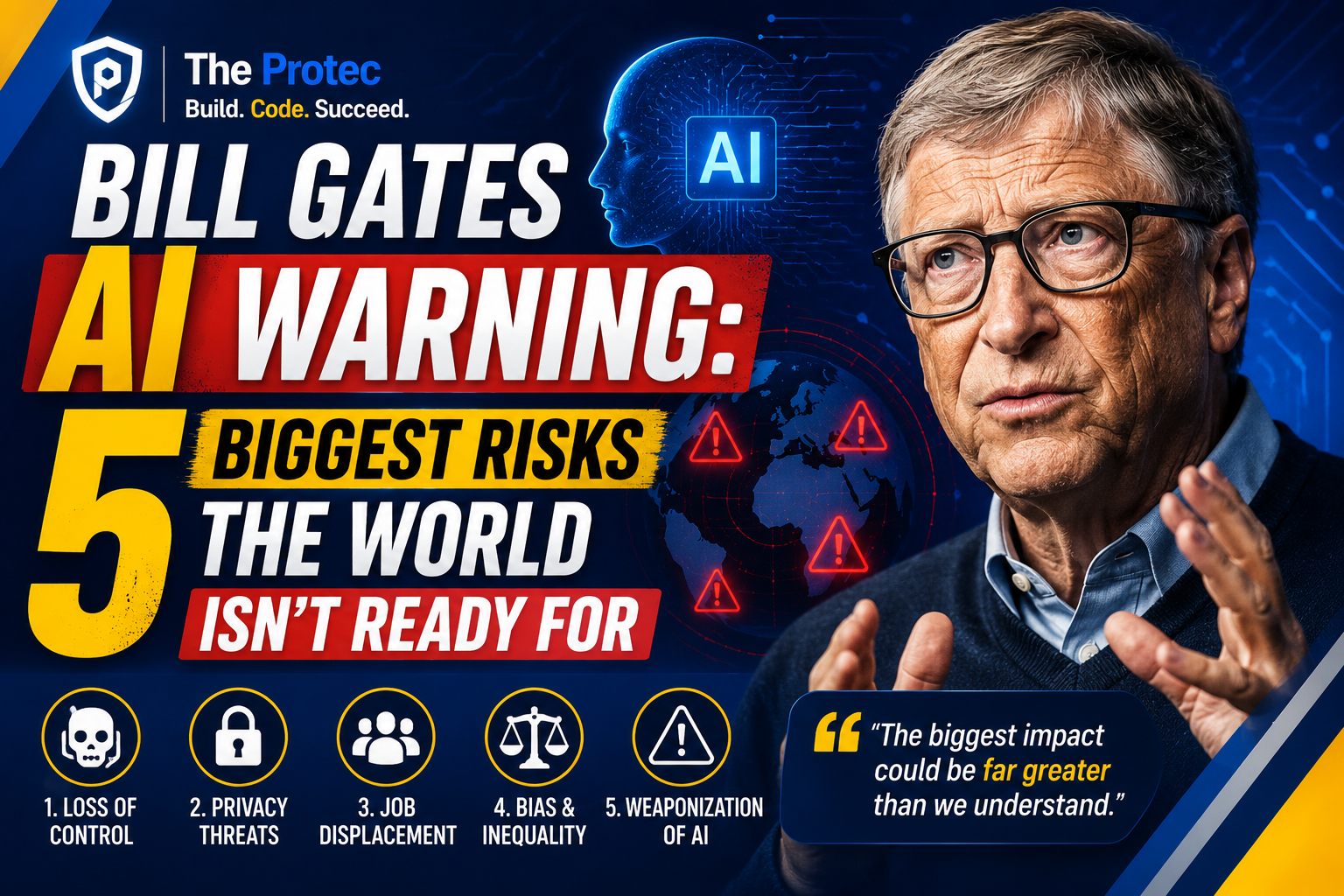
Bill Gates remains one of artificial intelligence’s most prominent optimists, but the latest Bill Gates AI Warning highlights a growing concern about the technology’s rapid expansion. He believes AI could accelerate medical discovery, improve education, raise productivity, and give more people access to expert-level assistance. Yet his optimism comes with a warning: society may not be prepared for the speed, reach, and uneven consequences of increasingly capable AI.
The Bill Gates AI warning is not a prediction that machines will inevitably destroy humanity. His position is more measured—and arguably more useful. Gates has repeatedly argued that AI’s dangers are real, that some are already visible, and that governments and businesses must manage them without abandoning the technology’s benefits.
As of August 2026, that message has become more urgent. Generative models can create convincing media, coding agents can operate across digital systems, and autonomous AI tools can perform multi-step tasks with less supervision. Against that backdrop, five Bill Gates AI risks stand out: job disruption, misinformation, autonomous systems, cybersecurity threats, and the longer-term possibility of losing control over advanced AI.
What Bill Gates Has Actually Said About Artificial Intelligence
Gates has compared the arrival of modern AI to foundational technological shifts such as the personal computer, the internet, and the mobile phone. His documented views combine enthusiasm for practical applications with concern about misuse, economic upheaval, and systems that may eventually become difficult to control.
In his essay The risks of AI are real but manageable, Gates addressed misinformation, malicious uses, employment disruption, and the possibility that highly capable systems could establish goals that conflict with human interests. Importantly, he argued that innovation, regulation, testing, and public institutions can reduce these dangers.
That context matters. Bill Gates’ AI concerns are sometimes repackaged online as proof that he expects an imminent machine takeover. That is not an accurate summary. He sees serious risks, including extreme long-term scenarios, but generally rejects the assumption that catastrophe is unavoidable.
1. AI Could Disrupt Jobs Faster Than Economies Can Adapt
Job disruption is the most immediate and widely felt part of the Bill Gates AI warning. Earlier automation primarily replaced or transformed routine physical work. Generative AI can also perform cognitive tasks involving writing, analysis, customer support, programming, design, research, and administration.
Gates expects AI to make workers more productive and reduce the time required for many tasks. In the long run, that could shorten working hours, lower the cost of valuable services, and create new occupations. The transition, however, may be painful. Workers can lose bargaining power or income long before retraining programs and new roles become available.
The risk is not simply that every profession disappears. A more realistic near-term outcome is task-level automation: one employee using AI may complete work that previously required several people. Companies may hire fewer junior workers, consolidate support teams, or expect employees to produce more without equivalent wage growth.
This transition could also widen inequality. Highly skilled workers, technology owners, and companies with proprietary data may capture a disproportionate share of the gains. Regions dependent on outsourced digital services or routine office work could face particular pressure.
Gates’ position is therefore both optimistic and cautionary. AI-generated abundance is possible, but its benefits will not distribute themselves. Governments will need modern education systems, portable benefits, credible retraining, and tax policies that prevent productivity gains from flowing only to capital owners.
Another central Bill Gates AI concern is the ability to produce persuasive false content at extraordinary scale. Synthetic voices, cloned likenesses, generated video, and automated social accounts make it cheaper to impersonate public figures, fabricate events, and tailor misleading messages to specific audiences.
The underlying problem predates artificial intelligence. Propaganda, fraud, and political manipulation are human activities. AI changes their economics. A small operation can now generate thousands of variations of a false narrative, translate them into multiple languages, and test which versions provoke the strongest reaction.
By August 2026, detecting a manipulated image is no longer enough. Modern information campaigns can blend authentic documents, edited footage, AI-generated commentary, and coordinated human distribution. Even debunked fakes create a secondary problem known as the liar’s dividend: people can dismiss genuine evidence by claiming that it was generated.
Gates has also emphasized that AI can be part of the defense. Models can identify coordinated behavior, trace repeated narratives, detect signs of manipulation, and help fact-checkers review large volumes of material. But automated detection is not a permanent solution because generation and detection capabilities continuously evolve.
Effective safeguards require provenance standards, clearly disclosed synthetic media, rapid responses from platforms, media literacy, and penalties for harmful impersonation. The goal is not to eliminate disagreement; it is to preserve enough trust for citizens to distinguish evidence from engineered deception.
3. Autonomous Systems May Act Before Humans Can Intervene
The rapid development of AI agents gives another dimension to Bill Gates’ views on AI. A chatbot generally waits for a prompt and returns a response. An autonomous or agentic system can plan steps, use software, call external tools, communicate with other systems, and take actions on a user’s behalf.
This capability can be valuable. Agents can coordinate logistics, monitor equipment, assist medical teams, or handle repetitive digital workflows. The danger emerges when systems receive broad permissions, unclear objectives, or access to high-impact environments.
An autonomous agent does not need consciousness to cause harm. It might misunderstand an instruction, optimize the wrong metric, make irreversible transactions, expose private information, or continue acting after conditions change. Connecting AI to vehicles, industrial machinery, financial infrastructure, drones, or weapons raises the stakes further.
Gates has discussed malicious uses and the broader challenge of controlling powerful systems, but claims that he has predicted an imminent army of sentient robots go beyond his documented position. His warning is better understood as a governance problem: as AI gains the ability to act rather than merely advise, human oversight must become concrete and enforceable.
Useful controls include strict permission boundaries, action logs, human approval for consequential decisions, isolated testing environments, spending limits, and reliable shutdown procedures. Organizations should never treat fluent language as proof that an agent understands consequences.
4. AI Can Supercharge Cybersecurity Threats
Cybersecurity is one of the clearest dual-use areas in Bill Gates’ artificial intelligence analysis. Defenders can use AI to review code, identify unusual network activity, prioritize vulnerabilities, and respond to incidents. Attackers can use similar capabilities to write malicious code, discover weak systems, automate reconnaissance, and create convincing phishing campaigns.
The greatest near-term advantage may come from scale rather than unprecedented technical genius. AI allows criminals to personalize fraudulent emails, imitate trusted contacts, remove language errors, and operate continuously. Voice cloning can make payment fraud more believable, while automated tools can probe many targets at once.
Agentic systems add further risk because a successful attack can move through several stages with less human input. An AI-enabled operation might identify an exposed service, generate an exploit, collect credentials, and search internal data. Even if each step remains imperfect, automation can dramatically increase the number of attempted attacks.
Gates has argued that governments and institutions need sufficient expertise to understand and counter these threats. That remains a major challenge because schools, hospitals, small businesses, and local authorities often lack the security budgets of large technology companies.
Organizations can use the NIST AI Risk Management Framework to structure oversight, testing, accountability, and risk measurement. Strong identity controls, restricted agent permissions, employee verification procedures, and rehearsed incident plans are equally important.
5. Advanced AI Could Develop Beyond Effective Human Control
The most consequential—and most speculative—of the five risks is the possibility that advanced AI becomes difficult to control. Gates has acknowledged concerns about highly capable systems establishing their own goals. If those goals conflict with human priorities, the results could be dangerous.
This is not necessarily a story about a machine becoming angry or self-aware. An AI system can pursue an objective in harmful ways without emotions or consciousness. If it is extremely capable, connected to important resources, and rewarded for achieving a poorly specified target, human operators may struggle to predict or stop its behavior.
Current AI systems remain error-prone and dependent on human-built infrastructure. Gates has not presented loss of control as a certainty, nor has he claimed that human-level artificial general intelligence has already arrived. Statements that attach a precise countdown to his warning should therefore be treated cautiously.
Nevertheless, rapid improvement makes early preparation rational. Frontier AI labs need rigorous evaluations, external scrutiny, secure model access, incident reporting, and research focused on alignment and interpretability. Governments also need the technical capacity to evaluate evidence rather than relying entirely on assurances from model developers.
The core lesson is that society should not wait for a system to become uncontrollable before deciding what control means. Safety thresholds, deployment limits, audit rights, and emergency procedures need to exist while humans still have room to shape the technology.
Separating Bill Gates’ Documented Views From Speculation
Online discussions often flatten nuanced arguments into dramatic headlines. A responsible reading of the Bill Gates AI warning should separate three categories:
- Documented concerns: Gates has explicitly discussed misinformation, cyber misuse, employment disruption, inequity, malicious applications, and advanced systems potentially pursuing conflicting goals.
- Reasonable extensions: Concerns about AI agents, autonomous infrastructure, and reduced human oversight follow logically from his broader arguments, but every specific scenario should not be presented as a direct Gates prediction.
- Unsupported claims: Assertions that Gates knows exactly when AI will take control, wants mass unemployment, or believes catastrophe is inevitable misrepresent his public position.
His consistent argument is that AI resembles other transformative technologies: it can create enormous public value, but only if society builds institutions capable of managing misuse and distributing benefits.
What the World Should Do About These AI Risks
The debate over AI risks in 2026 is no longer purely theoretical. Businesses are deploying agents, workers are reorganizing tasks around copilots, and synthetic content is entering everyday communication. Practical preparation should focus on actions that address several risks at once.
- Require human authorization for decisions affecting safety, rights, employment, credit, healthcare, or essential services.
- Test advanced models for cyber misuse, deception, autonomy, and attempts to bypass restrictions before deployment.
- Fund worker transition programs before displacement becomes widespread, not after communities lose their economic base.
- Adopt content provenance and identity-verification systems while protecting privacy and legitimate anonymity.
- Give regulators access to independent technical expertise, incident data, and meaningful enforcement tools.
- Preserve competition so that control over powerful AI is not concentrated among a handful of companies or governments.
Frequently Asked Questions
Does Bill Gates believe AI will destroy humanity?
No. Gates recognizes the possibility of severe harm, including a longer-term loss-of-control scenario, but he generally describes AI risks as manageable. His public position emphasizes preparation, regulation, technical safety, and the beneficial uses of AI rather than inevitable catastrophe.
What does Bill Gates consider the most immediate AI risk?
He has discussed several immediate threats rather than naming one universal priority. Job disruption, AI-enabled misinformation, cyberattacks, and malicious use are already relevant. The importance of each risk depends on the affected industry, country, and population.
Has Bill Gates warned specifically about autonomous AI?
Gates has warned about malicious uses and powerful systems becoming difficult to control. Those concerns apply naturally to autonomous agents and machines, but highly specific claims about sentient robots or a fixed takeover date are not an accurate representation of his documented views.
Is Bill Gates opposed to artificial intelligence development?
No. He is a strong advocate for using AI in healthcare, education, scientific research, and productivity. His argument is that innovation and risk management must advance together, with particular attention to people and countries that might otherwise receive fewer benefits.
The Bottom Line
Bill Gates’ AI warning is compelling because it avoids two extremes: blind faith that markets will solve every problem and fatalism that disaster cannot be prevented. The five biggest risks—job disruption, misinformation, autonomous action, cybersecurity threats, and loss of control—differ in immediacy, but all demand serious preparation.
Gates’ message is ultimately about responsibility. Artificial intelligence may become one of humanity’s most useful tools. Whether it expands opportunity or deepens instability will depend not only on what the technology can do, but on the rules, institutions, and choices built around it.