








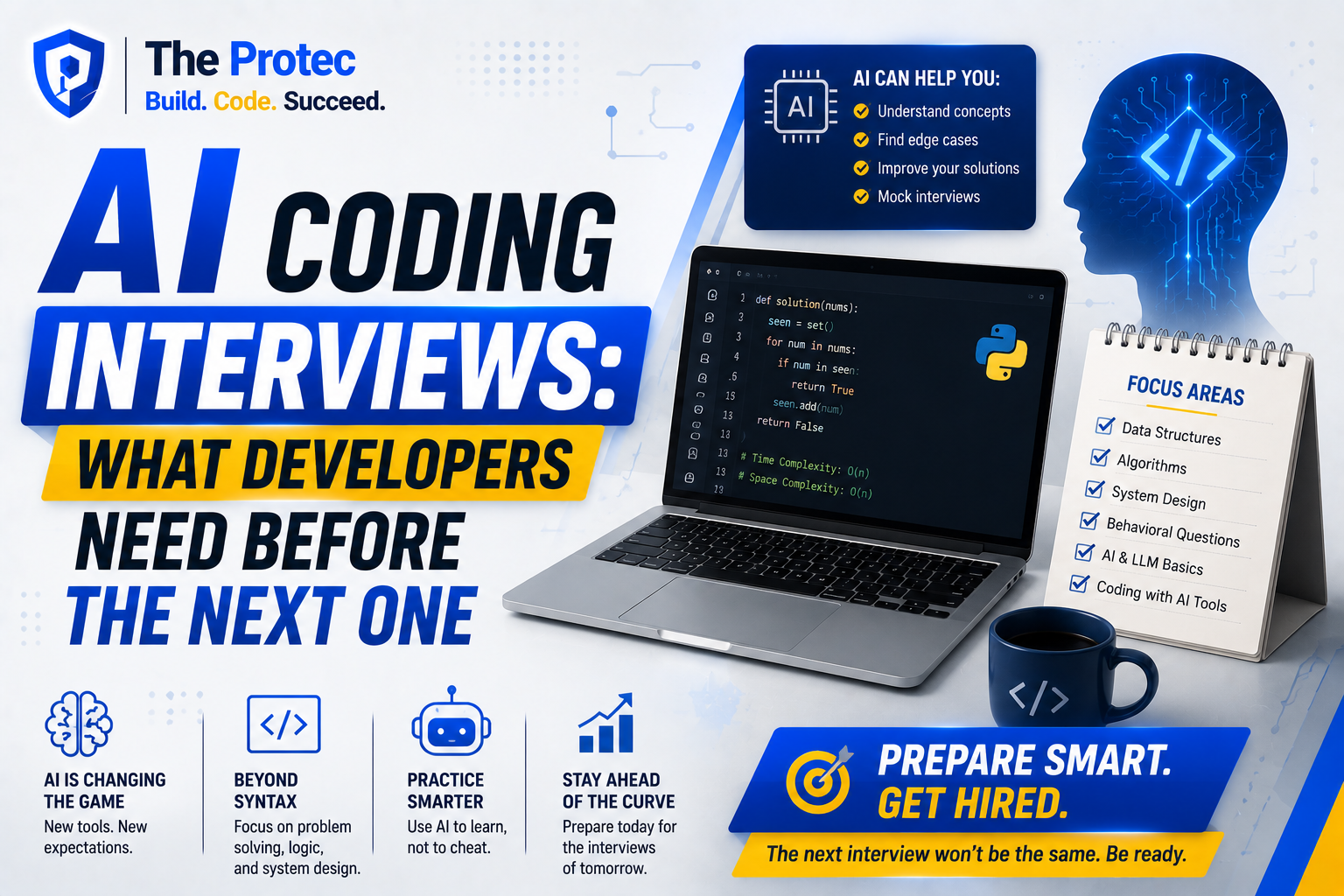
Technical interviews are no longer built around the assumption that developers work alone with an empty editor and a memorized collection of algorithms. AI Coding Interviews are emerging as hiring teams adapt to the reality of AI-assisted development. AI coding assistants can now navigate repositories, generate tests, explain unfamiliar code, propose architecture, and complete multi-file changes. Hiring teams know candidates use these tools on the job, so interviews are evolving to measure something more valuable than raw code generation.
As of September 2026, there is no universal format for an AI coding interview. Some employers prohibit assistants during a controlled skills assessment. Others explicitly encourage them and evaluate how candidates prompt, review, test, and correct the output. Many use a hybrid process that combines an AI-free baseline exercise with an AI-assisted development task.
For candidates, the central lesson is simple: do not assume AI is either permitted or forbidden. Clarify the rules, prepare for multiple formats, and be ready to defend every line of submitted code.
Why the AI Coding Interviews Are Replacing the Traditional Test
Traditional coding tests were designed to isolate an individual’s ability to produce a solution under artificial constraints. That approach still reveals problem-solving fundamentals, but it says less about how developers operate in modern engineering environments.
Repository-aware assistants and coding agents can now inspect dependencies, plan changes, run commands, create files, and revise implementations after test failures. Consequently, employers increasingly want evidence that candidates can direct these systems without surrendering technical judgment.
A software developer interview in 2026 may therefore test two distinct abilities. The first is foundational competence: understanding data structures, APIs, databases, debugging, security, and system behavior. The second is AI-enabled execution: providing useful context, evaluating generated code, detecting subtle defects, and deciding when manual work is safer or faster.
This shift does not make engineering knowledge less important. It raises the cost of weak knowledge because plausible-looking output can conceal race conditions, security flaws, invented APIs, inefficient queries, and broken edge cases.
What to Expect From Take-Home Assignments
Take-home projects remain common, but employers are redesigning them because unrestricted code generation makes authorship difficult to infer. Instead of asking candidates to build a generic application from scratch, teams increasingly provide an existing repository, incomplete feature, production-style bug, or ambiguous requirement.
An AI-permitted take-home assignment may require candidates to disclose which tools they used, summarize important prompts, identify generated sections, or submit a short decision log. The final review may include an oral defense in which interviewers ask why a design was selected, what alternatives were rejected, and how the candidate validated the result.
Expect evaluation to focus on:
- Whether the solution satisfies explicit and implied requirements
- Code readability, maintainability, and consistency with the repository
- Test quality, including failure paths and boundary conditions
- Security, dependency, accessibility, and performance considerations
- Commit history and the clarity of technical decisions
- The candidate’s ability to explain and modify the submission
Before beginning, ask whether AI is allowed, which tools are approved, what disclosure is expected, and whether company code may be sent to an external service. If the instructions prohibit AI, using it can become an integrity issue regardless of the quality of the result.
How Live Coding Is Changing
Live coding has not disappeared, but interviewers are placing less emphasis on perfect syntax and more on observable reasoning. A session may start with a small AI-free problem before moving into debugging, refactoring, or extending an unfamiliar codebase.
When AI is prohibited, explain your plan before typing, state assumptions, test incrementally, and discuss trade-offs. Interviewers generally care more about a structured approach than whether you remember every library method. If you become stuck, describe what you would inspect in documentation rather than silently guessing.
In an AI-enabled session, treat the assistant as a junior collaborator rather than an answer engine. State what context you will provide, request a limited change, inspect the proposed diff, and verify it with tests or direct reasoning. Narrate disagreements with the output. Rejecting an unsafe or overcomplicated suggestion can demonstrate more expertise than accepting a correct one.
You may also be asked to repair code generated moments earlier. Common traps include missing authorization checks, stale assumptions about APIs, poor error handling, unnecessary abstractions, and tests that merely repeat the implementation.
AI-Assisted Development Exercises Are Becoming More Realistic
The most representative coding interview AI format resembles a short working session. Candidates receive a repository, ticket, documentation, and access to an approved assistant. They must understand the system, plan a change, implement it, and present the result.
These exercises measure how effectively a developer controls scope and context. Dumping an entire repository into a prompt is rarely a strong strategy. Better candidates identify the relevant files, inspect interfaces and tests, formulate a hypothesis, and ask the tool for a narrow contribution.
Agentic tools add another dimension. An agent may propose a plan, edit several files, execute tests, and iterate autonomously. Interviewers will watch whether the candidate reviews the plan before execution, notices unrelated edits, checks command safety, and stops the agent when its approach diverges from the requirement.
Expect follow-up questions such as: What did the tool misunderstand? Which output did you verify manually? What risk remains? How would this change behave under load? Could the same result be achieved with a smaller diff?
What Employers Actually Evaluate
An AI coding interview is rarely a contest to see who can produce the longest prompt or the fastest implementation. Strong hiring teams look for durable engineering signals:
- Problem framing: Can you turn an ambiguous request into testable requirements?
- Decomposition: Can you divide work into small, verifiable steps?
- Technical judgment: Do you recognize when generated code conflicts with system constraints?
- Verification: Do you use tests, static analysis, logs, documentation, and code inspection appropriately?
- Communication: Can you explain decisions without hiding behind the assistant?
- Ownership: Will you accept responsibility for code produced with AI?
Tool fluency matters, but transferable judgment matters more. A candidate who can use one product only through memorized commands is less adaptable than someone who understands context management, review, and verification across different tools.
How to Prepare for a Software Developer Interview
Practice With and Without AI
Maintain enough fluency to solve modest problems without assistance. Practice reading code, tracing state, writing tests, analyzing complexity, and debugging from symptoms. Then repeat similar exercises with an assistant and compare the workflow. This exposes where AI saves time and where it encourages shallow thinking.
Build a Repeatable Verification Routine
Never stop at “the tests pass.” Review input validation, authorization, failure handling, data exposure, concurrency, dependency behavior, and performance. Confirm APIs against primary documentation rather than trusting generated explanations. The NIST AI Risk Management Framework offers a useful foundation for thinking about reliability and responsible oversight.
Practice Explaining Generated Code
Take an AI-generated change and explain every function, type, query, and test. Remove unnecessary abstractions, rename unclear variables, and identify assumptions. If you cannot explain a line, you are not ready to submit it in an interview.
Prepare an AI Usage Narrative
Be ready to describe how you use assistants professionally: which tasks you delegate, what information you avoid sharing, how you review output, and when you work manually. Concrete examples are more persuasive than claiming that AI makes you dramatically faster.
Rehearse Repository-Level Tasks
Small algorithm challenges are still useful, but modern interviews increasingly involve existing systems. Practice finding an execution path, reading tests, locating configuration, reproducing a bug, and delivering a focused patch. Keep your changes narrow and commits understandable.
Security, Privacy, and Integrity Still Apply
Do not paste proprietary interview material, secrets, personal data, or private repository contents into an unapproved model. Read the employer’s policy and use only the environment provided. Security awareness is itself an interview signal.
Generated code also requires the same scrutiny as human-written code. Review authentication boundaries, injection risks, insecure defaults, exposed credentials, and unsafe dependency choices. The OWASP guidance for LLM applications provides practical context for risks involving model-enabled systems.
Be transparent about assistance. Inventing a false account of how code was produced can end a hiring process, while a concise disclosure often demonstrates maturity and professional judgment.
A Practical Workflow for Interview Day
- Confirm the AI policy, approved tools, internet access, and disclosure requirements.
- Restate the task and clarify ambiguous requirements before coding.
- Inspect the repository, tests, interfaces, and constraints.
- Propose a small plan and identify how each step will be verified.
- Use AI for bounded tasks rather than requesting a complete solution immediately.
- Review every diff, run relevant checks, and test edge cases.
- Summarize trade-offs, remaining risks, and what you would improve with more time.
If a tool fails, continue methodically. Interviewers may intentionally limit features or introduce misleading output to see whether you remain effective without automation.
Common Mistakes to Avoid
The most damaging mistake is submitting code you do not understand. Other warning signs include accepting the first generated answer, creating a large diff for a small requirement, ignoring failing tests, fabricating benchmark claims, and using excessive prompting while providing little independent analysis.
Avoid performative AI use as well. If the task is faster to solve manually, say so and proceed. Good judgment includes knowing when a tool adds overhead. Conversely, refusing all AI use in an explicitly AI-assisted exercise can suggest inflexibility rather than craftsmanship.
Frequently Asked Questions
Are AI tools allowed in coding interviews?
It depends on the employer and interview stage. Some companies permit approved tools in take-home and live exercises, while others prohibit them for baseline assessments. Ask before using any assistant and follow disclosure requirements precisely.
Will traditional algorithm questions disappear?
No. Algorithms still reveal reasoning, complexity awareness, and foundational knowledge. However, many employers now combine shorter fundamentals checks with debugging, code review, system design, or repository-level work that better reflects day-to-day development.
What if the AI generates a correct solution immediately?
Do not present it immediately. Review the assumptions, trace the execution, test edge cases, inspect security and performance, and simplify unnecessary code. Interviewers may ask you to explain or modify any part of the solution.
Should candidates disclose AI use in a take-home assignment?
Yes, when requested—and it is wise to clarify expectations even when instructions are silent. A brief record of tools, important prompts, generated contributions, and verification steps shows transparency without overwhelming the reviewer.
What is the best way to stand out in an AI coding interview?
Demonstrate controlled, evidence-based development. Frame the problem clearly, keep changes focused, challenge weak suggestions, verify behavior, and communicate trade-offs. The strongest candidates show that AI increases their reach without replacing their judgment.
Final Thoughts
AI-assisted development is changing interview mechanics, not the core responsibility of a software engineer. Candidates still need to understand systems, make sound decisions, protect data, and own the result. Prepare for both assisted and unassisted work, clarify the rules, and make verification visible. In the modern technical interview, trustworthy judgment is the skill that matters most.