








AI coding tools have become remarkably capable, but getting several of them to work effectively on the same repository has remained unnecessarily awkward. A team using Claude Code, OpenAI Codex, and another agentic development tool might need to maintain multiple instruction files containing nearly identical commands, architectural notes, testing requirements, and coding conventions. Every duplicated rule creates another opportunity for instructions to drift out of sync.
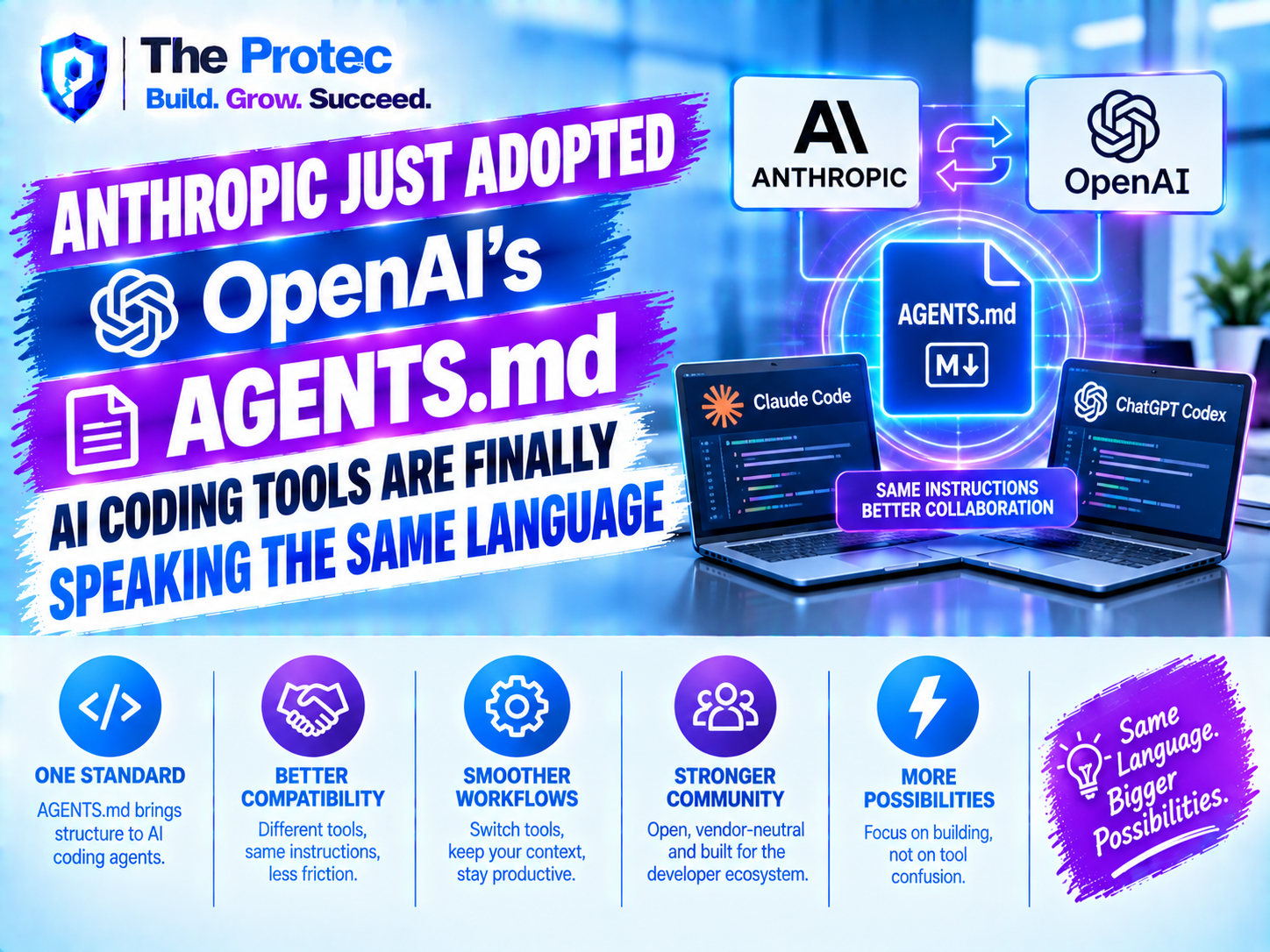
Anthropic’s adoption of AGENTS.md support in Claude Code directly addresses that problem. The format, initially associated with OpenAI’s Codex ecosystem, gives repositories a tool-neutral place to tell AI coding agents how to work. Claude Code previously centered its persistent project guidance on CLAUDE.md; it can now participate in the increasingly broad AGENTS.md ecosystem without requiring teams to abandon Claude-specific configuration.
This is an important step toward AI agent interoperability, but it is not a universal agent protocol. The distinction matters. Shared instruction files make projects easier to move between AI coding tools, while model behavior, permissions, tool access, context handling, and execution environments remain different.
What Anthropic AGENTS.md Support Changes
As of September 2026, Claude Code can recognize AGENTS.md as a source of repository instructions. Developers can place guidance in the project that travels with the code and can be consumed by Claude Code, OpenAI Codex, and other compatible AI coding agents.
An AGENTS.md file can describe the practical knowledge an agent needs before editing a repository, including:
- Commands for installing dependencies, building the application, and running tests
- Repository structure and the purpose of important directories
- Formatting, linting, naming, and type-safety requirements
- Required validation steps before a change is considered complete
- Files, generated assets, or APIs that should not be modified
- Security, accessibility, documentation, and review expectations
The immediate benefit is less configuration duplication. A team no longer has to copy every shared rule into separate Claude Code AGENTS.md, Codex, and vendor-specific instruction systems. The repository can establish a common baseline while retaining specialized files where a particular tool needs additional direction.
How AGENTS.md Originated in the OpenAI Codex Ecosystem
AGENTS.md emerged through OpenAI’s Codex ecosystem as a straightforward answer to a practical question: if human contributors can consult a README, where should an autonomous coding agent find operational instructions?
The format deliberately uses Markdown and a recognizable filename rather than a complicated machine-only configuration language. This makes the instructions readable in pull requests, editable by any contributor, and portable across local terminals, cloud agents, IDE integrations, and automated development environments. The public AGENTS.md specification also supports files at different directory levels, allowing instructions to become more specific as an agent works deeper in a repository.
Although phrases such as OpenAI AGENTS.md and AGENTS.md OpenAI reflect the format’s Codex roots, its value increases when it is not limited to one vendor. Broader stewardship through the Agentic AI Foundation helps position the project as shared infrastructure rather than a private preference belonging to a single AI platform.
Why Claude Code Previously Relied on CLAUDE.md
Before native AGENTS.md support, CLAUDE.md was the primary repository-level instruction file associated with Claude Code. It remains useful because it can capture guidance intended specifically for Claude, including preferred workflows, project context, and instructions tied to Claude Code features.
CLAUDE.md also became embedded in many existing development processes. Teams created project-level files, local instructions, and directory-specific guidance around it. Anthropic’s decision does not make that investment obsolete. Instead, AGENTS.md Claude Code support adds a shared compatibility layer alongside the established Claude-specific mechanism.
This additive approach is more practical than forcing an immediate migration. Organizations can adopt the common format gradually, moving broadly applicable AI coding agent instructions into AGENTS.md while keeping genuinely Claude-specific details in CLAUDE.md.
How Claude Code Handles AGENTS.md Alongside CLAUDE.md
The safest way to understand the new behavior is that Claude Code can consume both shared and tool-specific project guidance. AGENTS.md provides portable repository instructions, while CLAUDE.md remains available for Claude Code configuration and context.
A sensible division looks like this:
- AGENTS.md: build commands, test suites, repository architecture, style rules, generated-file warnings, security requirements, and completion criteria that should apply to every coding agent.
- CLAUDE.md: Claude-specific workflows, preferred Claude Code features, specialized tool usage, or guidance that would be irrelevant or confusing to another agent.
AGENTS.md can also be scoped through nested files. A root file might define organization-wide repository conventions, while a file inside a mobile, backend, or infrastructure directory can explain commands and constraints for that area. An agent working within a subtree can use the more local guidance applicable to its task.
Teams should not treat support for both files as permission to repeat the same rule everywhere. Duplicate instructions can diverge, and contradictory guidance forces the agent to determine which direction is authoritative. Anthropic support does not transform conflicting prose into a formally resolved policy system. Repositories should keep shared rules in one place, document intentional exceptions, and verify current Claude Code behavior before relying on an assumed precedence rule.
Modern teams rarely standardize permanently on one AI developer tool. A developer may use Claude Code for repository exploration and a complex refactor, OpenAI Codex for a delegated implementation, and an IDE agent for quick local changes. Automated agents may also open pull requests independently of the tools used by human developers.
Without a shared instruction format, each tool needs a separate onboarding layer. One file says to run a monorepo test command, another references an outdated package script, and a third omits the required database migration check. The resulting failures are often blamed on model quality even though the real cause is fragmented project context.
A well-maintained AGENTS.md creates a consistent operational contract. Switching tools becomes easier because the new agent can immediately discover the same essential rules. That improves coding agent compatibility in several concrete ways:
- Fewer tool-specific setup steps for developers
- More consistent builds, tests, and validation across generated changes
- Less maintenance when commands or repository structures change
- Clearer review of AI agent instructions through normal version control
- Lower switching costs when teams evaluate new AI coding tools
What AI Agent Interoperability Does—and Does Not—Mean
Anthropic AGENTS.md support is genuine progress for AI agent interoperability because multiple tools can now read a common category of project context. It makes instructions portable, discoverable, and easier to govern. That is valuable infrastructure for cross-tool software development.
However, compatibility at the instruction-file level does not mean Claude Code and OpenAI Codex become interchangeable. They may interpret the same prose differently because they use different models, system prompts, context strategies, tool interfaces, and safety controls. They can also differ in how they execute shell commands, request approval, access networks, process images, manage long-running tasks, or recover after a failed test.
AGENTS.md is also not a universal workflow engine. It does not standardize authentication, memory, tool schemas, agent-to-agent communication, permission boundaries, or output quality. Nor does it guarantee that every compatible tool implements nested instructions and conflicts identically.
In short, the AGENTS.md specification standardizes where important coding guidance can live and establishes broad expectations about its purpose. It does not standardize the entire agent runtime. Calling it a complete AI agent standard would overstate the current milestone.
Could AGENTS.md Become a Foundation for AI Coding Standards?
Yes—but likely as one layer within a larger standards stack. Software development already depends on complementary conventions rather than one specification that controls everything. README files explain projects, package manifests describe dependencies, editor configurations establish formatting behavior, and continuous integration workflows enforce checks.
AGENTS.md can play a similarly focused role for AI coding standards: human-readable instructions that sit close to the source code and apply across agentic tools. Its simplicity is an advantage. Developers do not need a new service or proprietary control plane to adopt it, and instructions can be reviewed with the same governance used for code.
The Agentic AI Foundation may help encourage neutral collaboration, but long-term success will depend on consistent implementations and real-world adoption. Tool vendors will need to clarify discovery, scoping, precedence, and error behavior. Repository hosts and IDEs may eventually add validation or editing support. Security teams will also need reliable ways to audit instruction changes.
Best Practices for Writing AI Coding Agent Instructions
Supporting a common filename is only useful if the content is actionable. Teams adopting AGENTS.md should treat it as operational documentation, not as a dumping ground for every fact about the codebase.
- Use exact commands. Specify the commands for targeted tests, full test suites, linting, type checks, builds, and migrations.
- State boundaries clearly. Identify generated code, vendored dependencies, sensitive configuration, and directories that should not be edited.
- Keep guidance testable. “Maintain quality” is vague; “run the formatter and the package-level test suite before completion” is verifiable.
- Prefer shared rules. Put cross-tool requirements in AGENTS.md and reserve CLAUDE.md for instructions that truly concern Claude Code.
- Use scoped files carefully. Add nested instructions when a directory has distinct workflows, not merely to repeat the root file.
- Review instruction changes as code. An edited agent instruction can change how automated tools modify a repository, so it deserves ownership and pull-request review.
- Never store secrets. Instruction files are versioned project content, not a place for credentials, private tokens, or unrestricted production access.
Teams should also test their instructions with more than one agent. If Claude Code and Codex repeatedly interpret a sentence differently, rewrite it with explicit commands, paths, and completion criteria rather than assuming the models will infer the same intent.
FAQ About AGENTS.md and Claude Code
Does Claude Code support AGENTS.md now?
Yes. Anthropic has added AGENTS.md support to Claude Code, enabling it to read shared repository guidance used by Codex and other compatible AI coding agents. Teams should keep Claude Code updated and consult Anthropic’s current documentation for implementation-specific behavior.
Does AGENTS.md replace CLAUDE.md?
No. CLAUDE.md remains useful for Claude-specific project guidance. AGENTS.md is the better location for portable rules that should apply across Claude Code, OpenAI Codex, and other AI developer tools. Many repositories will benefit from using both without duplicating instructions.
Is AGENTS.md an OpenAI-only format?
No. It originated in the OpenAI Codex ecosystem, but adoption by Anthropic and other tool providers makes it increasingly vendor-neutral. Its broader role is to provide a common home for AI agent instructions stored with a codebase.
Does support guarantee identical results across coding agents?
No. Shared instructions improve consistency, but agents still differ in reasoning, model behavior, tools, permissions, context management, and execution environments. AGENTS.md improves portability; it does not make every agent behave identically.
A Meaningful Step Toward Cross-Tool AI Development
Anthropic’s adoption of AGENTS.md removes a small but persistent barrier for developers using multiple AI coding agents. Shared project instructions can now follow the repository more easily across Claude Code, OpenAI Codex, and a growing set of agentic tools.
The development ecosystem has not reached a fully unified AI agent standard, and AGENTS.md should not be presented as one. What it offers is narrower and immediately useful: a common language for explaining how software should be built, tested, and changed. That foundation could become one of the most important pieces of interoperable AI-assisted development.